


Lion Corporation H1 FY2026 Earnings Analysis: Revenue and Profit Growth Driven by Premiumization and International Expansion, Building a Resilient Business Model Beyond External Volatility

StockClub
Published: Aug 07, 2026, 10:55 AM
Sentiment Analysis

Lion Corporation's financial results for the first half of the fiscal year ending December 2026 (H1 FY2026) surpassed initial projections in both revenue and all profit tiers, achieving year-over-year growth in both top and bottom lines. Performance was significantly bolstered by the expansion of high-priced products in the core domestic oral health care segment, as well as the impact of new consolidations and growth in high-margin businesses within the international segment. While rising raw material costs due to the Middle East situation remain a concern for the second half, the company aims to achieve its full-year targets through price pass-throughs and the further acceleration of structural reforms. This report provides a detailed analysis of the company's performance, segment trends, H2 countermeasures, and mid-to-long-term growth strategies, centered on 10 key topics derived from the earnings materials.
1. H1 FY2026 Consolidated Earnings Summary
Consolidated results for the first half were strong, exceeding initial expectations as both the core consumer products business and international operations performed robustly.
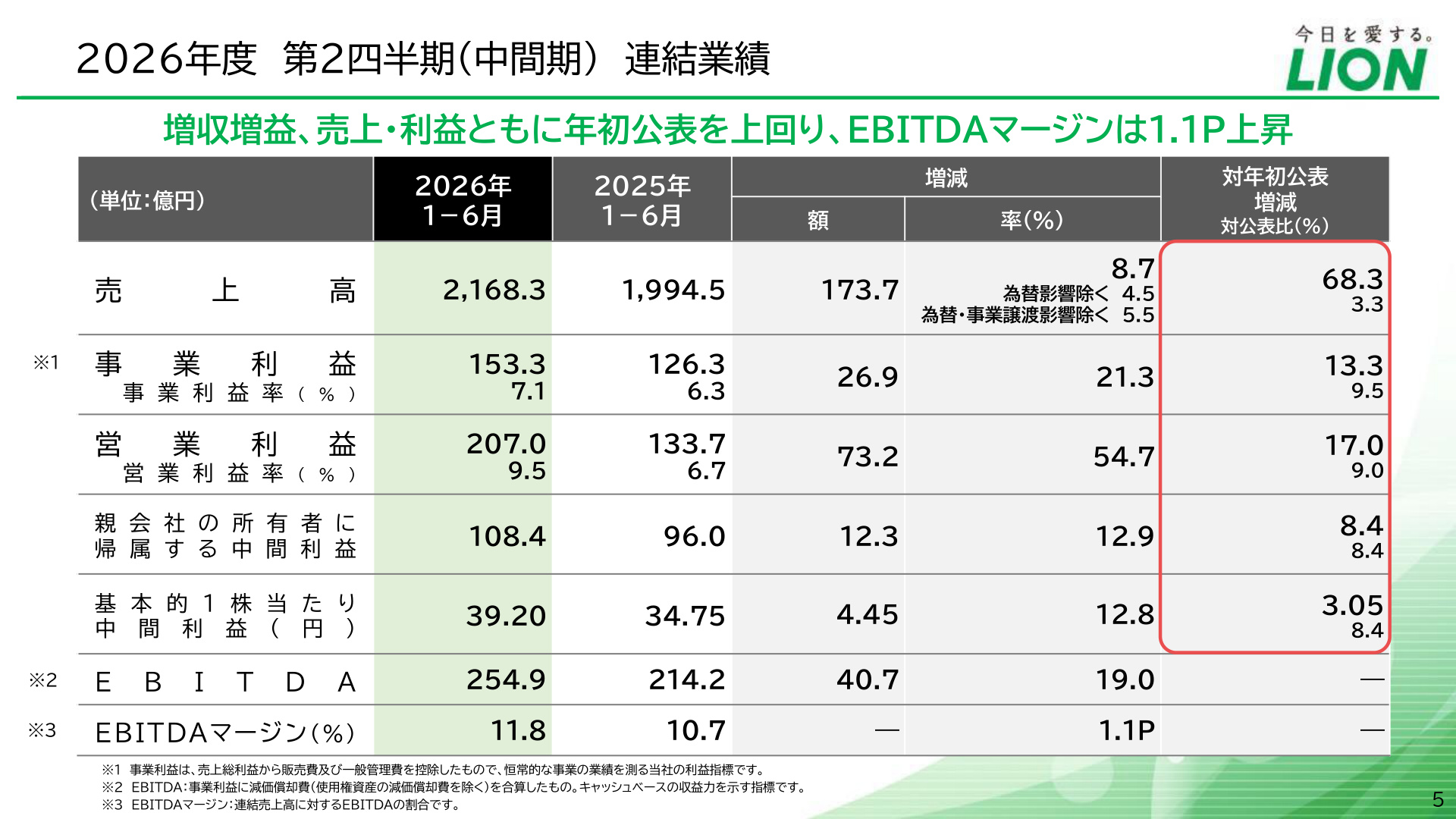
As shown in the slide above, net sales reached ¥216.83 billion (+8.7% YoY) , business profit was ¥15.33 billion (+21.3% YoY) , and operating profit stood at ¥20.70 billion (+54.7% YoY) . Profit attributable to owners of the parent for the interim period reached ¥10.84 billion (+12.9% YoY) .
Compared to the initial full-year forecast, the company achieved an upside of ¥6.83 billion (+3.3%) in net sales and ¥1.33 billion (+9.5%) in business profit. Furthermore, EBITDA , a key indicator of cash-generating ability, increased to ¥25.49 billion (+19.0% YoY) , with the EBITDA margin improving to 11.8% (+1.1 percentage points YoY) . This reflects the success of increased gross profit from sales growth and a management approach strictly focused on profitability, particularly in international markets.
2. Analysis of Factors Affecting Business Profit
Breaking down the H1 business profit (¥15.33 billion, +¥2.69 billion YoY) reveals a structure where gross profit growth from sales expansion and premiumization successfully absorbed rising costs.
- Gross Profit Factors (+¥11.1 billion / including +¥3.6 billion FX impact):
- +¥7.9 billion from volume effects and segment mix changes, including new consolidations (Vietnam and Australia).
- +¥1.8 billion from premiumization and price increases.
- +¥1.1 billion from cost reductions.
- These gains sufficiently offset the -¥1.5 billion negative impact from rising raw material costs (Middle East situation, etc.; -¥0.6 billion domestic, -¥0.9 billion international).
- SG&A Expenses Factors (-¥8.4 billion / including -¥3.0 billion FX impact):
- -¥3.1 billion from increased strategic competitive spending (including overseas cutbacks in response to the Middle East situation).
- -¥5.3 billion from other expenses, including increased personnel costs (-¥2.6 billion) and expenses associated with new consolidations.
Thus, despite uncertainties such as the situations in Latin America and the Middle East, a positive profit cycle driven by sales growth has been established.
3. Segment Performance Trends
By segment, both the Consumer Products and International Business segments achieved growth in both revenue and profit.
- Consumer Products Business:
- Net Sales: ¥123.64 billion (+1.6% YoY)
- Business Profit: ¥9.78 billion (+7.1% YoY) / Business Profit Margin: 7.9% (+0.4 pts)
- Strong growth in oral health care offset temporary revenue declines in fabric care and living care.
- International Business:
- Net Sales: ¥100.85 billion (+19.7% YoY)
- Business Profit: ¥5.27 billion (+66.1% YoY) / Business Profit Margin: 5.2% (+1.4 pts)
- Profit margins improved significantly due to the contribution of newly consolidated entities in Vietnam (Merap Lion) and Australia (PNB), alongside a recovery in sales momentum in key countries.
4. Domestic Consumer Products: Driven by Oral Health Care
In the domestic consumer products business, the top-priority oral health care segment saw significant growth, with net sales reaching ¥40.53 billion (+9.6% YoY).
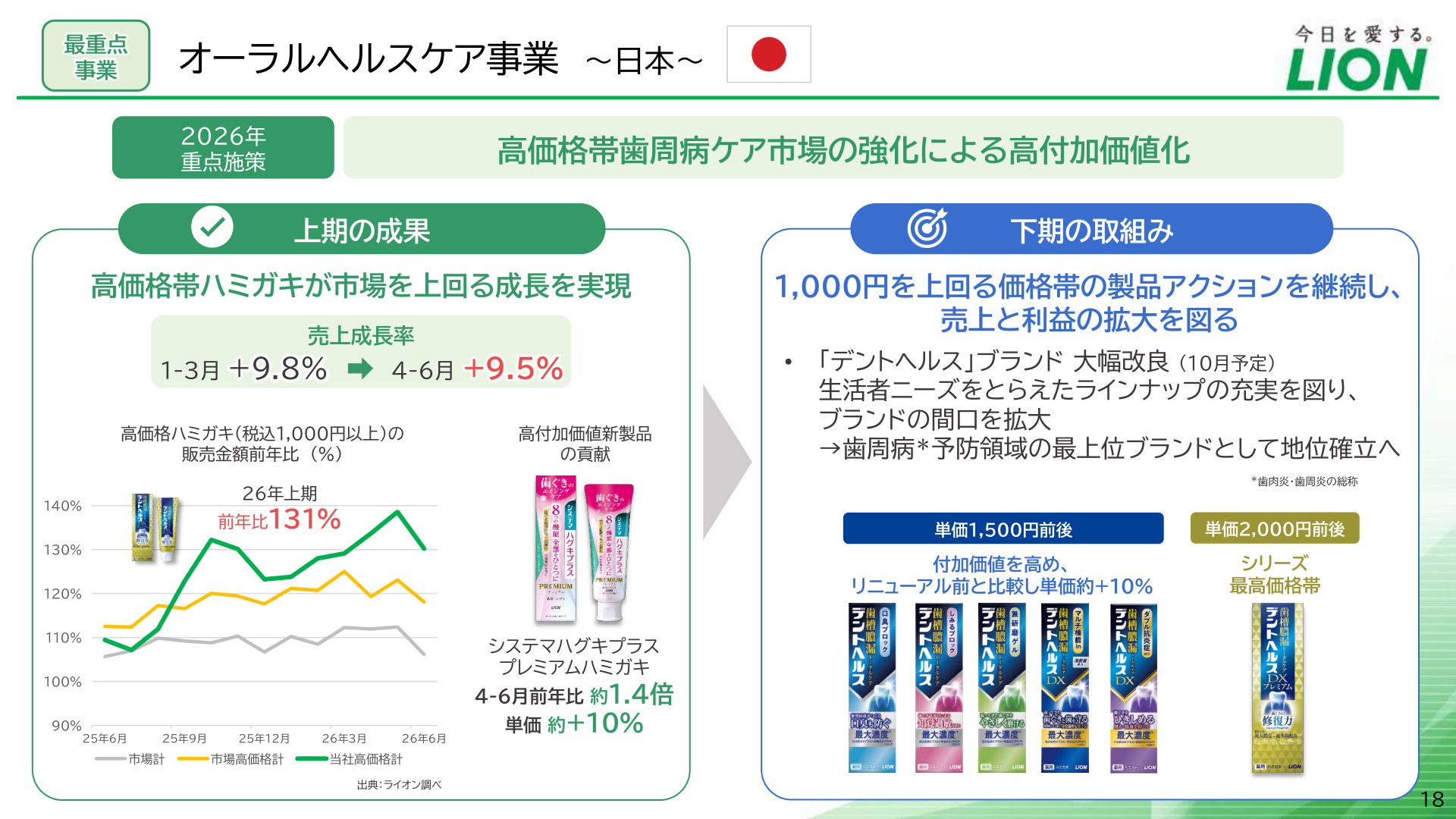
The slide above illustrates the initiatives and achievements of the domestic oral health care business. A critical takeaway from this data is that in the high-priced toothpaste market (¥1,000 or more including tax), Lion's growth rate outperformed the overall market (131% compared to H1 2025).
Flagship brands "Clinica" and "Systema" performed well in both toothpaste and toothbrushes. Furthermore, the "Systema Haguki Plus Premium Toothpaste," relaunched in April, saw its sales volume grow by approximately 1.4 times year-over-year while achieving a unit price increase of about 10%. Looking toward the second half, the company plans to further solidify its position in the premium market (¥1,500–¥2,000 range) through a major upgrade of its top-tier brand, "Dent Health," scheduled for October.
In other areas, beauty care saw a slight increase due to the success of high-value products like "hadakara," and pharmaceuticals remained steady at +4.0% YoY, driven by inbound demand and domestic sales of the acne treatment "PAIR."
5. International Business: Regional Details and New Consolidation Effects
International business (net sales of ¥100.85 billion) has achieved significant growth through region-specific strategies and M&A integration.
- Southeast/South Asia & Oceania:
- Net Sales: ¥64.87 billion (+25.9% YoY) , Business Profit: ¥4.02 billion (+46.0% YoY)
- In Malaysia, body soap and new liquid detergent products drove a substantial organic sales increase of +10.4%. While Thailand faced sluggish domestic consumption and lower exports (organic -3.4%), the personal care segment (especially oral care at +10.2%) remained solid.
- Newly consolidated entities in Australia (Sukin brand, etc.) and Vietnam (Merap Lion) contributed significantly to both top and bottom lines.
- Northeast Asia:
- Net Sales: ¥35.98 billion (+10.1% YoY) , Business Profit: ¥1.25 billion (+196.8% YoY)
- In China, after optimizing offline channel inventory in Q1, large-scale promotions in Q2 led to a rapid recovery in revenue and profit (April–June sales +15%). South Korea also contributed to profit through the expansion of capsule detergents and the import/sale of "Kyusoku Jikan" (April–June sales +8.1%).
6. Full-Year Forecast and Response to H2 Middle East Situation
For the full fiscal year ending December 2026, the company maintains its initial guidance: net sales of ¥430.0 billion (+1.9% YoY) , business profit of ¥35.0 billion (+13.8% YoY) , and operating profit of ¥40.0 billion (+10.0% YoY).
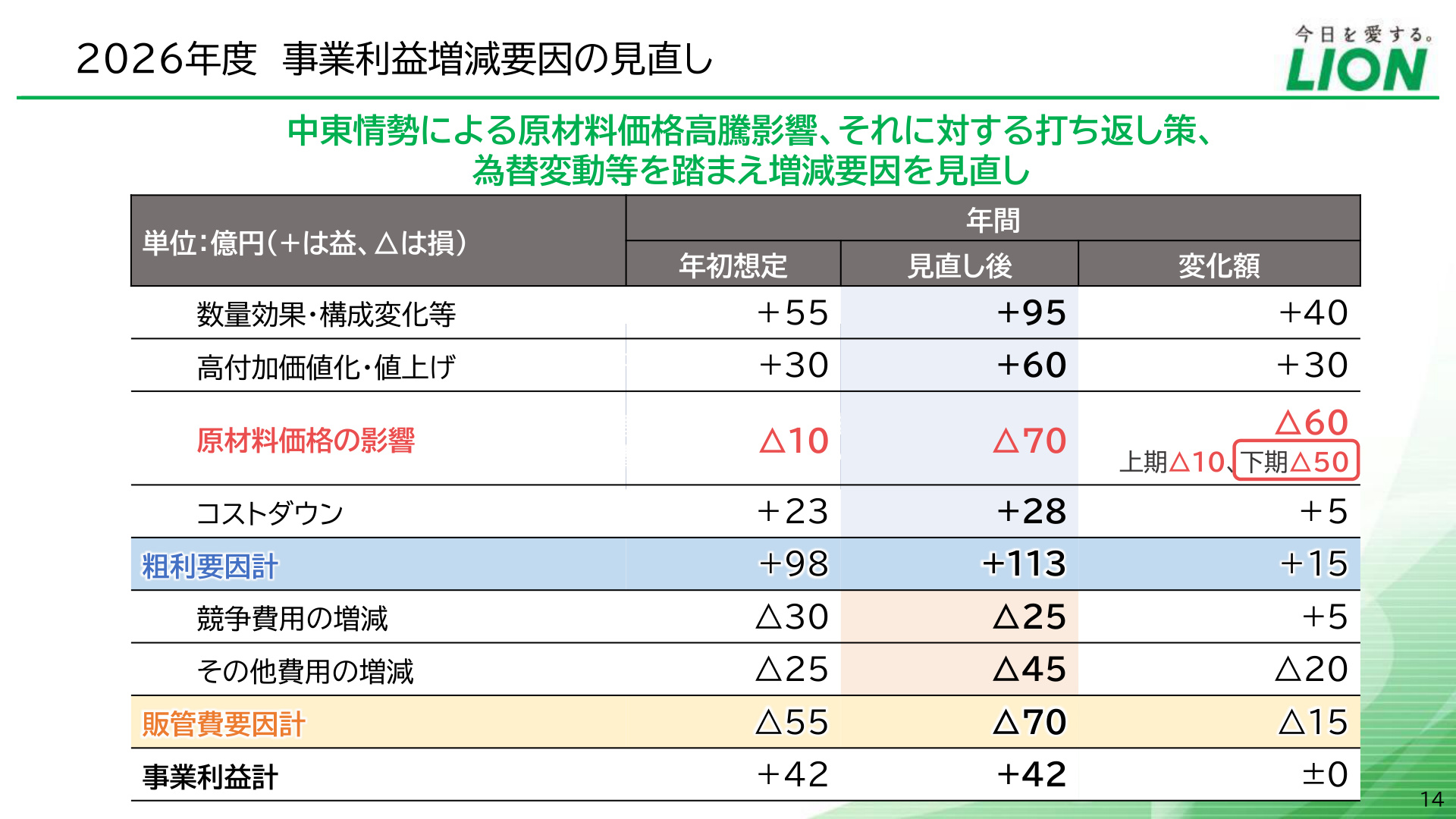
This slide is a critical document showing the revised factors for full-year business profit. While the first half exceeded plans, the second half faces an expected negative impact of ¥7.0 billion for the full year due to rising raw material costs from the escalating Middle East situation (a deterioration of ¥6.0 billion from the initial forecast of -¥1.0 billion, with -¥5.0 billion occurring in H2 alone).
To counter this massive cost pressure, the company aims to achieve the ¥35.0 billion business profit target through the following additional countermeasures and structural reforms:
- Boosting Volume and Mix Effects: Revised from +¥5.5 billion to +¥9.5 billion (+¥4.0 billion upside).
- Expanding Premiumization and Price Increases: Increased from +¥3.0 billion to +¥6.0 billion (+¥3.0 billion upside). Domestic shipping prices will be raised for a wider range of products starting in October.
- Strengthening Cost Reductions: Additional cuts, revised from +¥2.3 billion to +¥2.8 billion (+¥0.5 billion upside).
- Thorough SG&A Management: Prioritizing advertising and promotion, and driving productivity and logistics efficiency.
The company is demonstrating a commitment to structural reform that goes beyond temporary cost-cutting, positioning these as "measures to strengthen profitability that will yield benefits in the next fiscal year and beyond."
7. Mid-to-Long-Term Growth Strategy "Vision2030 2nd STAGE" and Shareholder Returns
Under the mid-term management plan "Vision2030 2nd STAGE" (2025–2027), the company is pursuing reforms to enhance both capital efficiency and profitability under the theme of "Strengthening Profitability."
-
Progress on Key KPIs (Jan–Jun 2026):
- Group Total Oral Health Care Sales Growth: 10.5% (2027 Target: CAGR ~8%)
- International Sales Growth: 19.7% (2027 Target: CAGR ~10%)
- EBITDA Margin: 11.8% / +2.3 pts YoY (2027 Target: +2 pts level) The company is showing steady and ambitious progress against its mid-term targets.
-
Shareholder Return Policy:
- Based on its progressive dividend policy , the company plans an annual dividend of ¥34 per share for FY2026, an increase of ¥4 from the previous year (¥17 interim, ¥17 year-end). This marks the 11th consecutive year of dividend increases (consolidated payout ratio of 37.6%).
- The company also continues to maintain a stance of flexibly considering and executing share buybacks.
8. Summary and Outlook
Lion's H1 FY2026 results demonstrate the strength of its domestic oral health care business, which has successfully shifted to high-priced products, and the growth potential of its international business, which is successfully executing a strategy of selection and concentration in M&A and high-margin areas.
Key points to watch moving forward include how effectively the planned price pass-throughs and new high-value product launches starting in October will offset the peak impact of raw material cost increases (approx. -¥5.0 billion) in the second half, as well as the maintenance and expansion of sales momentum in key Asian countries such as China and Thailand. The fruits of margin-improvement measures through structural reform are steadily becoming visible.
This content is not intended as investment advice or a recommendation. Any opinions expressed are solely the personal views of each article.