


ID Holdings: Q1 FY2027 Earnings Analysis and Growth Strategy in the AI Era

StockClub
Published: Aug 07, 2026, 10:53 AM
Sentiment Analysis

ID Holdings (Securities Code: 4709) reported a temporary decline in profits for the first quarter of the fiscal year ending March 2027. While revenue remained flat, the company actively implemented upfront investments, including human capital development and base salary increases , to drive sustainable future growth. Despite the profit dip, the company is steadily advancing measures to enhance mid-to-long-term value, such as a qualitative transformation of its business structure, the reconstruction of its unique strengths for the AI (AX) era, and an organizational restructuring to transition from a pure holding company to an operating company structure .
This report provides a comprehensive analysis of the Q1 financial results, detailed trends by service and channel, the full-year earnings forecast, and the company's growth narrative for the AI era.
1. Summary of Q1 FY2027 Financial Results
Key consolidated performance indicators for the first quarter (April–June 2026) are as follows:
- Revenue : ¥9,652 million (-0.2% YoY)
- Gross Profit : ¥2,604 million (+0.7% YoY)
- Operating Profit : ¥812 million (-19.5% YoY)
- Operating Profit Margin : 8.4% (-2.0 percentage points YoY)
- Ordinary Profit : ¥852 million (-15.8% YoY)
- Quarterly Net Income Attributable to Owners of Parent : ¥505 million (-18.8% YoY)
Although revenue was impacted by the completion of certain projects in System Management, it remained on par with the previous year ( ¥9,652 million ) due to steady performance in focus areas such as IT infrastructure, cybersecurity, and consulting/education. Gross profit also saw a slight increase to ¥2,604 million (+0.7% YoY) thanks to reductions in the cost of sales (e.g., lower outsourcing expenses).
Conversely, operating profit declined from ¥1,009 million in the same period last year to ¥812 million . This was primarily due to an increase in SG&A expenses, driven by the concentration of strategic investment costs in Q1 aimed at employee compensation (base salary increases) and talent development/acquisition.
2. Analysis of Operating Profit Decline: "Strategic Investment" for Growth
A detailed breakdown of the factors affecting operating profit reveals that the decline is not due to structural deterioration, but rather intentional upfront investment.
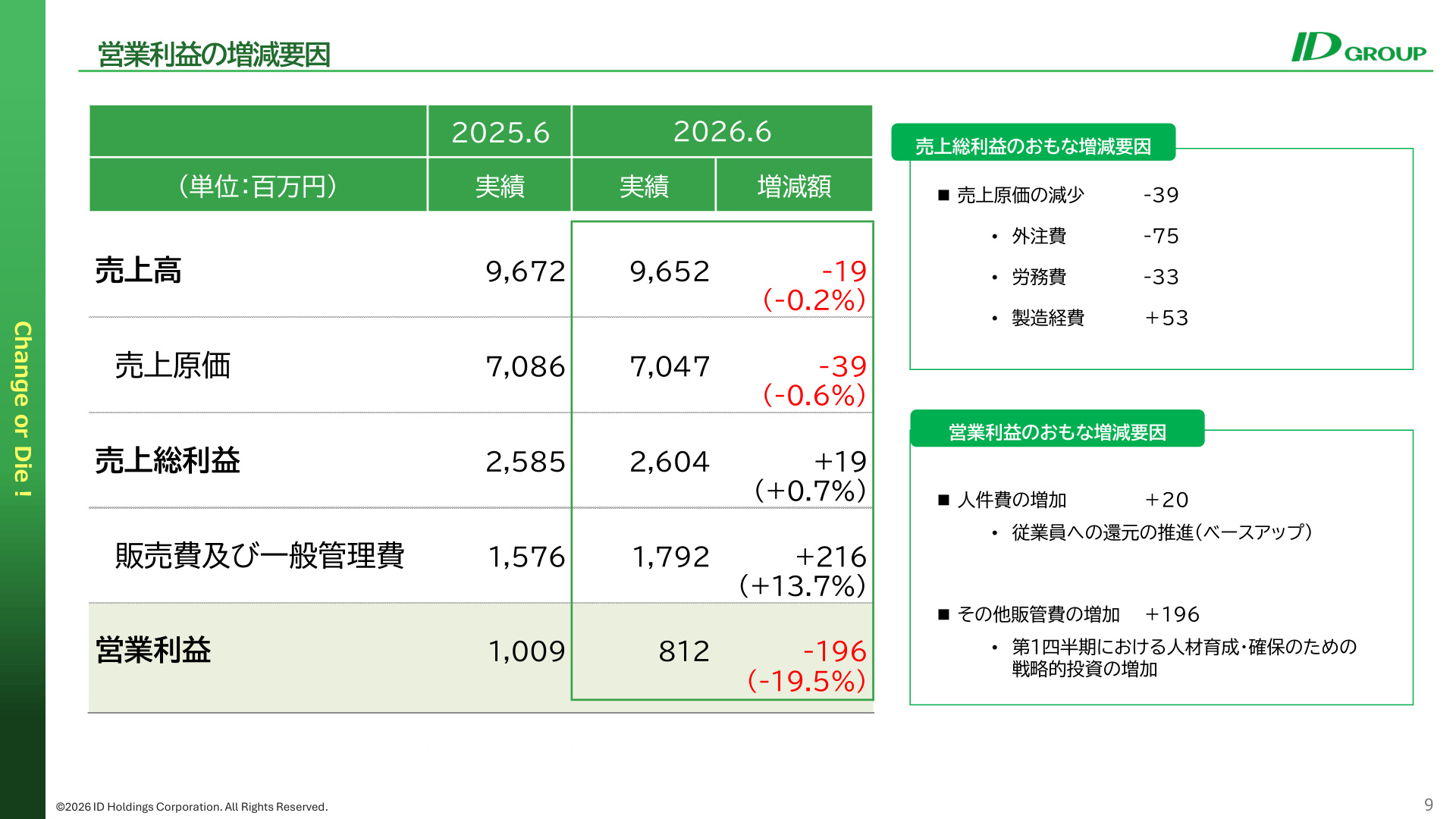
As shown in the slide above (Factors for Operating Profit Fluctuation), gross profit contributed a +¥19 million increase due to lower cost of sales (outsourcing costs -¥75 million, labor costs -¥33 million, etc.). However, SG&A expenses rose from ¥1,576 million to ¥1,792 million, an increase of +¥216 million (+13.7%) , which weighed on profits.
The breakdown of the SG&A increase is as follows:
- Increase in Personnel Expenses (+¥20 million) : Resulting from base salary increases aimed at improving employee engagement and retention.
- Increase in Other SG&A Expenses (+¥196 million) : Strategic investments in talent development and the acquisition of highly skilled personnel , concentrated in the first quarter.
Amid the severe shortage of engineers across the IT industry, acquiring and developing top-tier talent and upskilling existing employees are top priorities. The increase in SG&A expenses in Q1 represents an essential upfront investment that will contribute to securing high-value-added projects and improving productivity in the future.
3. Revenue Trends by Service: Expansion of "Focus Areas"
The company's service portfolio is categorized into " Foundation Areas ," which provide stable revenue, and " Focus Areas ," which drive future growth.
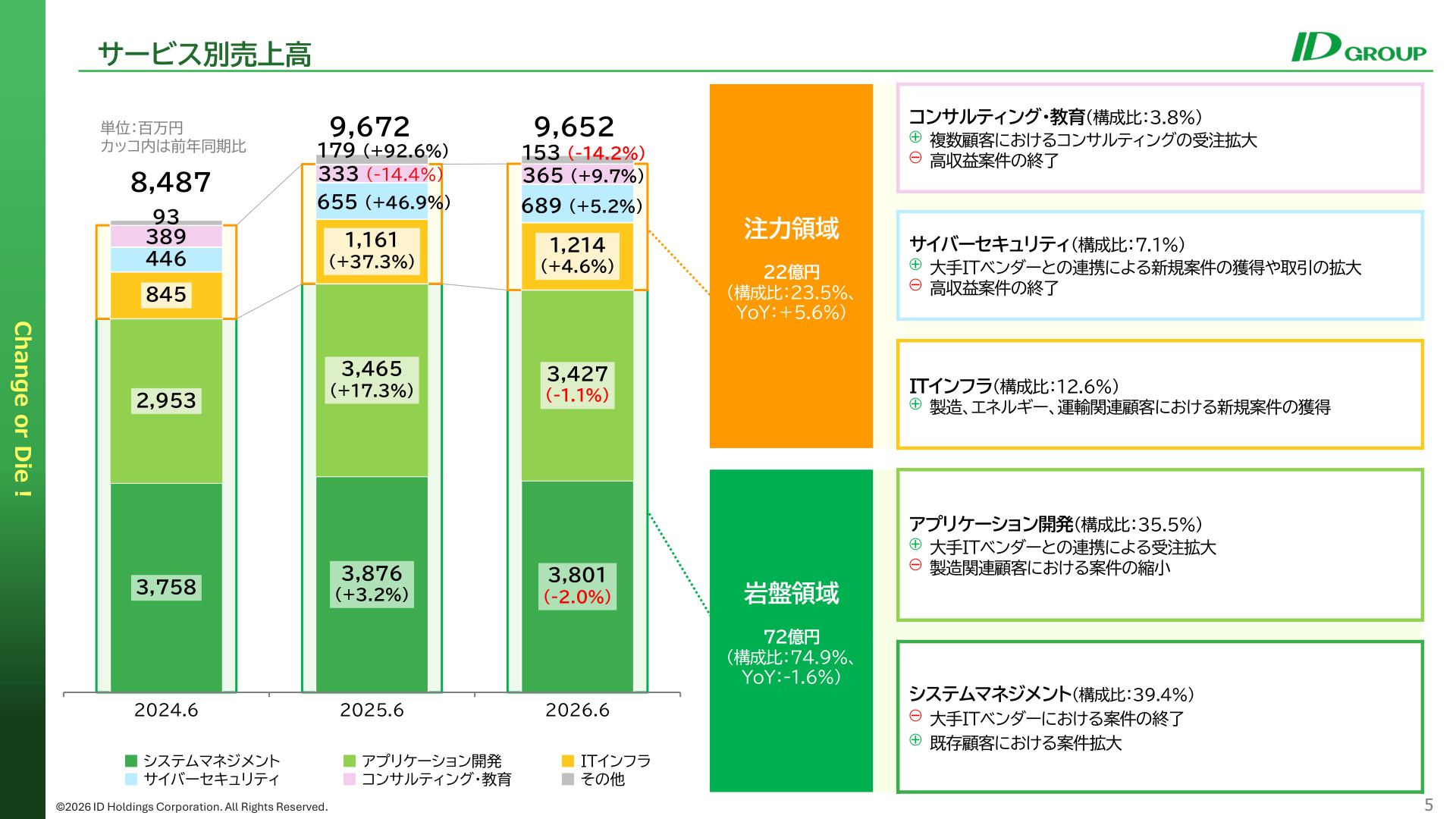
As indicated in the slide (Revenue by Service), the performance of these areas in Q1 showed contrasting trends.
【Focus Areas】 Revenue: ¥2.2 billion (23.5% of total / +5.6% YoY)
- Consulting & Education : Revenue of ¥365 million (+9.7% YoY). Driven by an increase in consulting project orders from multiple clients.
- Cybersecurity : Revenue of ¥689 million (+5.2% YoY). Growth was supported by deeper collaboration with major IT vendors and the acquisition of new projects.
- IT Infrastructure : Revenue of ¥1,214 million (+4.6% YoY). Success in acquiring new projects from clients in manufacturing, energy, and transportation sectors.
【Foundation Areas】 Revenue: ¥7.2 billion (74.9% of total / -1.6% YoY)
- Application Development : Revenue of ¥3,427 million (-1.1% YoY). While orders increased through collaboration with major IT vendors, the reduction of certain projects in the manufacturing sector had an impact.
- System Management : Revenue of ¥3,801 million (-2.0% YoY). Despite project expansions with existing clients, the completion of certain projects at major IT vendors affected results.
The revenue share of Focus Areas has risen to 23.5% , indicating that the company's business portfolio transformation is progressing smoothly.
4. Customer Base and Sales Channel Structure
The stability of the company's business is supported by a robust customer portfolio and a balanced sales channel structure.
- Contract Structure : Direct transactions account for 63.9% (¥6,164 million) of revenue, establishing a stable revenue base centered on direct sales. Transactions via major SIers account for 36.1% (¥3,487 million), maintaining partnerships with key players such as the IBM Group (12.7% of revenue), Hitachi Group (7.5%), and Kyndryl Japan (9.0%).
- End-User Industry : Financial services account for ¥4,413 million (45.7% of total) , forming a solid foundation. Additionally, the transportation sector grew significantly to ¥515 million (+52.2% YoY) , while manufacturing ( ¥1,019 million, +7.4% YoY ) and information/communications ( ¥867 million, +7.3% YoY ) also showed steady growth.
5. Order Backlog and Financial Soundness
The order backlog (a leading indicator) saw a slight decrease from ¥10,344 million in the same period last year to ¥10,008 million , but remains at a healthy level exceeding ¥10 billion. Specifically, System Management ( ¥4,656 million ) and Cybersecurity ( ¥18,211 million ) maintain substantial backlogs, ensuring a solid foundation for operations from Q2 onwards.
The financial position is also extremely sound. As of the end of June 2026, the balance sheet shows total assets of ¥21,937 million , an equity ratio of 68.2% , and a current ratio of 238.3% . The company continues to reduce interest-bearing debt (short-term loans -¥400 million), maintaining sufficient financial flexibility to respond to strategic investments and environmental changes.
6. Full-Year FY2027 Earnings Forecast and Outlook
The company has maintained its full-year consolidated earnings forecast for the fiscal year ending March 2027.
- Revenue : ¥42.0 billion (+6.7% YoY)
- EBITDA : ¥4,850 million (+7.3% YoY)
- Operating Profit : ¥4,500 million (+9.0% YoY)
- Ordinary Profit : ¥4,550 million (+8.0% YoY)
- Net Income Attributable to Owners of Parent : ¥3,000 million (+3.2% YoY)
- Earnings Per Share (EPS) : ¥88.29
The progress rate of Q1 operating profit (¥812 million) against the full-year plan (¥4,500 million) is 18.0% , which is due to the concentration of upfront investments in Q1. From Q2 onwards, the company aims to recover profit margins and achieve its full-year targets by increasing the utilization rate of trained personnel, expanding orders in focus areas, and shifting toward high-value-added projects.
7. Business Environment Changes and Strengths in the AI (AX) Era
The company views the advancement of AX (AI Transformation), including generative AI, as an opportunity to expand its business and increase value-added services.
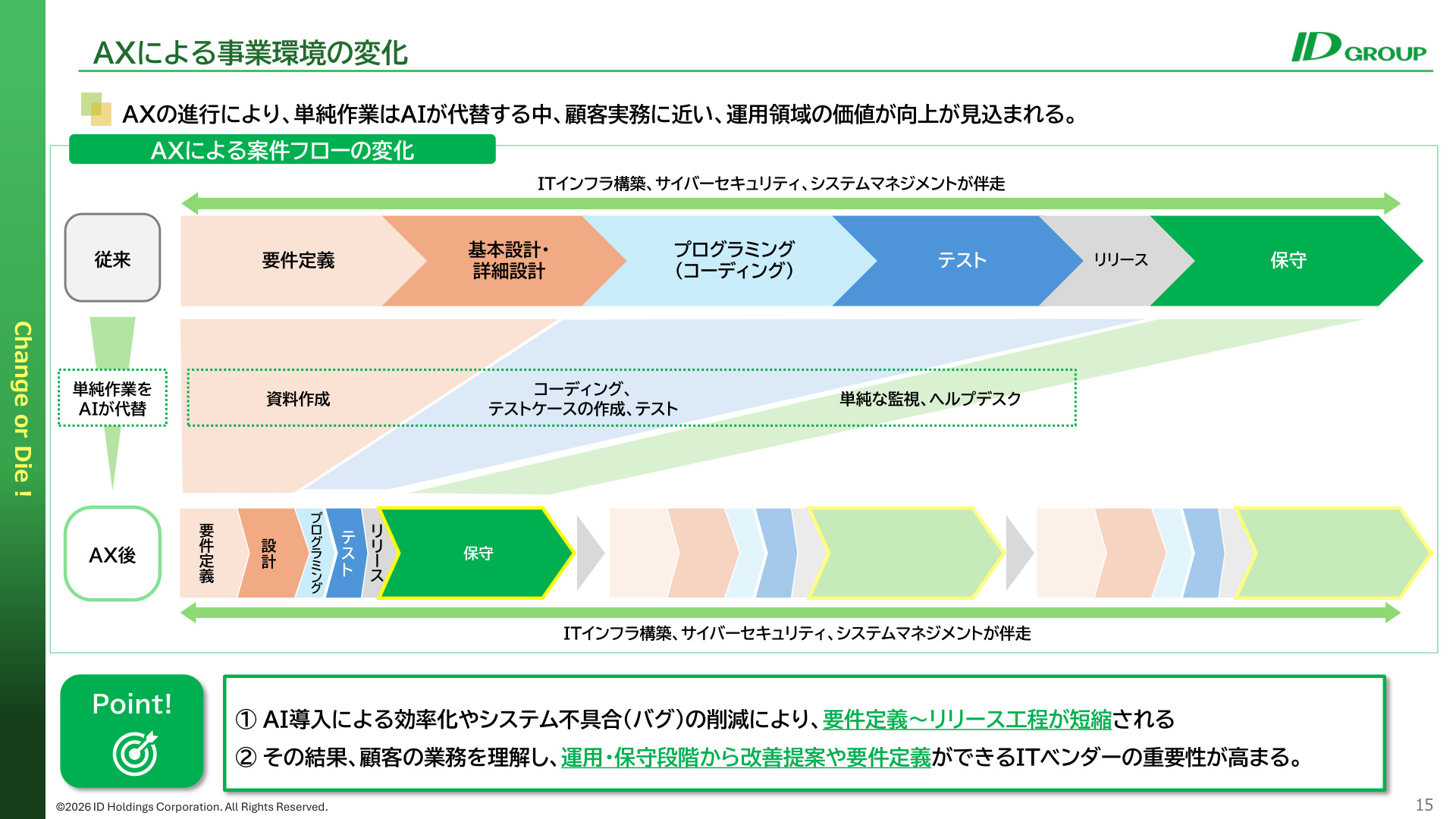
As summarized in the slide above (Changes in Business Environment due to AX), the progress of AX is causing structural changes in the software development project flow:
- Shortening of Development Processes : Efficiency gains and bug reduction through AI will significantly shorten development cycles from requirements definition to release.
- Increased Value in Operations & Maintenance : While simple tasks (coding, basic monitoring) will be replaced by AI, the importance of improvement proposals and new requirements definition during the operations and maintenance phase , which involves deep engagement with client business processes, will increase dramatically.
With over 56 years of experience in mission-critical system operations (particularly in finance), approximately 60% of the company's business is concentrated in "System Management," "IT Infrastructure," and "Cybersecurity"—areas close to the client's core operations. Since social infrastructure systems that cannot afford 24/7 downtime will remain an area that "only humans can handle," the company is well-positioned to create strong barriers to entry and provide high value by combining its operational know-how with AI technology.
To adapt to these changes, the company has clarified its talent development policy across three axes: " Data Center Personnel ," " AI Technical Personnel ," and " Non-AI Task Personnel ," and is actively investing in education.
8. Organizational Restructuring: Transition to an Operating Company in April 2027
As part of its mid-to-long-term growth strategy, the company plans to transition from its current pure holding company structure to an operating company structure by April 2027 .
Specifically, the company plans to absorb its wholly-owned subsidiary, Information Development Co., Ltd., change the trade name of ID Holdings, and integrate strategic planning with execution. By streamlining organizational layers, the company aims to dramatically accelerate decision-making speed and evolve into a management structure that maximizes synergies with group companies (Pride, ID Wuhan, overseas subsidiaries, etc.).
Conclusion
Although ID Holdings reported a decline in profits for Q1 FY2027, the results reflect investments in the future through talent acquisition, development, and employee compensation . There is no instability in the soundness of the business foundation or the order environment.
The mid-to-long-term growth story remains consistent, supported by the steady growth of focus areas (IT infrastructure, security, consulting), a stable customer portfolio centered on direct transactions, and a competitive advantage in the operations domain, which is poised to thrive in the AX era. Attention will now turn to how the human capital investments made in Q1 will translate into profitability from Q2 onwards.
This content is not intended as investment advice or a recommendation. Any opinions expressed are solely the personal views of each article.