


Safie (4375) Q2 FY2026 Earnings Deep Dive: Robust Recurring Revenue Growth and Accelerated Field AX in the Enterprise Sector

StockClub
Published: Aug 07, 2026, 10:47 AM
Sentiment Analysis

Safie (4375) Q2 FY2026 Earnings Deep Dive Report
This report provides a comprehensive analysis of the Q2 FY2026 financial results for Safie Inc. , a provider of cloud-based video surveillance and field DX/AX (Service Automation) platforms. We examine the company's performance from multiple perspectives, including revenue structure, key performance indicators (KPIs), mid-to-long-term growth strategies, and industry-specific deployment status.
1. Earnings Highlights: Steady Growth in Top-Line and Gross Profit
In Q2 FY2026, Safie leveraged the strengths of its stock-based business model to achieve steady growth in both revenue and gross profit.
- Revenue : ¥5.31 billion ( +18.3% YoY)
- Gross Profit : ¥2.76 billion ( +22.0% YoY)
- Adjusted Operating Profit : ¥18 million (Decrease YoY, prioritizing upfront investment)
The robust +22.4% year-on-year growth in "recurring revenue," the core of the business, served as the primary driver for overall performance. While adjusted operating profit declined quarter-over-quarter, this is the result of planned upfront investments in talent acquisition, office-related expenses, and advertising aimed at accelerating growth from FY2027 onward. The company remains committed to maintaining profitability on both a full-year and quarterly basis.
2. Revenue Trends and Structural Analysis: Recurring Ratio Rises to 73%
Safie's revenue is composed of "recurring revenue" (cloud usage fees, app subscriptions, SIM fees, etc.) and "spot revenue" (camera hardware sales, installation work, etc.).
[Significance and Background of the Slide]
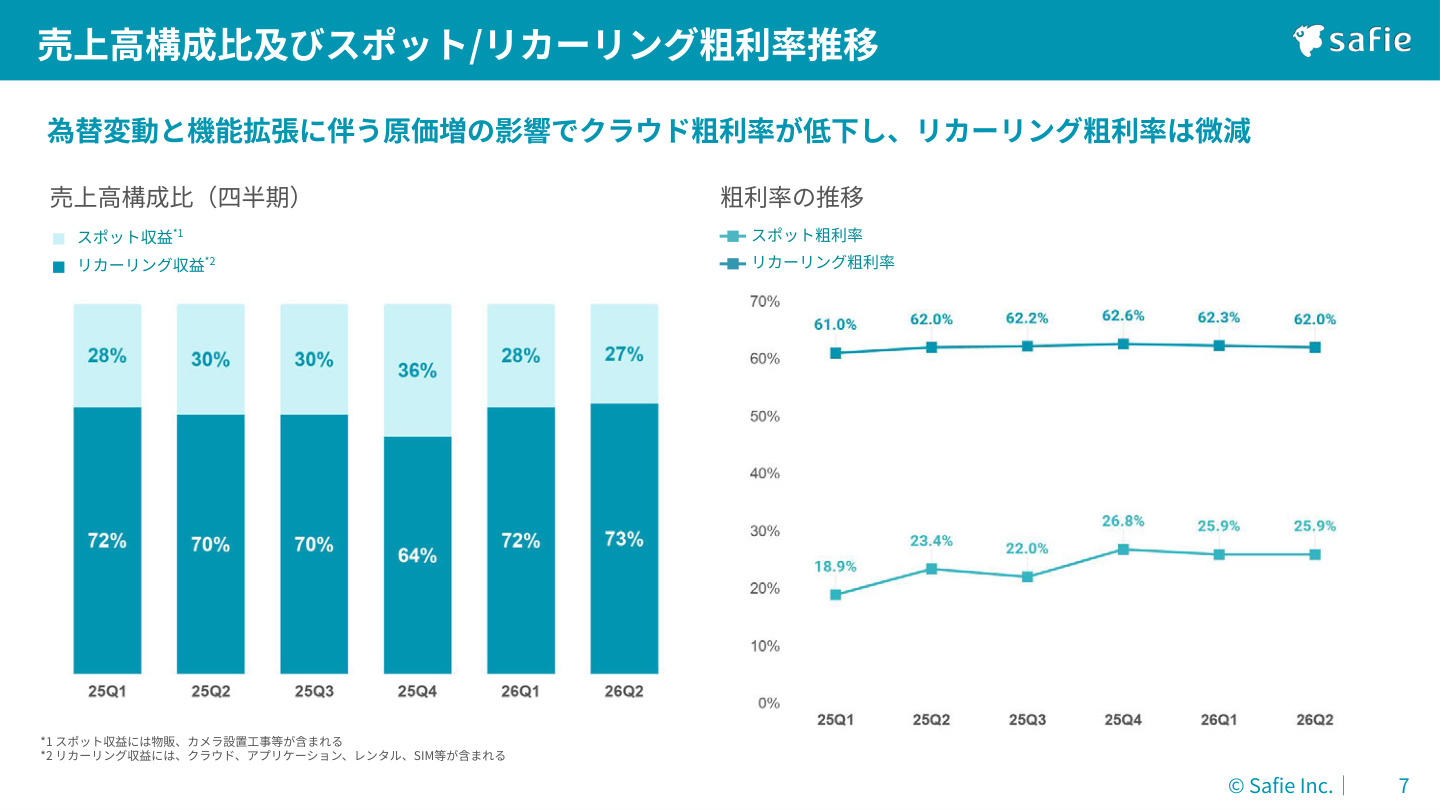
This slide presents critical data on quarterly revenue trends and breakdowns , illustrating the quality of the company's growth. As shown in the graph, cumulative recurring revenue has grown to ¥3.855 billion (+22.4% YoY) , now accounting for 73% of total quarterly revenue (up from 70% in the same period last year). The continued expansion of low-churn stock revenue indicates an increasingly stable earnings foundation.
Meanwhile, spot revenue from hardware sales remained solid at ¥1.455 billion (+8.6% YoY) , confirming sustained demand for new camera installations.
Regarding gross margin, while the recurring gross margin dipped slightly to 62.0% due to exchange rate fluctuations and increased costs associated with functional enhancements, the overall gross margin remained high at 52.1% (+1.6 pt YoY) due to an improved mix of high-value-added solutions.
3. Key Performance Indicators: ARR Reaches ¥15.79 Billion, Paid Cameras Hit 385,000 Units
As a SaaS/stock-based business, the most critical metrics— ARR (Annual Recurring Revenue) and the number of paid cameras —continue to reach record highs.
- ARR : ¥15.791 billion ( +22.8% YoY)
- Paid Cameras : 385,000 units ( +20.7% YoY)
Beyond the steady expansion of installed cameras, the cross-selling of high-value-added solutions (discussed below) has driven an upward trend in ARPA (Average Revenue Per Account/Camera), contributing to a higher growth rate for ARR.
4. Growth Factor Analysis by Sales Channel
Analyzing the number of paid cameras by sales channel clarifies demand trends across different customer segments.
[Significance and Background of the Slide]
This slide shows the trend in paid cameras by sales channel , highlighting the drivers of growth. Notably, Safie PRO Direct Sales recorded the highest growth rate at +32.0% (169,000 units) . This is driven by large enterprises adopting the system across multiple locations and the direct implementation of advanced AI solutions.
Furthermore, the partner-led Safie PRO Wholesale channel remained steady at 159,000 units (+12.8% YoY) , and the construction-focused Safie GO/Pocket package also grew reliably to 56,000 units (+16.7% YoY) . The company maintains a balanced structure between deep solution development via direct sales and broad market coverage via wholesale channels.
5. Cost Structure and Talent Investment: Strategic SG&A for Growth
Selling, General, and Administrative (SG&A) expenses for Q2 2026 were ¥2.767 billion , an increase from the previous quarter (¥2.564 billion).
- G&A Ratio : 9.8% (due to increased office-related costs)
- S&M Ratio : 27.3% (due to increased personnel costs for hiring and advertising)
- R&D Ratio : 15.0%
To strengthen the enterprise sector, the company aggressively hired sales and consulting talent. Consequently, gross profit per employee was ¥17.6 million , slightly lower than the previous quarter (¥18.8 million). However, based on historical trends, productivity is expected to rise again as new hires become fully operational, marking this as a transitional phase for mid-to-long-term growth acceleration.
6. Business Strategy: Evolving from Cameras to "Monitoring," "Field AX," and "AI Utilization"
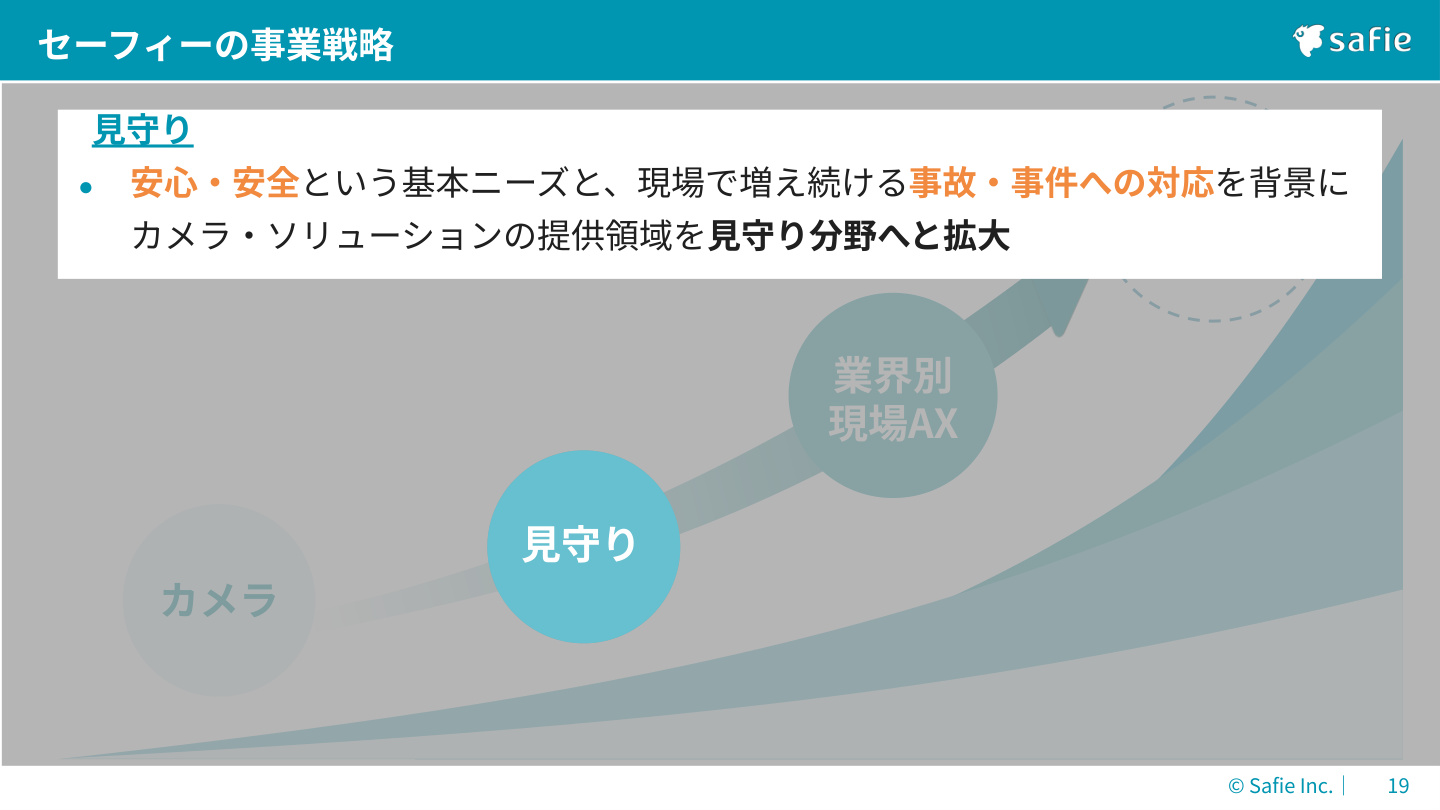
Safie is expanding its business definition from mere "security camera provision" to "monitoring," "industry-specific Field AX (Appliance Transformation)," and "new AI-driven businesses."
In particular, the company is moving beyond the existing security camera market (approx. 550,000 units in Japan) to capture the massive on-premise (legacy) camera market.
[Significance and Background of the Slide]
This slide illustrates the Total Addressable Market (TAM) expansion strategy . Against the current cloud-connected camera market (approx. 550,000 units), there exists a domestic market of approx. 9 million legacy on-premise cameras (using DVRs, etc.), with a total potential domestic market of 40 million units and a global market of 500 million units.
The company has launched solutions such as the newly developed portal edge device, "Safie Trail Station," which allows legacy on-premise cameras to be retrofitted for cloud connectivity and centralized management. This enables the company to migrate existing camera infrastructure to its cloud platform, capturing a significant share of the vast on-premise market.
7. Industry-Specific Solutions and Subsidiary Initiatives
① Security Sector (Safie Security)
Eighteen months after the establishment of the subsidiary "Safie Security Inc.," the business has transitioned from pilot testing to full-scale service provision.
- Background : While the security industry market is expanding to ¥1.92 trillion , the active job opening ratio for security guards is 6.55x , indicating a severe labor shortage.
- Solution : A security solution combining AI camera intrusion detection with "automatic/manual voice warnings" via remote speakers. Pilot tests at construction sites and solar power plants have achieved a 100% prevention rate for unauthorized entry (10 cases total) , with the number of operational "Safie GO PTZ Monitoring Plus" units growing to 50 .
② Field AX in Retail and Service Sectors
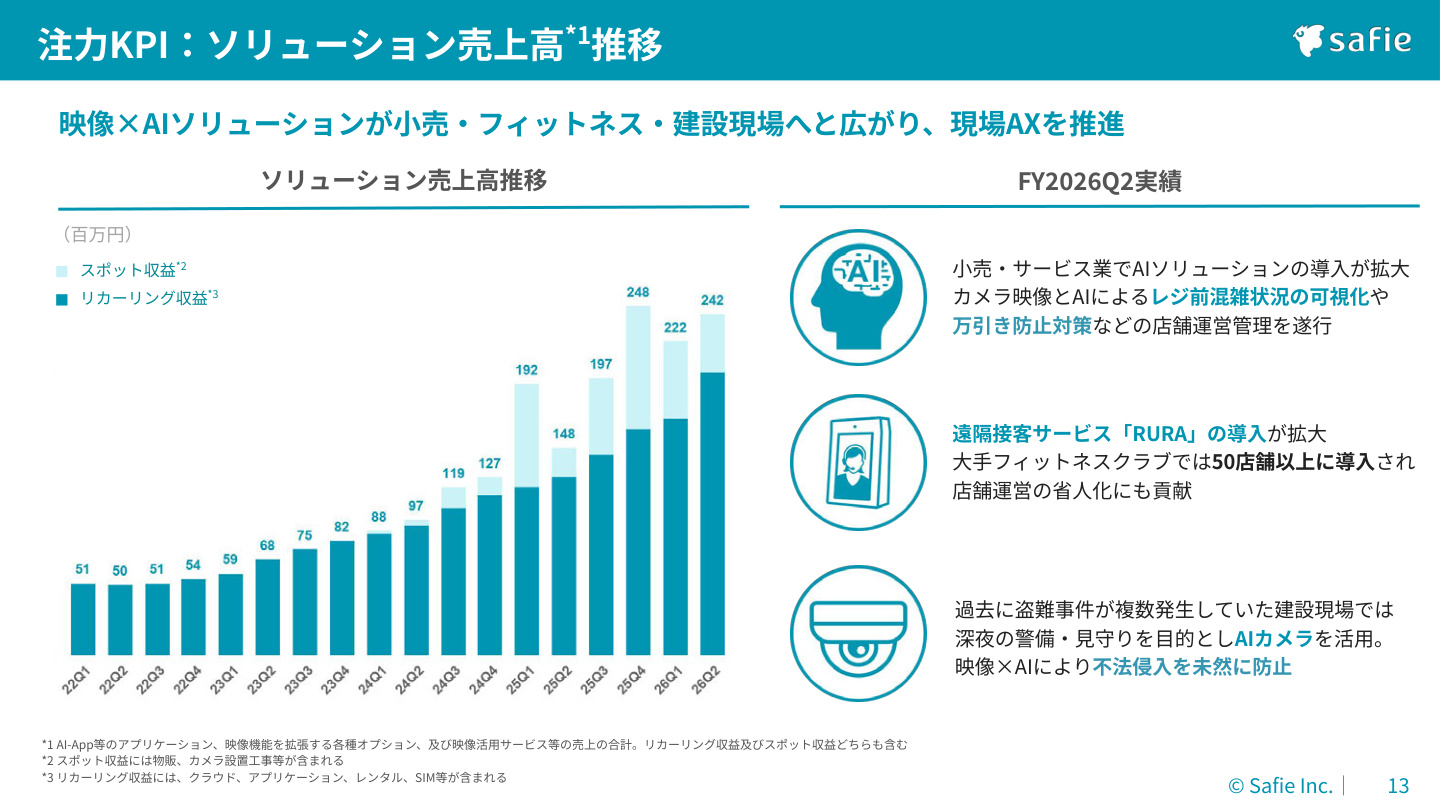
ARR for enterprise customers in the retail and service sectors grew by +35.4% YoY (driven by a 16.5% increase in customer count and a 16.2% increase in ARPA).
- Integration of Remote Customer Service and Audio : By combining remote service platforms like "RURA" and cloud intercoms like "BONX" with Safie's camera system, floor management tasks are centralized in contact centers. This enables "one person managing three stores" operations, with adoption expanding among major fitness clubs (50+ locations) and mobile carrier shops.
- AI-Driven Store Optimization : The company provides solutions beyond security, such as AI-based queue visualization, detection of repeat shoplifters, and visitor counting/attribute analysis, contributing to "revenue growth and labor savings."
8. Summary and Full-Year Outlook
Safie's position as of Q2 FY2026 is characterized by a solid recurring revenue foundation (ARR of ¥15.79 billion), with growth momentum maintained through deep penetration of enterprise customers and cross-selling of high-value-added AI solutions.
In the short term, profitability is constrained by upfront investments in talent and development; however, the company expects to remain profitable on a full-year and quarterly basis, balancing financial health with growth investment. Moving forward, the cloud migration of the 9 million legacy on-premise cameras and the penetration of Field AX solutions into labor-strapped security and retail sectors are expected to be the primary drivers of mid-to-long-term growth.
This content is not intended as investment advice or a recommendation. Any opinions expressed are solely the personal views of each article.