


Medical System Network: Q1 FY2027 Earnings Deep Dive Report

StockClub
Published: Aug 07, 2026, 10:46 AM
Sentiment Analysis

Medical System Network: Q1 FY2027 Earnings Deep Dive Report
This report provides a comprehensive analysis of the Q1 FY2027 financial results for Medical System Network Co., Ltd. (Securities Code: 4350) , a company primarily engaged in operating pharmacy chains, providing pharmacy management support, and developing pharmaceutical supply infrastructure. We examine performance highlights, segment-specific trends, shifts in financial structure, and the full-year outlook.
1. Performance Highlights: Revenue Growth Offset by Higher Personnel and System Costs
In Q1 FY2027, the Medical System Network Group achieved year-on-year revenue growth driven by the expansion of its core regional pharmacy network and various support services. However, the company reported a decline in operating profit and subsequent profit lines compared to the same period last year, as investments in future infrastructure and increased costs weighed on the bottom line.
The following table summarizes the key consolidated financial results for the first quarter and progress against full-year forecasts.
[Key Financial Metrics]
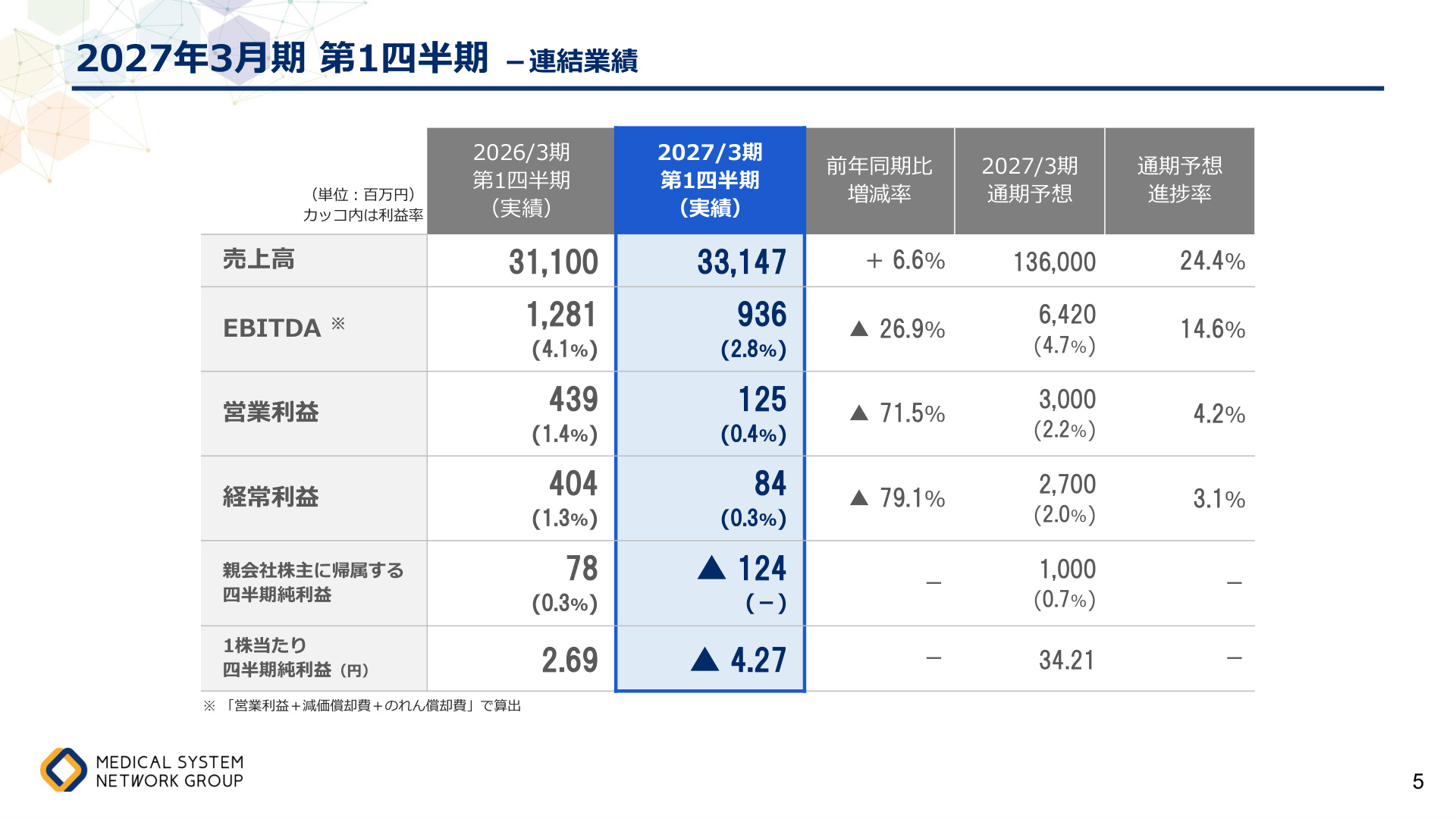
- Net Sales : 33,147 million yen (+6.6% YoY, 24.4% progress against full-year forecast)
- EBITDA : 936 million yen (-26.9% YoY, 14.6% progress against full-year forecast)
- Operating Profit : 125 million yen (-71.5% YoY, 4.2% progress against full-year forecast)
- Ordinary Profit : 84 million yen (-79.1% YoY, 3.1% progress against full-year forecast)
- Quarterly Net Loss Attributable to Owners of Parent : -124 million yen (compared to a profit of 78 million yen in the same period last year)
- Quarterly Earnings Per Share (EPS) : -4.27 yen
[Significance of the Slide and Background Analysis]
The slide above (Page 4) clearly illustrates the profit structure for the first quarter. While net sales are progressing as planned at 24.4% of the full-year forecast (136,000 million yen), the operating profit progress rate remains at 4.2%. This significant profit decline is primarily attributed to three factors:
- Increased Personnel Costs : Higher salary levels and recruitment expenses due to intense competition for talent within the medical and pharmacy industries.
- Customer Management Infrastructure Integration Costs : Costs associated with building a foundation for group-wide data integration and marketing efficiency.
- One-time Costs for System Improvements : Concentrated development and renewal expenses aimed at promoting DX and operational efficiency. These cost increases are largely planned, one-time expenditures concentrated in the first half of the fiscal year and should be distinguished from structural earnings deterioration.
2. Segment Trends and Business Structure Changes
The group's business is primarily categorized into the " Regional Pharmacy Network Business " and " Leasing/Equipment/Food Service/Home Nursing Business ," with services diversified across three domains: Medical, Medical Support, and Medical Supply.
Segment Revenue and Profit Overview
- Regional Pharmacy Network Business
- Net Sales: 32,183 million yen (+7.8% YoY)
- Segment Profit: 857 million yen (-19.5% YoY)
- Leasing/Equipment/Food Service/Home Nursing Business
- Net Sales: 1,162 million yen (-17.9% YoY)
- Segment Profit: -2 million yen (compared to a profit of 16 million yen in the same period last year)
- (*Note: Revenue decline due to the partial divestiture of the food service business for elderly care facilities and hospitals.)
2-1. Medical Domain (Regional Pharmacy Business): Moving Beyond Prescription Dependency and Expanding CCR
In the Medical domain, which operates pharmacy outlets, the company is actively shifting from a revenue structure centered on acute care to Chronic Care Revenue (CCR) , generated through continuous and comprehensive health management.
[Significance of the Slide and Analysis]
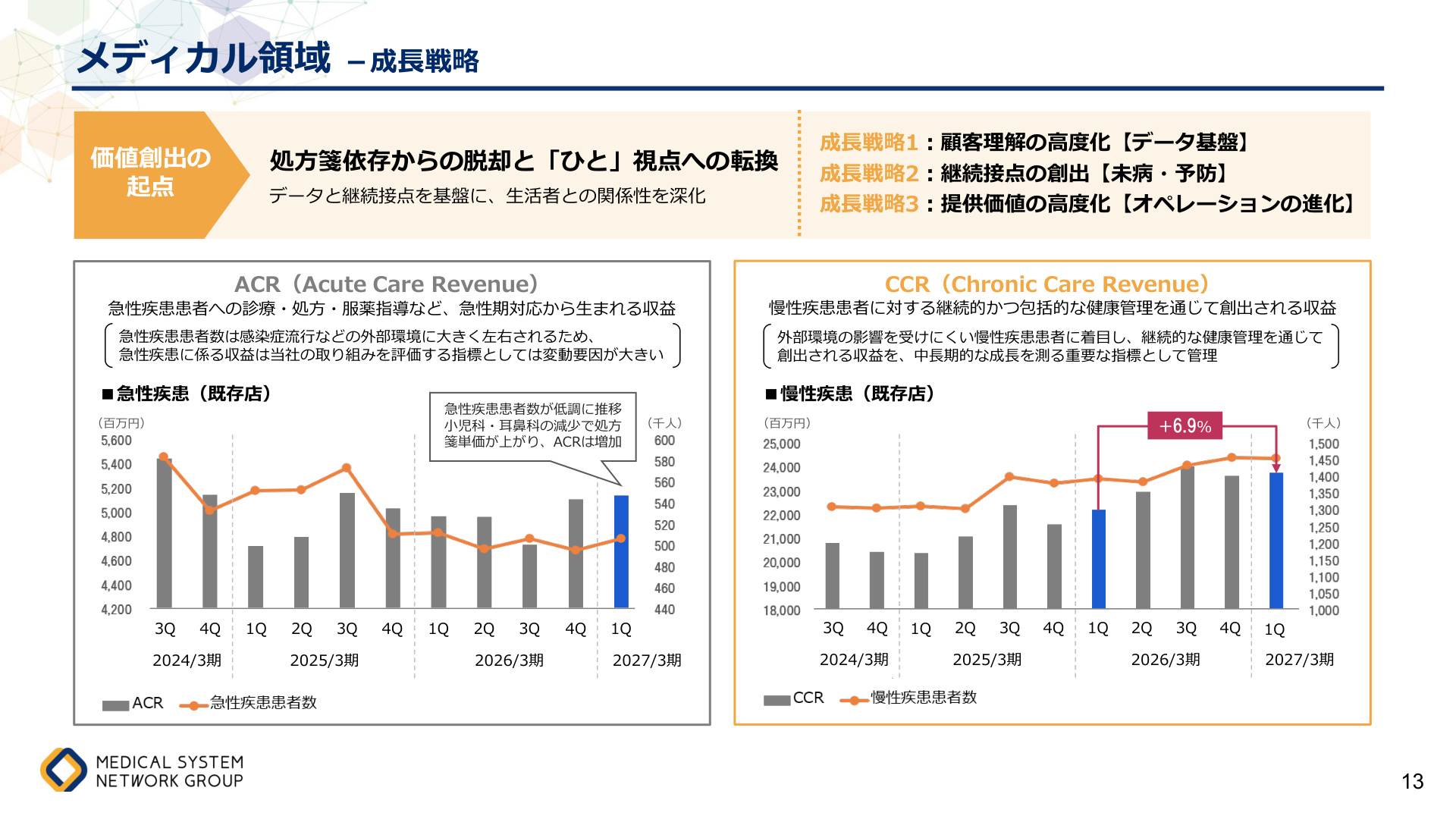
The slide above (Page 12) contrasts the trends of "Acute Care Revenue (ACR)" and "Chronic Care Revenue (CCR)," the core of the company's growth strategy.
- ACR (Acute Care Revenue) : Revenue based on visits and prescriptions for acute illnesses such as colds and influenza. Performance was sluggish this period due to the stabilization of infectious diseases that were prevalent in the same period last year.
- CCR (Chronic Care Revenue) : Revenue derived from continuous engagement and lifestyle support for patients with chronic conditions. Existing store CCR grew steadily by +6.9% (23.8 billion yen) year-on-year. This demonstrates the success of the strategy to reduce reliance on ACR, which is susceptible to external environmental factors (such as infection trends), and instead grow CCR, which offers high repeatability and stability.
Details on Dispensing Fees and Store Counts
- Existing Store Prescription Unit Price : 10,852 yen (+4.4% YoY). Contributed by an increase in long-term prescriptions, higher-priced pharmaceuticals, and increased dispensing technical fees.
- Existing Store Prescription Volume : -0.5% YoY (due to a decrease in acute illness patients).
- Store Count Trends : The number of stores nationwide reached 474 at the end of the quarter. This includes 2 new openings, 1 M&A, and 1 closure. While the full-year target for new openings and M&As is 10 stores (50.0% progress), the medical institution attraction plan (12 cases) has already exceeded the full-year target (10 cases).
2-2. Medical Support Domain: Accelerating ARPU Growth and Platform Strategy
In the Medical Support domain, which provides comprehensive management support to pharmacies nationwide, the company is advancing the sophistication and diversification of its services.
[Significance of the Slide and Analysis]
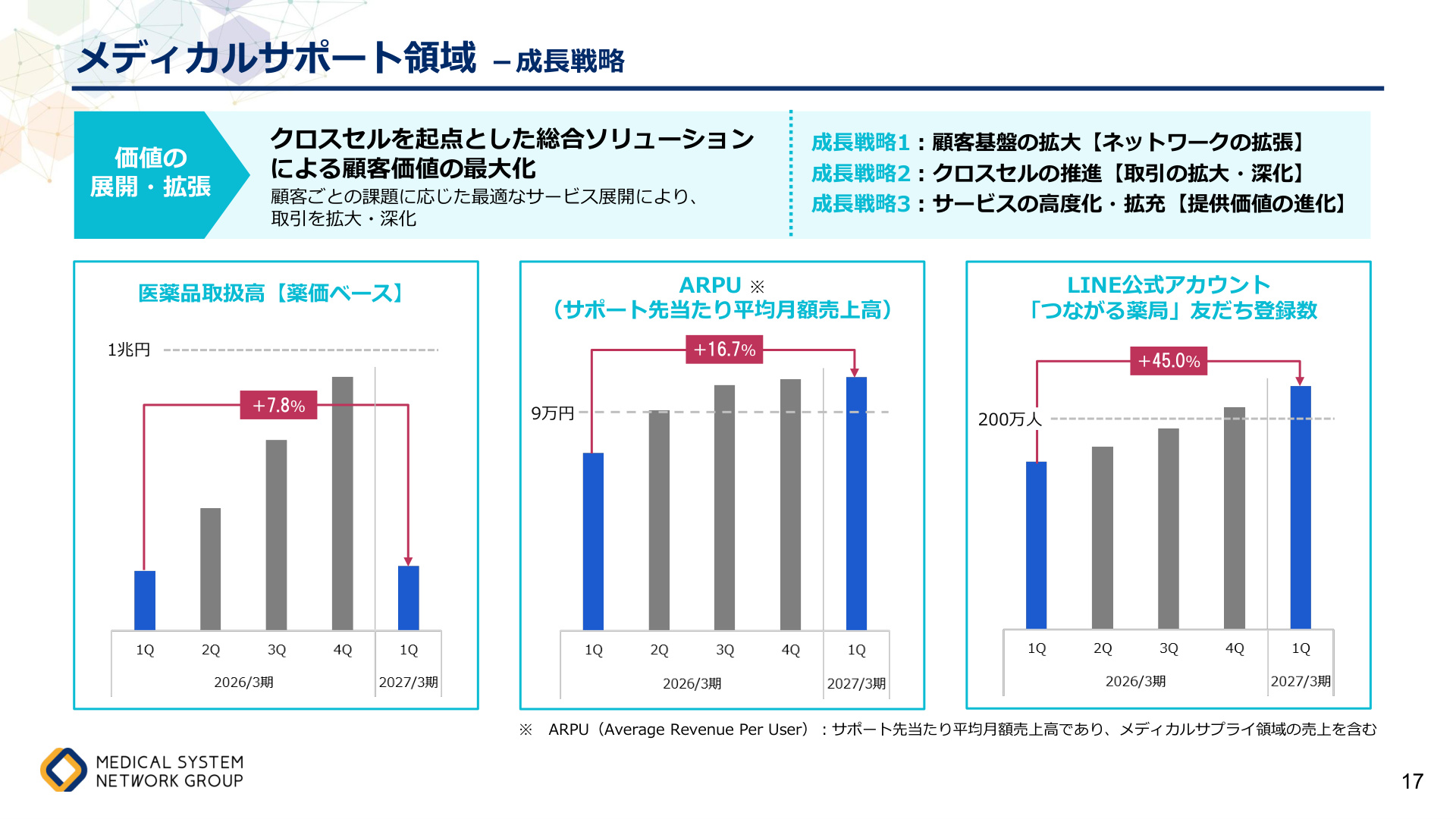
The slide above (Page 16) highlights three key growth indicators (KPIs) for the Medical Support domain:
- Pharmaceutical Transaction Volume (Drug Price Basis) : Distribution scale through the network is expanding steadily.
- ARPU (Average Monthly Revenue per Supported Pharmacy) : Increased significantly to 96.1 thousand yen from 82.3 thousand yen in the same period last year (+16.7% YoY). Cross-selling initiatives (providing multiple services to a single location) are proving effective.
- "Tsunagaru Yakkyoku" (Connected Pharmacy) LINE Official Account Friends : Surpassed 2 million (+45.0% YoY). Digital touchpoints with patients and consumers are expanding dramatically, contributing to improved patient convenience and pharmacy operational efficiency.
Furthermore, in July 2026, the company launched " MEDISYS ONE ," an integrated portal site consolidating services and information for pharmacies across the group. It provides industry news, online seminars, and dispensing fee revision simulations to further expand the support base.
2-3. Medical Supply Domain: Distribution Efficiency and Product Expansion
The Medical Supply domain, aimed at innovating pharmaceutical distribution and ensuring stable supply, is also expanding steadily.
- Number of Transaction Stores : Expanded to 9,517 stores (+23.6% YoY).
- Manufacturing and Sales Business (Felsen Pharma) : The number of handled items increased to 130 items (+8.3% YoY) across 56 components. With the launch of "Bilastine OD Tablets" in June 2026, the company continues to ensure the stable supply of generic drugs and expand its product lineup.
3. Financial Position and Cash Flow Structure Changes
The consolidated balance sheet (B/S) and cash flow (C/F) for this quarter show significant changes following the resumption of accounts receivable securitization .
Balance Sheet (B/S) Highlights
- Total Assets : 79,294 million yen (-805 million yen from the end of the previous fiscal year). Total assets were compressed as accounts receivable decreased by 1,183 million yen due to the partial resumption of the accounts receivable securitization (early cash conversion scheme), which had been temporarily suspended.
- Liabilities : 62,158 million yen (-527 million yen from the end of the previous fiscal year). While interest-bearing debt was reduced, accounts payable increased.
- Net Assets : 17,136 million yen (-277 million yen from the end of the previous fiscal year). Retained earnings decreased due to dividend payments and the recording of a quarterly net loss.
- Equity Ratio : 21.4% (-0.1pt from 21.6% at the end of the previous fiscal year).
Cash Flow (C/F) Highlights
- Cash Flow from Operating Activities : +2,206 million yen (a significant increase of +1,514 million yen YoY). In addition to securing EBITDA, the decrease in accounts receivable due to the resumption of securitization (+1,207 million yen) contributed significantly.
- Cash Flow from Investing Activities : -933 million yen (-91 million yen YoY). Expenditures included new store openings/M&As (-307 million yen), existing pharmacy renovations (-255 million yen), and system-related investments (-137 million yen).
- Cash Flow from Financing Activities : -1,733 million yen (-2,195 million yen YoY). The negative impact widened due to debt repayment (-1,431 million yen) and dividend payments (-173 million yen).
- Cash and Cash Equivalents at End of Period : 7,281 million yen (-1,460 million yen YoY).
4. FY2027 Full-Year Earnings Forecast and Mid-Term Growth Scenario
The full-year consolidated earnings forecast for the fiscal year ending March 2027 remains unchanged from the initial plan.
[Full-Year Consolidated Earnings Forecast]
- Net Sales : 136,000 million yen (+2.9% YoY)
- EBITDA : 6,420 million yen (-4.6% YoY)
- Operating Profit : 3,000 million yen (-9.4% YoY)
- Ordinary Profit : 2,700 million yen (-15.4% YoY)
- Net Income Attributable to Owners of Parent : 1,000 million yen (-6.6% YoY)
- Earnings Per Share (EPS) : 34.21 yen
Logical Narrative for the Full-Year Outlook
While the Q1 operating profit of 125 million yen appears low relative to the full-year forecast, this is primarily due to the initial impact of drug price and dispensing fee revisions and one-time costs related to systems and customer base integration that are concentrated in the first half. The recovery scenario is based on the following factors:
- Resolution of One-time Costs and Realization of System Investment Benefits : Operational efficiency gains from DX initiatives and system unification are expected to emerge toward the second half.
- Revenue Contribution from Medical Support and Supply Domains : Accumulation of high-margin support fee revenue and profits from logistics and manufacturing businesses as the number of supported facilities (approx. 17,800) and transaction stores (9,517) grows.
- Steady Growth in Prescription Unit Prices and CCR in Regional Pharmacies : Boosting unit prices and revenue through high-priced pharmaceuticals, long-term prescription handling, and continuous guidance for chronic disease patients.
Conclusion
Medical System Network's Q1 FY2027 results reflect "revenue growth with a profit decline" accompanied by temporary costs during a transitional period. However, an analysis of the underlying data suggests that this is not mere stagnation, but rather a structural reform in progress aimed at sustainable growth:
- In the core pharmacy business, the company is steadily shifting toward CCR-focused management , moving away from dependency on infectious disease trends.
- In the platform business, the customer base is being strengthened through improved ARPU (+16.7%) and the expansion of "Tsunagaru Yakkyoku" members (over 2 million) .
- In the supply domain, the company is increasing its presence in pharmaceutical distribution through a rapid expansion in transaction stores (+23.6%) and the addition of product items.
- Financially, the company has resumed accounts receivable securitization, significantly improving operating cash flow (2,206 million yen) .
Following the concentration of one-time investments and costs in the first half, the key point to watch moving forward is how the expanding business foundation and the results of DX promotion will contribute to achieving the full-year performance targets.
This content is not intended as investment advice or a recommendation. Any opinions expressed are solely the personal views of each article.