

Toagosei FY2026 H1 Earnings & Mid-Term Management Plan 2028 Deep Dive: A Growth Story Driven by High-Value Products and Capital Efficiency

StockClub
Published: Aug 07, 2026, 10:37 AM
Sentiment Analysis
Toagosei FY2026 H1 Earnings & Mid-Term Management Plan Deep Dive Report
Toagosei Co., Ltd. (Securities Code: 4045) has released its FY2026 H1 (Second Quarter) financial results , alongside an upward revision to its full-year earnings forecast and a progress update on its Mid-Term Management Plan 2028 . Amid a challenging external environment characterized by rising crude oil and naphtha prices due to Middle East tensions and constraints on raw material procurement, the company has achieved growth in both revenue and profit by shifting toward high-value-added areas (specialty chemicals) and implementing effective price pass-throughs.
This report provides a comprehensive analysis of the disclosed financial materials, detailing current performance, segment-specific results, challenges for the second half, and the company's long-term growth strategy and shareholder return policy.
1. FY2026 H1 Financial Overview and Highlights
Summary of H1 Performance
For the first half of the fiscal year ending December 2026, Toagosei reported consolidated net sales of 82,405 million yen (+2.6% YoY) , operating profit of 7,912 million yen (+12.7% YoY) , ordinary profit of 8,580 million yen (+14.4% YoY) , and net income attributable to owners of the parent of 6,019 million yen (+5.3% YoY) . The operating profit margin improved from 8.7% in the same period last year to 9.6% (+0.9 percentage points) .
While global economic uncertainty persists due to high crude oil prices and geopolitical risks, performance was bolstered by resilient demand for semiconductor-related products —supported by AI and data center growth—and the expansion of high-performance materials for automotive and electronic applications.
Analysis of Operating Profit Variance
The 900 million yen increase in operating profit from the previous year (7.0 billion yen) is attributed to the following factors:
- Price Variance (+3.3 billion yen) : The most significant positive factor, driven by successful price pass-throughs to offset rising raw material and logistics costs.
- Volume Variance (▲0.5 billion yen) : A negative impact caused by lower sales volumes of acrylic monomers in the basic chemicals segment.
- Fixed Cost Variance (▲1.9 billion yen) : Increased burden due to higher periodic maintenance expenses, labor costs, and construction costs.
Ultimately, the company’s pricing power outweighed the impact of fixed costs and volume declines, securing an operating profit of 7.9 billion yen .
Segment Performance and Structural Shifts
Segment-level data highlights a clear shift in the profit structure from basic chemicals toward high-performance chemicals.
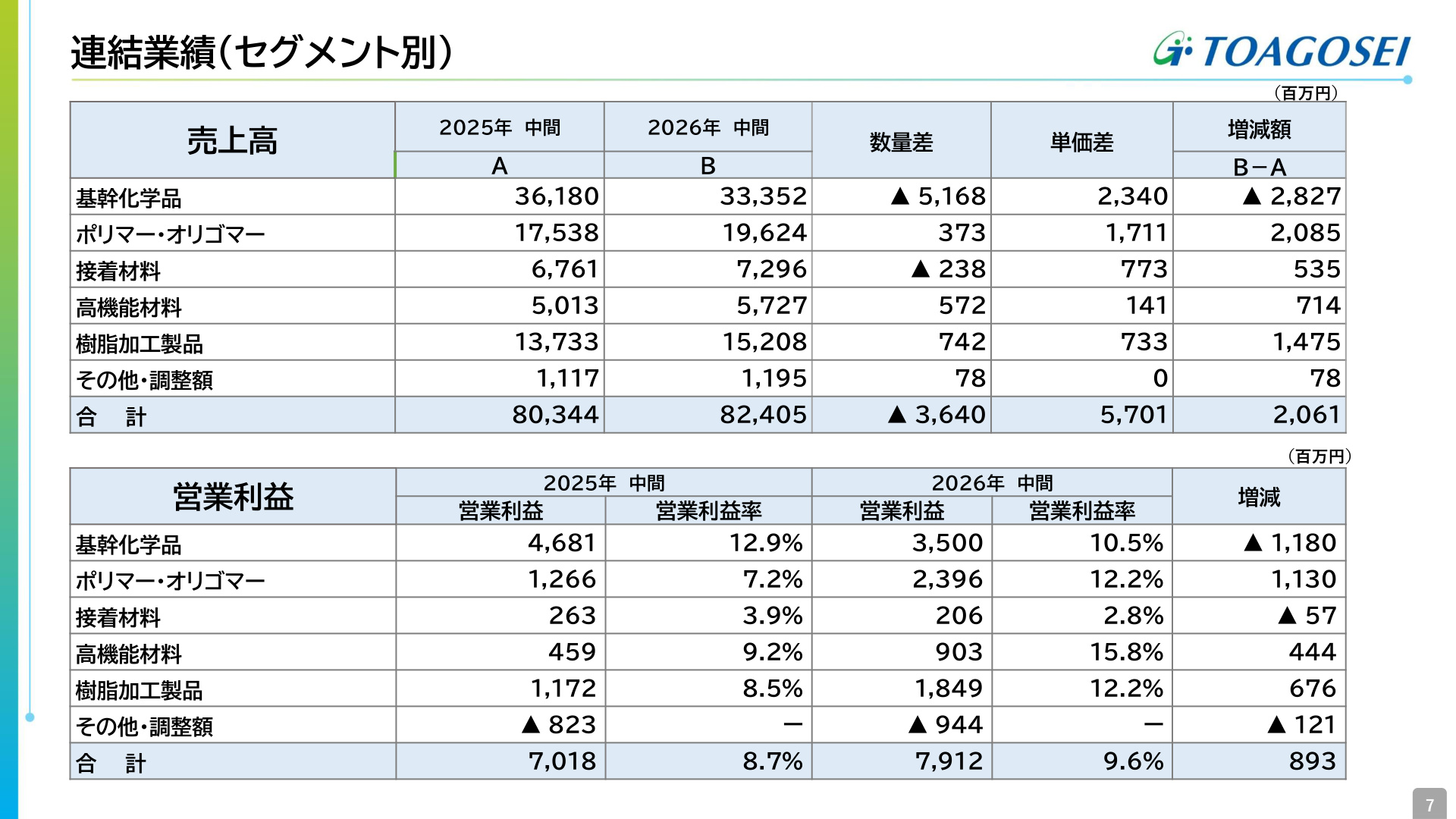
The slide above compares sales and operating profit by segment. The data underscores that the company's growth is being driven by three high-value-added areas: "Polymers & Oligomers," "High-Performance Materials," and "Resin Processed Products."
Performance by segment:
- Basic Chemicals : Sales of 33,352 million yen (▲2,827 million yen YoY), Operating profit of 3,500 million yen (▲1,180 million yen YoY). Faced a decline in both revenue and profit due to lower acrylic monomer sales and increased maintenance costs.
- Polymers & Oligomers : Sales of 19,624 million yen (+2,085 million yen YoY), Operating profit of 2,396 million yen (+1,130 million yen YoY, +89.3% profit growth ). Significant growth in products for semiconductors, mobility, and pharmaceuticals/cosmetics.
- Adhesive Materials : Sales of 7,296 million yen (+535 million yen YoY), Operating profit of 206 million yen (▲57 million yen YoY). Despite higher sales, profit declined slightly due to increased costs.
- High-Performance Materials : Sales of 5,727 million yen (+714 million yen YoY), Operating profit of 903 million yen (+444 million yen YoY, +96.7% profit growth ). Driven by increased demand for AI-related semiconductor applications (e.g., high-purity liquefied hydrogen chloride).
- Resin Processed Products : Sales of 15,208 million yen (+1,475 million yen YoY), Operating profit of 1,849 million yen (+676 million yen YoY, +57.7% profit growth ). Steady performance in sewage-related products and nursing care supplies.
2. FY2026 Full-Year Forecast and H2 Management Challenges
Upward Revision of Full-Year Forecast
Based on H1 results, the company has revised its full-year forecast:
- Net Sales : 170,000 million yen (+7,687 million yen YoY)
- Operating Profit : 15,500 million yen (+1,319 million yen YoY)
- Ordinary Profit : 16,300 million yen (+1,232 million yen YoY)
- Net Income Attributable to Owners of the Parent : 11,800 million yen (▲966 million yen YoY)
- Earnings Per Share (EPS) : 111.22 yen
The projected decline in net income is due to the absence of extraordinary gains from fixed asset sales recorded in the previous year; however, operating profit is expected to grow by 9.3% YoY .
Full-Year Operating Profit Scenario
Compared to the previous year (14.2 billion yen), the company expects a 4.9 billion yen boost from price variance , while anticipating a 0.5 billion yen drag from volume and a 3.1 billion yen increase in fixed costs . The company plans to counter rising raw material, construction, and labor costs by continuing to expand sales of high-value-added products and implementing agile price adjustments.
Key Management Challenges for H2
- Stable Procurement and Supply : Continue addressing raw material procurement constraints caused by Middle East tensions to ensure stable production and supply.
- Accelerating High-Value-Added Strategy : Sustain profit growth, particularly in Polymers & Oligomers, High-Performance Materials, and Resin Processed Products.
- Increasing Overseas Presence : Expand global market share for high-value-added products.
- Pursuing Capital Efficiency : Implement measures to improve capital efficiency, aiming for a PBR exceeding 1.0x , and execute proactive shareholder returns.
3. Progress on Mid-Term Management Plan 2028 and Growth Story
Mid-to-Long-Term Profit Roadmap (Vision 2030)
Under the slogan "Opening the Future through Co-creation," the company aims for an operating profit of over 20 billion yen by FY2030 , with an interim target of 18 billion yen by FY2028 .
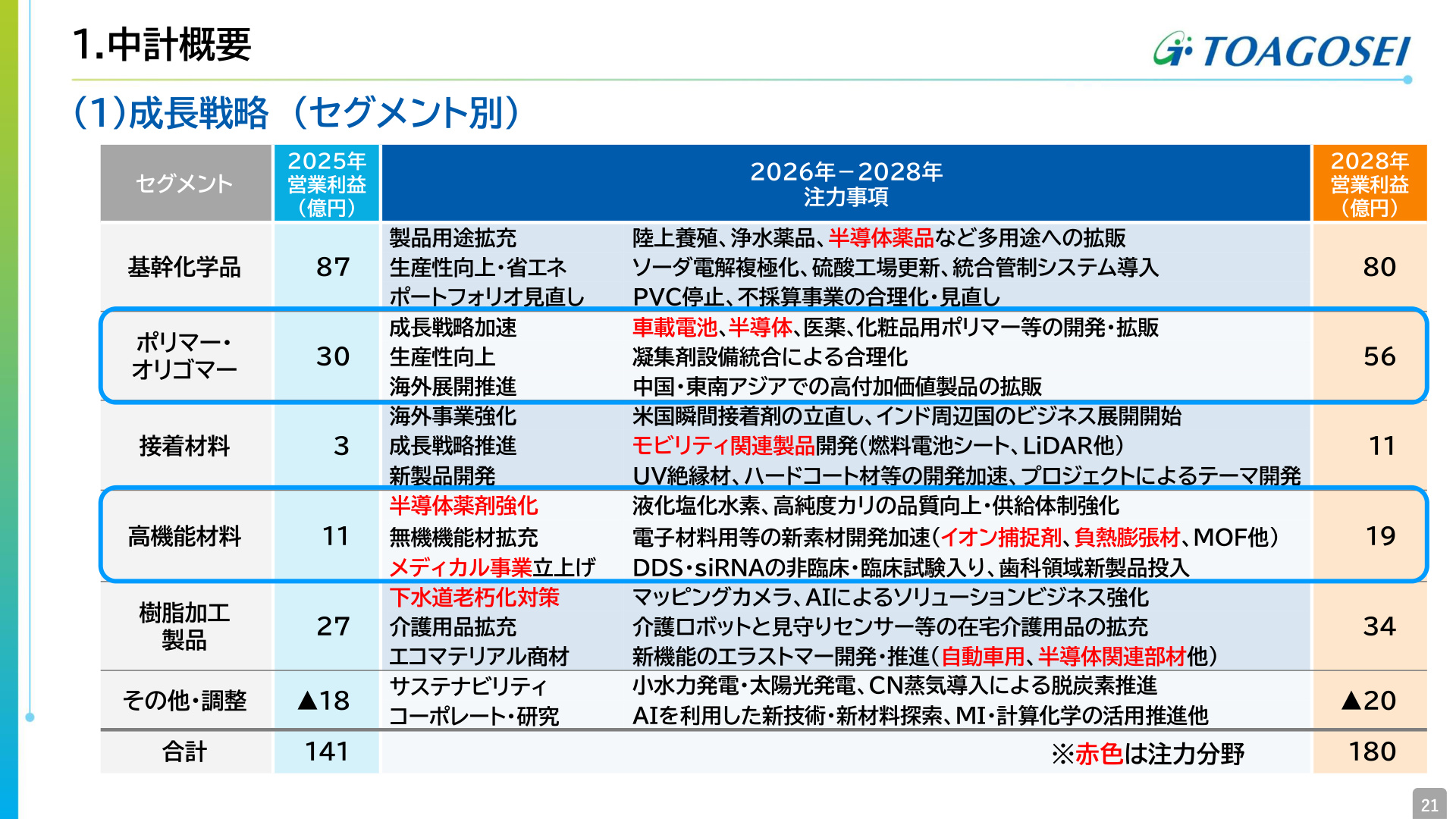
The slide above outlines the growth strategy and targets by segment for the Mid-Term Management Plan 2028. This is critical as it clearly identifies the company's designated growth drivers.
Specifically, while controlling operating profit in Basic Chemicals at the 8 billion yen level (including business restructuring and review of unprofitable operations from the 8.7 billion yen achieved in 2025), the company plans to significantly expand Polymers & Oligomers from 3.0 to 5.6 billion yen , High-Performance Materials from 1.1 to 1.9 billion yen , and Resin Processed Products from 2.7 to 3.4 billion yen .
Progress in Focus Areas (Polymers & Oligomers & High-Performance Materials)
Resources are being concentrated in the following areas:
- Semiconductor & Electronic Materials :
- CMP (Chemical Mechanical Planarization) Polymers : Additives for semiconductor chip planarization; demand is growing with miniaturization and multi-layering.
- High-Purity Liquefied Hydrogen Chloride : Essential for wafer manufacturing; the company holds the #1 global market share . New facilities at the Yokohama Plant are under construction, with full-scale operation scheduled for 2027.
- High-Purity Potassium Hydroxide : Demand is rising as a raw material for CMP slurry due to the multi-layering of memory semiconductors.
- Mobility & Automotive Batteries :
- Developing polymers for automotive batteries and various functional adhesives.
- Pharmaceuticals & Cosmetics :
- Promoting global expansion of proprietary products such as high-absorbency microparticles "ARON NT-Z," film-forming materials "ARON AC-1000," and high-adhesion gels for poultices, the "ARONVIS series."
- Environment & Infrastructure :
- Improving productivity in the flocculant business by consolidating cation powder production at the Sakaide Plant (commercial operation starting July 2026).
Overseas Expansion and Carbon Neutrality
- Increasing Overseas Sales Ratio : Overseas sales have grown YoY. The company aims for further expansion by establishing an integrated production system for cyanoacrylate adhesives in North America and strengthening sales of semiconductor/electronic materials in Asia.
- Contribution to Decarbonization : To achieve carbon neutrality by 2050, the company is engaged in multifaceted environmental initiatives, including waste incineration heat utilization tests with Yokohama City, joint development of small-scale hydroelectric power, joint demonstration of hydrogen fuel cell systems, and technical cooperation for hydrogen engine hybrid vehicles.
4. Shareholder Return Policy and Capital Efficiency
Consecutive Dividend Increases and Robust Returns
Toagosei views capital efficiency and the maximization of shareholder value as top management priorities, maintaining a proactive stance on shareholder returns.
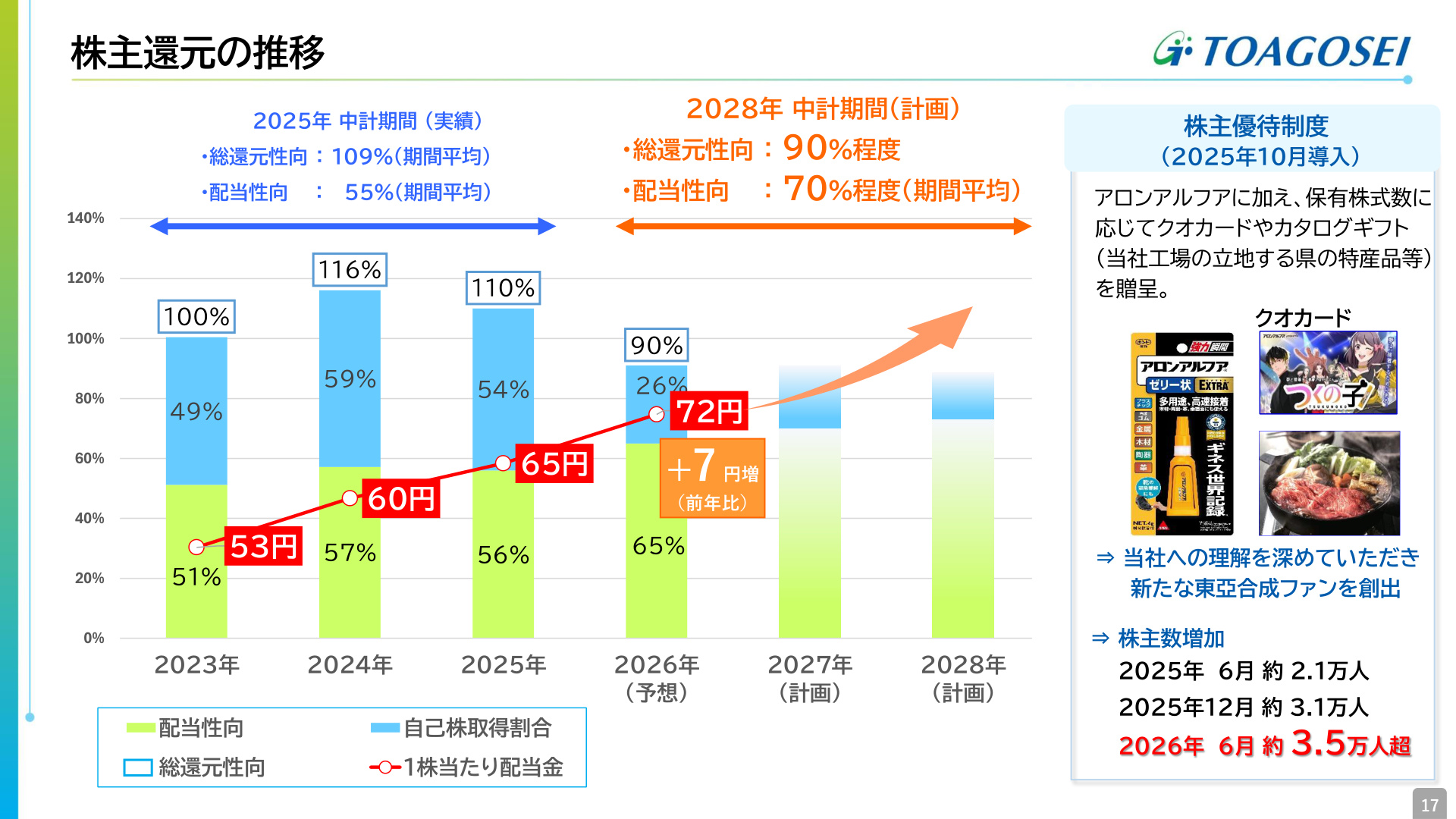
The slide above visualizes the history and future plans for shareholder returns . This data demonstrates the company's clear and attractive commitment to investors.
Key points:
- Dividend Increases : Consecutive increases from 53 yen in 2023 to 60 yen in 2024 and 65 yen in 2025. The FY2026 forecast is 72 yen per year (+7 yen YoY) (36 yen interim, 36 yen year-end).
- Return Targets : The company has set high targets for the Mid-Term Plan 2028 period: a dividend payout ratio of approximately 70% (period average) and a total return ratio of approximately 90% (period average) .
- Shareholder Perks and Individual Investor Base : In October 2025, the company introduced a shareholder benefit program offering Quo cards and specialty product catalogs based on the number of shares held, in addition to "Aron Alpha." As a result, the number of shareholders has grown rapidly from approximately 21,000 at the end of June 2025 to over 35,000 by the end of June 2026 , successfully cultivating a loyal fan base.
5. Conclusion
Toagosei’s FY2026 H1 results and future strategy highlight three core strengths: "pricing power against uncertain external environments," "portfolio shift toward high-value-added areas," and "strong commitment to shareholder returns."
By mitigating market volatility risks in basic chemicals and concentrating resources on high-growth, high-margin sectors like AI/semiconductors, mobility, and pharmaceuticals/cosmetics, the company is steadily advancing its structural reforms to achieve its mid-to-long-term targets of 18 billion yen in operating profit by 2028 and over 20 billion yen by 2030 .
This content is not intended as investment advice or a recommendation. Any opinions expressed are solely the personal views of each article.