

![[In-Depth Analysis] Surala Net (3998) FY2026 Q2 Earnings: Factors Behind Earnings Revision and Strategy for Resurgence Centered on AI Learning Service 'Surala-i'](https://news-images.stock-club.net/market_news/images/3998/140120260807514978/slide_eyecatch_en_b5c19b6d.webp)
[In-Depth Analysis] Surala Net (3998) FY2026 Q2 Earnings: Factors Behind Earnings Revision and Strategy for Resurgence Centered on AI Learning Service 'Surala-i'

StockClub
Published: Aug 07, 2026, 10:35 AM
Sentiment Analysis

Based on the supplementary earnings materials for the second quarter of the fiscal year ending December 2026, we have compiled a detailed analysis of Surala Net Co., Ltd.'s performance highlights, business environment, segment-specific status, factors behind the full-year earnings revision, and future growth strategies.
1. Macro Environment and Surala Net's Value Proposition
In Japan's educational landscape, while the declining birthrate continues, challenges are becoming increasingly multifaceted and complex. These include a rise in the number of truant students (a record high of approximately 350,000 for elementary and junior high combined in FY2024) , the need to address developmental disabilities and academic disparities , and a rapid increase in foreign students requiring Japanese language instruction (approximately 71,000, a 2.1-fold increase over the past decade) . Consequently, the burden on teachers has reached a breaking point, making the provision of "individually optimized learning" a critical challenge.
To address these social issues, Surala Net provides "Surala," an ICT learning tool equipped with adaptive learning functions . The company offers solutions that facilitate grade-level-free mastery of fundamental academic skills and reduce the administrative burden on school staff.
2. FY2026 Q2 Consolidated Earnings Summary
The consolidated results for the first half of the fiscal year (January 1, 2026, to June 30, 2026) showed a year-on-year decline in revenue, with losses recorded across all profit categories.
- Net Sales : 898 million JPY ( down 5.1% YoY)
- EBITDA : 125 million JPY ( down 32.4% YoY)
- Operating Profit : -27 million JPY (compared to +39 million JPY in the same period last year)
- Ordinary Profit : -9 million JPY (compared to +45 million JPY in the same period last year)
- Net Income Attributable to Owners of Parent : -6 million JPY (compared to +35 million JPY in the same period last year)
[Analysis of Revenue and Profit Fluctuations]
Regarding net sales, while the private school market grew from 273 million JPY to 274 million JPY due to new adoptions in vocational and correspondence high schools, this was offset by a decline in public schools (145 million JPY to 143 million JPY) due to insufficient replacement of expired contracts, a decrease in IDs per school in the private education sector (307 million JPY to 284 million JPY) , and intensified competition in the BtoC sector (185 million JPY to 163 million JPY) , particularly in the truancy segment. Overall, this resulted in a revenue decline of 48 million JPY.
In terms of profit, in addition to the impact of lower revenue, earnings were weighed down by increased depreciation (up 15 million JPY) due to system development and content enhancement, as well as higher advertising expenses (up 13 million JPY) from promotional activities.
3. Trends in Key Performance Indicators (KPIs) and Channel Status
The trends for "Number of Schools" and "Number of IDs," which form the foundation of the business, are as follows:
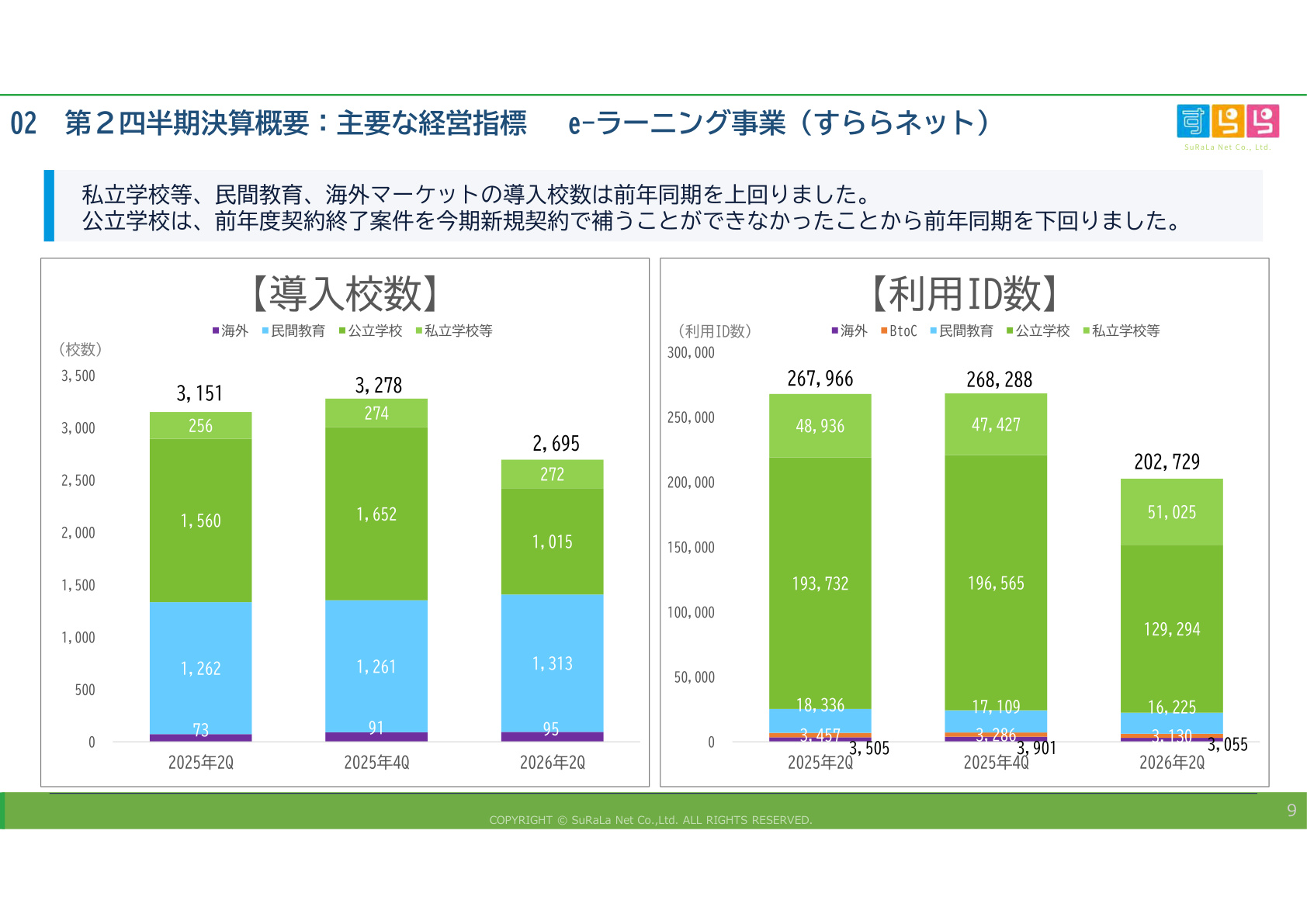
[Slide Commentary: Trends in Key Performance Indicators]
The slide above provides critical data on the company's business foundation: "Number of Schools" and "Number of IDs" (2025 Q2, 2025 Q4, 2026 Q2).
- Number of Schools : Stood at 2,695 as of 2026 Q2 (down from 3,151 in the same period last year), showing a downward trend. While private schools (272) , overseas (95) , and private education (1,313) are steadily expanding or remaining stable, the significant decrease in public schools to 1,015 (from 1,560 in the same period last year) is the primary driver of the overall decline.
- Number of IDs : Stood at 202,729 as of 2026 Q2 (down from 267,966 in the same period last year). The number of IDs in public schools shrank to 129,294 (from 193,732), and BtoC IDs also decreased to 16,225. The impact of the expiration and replacement of large-scale municipal contracts in public schools is evident, highlighting that the company's ability to re-acquire and retain municipal contracts is a key performance indicator.
Detailed Trends by Channel
- Private Schools : New adoptions in vocational and correspondence high schools are progressing, and support for implementation has maintained an upward trend in both contract numbers and IDs.
- Public Schools : Despite inquiries regarding truancy support and Japanese language education, the company could not offset the loss of previous-year municipal contracts with new ones, leading to a revenue decline.
- Private Education : Although the number of schools exceeded the previous year, the number of IDs per school decreased, resulting in an overall decline in revenue.
- BtoC : Market competition in the truancy and developmental disability segments has intensified, leading to a decrease in IDs. The company is currently reviewing its web marketing and strengthening customer touchpoints using "Home-bility" (praise-based ability).
- Overseas Market : Japanese language education for vocational high schools in Indonesia and the expansion of "Surala Math" in Cambodia are progressing, with the number of schools reaching 95 (+30.1% YoY) , demonstrating strong growth.
4. Revision of Full-Year Consolidated Earnings Forecast and Background
Based on the performance progress through the second quarter, the company has significantly revised its full-year consolidated earnings forecast for the fiscal year ending December 2026 (FY2026/12) .
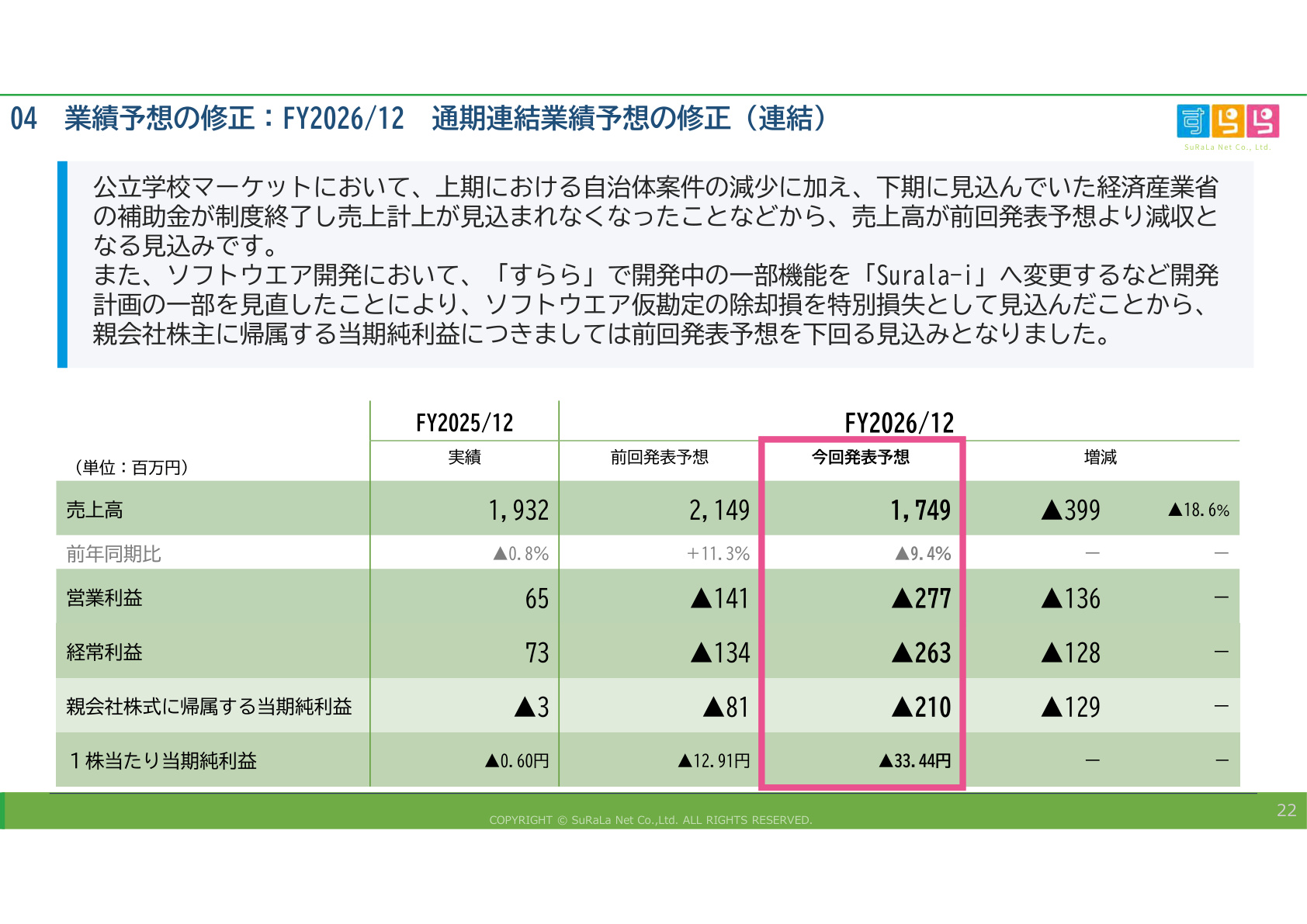
[Slide Commentary: Overview of Full-Year Earnings Forecast Revision]
This slide is a comparison table showing the extent of the revisions made to the initially announced full-year plan.
- Net Sales : Previous forecast 2,149 million JPY → Revised forecast 1,749 million JPY ( -399 million JPY / -9.4% YoY )
- Operating Profit : Previous forecast -141 million JPY → Revised forecast -277 million JPY ( Loss expansion of -136 million JPY )
- Ordinary Profit : Previous forecast -134 million JPY → Revised forecast -263 million JPY ( Loss expansion of -128 million JPY )
- Net Income Attributable to Owners of Parent : Previous forecast -81 million JPY → Revised forecast -210 million JPY ( Loss expansion of -129 million JPY )
Main Reasons for Downward Revision
- Revenue Shortfall in Public School Market : In addition to the decrease in municipal projects in the first half, the termination of a Ministry of Economy, Trade and Industry subsidy program expected for the second half meant that planned revenue could not be recognized.
- Intensified Competition and Decrease in Individual ID Usage : The impact of intensified competition in the BtoC market and a decrease in IDs per school in the private education market.
- Recording of Extraordinary Loss (Loss on Retirement of Software in Progress) : Due to the integration and modification of certain "Surala" features into the next-generation service "Surala-i," a review of the development plan resulted in impairment and retirement losses, further expanding the final deficit.
On the other hand, the company is implementing cost-cutting measures (a total positive impact of 211 million JPY ) by reviewing selling, general, and administrative expenses and development costs to prevent the unlimited expansion of operating losses.
5. Future Growth Strategy and Product Innovation
To rebuild performance and achieve medium- to long-term growth, Surala Net is promoting a strategy to "reframe new educational challenges as new business opportunities."
Launch of Next-Generation Digital Learning Service "Surala-i"
The company is advancing product innovation centered on the new service "Surala-i," which will begin trial operations for public schools in the spring of 2026.
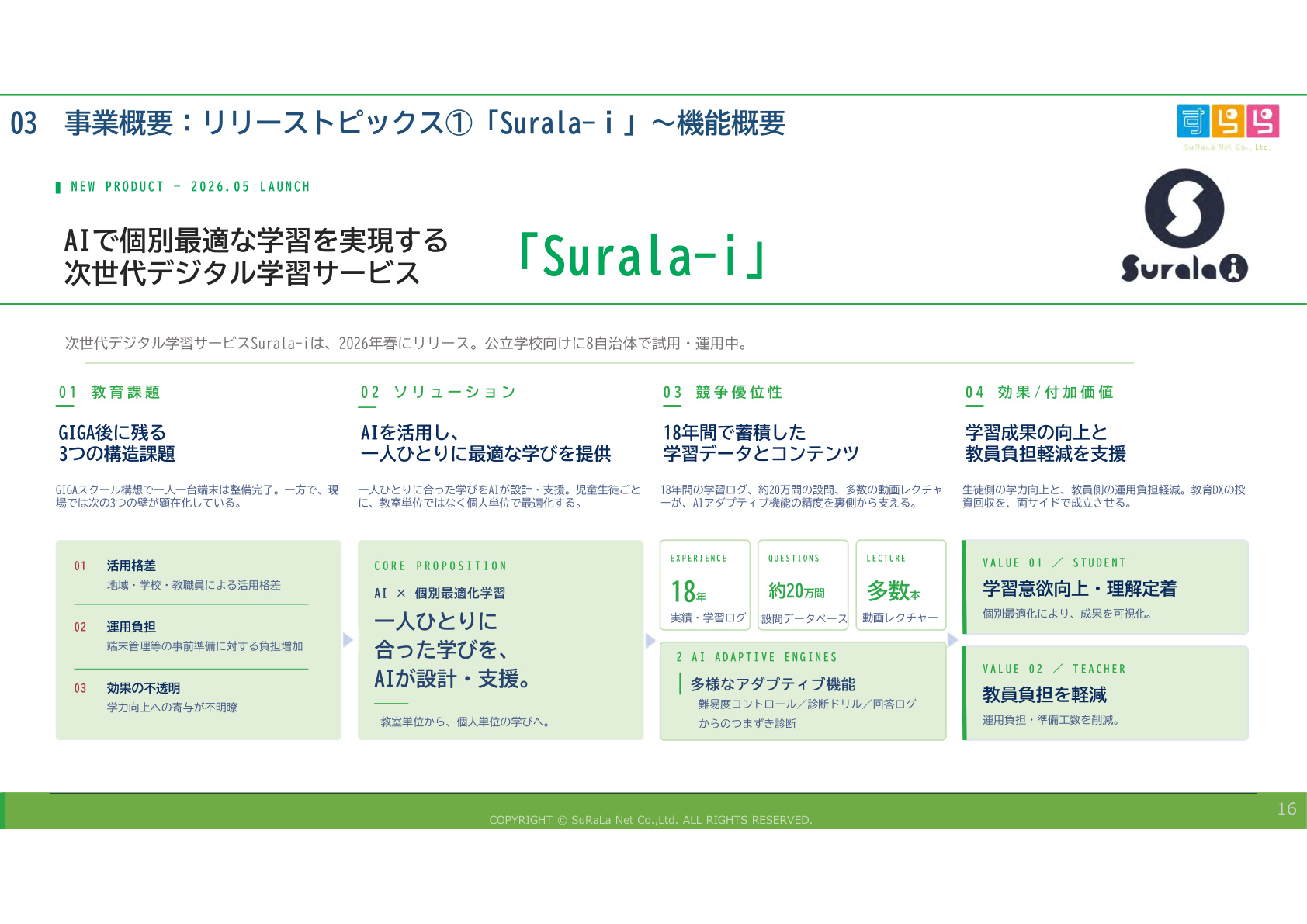
[Slide Commentary: Value and Competitive Advantage of "Surala-i"]
This slide summarizes the solutions and strengths of "Surala-i" regarding the "post-GIGA School Program challenges" faced by conventional ICT learning tools.
- Challenges Addressed : (1) Disparities in utilization between regions and schools, (2) teacher burden related to device management and preparation, and (3) lack of transparency in effectiveness regarding academic improvement.
- Solutions and Strengths : Utilizing 18 years of accumulated learning logs and a database of approximately 200,000 questions , it provides an AI-driven, individually optimized approach . By enhancing difficulty control and diagnostic drills, it designs learning tailored to each individual student.
- Value for Both Parties : By providing students with "increased motivation and mastery of understanding" and teachers with "significant reductions in operational burden and preparation time," the company aims to improve adoption rates and retention in schools.
Market Expansion Roadmap and Target Market (TAM/SAM)
- Expansion Plan : After releasing "Surala-i" for municipalities in 2026, the company plans to expand horizontally to private schools, private education, and BtoC in 2027, and to overseas markets from 2028 onwards.
- Target Market Size : The company's target SAM (Serviceable Available Market) is estimated at approximately 60-70 billion JPY (School market: ~26.5 billion JPY, BtoC market: ~23 billion JPY, Overseas market: ~12.5 billion JPY, Cram school market: ~5 billion JPY). By deepening its presence in niches such as truancy, special needs, mid-to-low academic performers, and foreign language instruction, it aims to capture share within the TAM (approximately 200 billion JPY).
- Development of New Content : In July 2026, the company plans to release "Elementary School English" content to solve the transition gap between elementary and junior high school English, which is expected to be a new growth driver incorporating phonics and conversational AI learning.
Conclusion
Surala Net's earnings for the second quarter of the fiscal year ending December 2026 presented a challenging situation, with declining revenue and operating losses due to the expiration of municipal contracts, changes in subsidy programs, and intensified competition in the BtoC market.
However, in response to these short-term headwinds, the company is optimizing its cost structure , concentrating investment into "Surala-i" —which fuses 18 years of accumulated learning data with AI technology—and accelerating multi-channel expansion into the high-demand Japanese language education and overseas markets . As national educational policy shifts from "volume of knowledge" to "conceptual understanding and application," the value of the company's grade-level-free, fundamental-understanding-focused content will be a key factor for future resurgence.
This content is not intended as investment advice or a recommendation. Any opinions expressed are solely the personal views of each article.