


TradeWorks FY2026 Q2 Earnings Analysis: Achieving First-Half Profitability, Overcoming Timing Mismatches, and Outlining a New Mid-Term Plan Targeting ¥10 Billion in Revenue

StockClub
Published: Aug 07, 2026, 10:34 AM
Sentiment Analysis

TradeWorks, Inc. (Securities Code: 3997) announced its financial results for the second quarter of the fiscal year ending December 2026, along with the core framework of its next Mid-Term Management Plan (2027–2029), on August 7, 2026.
This report provides a comprehensive analysis based on the disclosed earnings materials, covering first-half performance highlights , the impact of temporary timing mismatches , the shift toward a stock-based business model , significant strengthening of the financial base , and growth strategies for the upcoming mid-term plan .
1. FY2026 Q2 Cumulative Results: Significant Revenue and Profit Growth, Achieving Profitability
For the first half (1Q-2Q) of the fiscal year ending December 2026, consolidated revenue reached ¥2.623 billion (+28.0% YoY), with an operating profit of ¥59 million (a turnaround to profitability from a ¥42 million loss in the same period last year). Improved project profitability and rigorous cost management have successfully boosted the gross profit margin from 20.8% in the previous year to 23.2% , signaling a steady trend of profitable growth.
Reality of "Timing Mismatches" in 2Q and Verification of Earning Power
Looking at 2Q results in isolation, revenue was ¥1.378 billion (+19.2% YoY) and operating profit was ¥23 million (-51.1% YoY). While operating profit appears to have declined, this is not due to a decrease in orders, but rather because the acceptance of seven projects, including large-scale ones (impacting revenue by ¥204 million and gross profit by ¥96 million), was pushed to the third quarter or later due to client-side confirmation processes.
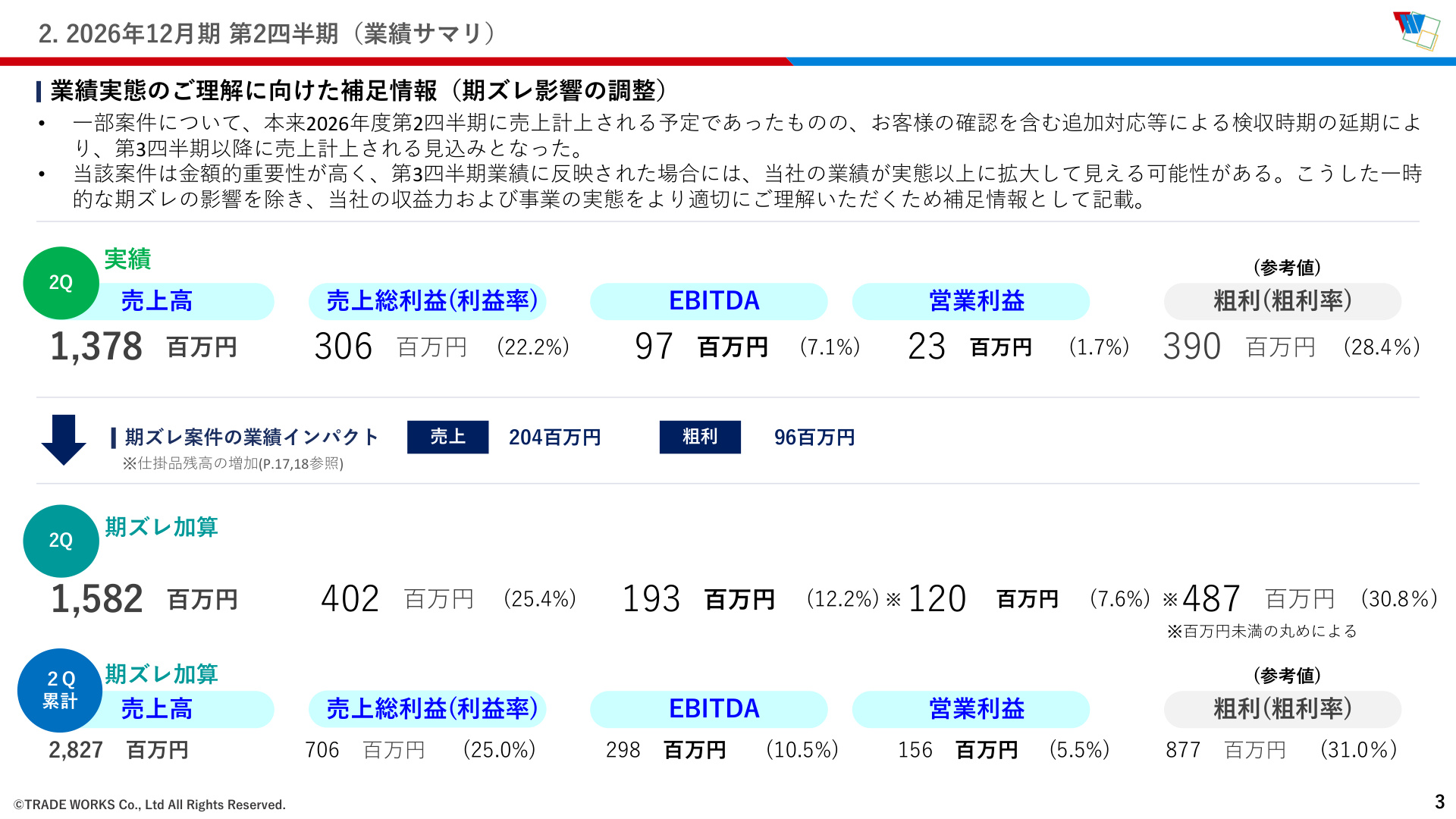
Significance and Background of the Slide Above (P.3)
This slide is crucial for objectively grasping the divergence between "reported financial figures" and the company's "actual earning power." While the 2Q standalone operating profit stands at ¥23 million (1.7% margin), adding back the delayed projects (¥204 million in revenue, ¥96 million in gross profit) results in a pro-forma 2Q revenue of ¥1.582 billion , an operating profit of ¥120 million (7.6% margin), and a gross profit margin of 30.8% .
In short, the company's earnings foundation is steadily rising, and the stagnation in 2Q profit is merely a temporary result of acceptance timing lags.
2. Q3 Earnings Guidance and Full-Year Progress
As the projects delayed in Q2 are expected to be accepted and recognized in Q3, the third quarter is projected to see a very high level of revenue and profit.
- 3Q Standalone Revenue Forecast : ¥1.748 billion – ¥1.847 billion (+17.1% to +23.7% YoY)
- 3Q Standalone Operating Profit Forecast : ¥181 million – ¥260 million (+13.1% to +62.5% YoY)
Consequently, cumulative revenue for the first three quarters (1Q-3Q) is expected to reach ¥4.371 billion – ¥4.470 billion . This represents a progress rate of 76.7% – 78.4% against the full-year revenue forecast of ¥5.7 billion and operating profit forecast of ¥480 million . The company has maintained its full-year guidance, indicating that it is on a very smooth trajectory to meet its targets.
3. Transformation of the Revenue Model: Expansion of Stock-Based Business and Structural Reform
TradeWorks is moving away from its traditional reliance on spot-based contract development, prioritizing the expansion of stock-based revenue —such as system usage fees, maintenance fees, and monthly license income—as a key KPI.
In 2Q 2026, stock-based revenue reached ¥565 million , with the stock revenue ratio consistently remaining in the 40% range of total company revenue.
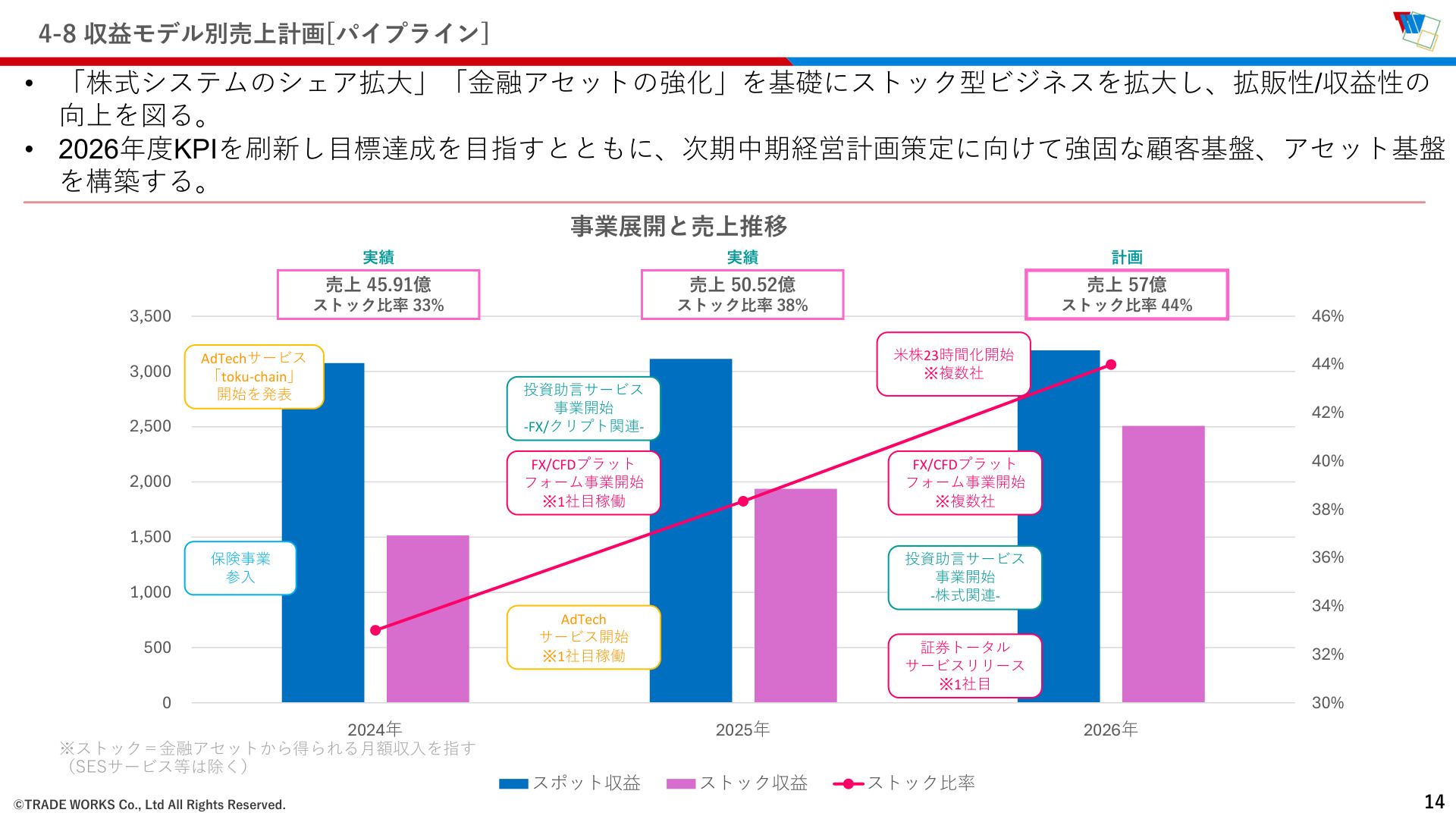
Significance and Background of the Slide Above (P.14)
This slide symbolizes the qualitative shift in the company's revenue structure toward higher profitability and stability. As total revenue grows (¥4.591 billion in 2024 → ¥5.052 billion in 2025 → ¥5.700 billion planned for 2026), the stock ratio has expanded from 33% in 2024 to 38% in 2025, with a target of 44% in the 2026 plan.
Key drivers include ad-tech services like "toku-chain," FX/CFD platforms, investment advisory services, and services related to US stock trading. A structure is being established where monthly recurring revenue accumulates upon the completion of development projects, reducing the risk of quarterly earnings volatility.
4. Qualitative Shift in Financial Base: Equity Ratio Rising to 62.5% and Extraordinary Items
This quarter saw dramatic changes in the balance between financial health and growth investment.
Rapid Improvement in Financial Soundness
Using funds raised through a third-party allotment (¥850 million), the company repaid and reduced short-term borrowings by ¥500 million, from ¥530 million to ¥30 million. After executing share buybacks (two tranches, totaling 384,300 shares, approx. ¥150 million), the equity ratio surged from 46.3% to 62.5% (+16.2pt) , and net assets expanded significantly to ¥2.53 billion . Operating cash flow also turned from a deficit in the same period last year (-¥370 million) to a surplus of +¥90 million , establishing a foundation for future Prime Market listing criteria .
Background of Extraordinary Items
Regarding business investments aimed at strengthening the insurance-related business, the company decided to shift from equity holding to "securing business assets and technical foundations" following changes in the target company's capital structure.
- Extraordinary Loss : Loss on sale of investment securities: -¥54.6 million
- Extraordinary Profit : Gain on donated fixed assets from the acquisition of next-gen insurance management infrastructure: +¥38.9 million
- Net Extraordinary Loss : -¥15.7 million (roughly the same level as the -¥10.9 million in the previous year) This was a strategic move to recover capital while securing necessary software assets and master database infrastructure for the insurance business at no cost, effectively preserving business value.
5. Business Topics: Finance, Security, AI/On-Chain, and Global Expansion
Progress is being made on numerous initiatives across various business domains to ensure future growth:
- Global Expansion (First Project in Thailand) :
- Commenced provision of a securities white-label service centered on US stock trading for SBI Thai Online Securities (SBITO) (final stages of commercial launch). This integrates Alpaca's trading infrastructure with Minkabu's investment information, serving as a model for expansion into Asia and the Middle East.
- Support for 23-Hour US Stock Trading (Started Dec 6, 2026) :
- The company's US stock system immediately supported the launch of 23-hour trading on the NYSE and Nasdaq, building on its track record of full system renewals for firms like Monex, Inc.
- Horizontal Expansion of Security Solutions :
- Implemented the " SpotPath " multi-factor authentication platform (FIDO2/Passkey) for all trading tools at Tachibana Securities.
- Launched AI-driven penetration testing services leveraging expertise gained from Hirose Tusyo.
- Foundations for AI and On-Chain Solutions :
- Building an "AI-native next-gen information platform" in collaboration with Minkabu.
- Initiated a PoC for the " LastEvidence " audit trail platform in partnership with SBI Securities and THXLAB (recording AI agent operations in a tamper-resistant format).
- Added US stock accumulation functionality to DMM.com Securities' "Tsumitate Kabu" service.
6. New Mid-Term Management Plan (2027–2029): Breakthrough to ¥10 Billion in Revenue
On the same day as the earnings announcement, the company released the "framework" for its next Mid-Term Management Plan , covering the fiscal years ending December 2027 through December 2029.
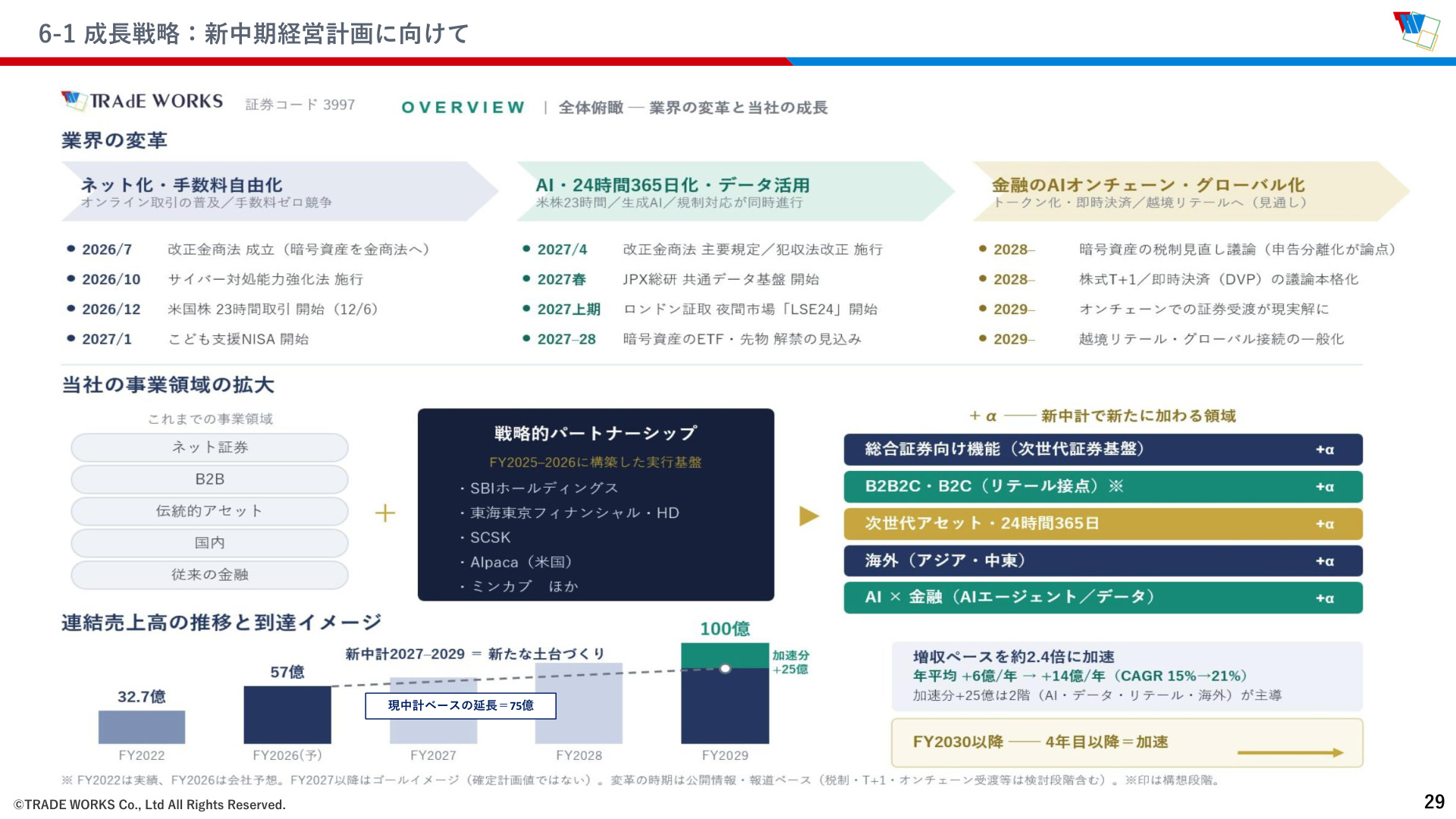
Significance and Background of the Slide Above (P.29)
This is a critically important slide that clearly outlines the roadmap and scale of the company's accelerated growth.
The company is capturing the structural shift in the financial industry from the first wave (digitization/deregulation) and second wave (AI/24-7 operations/data usage) to the third wave (AI/on-chain/globalization).
In addition to existing domains (B2B online brokerage, etc.), the new plan incorporates the following "+α" (additional areas) :
- Functions for comprehensive securities firms (next-gen infrastructure)
- B2B2C / B2C (retail touchpoints)
- Next-gen assets / 24-7 operations
- Overseas expansion (Asia/Middle East)
- AI × Finance (AI agents/data)
Through these, the company aims to accelerate its average annual revenue growth by approximately 2.4 times (from +¥600 million/year, 15% CAGR, to +¥1.4 billion/year, 21% CAGR), targeting ¥10 billion in revenue by 2029 , up from the ¥5.7 billion projected for 2026. The vision is to further accelerate this growth beyond 2030.
Summary
In the second quarter of FY2026, despite a temporary, superficial decline in profit due to project timing mismatches, TradeWorks demonstrated very robust underlying earning power and successfully achieved a turnaround to profitability in the first half. With a clear earnings rebound expected in Q3, an improved stock revenue ratio, and a strengthened equity ratio of 62.5%, the company's fundamental strength has significantly increased.
Furthermore, with the first overseas project in Thailand, advanced initiatives like "LastEvidence," and the new mid-term plan targeting ¥10 billion in revenue by 2029 , these results confirm that the company is evolving from a "securities system developer" into a "global provider of next-generation digital financial infrastructure."
This content is not intended as investment advice or a recommendation. Any opinions expressed are solely the personal views of each article.