


Sasatoku Print FY2026 Earnings Deep Dive: Overcoming Cost Pressures to Launch Growth Investments—New Dividend Policy and the 2030 Mid-Term Plan

StockClub
Published: Aug 07, 2026, 10:33 AM
Sentiment Analysis
Sasatoku Print (3958) FY2026 Earnings Deep Dive Report
Sasatoku Print Co., Ltd. has released its financial results for the fiscal year ended June 30, 2026 (July 1, 2025 – June 30, 2026). Amid a challenging macroeconomic environment characterized by surging crude oil and raw material prices, as well as rising labor costs, this comprehensive report analyzes the company's performance trajectory and the strategic measures being implemented to drive future growth, based on the latest official disclosures.
1. FY2026 Consolidated Financial Overview and Highlights
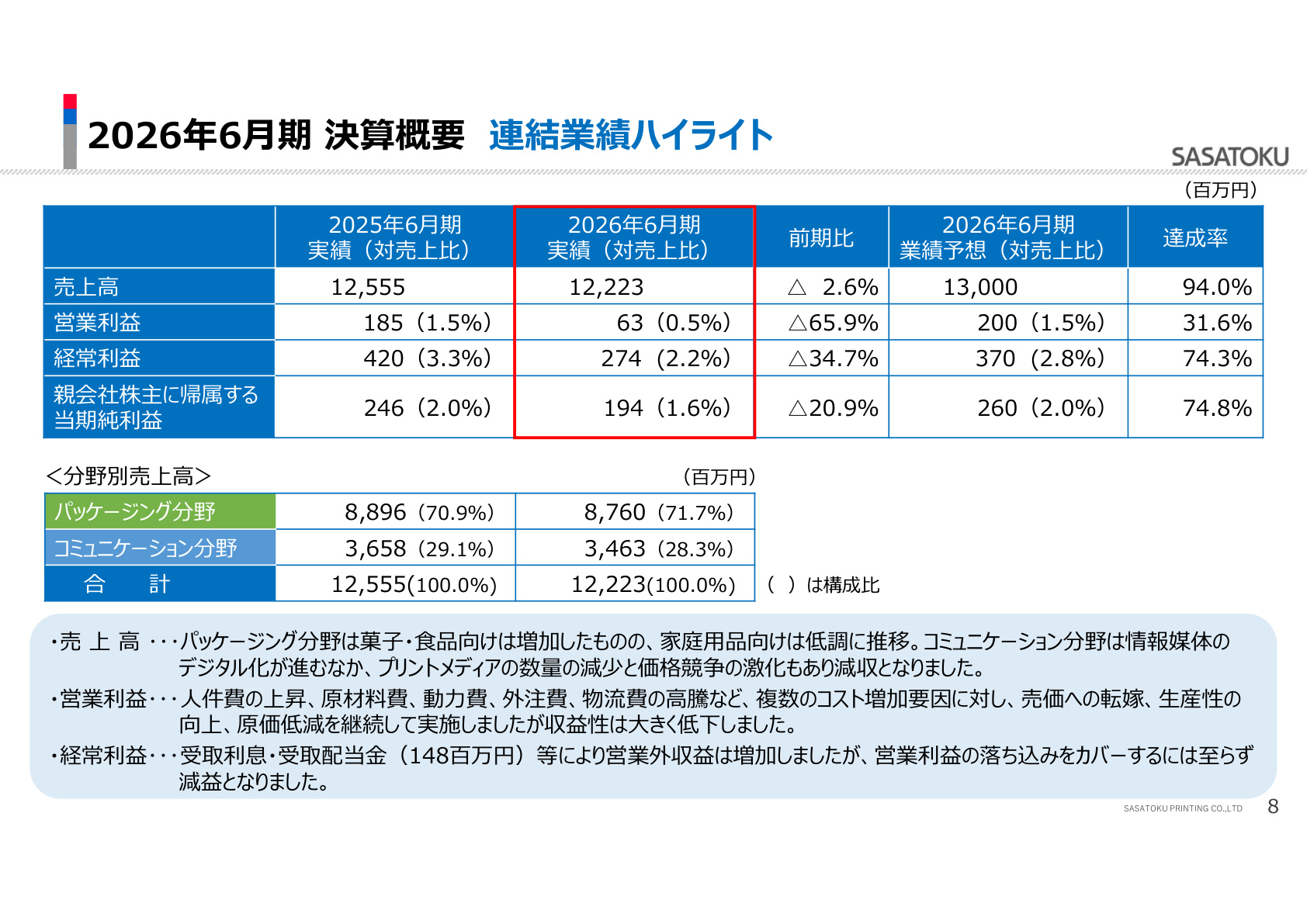
For the fiscal year ended June 30, 2026, the company reported consolidated net sales of ¥12.223 billion (down 2.6% YoY), operating profit of ¥63 million (down 65.9% YoY), ordinary profit of ¥274 million (down 34.7% YoY), and net income attributable to owners of the parent of ¥194 million (down 20.9% YoY). Both sales and profit figures fell short of initial forecasts.
[Commentary and Significance of Slide 7 (Consolidated Financial Highlights)]
The highlight table above provides critical data illustrating the challenges and the overall structure of the company's earnings. Net sales reached 94.0% of the plan, while operating profit significantly underperformed at 31.6% of the target.
The primary driver behind this was the increase in multiple cost categories, including labor, raw materials, energy, outsourcing, and logistics. Although the company continuously pushed for appropriate price pass-throughs, productivity improvements, and cost-reduction activities, a time lag in passing on the rapid inflation of costs to product prices directly impacted profit margins. Conversely, non-operating income, such as interest and dividend income (¥148 million), provided a buffer, mitigating the decline in ordinary and net profits.
2. Segment Trends and Business Structure Analysis
Sasatoku Print’s business is composed of two main pillars: the "Packaging Division" and the "Communication Division." The trends for each are as follows:
- Packaging Division (Net Sales: ¥8.76 billion / down 1.5% YoY / Sales Composition: 71.7%) While demand for confectionery and food packaging remained robust, driving sales, the overall division saw a slight decline due to sluggish orders for household goods.
- Communication Division (Net Sales: ¥3.463 billion / down 5.3% YoY / Sales Composition: 28.3%) As the shift toward digital information media continues, the division faced a decline in revenue due to reduced volumes in print media (commercial and publishing printing) and intensified price competition in the market.
3. Financial Position and Balance Sheet (B/S) Trends
Total assets at the end of FY2026 stood at ¥15.486 billion , an increase of ¥1.477 billion from the previous fiscal year-end. Key factors for this change include:
- Increase in Fixed Assets: Property, plant, and equipment increased by ¥530 million due to the expansion of production facilities at the Kanto Plant, while investment securities increased by ¥646 million due to fluctuations in the valuation of held shares.
- Liabilities: Total liabilities rose to ¥5.85 billion (up ¥989 million YoY), primarily due to an increase in long-term borrowings (+¥612 million).
- Net Assets and Safety Indicators: Total net assets expanded to ¥9.635 billion (up ¥487 million YoY), driven by an increase in valuation difference on available-for-sale securities (+¥374 million). The equity ratio remains at 62.2% (down from 65.3% at the previous year-end), and net assets per share have steadily accumulated to ¥1,771.32 . This indicates that the company is maintaining a sound financial base while aggressively pursuing capital investment.
4. FY2027 Earnings Outlook and Sales Recovery Scenario
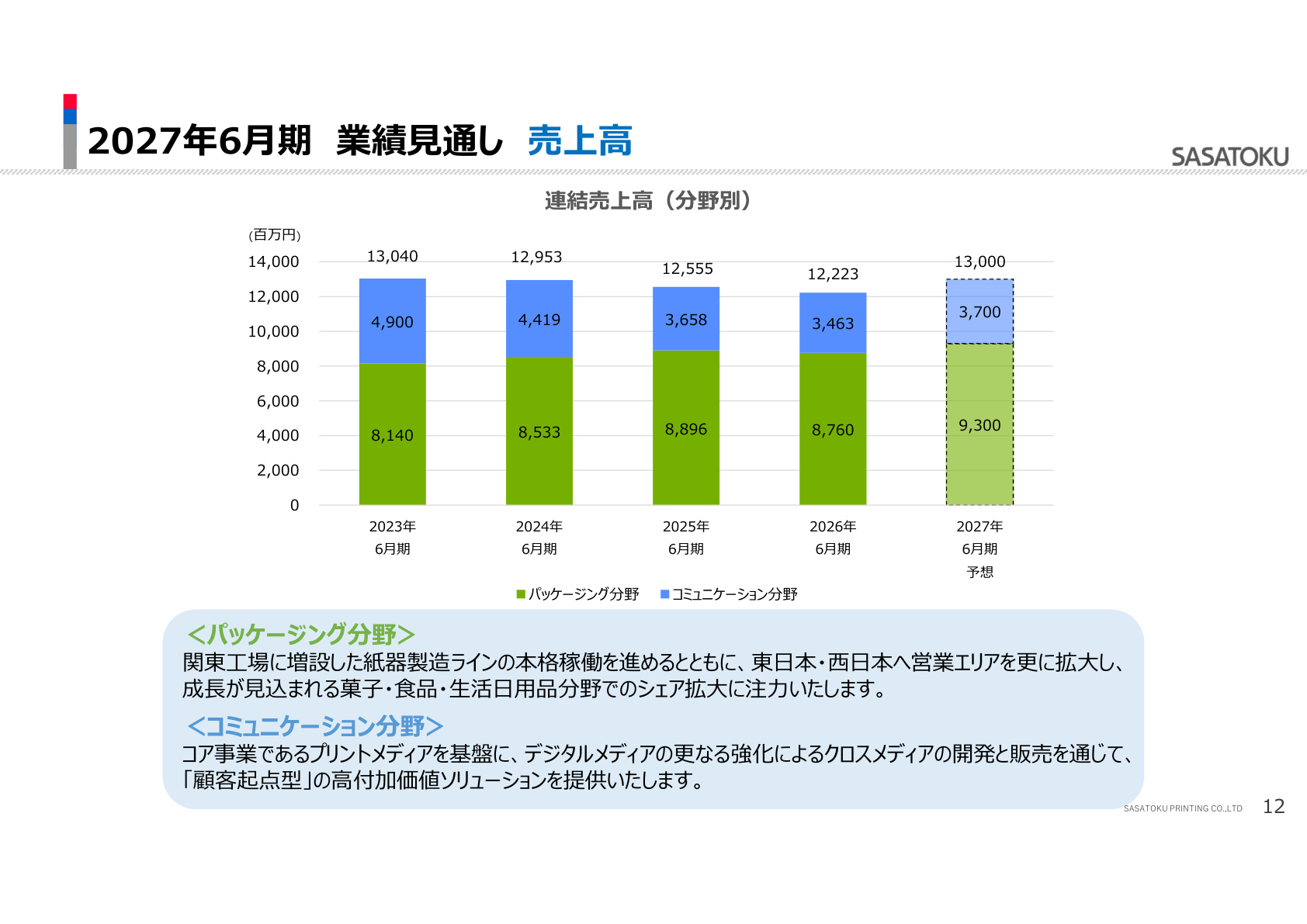
For the fiscal year ending June 30, 2027, the company forecasts consolidated net sales of ¥13.0 billion (up 6.4% YoY), operating profit of ¥80 million (up 26.4% YoY), ordinary profit of ¥420 million (up 52.9% YoY), and net income of ¥280 million (up 43.9% YoY).
[Commentary and Significance of Slide 11 (Earnings Outlook: Sales Trends)]
This graph illustrates the five-year trend in sales by segment and the growth scenario moving forward. The company plans to recover to a record-high sales level of ¥13.0 billion in FY2027.
The growth will be driven by the core Packaging Division , with a planned increase of ¥540 million to ¥9.3 billion . This is based on the full-scale operation of the new paper container production line at the Kanto Plant , as well as the acquisition of market share in the confectionery, food, and household goods sectors through an aggressive expansion of sales territories in Eastern and Western Japan. Meanwhile, in the Communication Division (forecasted at ¥3.7 billion), the company aims to add high value by strengthening digital media and providing cross-media solutions, while maintaining its foundation in traditional print media.
Regarding operating profit, although increased depreciation costs from the new Kanto Plant equipment and persistent high labor and other costs remain, the company plans to achieve profit growth through the penetration of price pass-throughs and production optimization.
5. Annual Strategy by Industry (Four Priority Areas)
The specific approach for each market in FY2027 is organized as follows:
- Mobility (Automobiles, Parts, Related Products): Strengthen capabilities for small-lot, high-mix production to secure stable orders. Promote the capture of event-related demand and the expansion of fulfillment services.
- Life (Food, Pharmaceuticals, Cosmetics): Expand business areas and strengthen orders for confectionery and food packaging. Enhance fulfillment functions in the Kanto region to increase equipment utilization rates.
- Culture (Publishing, Education, Tourism, Culture): Against the backdrop of a challenging publishing sector, strengthen the acquisition of growing card game-related and educational sectors, and roll out digital initiatives horizontally.
- Living (Household Goods, Electronics, Machinery): Promote combined proposals of manuals/print media and digital initiatives to expand orders for household goods packaging.
6. Strengthening Shareholder Returns and Introducing a New Dividend Policy
At the Board of Directors meeting held on August 7, 2026, Sasatoku Print resolved to make significant changes to its shareholder return policy.
[Commentary and Significance of Slide 15 (Changes to Shareholder Return/Dividend Policy)]
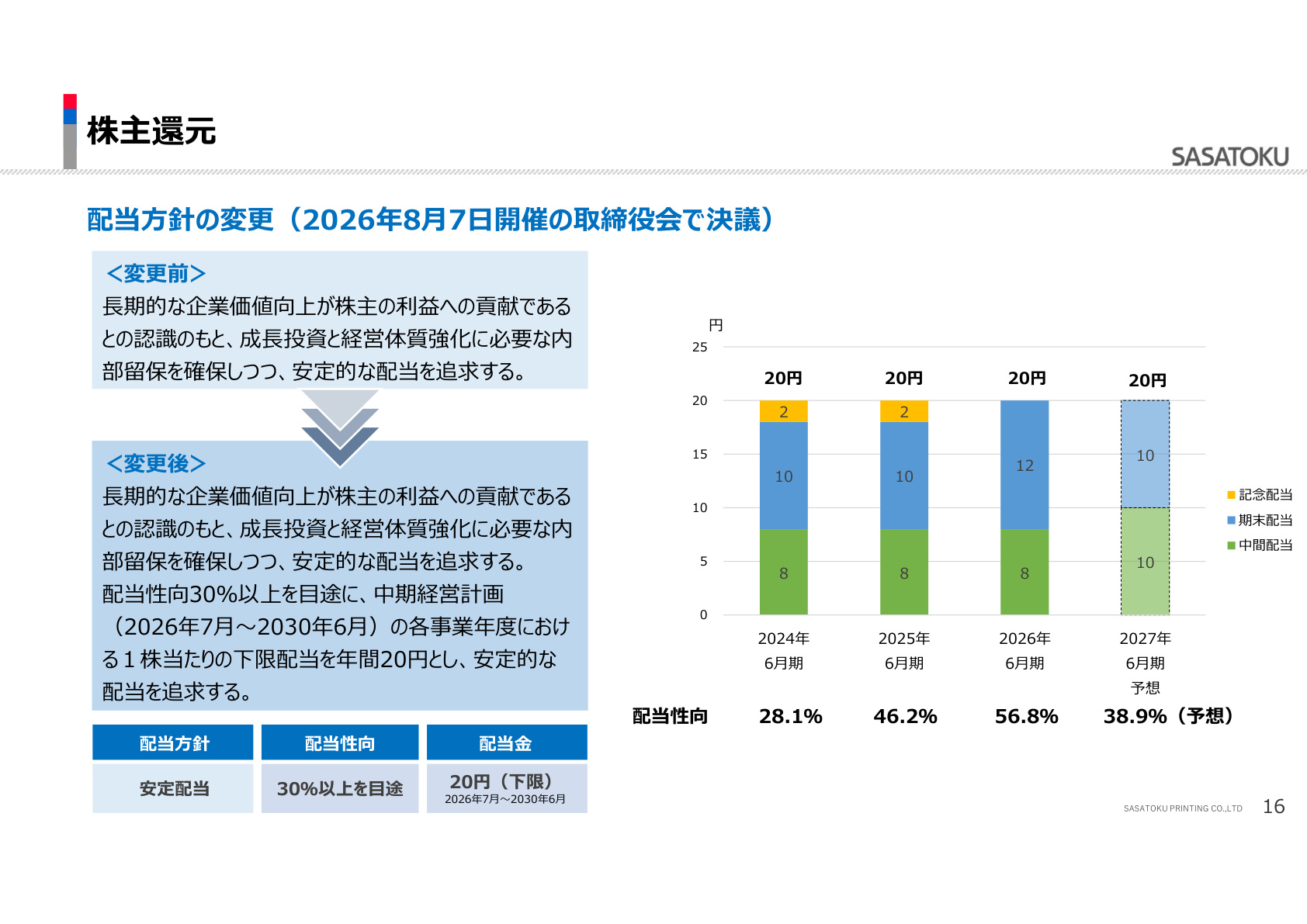
The slide above is highly noteworthy as it demonstrates a clear commitment to strengthening investor returns. Previously, the policy was limited to a qualitative goal of "pursuing stable dividends." Under the new policy, the company has set a "target dividend payout ratio of 30% or more" and established a "minimum annual dividend of ¥20 per share" for the duration of the new mid-term management plan (July 2026 – June 2030).
The annual dividend for FY2026 is set at ¥20 per share (56.8% payout ratio), and the company plans to maintain a dividend of ¥20 per share for FY2027 (forecasted payout ratio of 38.9%). By setting a minimum dividend, the company is firmly demonstrating its commitment to shareholder returns even during periods of earnings volatility.
Furthermore, to improve capital efficiency and execute flexible capital policies, the company has implemented a share buyback program with a limit of 200,000 shares (¥140 million) , with 50,200 shares already acquired as of June 30, 2026.
7. Addressing Cost of Capital/PBR and Launching the "2030 Mid-Term Management Plan"
The company recognizes that its PBR (Price-to-Book Ratio) is currently trading below 1.0x . To address this issue, it aims to enhance corporate value over the medium-to-long term by balancing aggressive growth investments with appropriate shareholder returns.
As part of this effort, the company formulated the "2030 Mid-Term Management Plan (July 2026 – June 2030)" in preparation for its 140th anniversary, which was released on August 7, 2026. The plan presents a detailed growth strategy for achieving sustainable growth, and future business developments are highly anticipated.
Summary (10 Key Points)
- FY2026 Results: Net sales of ¥12.22 billion and operating profit of ¥0.063 billion, marking a year-on-year decline.
- Profit Decline Factors: Primarily due to a time lag in passing on various rising costs to product prices.
- Segment Composition: The Packaging Division is the core business, accounting for 71.7% of total sales.
- Financial Base: Maintains a strong financial position with an equity ratio of 62.2% and BPS of ¥1,771.32.
- FY2027 Outlook: Expects a V-shaped recovery with net sales of ¥13.0 billion and operating profit of ¥0.08 billion.
- Investment Results: Established a production increase system through the full-scale operation of the Kanto Plant's paper container line.
- Area Strategy: Accelerating sales expansion in Eastern and Western Japan to capture food and household goods packaging demand.
- New Demand Creation: Promoting high-value-added areas such as card game-related demand and fulfillment functions.
- New Dividend Policy: Targets a payout ratio of 30% or more and sets a minimum annual dividend of ¥20 .
- Capital Efficiency: Commitment to exceeding a PBR of 1.0x through share buybacks and the "2030 Mid-Term Management Plan."
This content is not intended as investment advice or a recommendation. Any opinions expressed are solely the personal views of each article.