


iRidge (3917) Q1 FY2027 Earnings Deep Dive: Rapid Growth in EX-DX and the Future Vision Driven by New AI Subsidiary

StockClub
Published: Aug 07, 2026, 10:32 AM
Sentiment Analysis

Introduction
iRidge, Inc. (Securities Code: 3917) has released its Q1 financial results for the fiscal year ending March 2027 . This report provides a detailed, multi-faceted analysis of the company's performance, segment status, and strategic initiatives for future growth, focusing on ten key topics derived from the earnings presentation materials.
Beyond its existing app business, the company presents a wealth of quantitative and qualitative data demonstrating its rapid transformation and solid business foundation. This includes the strong performance of the high-growth EX-DX (Employee Experience Digital Transformation) sector and its full-scale entry into Generative AI and AI orchestration through the establishment of a new subsidiary.
1. Q1 FY2027 Earnings Highlights and Progress
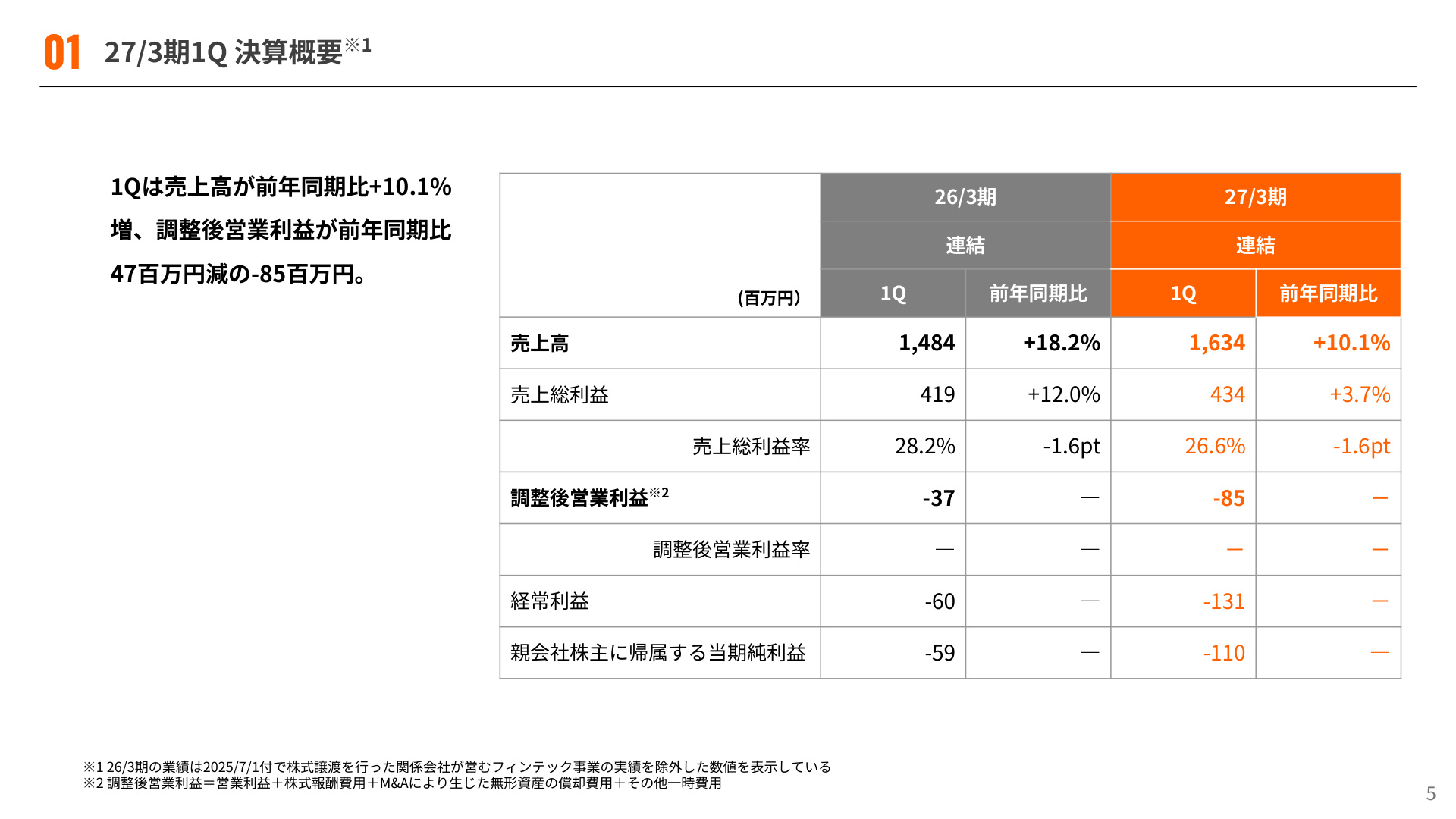
In Q1, consolidated net sales reached 1,634 million yen (+10.1% YoY) , marking a successful increase in revenue. Conversely, adjusted operating profit was -85 million yen (compared to -37 million yen in the same period last year), representing a year-on-year decline of 47 million yen. Ordinary profit stood at -131 million yen, and net profit attributable to owners of the parent was -110 million yen.
The following table provides an overview of the key consolidated financial figures for Q1 compared to the same period last year.
[Background Commentary on Slide: Earnings Overview]
This slide (Page 4) is critical for understanding the overall revenue structure for the quarter. While net sales show a solid 10.1% increase , the gross profit margin has deteriorated from 28.2% to 26.6% (-1.6pt) , and adjusted operating profit has fallen to -85 million yen . The pressure on profits despite sales growth is attributed to upfront investments (increased personnel costs for sales reinforcement, recruitment, and outsourcing expenses) and a concentration of projects with temporarily high cost-of-sales ratios . Investors should carefully assess whether this profit decline is a structural deterioration or a temporary phenomenon caused by strategic investments and the timing of project costs.
The company maintains its initial full-year forecast of 8,200 million yen in net sales and 500 million yen in adjusted operating profit . While the Q1 progress rate for net sales stands at 19.9% , the company’s sales and profits historically exhibit seasonality skewed toward the second half of the year , as seen in previous years (22.2% and 19.9% in the same periods of the prior two years). Therefore, the Q1 progress rate is considered to be on track with the planned trajectory.
2. Deep Dive into Profit Fluctuations and Cost Structure
According to the waterfall analysis of adjusted operating profit for Q1 (a -47 million yen difference YoY), the factors are categorized as follows:
- Growth in App Business EX-DX sector : +52 million yen profit contribution.
- Decline in Business Produce segment gross margin : -30 million yen profit drag.
- Increase in personnel, outsourcing, and promotional expenses : -36 million yen cost increase.
- Other expense increases : -32 million yen cost increase.
The consolidated cost-of-sales ratio rose by 1.6pt YoY to 73.4% . While the outsourcing ratio decreased from 44.0% to 42.5%, personnel costs within cost of sales increased from 15.4% to 17.2% , and other costs rose from 12.4% to 13.7%. This was primarily due to a temporary concentration of high-cost projects in the Business Produce segment.
Additionally, adjusted SG&A expenses reached 519 million yen (+62 million yen YoY) , primarily driven by new hiring to strengthen the sales structure, outsourcing, and promotional expenses (317 million yen in personnel costs, 20 million yen in recruitment costs, and 46 million yen in outsourcing fees, etc.).
3. Segment Performance and Key KPI Trends
The company’s business is divided into two main segments: "App Business" and "Business Produce."
① App Business
- Net Sales : 1,274 million yen (+12.3% YoY)
- Adjusted Operating Profit : 177 million yen (-1.1% YoY)
- Overview : Expansion in the EX-DX sector and the acquisition of large-scale projects in business DX support drove company-wide sales. Profit saw a slight decline due to costs associated with new hiring and partnerships with sales support firms, but the segment maintains a high profit margin.
② Business Produce Business
- Net Sales : 360 million yen (+2.8% YoY)
- Adjusted Operating Profit : -39 million yen (vs. -2 million yen in the same period last year)
- Overview : The segment deficit widened due to a temporary concentration of high-cost projects and increased personnel costs from new hiring.
Key KPIs: Product-Integrated App MAU and Stock-based Revenue
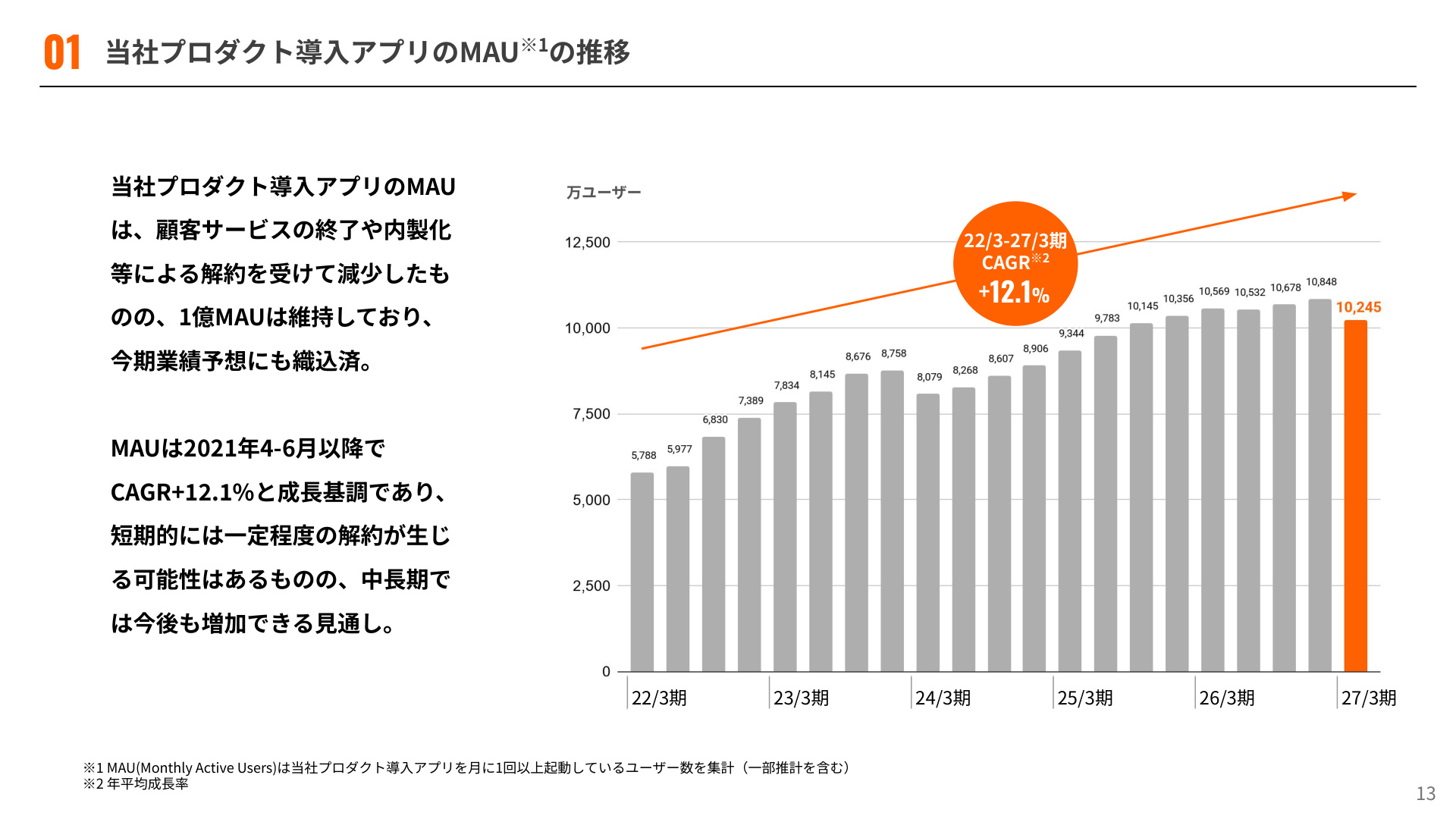
Key KPIs indicating the scale of the stock-based business continue to maintain high levels and an upward trend.
[Background Commentary on Slide: MAU Trends]
This slide (Page 12) is a key indicator of the strength of iRidge’s platform foundation. Despite some churn due to the termination of customer services or shifts to in-house development, the Monthly Active Users (MAU) of apps integrated with the company's products reached 102.45 million , maintaining an overwhelming platform scale of "100 million MAU." The Compound Annual Growth Rate (CAGR) since the April-June 2021 quarter has reached +12.1% , demonstrating a robust customer engagement foundation that continues to expand in the medium to long term despite short-term churn. This massive MAU base serves as the ignition point for the various DX solutions and AI agent applications the company is rolling out next.
Furthermore, stock-based revenue (monthly fees, licenses, sub-contracting agreements of 3 months or longer, etc.) has grown to 936 million yen (+12.0% YoY) , despite the impact of churn, highlighting the steady growth of its recurring revenue base.
4. EX-DX Sector Driving High Growth and New Business Topics
The most notable segments in the future growth story are the EX-DX (Employee Experience Digital Transformation) sector and initiatives in advanced technology.
[Background Commentary on Slide: EX-DX Sector Sales Growth]
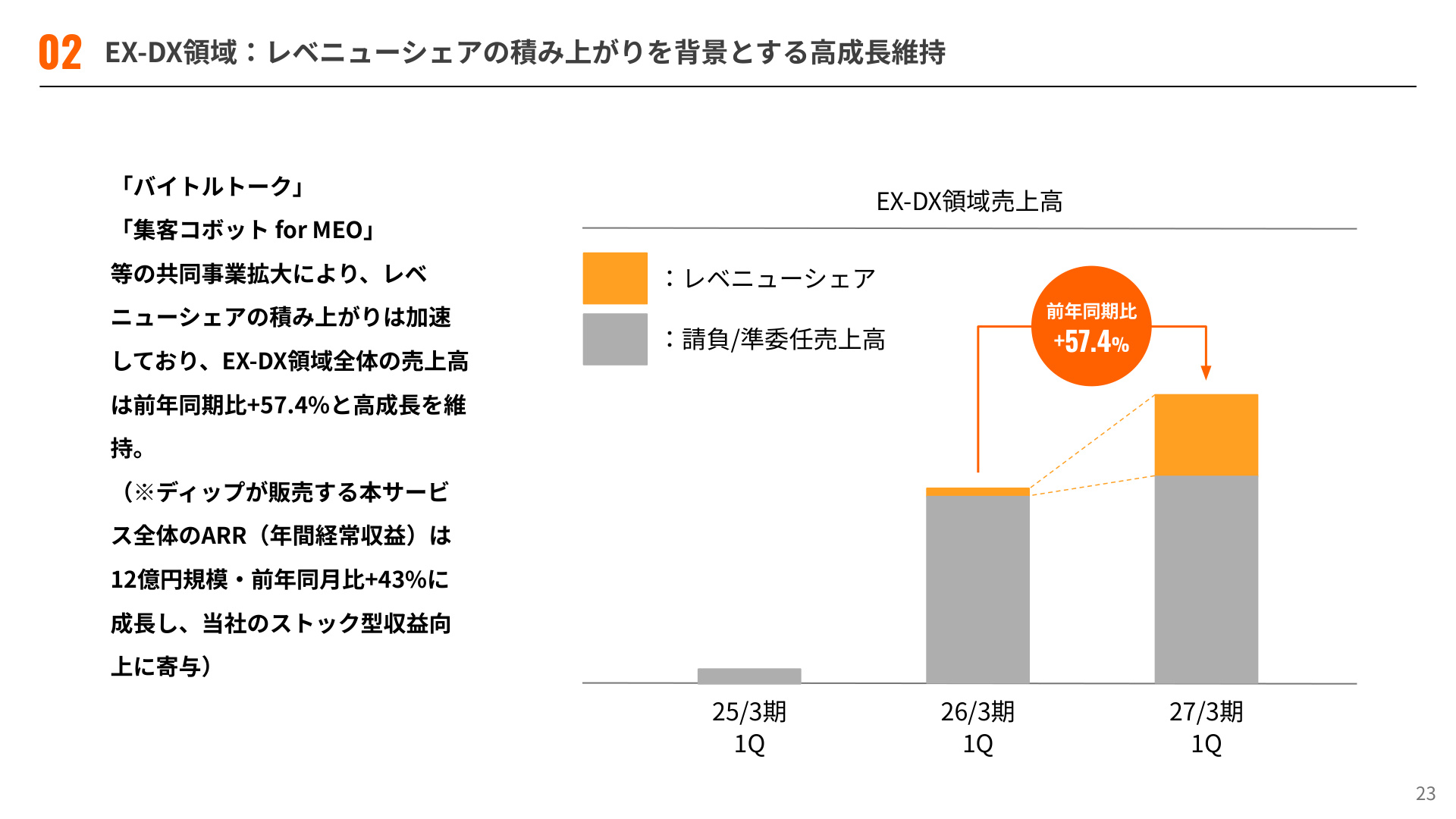
This slide (Page 22) provides key data proving that the company’s structural transformation (toward higher value-added and joint business models) is bearing fruit. Sales in the EX-DX sector recorded extremely high growth of +57.4% YoY . Revenue-sharing joint ventures, such as "Baitoru Talk" and "Shukyaku Kobot for MEO" promoted with partners like dip Corp., are steadily accumulating, marking a shift toward a revenue model that goes beyond simple contract development. The ARR (Annual Recurring Revenue) of services sold by dip has grown to the 1.2 billion yen scale (+43% YoY) , creating a mechanism that directly boosts iRidge’s own stock-based revenue.
Furthermore, notable qualitative and structural topics in Q1 include:
-
Establishment of In-house Development/Operation for "Shukyaku Kobot for MEO" : In May 2026, the company released a feature that uses generative AI to automatically generate review response drafts that capture a store's "uniqueness" for services co-developed with dip. This transition to an in-house development and operation structure enhances revenue-sharing efficiency.
-
Entry into Core System Domain for Business DX Support : The company acquired resale rights for "Oracle Fusion Cloud ERP." In addition to its traditional strengths in the front-end (apps and store touchpoints), it has begun providing end-to-end support from business consulting before requirements definition to core system renewal, winning projects with major domestic retailers.
-
New Business: Establishment of Orkextra AI, Inc. : In June 2026, the company established Orkextra AI, Inc. with a capital of 30 million yen. It provides an orchestration platform that leverages company-specific operations and knowledge to integrate various AI models via API. Equipped with Japan's first HITL (Human-in-the-Loop) control technology (patent pending) , it optimizes the "division of roles between AI and humans" based on risk, supporting safe and cost-effective enterprise AI implementation and operation.
5. Future Growth Strategy (Medium-Term Management Plan 2027) and Conclusion
iRidge is promoting its three-year medium-term management plan, " Tech & Innovation Partner ," ending in March 2027. The plan aims to deepen the company's role from an app development-centric firm to a partner that comprehensively supports customer business innovation.
The five pillars of the growth strategy are:
- Continuous growth of the App Business (Functional expansion of "APPBOX" and strengthening of app business production)
- Expansion into non-app DX areas (MaaS, EX-DX, Generative AI services)
- Entry into the Business Produce segment (Upstream support such as integrated marketing and consulting)
- Creation and acceleration of new businesses (Growth investments in "Co-Assign," "Orkextra AI," etc.)
- Strengthening strategic partnerships with client companies (Promoting alliances and capital/business tie-ups)
Conclusion
While the Q1 FY2027 earnings resulted in an adjusted operating loss of -85 million yen due to increased personnel costs from sales reinforcement and a temporary rise in the cost-of-sales ratio, this remains within the scope of seasonal characteristics skewed toward the second half and strategic growth investments. Meanwhile, on a solid foundation of +10.1% sales growth , maintenance of over 100 million MAU , and +12.0% growth in stock-based revenue , the EX-DX sector continues to grow explosively at +57.4% .
By linking front-end strengths with core systems (Oracle ERP) and implementing advanced AI control technology through Orkextra AI , the company is steadily evolving from a mere app development firm into a comprehensive DX and AI implementation partner . The focus moving forward will be on the recovery of earnings toward the second half and the further expansion of new businesses and domains.
This content is not intended as investment advice or a recommendation. Any opinions expressed are solely the personal views of each article.