


【LOIVE Q1 FY2027 Earnings Report】 Top-line Growth of Over 30% Driven by Massive Store Openings and the Full Scope of Strategic Investment for Future Profitability

StockClub
Published: Aug 07, 2026, 10:28 AM
Sentiment Analysis

1. Introduction: Overview of Financial Results and Key Summary
LOIVE Co., Ltd. (Securities Code: 352A) achieved significant growth in the first quarter (Q1) of the fiscal year ending March 2027, with net sales rising 32.0% year-on-year to 3.191 billion yen , marking a record-high quarterly revenue . While the company reported an operating loss of 225 million yen (compared to a 93 million yen loss in the same period last year), this was due to concentrated upfront investment costs associated with opening 36 new stores in Q1 alone —the fastest pace in company history—and hiring 375 new employees, including 214 new graduates . This progress is entirely in line with the company's internal plan.
Excluding the initial costs of new store openings, operating profit from existing stores has been steadily accumulating , driven by the expansion of the membership base and successful initiatives to increase customer lifetime value (LTV). This report provides a detailed analysis of the Q1 financial figures, the factors behind the results, the market dominance strategy for the Pilates business, and the growth trajectory leading into the next fiscal year (FY2028).
2. Earnings Highlights: Rapid Revenue Expansion and Strategic Upfront Investment
Key financial figures for Q1 FY2027 are as follows:
- Net Sales : 3,191 million yen ( +32.0% YoY / +773 million yen)
- Gross Profit : 1,015 million yen ( +36.8% YoY / +272 million yen)
- SG&A Expenses : 1,240 million yen ( +48.5% YoY / +405 million yen)
- Operating Profit : -225 million yen (Change of -132 million yen YoY)
- Ordinary Profit : -264 million yen (Change of -135 million yen YoY)
- Net Income Attributable to Owners of Parent : -93 million yen (Change of -1 million yen YoY)
The gross profit margin improved by 0.8 percentage points to 31.8% from 31.0% in the same period last year. Conversely, the SG&A expense ratio rose from 33.8% to 38.9% due to increased advertising, recruitment, and personnel costs associated with aggressive store expansion, leading to a wider operating loss. However, the progress rate against the first-half sales forecast reached 46.9% , which, considering the Q1-heavy nature of store openings, indicates that performance is proceeding exactly as anticipated.
3. Waterfall Analysis of Operating Profit and Existing Store Profitability
To understand the factors behind the Q1 operating loss and the company's underlying profitability, the operating profit waterfall analysis is critical.
[Slide Commentary: The Importance of PAGE 5]
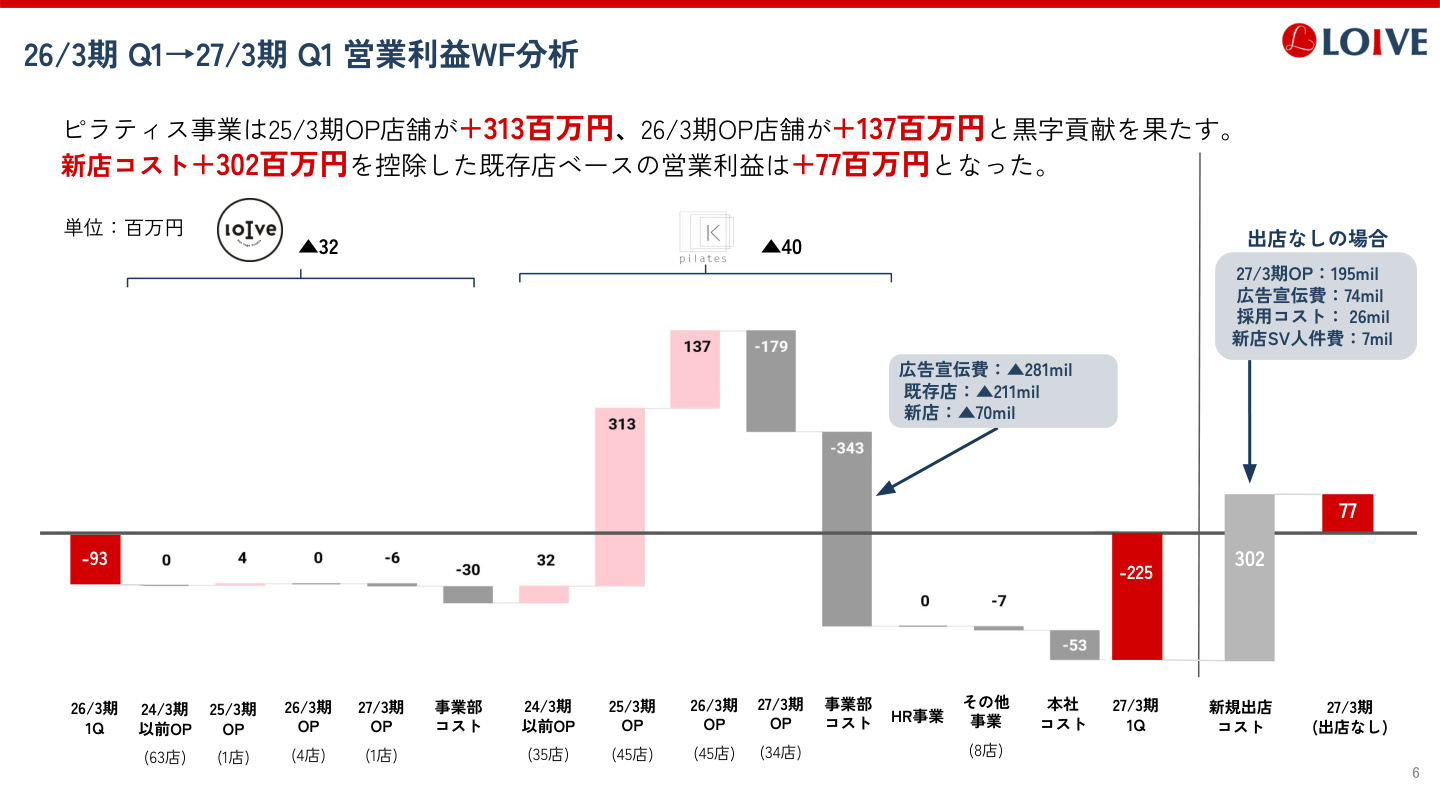
This slide visually breaks down the factors contributing to the change in operating profit from Q1 FY2026 to Q1 FY2027. While the operating loss appears to have widened from 93 million yen to 225 million yen, there is a clear structural reason for this.
- Strong Profit Contribution from Existing Stores : In the core Pilates business, stores opened before FY2025 contributed +313 million yen in profit, while stores opened in FY2026 contributed +137 million yen .
- Impact of New Store Costs : Direct costs and upfront investment expenses associated with new store openings in Q1 FY2027 totaled -302 million yen (including divisional advertising, recruitment costs, and supervisor personnel expenses for new stores).
- Underlying Profitability Excluding New Openings : If these new store costs (302 million yen) are excluded, the operating profit from existing stores stands at +77 million yen , representing a substantial underlying profit increase of 170 million yen compared to the same period last year (-93 million yen).
In short, the Q1 operating loss is not due to business deterioration but is the result of planned upfront investment to secure future revenue streams by launching new stores at a record pace.
4. Membership Trends and Segment Performance
In line with the expansion of the store network, the company's total membership base is growing steadily.
- Hot Yoga Business "loive" : Membership remains stable at 34,000 , serving as a solid foundation for the company's overall sales and profit.
- Pilates Business "pilates K" : Membership has surged alongside store expansion, reaching 53,000 at the end of Q1 FY2027.
Total company-wide stores now stand at 236 (69 hot yoga, 159 Pilates, 2 surf-fit, 3 women's gyms, and 3 senior-focused facilities), with the growth of pilates K serving as the primary driver.
5. Quarterly Performance Trends and Full-Year Outlook: Strategic Seasonality
The company's store opening schedule and operating profit trends exhibit clear strategic seasonality.
[Slide Commentary: The Importance of PAGE 11]
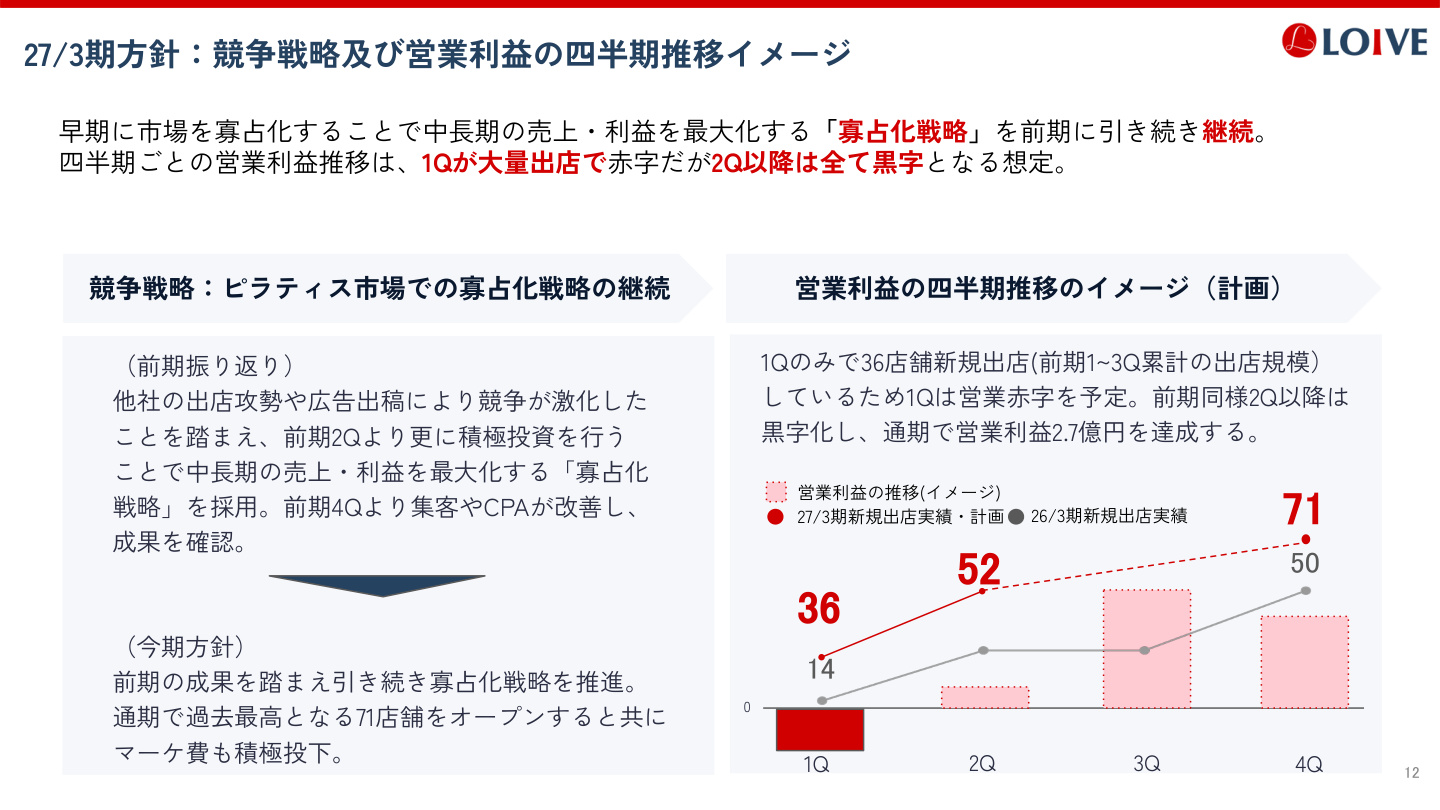
This slide illustrates the "Market Dominance Strategy" for FY2027 and the corresponding quarterly operating profit projection .
- Q1 Concentrated Openings and Profitability from Q2 Onward : To solidify its competitive advantage in the Pilates market, the company opened 36 stores in Q1—approximately half of its full-year target of 71 stores (a scale equivalent to the total openings from Q1 to Q3 of the previous year). Consequently, while Q1 shows an operating loss, the company plans to be profitable in Q2, Q3, and Q4 .
- Roadmap to Achieving Full-Year Forecasts : By completing store openings early, the company aims to accumulate members throughout the fiscal year and maximize profitability from Q2 onward. This structure supports the goal of achieving 14.57 billion yen in net sales (+27.6% YoY) and 270 million yen in operating profit for the full year.
6. Pilates Market Dominance Strategy and Priority Openings in Regional Cities
For the Pilates business (pilates K), the company is aggressively pursuing "preemptive openings in regional cities" in addition to the highly competitive metropolitan areas.
Of the 34 new stores opened in Q1, 24 were located in regional cities . While these areas are difficult for competitors to enter, they face less competition, leading to higher customer retention rates and potentially higher profit margins post-launch. The company is accelerating its "Market Dominance Strategy" to widen the gap in store count and capture market share rapidly.
This is supported by the company's unique talent development and recruitment competitiveness . By hiring instructors as full-time, direct employees and utilizing an education method that allows them to debut in just one month, the company maintains a high ratio of general staff capable of nationwide relocation ( 50.9% ; 603 out of 1,184 employees), enabling rapid, large-scale expansion into regional cities.
7. Improving Customer Acquisition Efficiency and LTV Initiatives
Significant results are also visible in marketing and customer lifetime value (LTV) initiatives.
- New Customer Acquisition and CPA Stabilization : Monthly customer acquisition in Q1 saw a high growth rate of +67% year-on-year. Meanwhile, as market heat has subsided, the Customer Acquisition Cost (CPA) has decreased and stabilized at 1.3x its year-on-year level, down from a peak of 3.6x, indicating improved efficiency.
- Expansion of Long-Term Contracts : The percentage of new contracts for long-term plans, which directly boosts LTV, rose to 62.9% (up from 55.8% in Q4 of the previous year). This has extended the average mandatory retention period to 9.6 months , contributing to lower churn rates and more stable recurring revenue.
- Growth in Merchandise Sales : Through the strengthening of original beauty products and protein sales, Q1 merchandise revenue grew significantly by +49% year-on-year to 174 million yen (accounting for 5.4% of total sales).
8. Mid-to-Long-Term Growth Roadmap: Strategic Positioning for FY2028
The most important perspective in evaluating the company's performance is that it has positioned the current fiscal year (FY2027) as an "investment phase for future profit explosion."
[Slide Commentary: The Importance of PAGE 9]
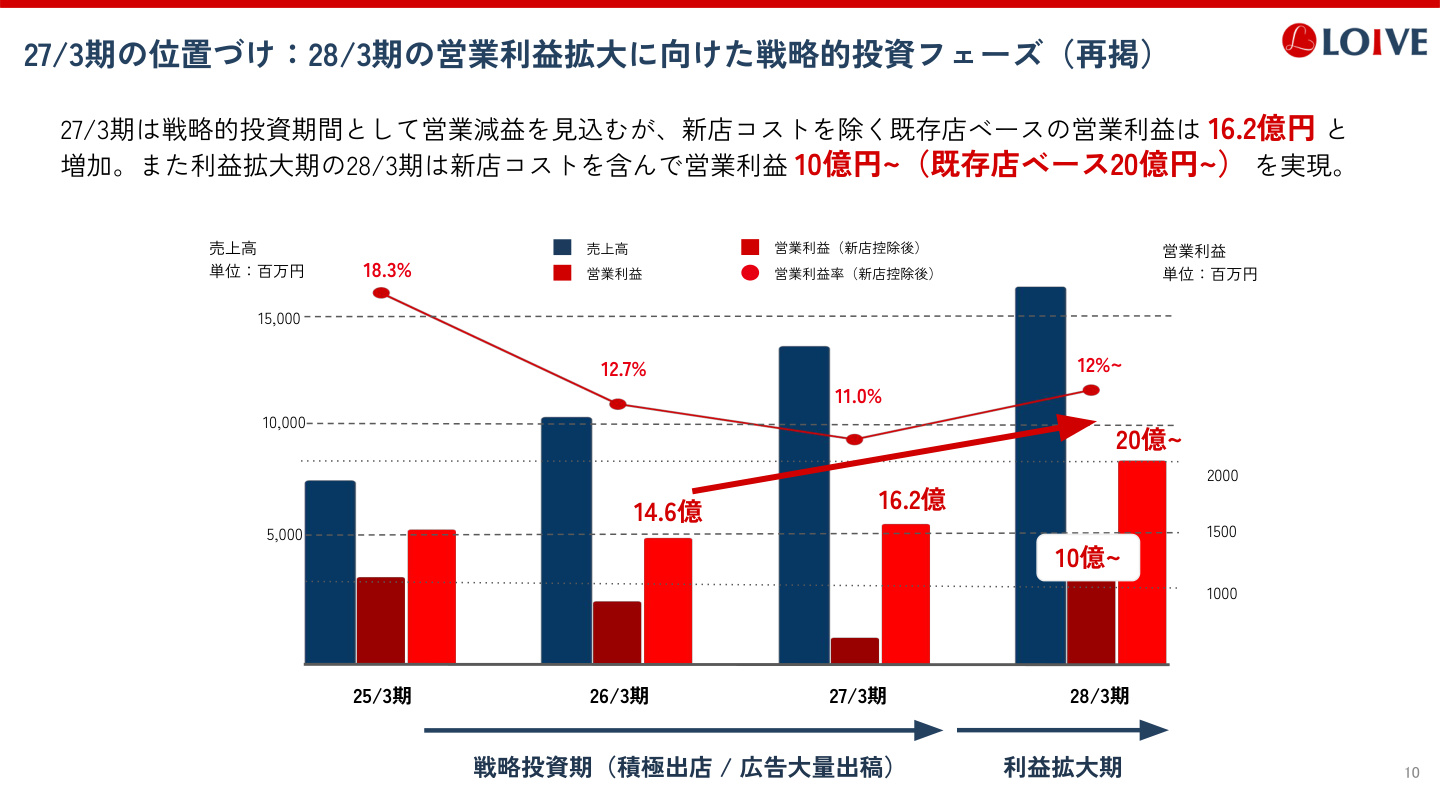
This slide is a crucial chart showing the trends in net sales and operating profit from FY2025 to FY2028 and the company's mid-to-long-term positioning.
- Positioning for This Fiscal Year (FY2027) : This is a "Strategic Investment Period" to complete market dominance. Due to massive store openings and advertising spend, the surface-level full-year operating profit is limited to 270 million yen. However, operating profit from existing stores, excluding new store costs, is expected to reach 1.62 billion yen .
- Profit Expansion Period (FY2028) : As the large number of stores invested in through FY2027 enter the profit-harvesting phase, the company plans for a dramatic leap in growth, targeting over 1 billion yen in operating profit (over 2 billion yen on an existing-store basis) in FY2028.
This roadmap clarifies that the current operating loss and projected profit decline are planned upfront investments for sustainable growth.
9. New HR Business and Business Model Advantages
The company is moving beyond studio operations to cultivate new growth axes and build highly efficient business models.
- Launch of New HR Business : The company has launched an HR business that deploys its internal female talent development know-how and purpose-management models to external clients. Q1 sales reached 7.4 million yen , with 123 client companies and 237 participants (57% of whom are executives). This is a high-margin model operated with zero direct advertising spend (relying on referrals and social media).
- Highly Efficient Boutique Model : By utilizing small-scale studios (65–80 tsubo) with a group-lesson format, initial investment is kept between 35–45 million yen. The gross profit margin at the store level is a high 43.1% , and the expected investment recovery period for pilates K is an excellent 2.8 years , demonstrating superior unit economics.
10. Conclusion and Future Focus Points
LOIVE's Q1 FY2027 earnings, while reflecting an upfront investment-driven operating loss due to concentrated Q1 store openings , showed extremely favorable and steady progress against the management plan , evidenced by over 30% top-line growth, steady accumulation of existing store profits, stabilized CPA, and improved long-term contract rates.
Key points to watch moving forward include:
- Achievement of Profitability from Q2 Onward : The ramp-up of the 36 stores opened in Q1 and the process of turning to an operating profit from Q2.
- Progress on the 71-store Annual Opening Target and Market Share Expansion in Regional Cities : Securing a competitive advantage in areas with fewer rivals.
- Accumulation of Existing Store Profitability toward the FY2028 Goal of Over 1 Billion Yen in Operating Profit : Continued success in LTV improvement initiatives.
Following this investment phase, the company's growth story and strategic execution capability as it heads toward a period of full-scale profit expansion next fiscal year remain the primary focus.
This content is not intended as investment advice or a recommendation. Any opinions expressed are solely the personal views of each article.