


Earnings Deep Dive: Global Link Management (3486) Q2 FY2026 Results, Second-Half Skewed Structure, and Mid-to-Long-Term Growth Strategy

StockClub
Published: Aug 07, 2026, 10:27 AM
Sentiment Analysis
This report provides a detailed analysis of the performance, business structure, and mid-to-long-term growth narrative of Global Link Management Inc. (Securities Code: 3486), based on their Q2 FY2026 earnings presentation materials.
1. Q2 Earnings Highlights and the Structural Context of "Second-Half Skewing"
For the first half (H1) of the fiscal year ending December 2026, the company reported net sales of 28.424 billion yen (down 20.3% YoY, 37.9% progress against the full-year plan), operating profit of 3.27 billion yen (down 27.8% YoY, 38.5% progress), ordinary profit of 2.691 billion yen (down 35.6% YoY, 35.9% progress), and net profit attributable to owners of the parent of 1.856 billion yen (down 34.3% YoY, 36.2% progress).
At first glance, these figures show a year-on-year decline in both revenue and profit, with progress against the full-year plan appearing low. However, this is driven by the company’s specific second-half skewed sales schedule and strategic value-add initiatives .
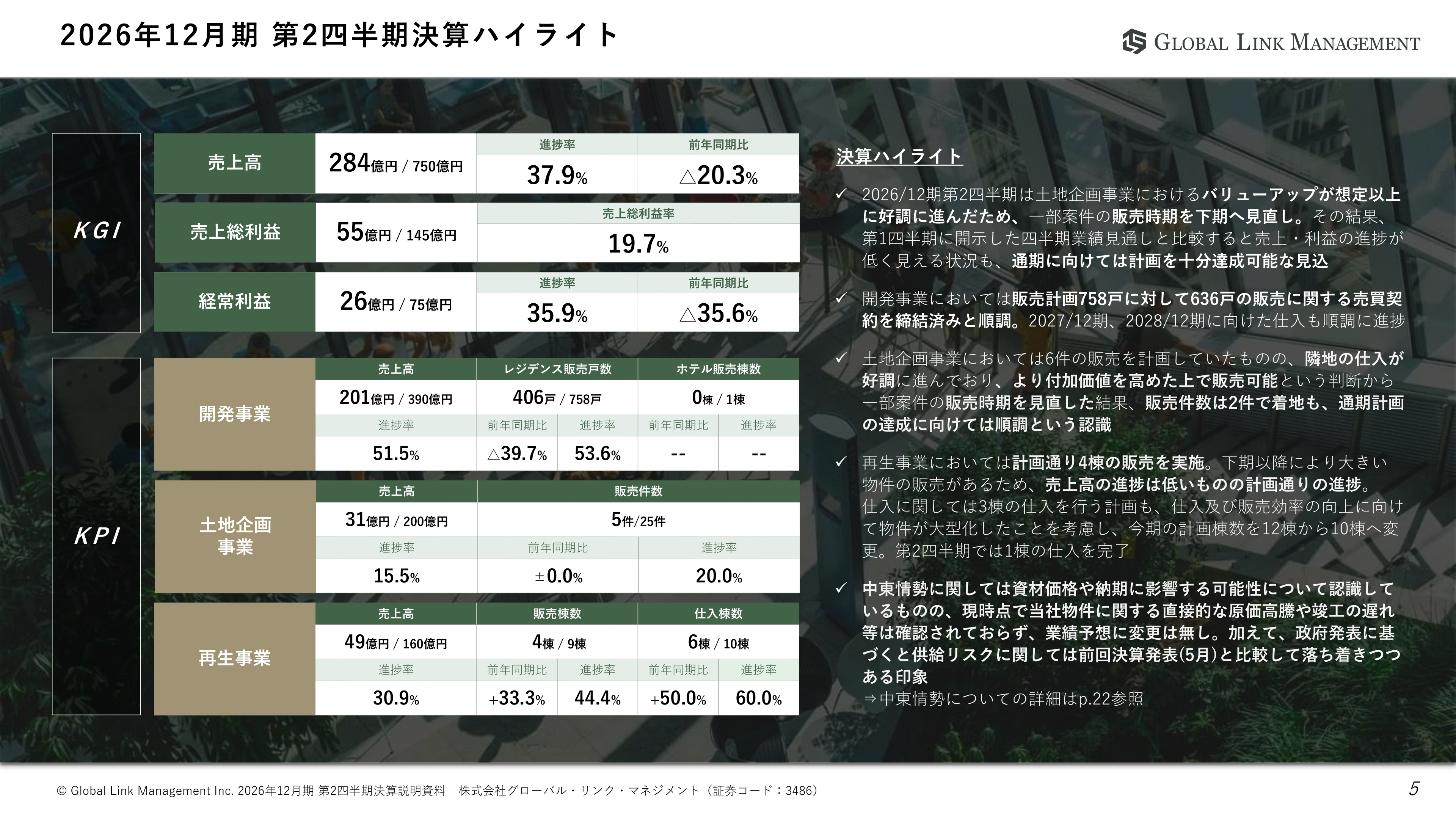
[Slide Commentary: Q2 Earnings Highlights (PAGE_4)]
This slide is a critical document that comprehensively illustrates the company-wide KGI (Key Goal Indicator) and KPI progress across the three main business segments (Development, Land Planning, and Revitalization). Unlike the previous fiscal year (Q2 FY2025), which was an irregular period where sales and profits were concentrated in the second quarter, the current period saw land planning projects progress more smoothly than anticipated . Consequently, the company opted to delay the settlement of certain properties to the third quarter and beyond (the second half) to further enhance property value through integrated development with adjacent land acquisitions. While this has resulted in lower superficial progress in the first half, the pipeline for achieving the full-year plan is being built with extreme consistency.
2. Progress of the Three Core Business Segments and Full-Year Achievement Probability
The company’s operations are built on three pillars: "Development," "Land Planning," and "Revitalization," each pursuing high profitability and growth.
① Development Business: Overwhelming Sales Contract Rate
Against a full-year residence sales plan of 758 units, the company has already signed sales contracts for 636 units (83.9%) as of the end of Q2. Furthermore, land acquisition for the fiscal year ending December 2027 (1,362 units already secured) and beyond is progressing steadily, establishing a solid foundation for future revenue.
② Land Planning Business: Strategic Shift to Maximize Value-Add
Land Planning is a high-efficiency business that generates short-term revenue through land rights adjustment, demolition, and planning. While the company initially planned to sell six projects in the first half, the success of additional adjacent land acquisitions led to a strategic shift from "standalone sales" to "higher value-add through integration." As a result, while sales in the first half were limited to two projects, significant profit contributions are expected in the second half.
③ Revitalization Business: Larger Property Scale and Value-Add Track Record
In the Revitalization business, which involves acquiring and renovating used properties for resale, the company completed the sale of four buildings in the first half as planned. Regarding acquisitions, the annual plan was adjusted from 12 to 10 buildings due to an increase in the scale of properties handled (larger floor area per building), which has significantly boosted profitability per unit. Past value-add performance shows an average rent increase of 31.2% at the time of sale , demonstrating deep expertise.
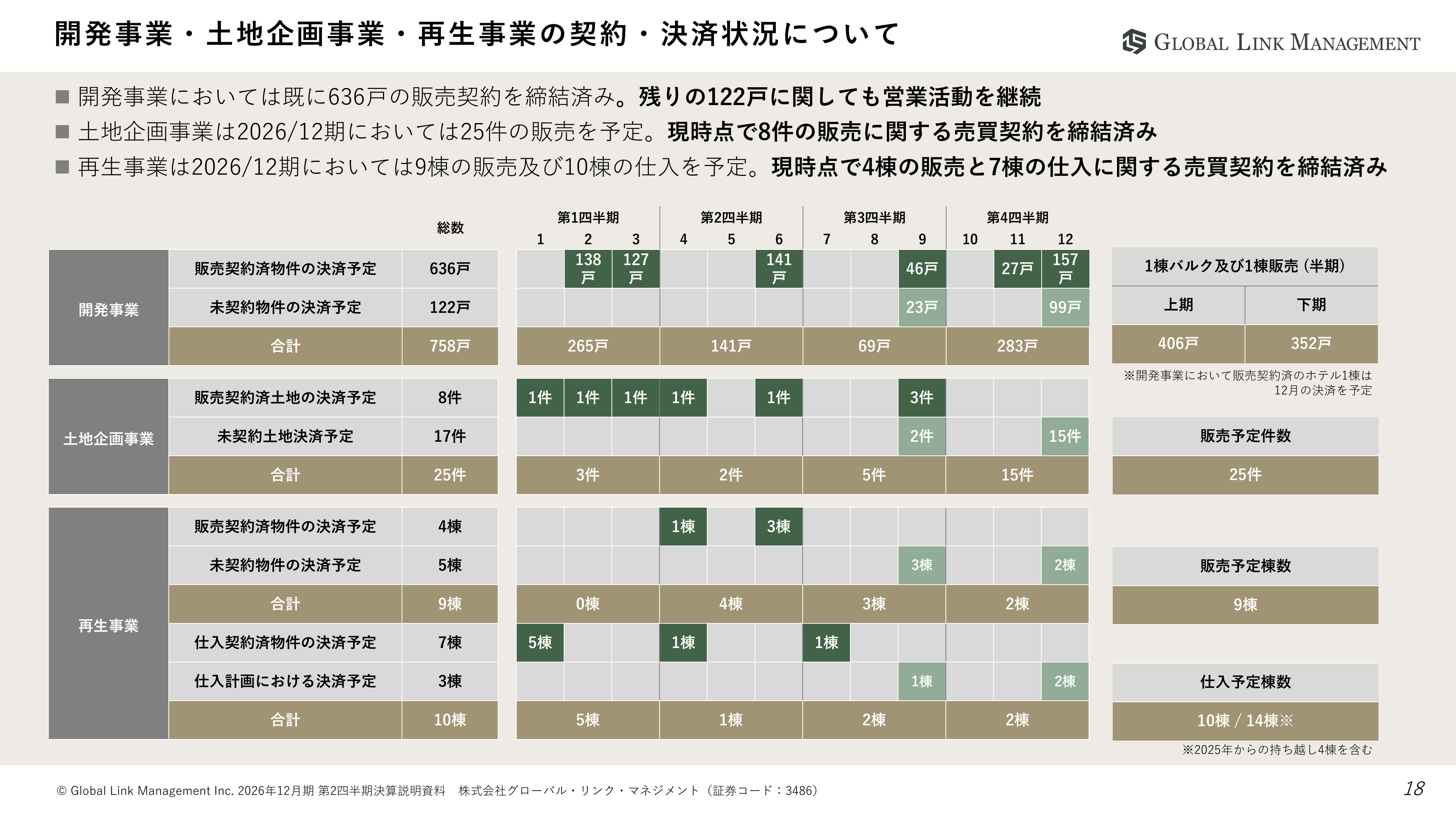
[Slide Commentary: Contract and Settlement Status by Business (PAGE_17)]
This slide provides the most definitive supporting data for why the full-year plan is achievable. It clearly outlines the quarterly settlement schedule (number of units/projects/buildings). It shows that settlements are concentrated in the fourth quarter: 283 units for the Development business (157 contracted, 126 uncontracted), 15 projects for the Land Planning business, and 3 buildings in Q3 and 2 in Q4 for the Revitalization business. This visualization of the second-half (particularly Q4) skewed settlement schedule , backed by secured acquisitions and contracts, is why management expresses strong confidence in their full-year earnings forecast.
3. Full-Year Forecast and Mid-to-Long-Term Growth Plans "GLM100" and "GLM1000"
Maintenance of Full-Year Earnings Forecast
The full-year consolidated earnings forecast for FY2026 remains unchanged from the initial plan, projecting net sales of 75 billion yen (up 8.3% YoY), operating profit of 8.5 billion yen (up 14.3% YoY), ordinary profit of 7.5 billion yen (up 11.3% YoY), and net profit of 5.13 billion yen (up 11.3% YoY), aiming for record-high profits .
Mid-Term Management Plan "GLM100" and 2040 Vision "GLM1000"
The company has set a long-term group goal of "GLM1000," aiming for 100 billion yen in ordinary profit by 2040 (a CAGR of 25% for ordinary profit). The first phase, the mid-term management plan "GLM100," targets 100 billion yen in sales and 10 billion yen in ordinary profit by the fiscal year ending December 2027. Having exceeded targets in the first year (FY2025), the company is steadily building the pipeline to achieve its FY2027 goals by maintaining its profit growth trajectory in FY2026.
4. Evolution of Business Structure through Full Subsidiary Acquisition of SAGL Advisors (GLCM)
On June 30, 2026, the company acquired additional shares of SAGL Advisors Co., Ltd., making it a wholly owned subsidiary and renaming it GL Capital Management Co., Ltd. (GLCM) .
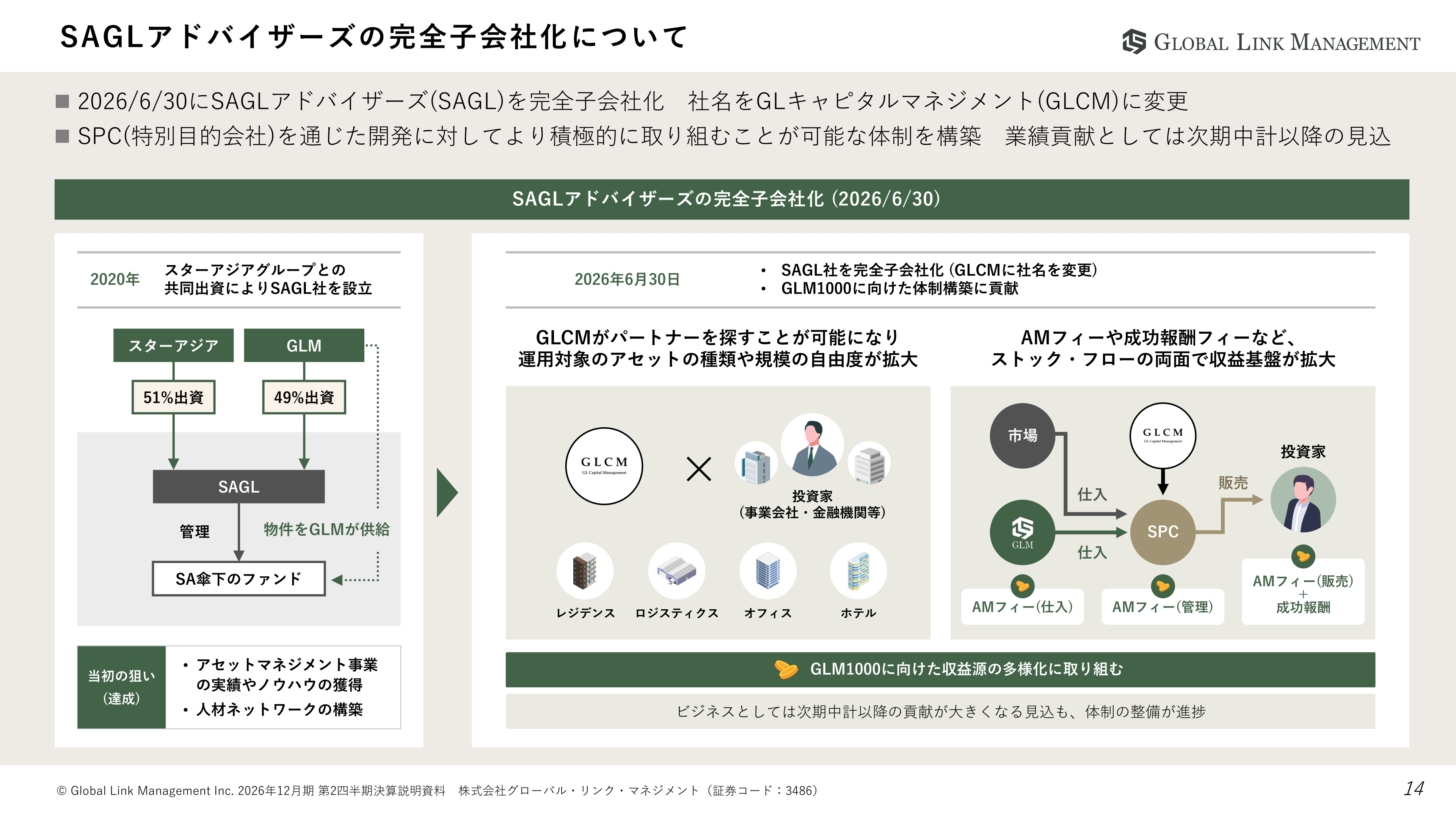
[Slide Commentary: Full Subsidiary Acquisition of SAGL Advisors (PAGE_13)]
This slide presents a strategic turning point showing the evolution of the company’s business model from "flow-oriented real estate development" to a "sustainable model that incorporates stock and fee businesses." By transitioning from a joint venture with the Star Asia Group to a wholly owned subsidiary, GLCM can now freely explore its own investment partners, dramatically expanding its range of assets (offices, hotels, logistics, etc.) and operational flexibility. This establishes a structure that generates not only direct sales gains (flow) from real estate development but also stable stock revenue through Asset Management (AM) fees and performance fees .
5. Adaptability to External Environment (Interest Rates, FX, Materials, Middle East Situation)
The company recognizes and addresses the following macro-environmental changes surrounding the real estate industry:
- Interest Rate Trends : Regarding the upward trend in Japanese long-term interest rates, the company believes the market has already priced in long-term rate hikes. Since rent increases are outpacing inflation, this has a positive impact on real estate prices. Furthermore, the company is mitigating interest rate risk by increasing the ratio of "Land Planning" and "Revitalization" businesses, which have shorter recovery periods from acquisition to settlement.
- FX and Overseas Investor Demand : With the yen remaining weak, demand from overseas institutional investors for Japanese real estate remains robust, providing a continuous tailwind.
- Construction Costs and Material Supply : While construction costs continue to rise due to labor shortages (the "2024 problem"), the supply of new residences is decreasing nationwide, leading to tighter supply-demand dynamics and maintaining pricing power. Regarding supply risks for chemical products and materials like paint and insulation due to the Middle East situation, the company analyzes, based on government and industry data, that "supply conditions are on a recovery and easing trend."
6. Human Capital Management and Proactive Shareholder Return Policy
Human Capital Management and Share-Buybacks
The company places extreme importance on "improving productivity per employee." On August 7, 2026, it announced a share buyback totaling 300 million yen (180,000 shares) . These shares will be used for stock-based compensation (restricted stock) for management and managers, creating an incentive structure that enhances employee entrepreneurial mindset while minimizing dilution. As a result, sales per employee have surged approximately 2.2 times (520 million yen) over the past five years, and ordinary profit per employee has increased approximately 6.7 times (53.86 million yen) , achieving a very high retention rate with a turnover rate of 7.9% compared to the industry average of 13.8%.
Dividend Policy (Progressive Dividends and 30% Payout Ratio)
Regarding shareholder returns, the company maintains a basic policy of a "30% dividend payout ratio and progressive dividends." The annual dividend per share for FY2026 is planned at 100.0 yen (an increase from 80.5 yen in the previous year), maintaining a high return level with a dividend yield of 5.2% (based on the share price of 1,918 yen as of August 6, 2026).
Furthermore, as it advances corporate value, the company is managing with an eye toward future new inclusion in the TOPIX (targeting a free-float market capitalization of 60 billion yen) .
7. Conclusion
While Global Link Management’s Q2 FY2026 earnings may appear to have low progress on paper, the reality is a strategic process driven by the upsizing and value-enhancement of the Land Planning business through adjacent land acquisitions and a second-half-concentrated settlement schedule .
With contract progress in the Development business exceeding 80%, and the expansion of the asset management domain through the full acquisition of GLCM and the scaling of the Revitalization business, the groundwork for achieving the mid-term management plan "GLM100" and the 2040 goal "GLM1000" is being laid in a highly logical and steady manner.
This content is not intended as investment advice or a recommendation. Any opinions expressed are solely the personal views of each article.