


Okamura Oil & Fat Co., Ltd. Earnings Deep Dive Report: Achieving Record-High Performance and Growth Strategy for FY2027

StockClub
Published: Aug 07, 2026, 10:18 AM
Sentiment Analysis

Based on the earnings supplementary materials of Okamura Oil & Fat Co., Ltd. (Securities Code: 2938), this report provides a comprehensive analysis of the company's performance summary, segment-specific trends, progress on key growth drivers, and future business plans and growth strategies.
1. Executive Summary
Okamura Oil & Fat delivered a robust financial performance for the full fiscal year, achieving record-high results in both net sales and operating profit. The company's performance was strongly driven by the expansion of Japanese food and sushi demand, primarily in Asia, within its core "Overseas Wholesale Business," as well as successful raw material procurement and price pass-through strategies in the "Domestic Processing Business."
On the other hand, regarding the domestic aquaculture volume , one of the group's most critical KPIs, the results fell short of the initial plan due to a combination of factors, including disease and human error during intermediate aquaculture, and delayed growth in sea-surface aquaculture. However, structural countermeasures to address these issues (such as the construction and operation of in-house intermediate aquaculture facilities) are already underway, and a recovery framework is in place for the next fiscal year.
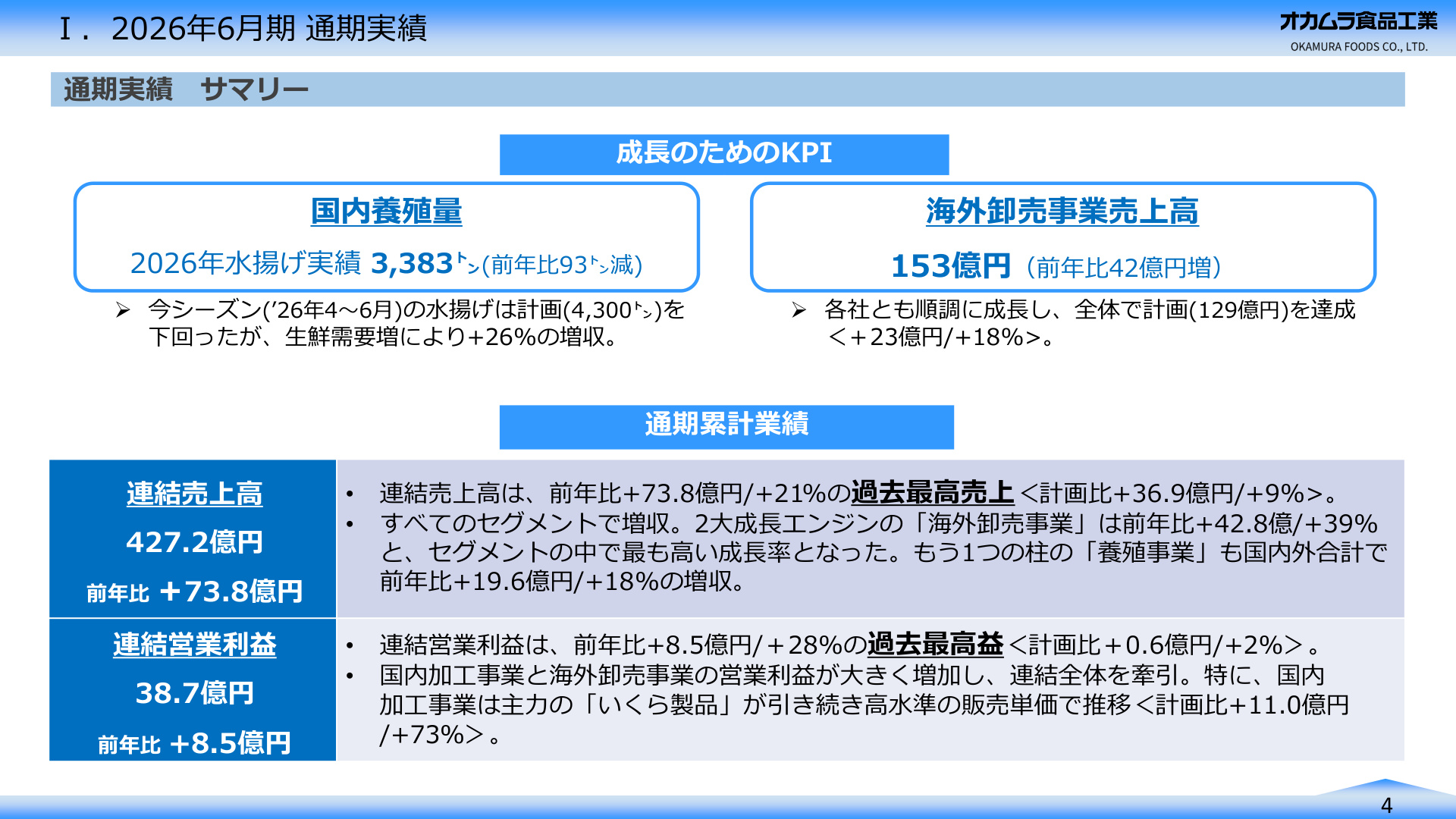
The slide above is crucial as it provides an at-a-glance view of the company's full-year performance highlights and progress on key KPIs. The achievement of consolidated net sales of 42.72 billion yen (+21.0% YoY) and consolidated operating profit of 3.87 billion yen (+28.2% YoY) —both record highs—can be attributed to the significant growth of the Overseas Wholesale Business, which reached 15.3 billion yen (+38.8% YoY) , and a dramatic increase in profits from the Domestic Processing Business.
2. Structural Analysis of FY2026 Consolidated Performance
The full-year results by major item are as follows:
- Net Sales : 42,726 million yen (+7,380 million yen / +20.9% YoY )
- Gross Profit : 9,370 million yen (+1,975 million yen / +26.7% YoY )
- Operating Profit : 3,873 million yen (+851 million yen / +28.2% YoY )
- Ordinary Profit : 4,056 million yen (+1,240 million yen / +44.1% YoY )
- Net Income Attributable to Owners of Parent : 2,782 million yen (+762 million yen / +37.7% YoY )
Factors contributing to the increase in net sales included the impact of foreign exchange translation (+2.497 billion yen) and substantial growth in actual business operations (+4.882 billion yen). Regarding profits, although selling, general, and administrative expenses such as personnel costs and storage fees increased (-1.176 billion yen), this was more than offset by profit growth from increased sales (+1.471 billion yen) and an improved gross profit margin resulting from a higher composition ratio of the high-margin Domestic Processing Business (+0.411 billion yen), leading to a significant increase in operating profit.
3. Detailed Segment Trends and Profit Drivers
Performance trends varied across business segments.
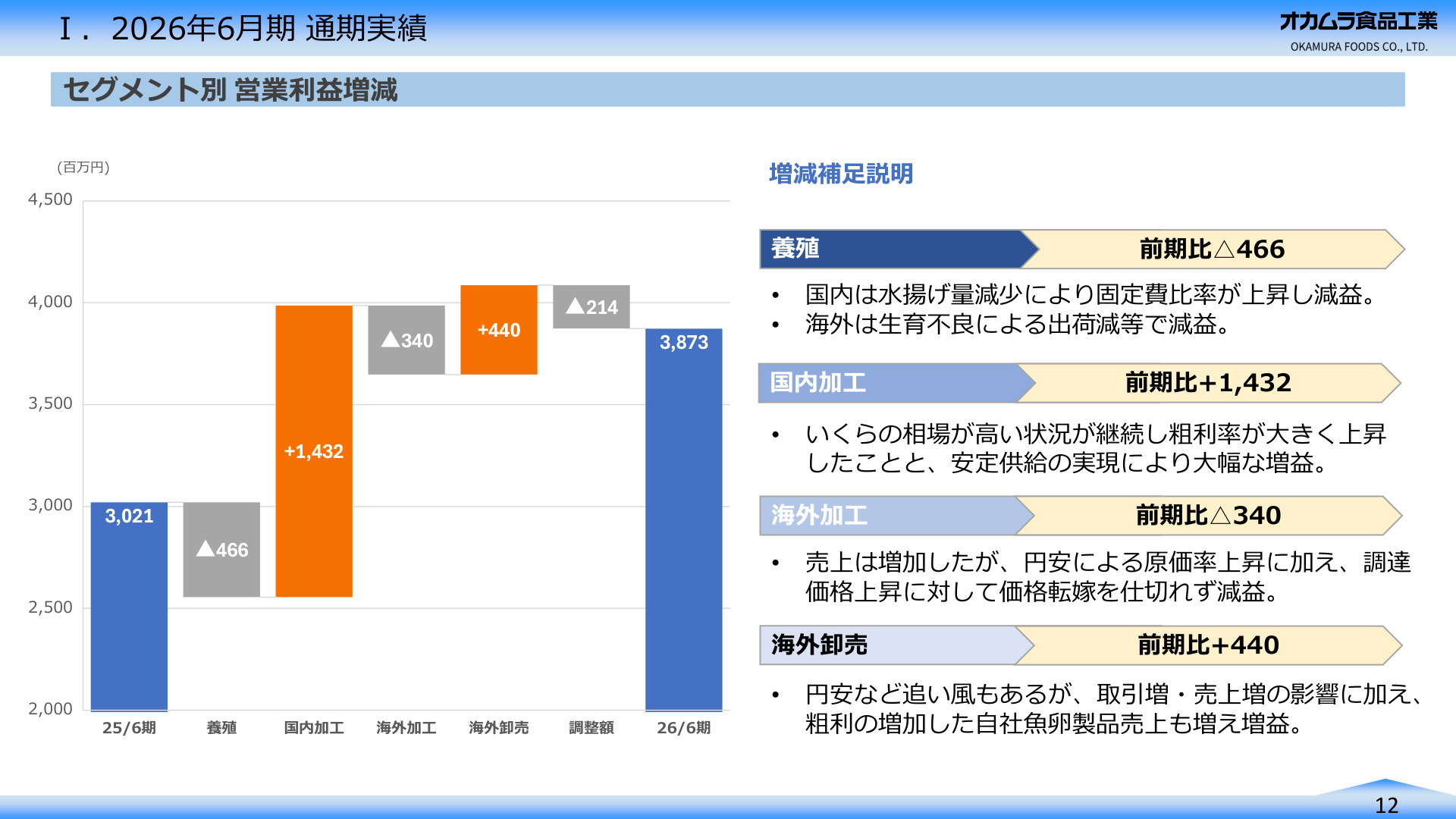
This slide clearly illustrates which segments contributed to the company-wide operating profit growth and which segments are facing challenges.
Key Points by Segment
-
Domestic Processing Business (Driver of Significant Profit Growth)
- Net Sales : 12,767 million yen ( +35.8% YoY )
- Segment Profit : 2,610 million yen ( +121.7% YoY )
- Factors : Amid rising domestic raw material and sales prices due to poor autumn salmon catches, the company maintained stable supply by leveraging sufficient inventory, including fish roe procured from its Danish aquaculture subsidiary. Gross profit margins improved significantly through appropriate price pass-through and revisions to contract unit prices.
-
Overseas Wholesale Business (Continued High Growth)
- Net Sales : 15,328 million yen ( +38.8% YoY )
- Segment Profit : 1,044 million yen ( +72.9% YoY )
- Factors : Against the backdrop of an increasing number of Japanese restaurants in East and Southeast Asia, the company strengthened sales activities tailored to local trends and needs. The maintenance of price competitiveness for Japanese products due to the weak yen and increased sales of in-house fish roe products led to improved profit margins.
-
Aquaculture Business (Temporary Profit Decline)
- Net Sales : 10,952 million yen ( +18.3% YoY )
- Segment Profit : 772 million yen ( -37.7% YoY )
- Factors : Although unit prices rose due to increased demand for fresh fish in Japan, the fixed cost ratio increased due to a decline in harvest volume. Overseas, cost of sales worsened due to poor growth at sea-surface aquaculture sites and a sluggish salmon market.
-
Overseas Processing Business (Lower Profit Margins)
- Net Sales : 15,457 million yen ( +9.7% YoY )
- Segment Profit : 700 million yen ( -32.7% YoY )
- Factors : While sales expanded, the company could not fully pass on the impact of the weak yen and soaring raw material costs to sales prices, resulting in a decline in gross profit margins.
4. Progress on Growth Drivers and Countermeasures
The status of the two key KPIs identified as the core of the company's mid-to-long-term growth is as follows:
(1) Expansion of Domestic Aquaculture Volume
Domestic aquaculture production for the season was 3,383 tons (compared to 3,476 tons in the previous year), falling 917 tons short of the initial plan (4,300 tons). The primary factors are as follows:
- Intermediate Aquaculture Factors (-400 tons) : Outbreak of cold-water disease at outsourced intermediate aquaculture sites and a decrease in fish count due to human error during transport.
- Sea-Surface Aquaculture Factors (-240 tons) : Suspension of feeding due to bacterial (Vibrio) infection and delayed growth.
- Fresh Demand Factors (-280 tons) : Early harvesting to meet demand for fresh salmon (shortening of the rearing period).
In response, the company is implementing specific improvements, such as the start of operations at its own intermediate aquaculture facility (Tomarikawa Intermediate Aquaculture Site), strengthening of sorting systems, and trial vaccinations with European vaccines, to resolve these one-time bottlenecks.
(2) Expansion of Overseas Wholesale Sales
Over the past five years, the Overseas Wholesale Business has achieved remarkable growth, with sales volume increasing more than fourfold . The company is capturing the trend of expanding Japanese restaurant numbers in Asia (approximately 112,000 stores as of 2025) and is expanding its market share by leveraging its region-specific sales network.
5. Financial Structure and Cash Flow Trends
- Total Assets : 60,639 million yen ( +19,368 million yen from the end of the previous year)
- The main factors were an increase in inventories (+12,607 million yen) due to strengthened raw material procurement in the Domestic Processing Business to cope with poor autumn salmon catches, and an increase in property, plant, and equipment (+2,376 million yen) due to investments in aquaculture facilities.
- Operating Cash Flow : -8,264 million yen
- While profit generation (profit before income taxes of 4,096 million yen) was steady, the accumulation of inventory for sales in the next fiscal year and beyond (-11,725 million yen) acted as a drag on cash flow.
- Investing Cash Flow : -3,709 million yen
- The company made active capital investments to expand future aquaculture volume, such as the construction of the Tomarikawa Intermediate Aquaculture Site and the acquisition of overseas land-based aquaculture sites.
These funding requirements were met flexibly through the procurement of long- and short-term loans (Financing CF +12,628 million yen ).
6. FY2027 Full-Year Plan and Growth Strategy
The company has formulated a plan for double-digit growth in sales and operating profit for the next fiscal year (ending June 2027).
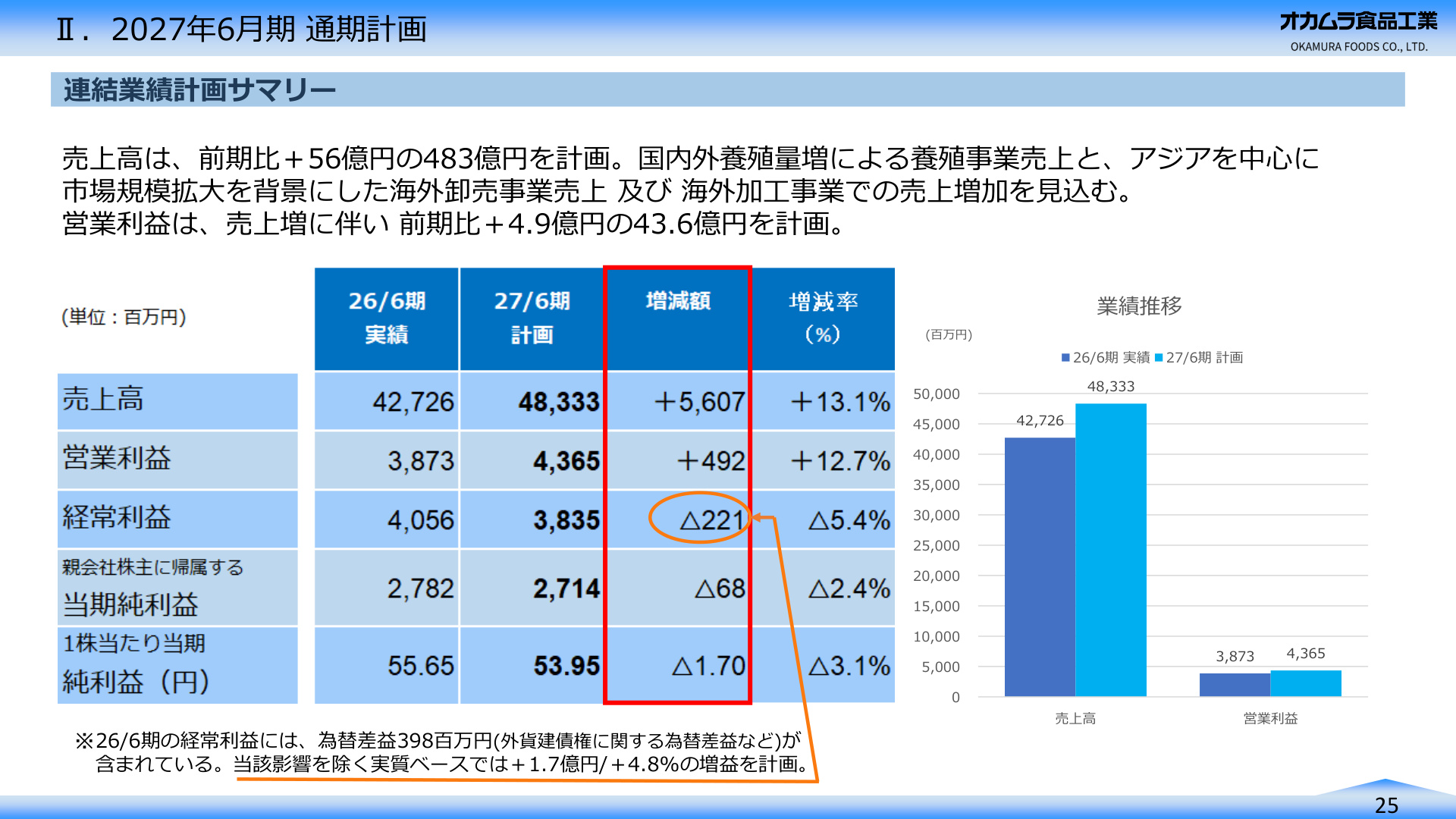
This planning slide is a key indicator of the company's intention to continue its growth trajectory. It projects net sales of 48,333 million yen (+13.1% YoY) and operating profit of 4,365 million yen (+12.7% YoY) . Even on an ordinary profit basis (-5.4%), which is affected by the completion of foreign exchange gains, the plan targets a +4.8% increase in profit on a real basis (excluding foreign exchange impacts).
Key Strategies for FY2027
- Achieving a 5,000-ton Domestic Aquaculture System
- The company plans to reach a domestic aquaculture volume of 5,000 tons , an increase of 1,617 tons YoY , through the full-scale operation of the new in-house intermediate aquaculture site (Tomarikawa) and strengthened cooperation with fisheries cooperatives.
- Strengthening Cooperation between Overseas Wholesale and Overseas Processing
- The company will promote the sale of high-value-added products in European and Asian markets by establishing a new Dutch subsidiary and strengthening the foundation of existing bases.
7. Shareholder Return Policy
The company maintains a policy of "striving for continuous dividend increases with a target dividend on equity (DOE) ratio of 2% or higher."
- FY2026 Results : Annual dividend of 8.00 yen per share (Interim 4.00 yen / Year-end 4.00 yen)
- FY2027 Plan : Planned annual dividend of 9.00 yen per share (Interim 4.00 yen / Year-end 5.00 yen), an increase of 1.00 yen .
In addition, the shareholder benefit program (for shareholders holding 100 shares or more), which presents group products (aquaculture and processed foods), will continue to be implemented to enhance shareholder appeal and strengthen brand awareness.
This content is not intended as investment advice or a recommendation. Any opinions expressed are solely the personal views of each article.