

![[Rigaku Holdings] FY26 2Q/1H Earnings Deep Dive: Rapid Growth in Semiconductor Metrology and Growth Strategy for 2H Performance Rebound](https://news-images.stock-club.net/market_news/images/268A/140120260807515240/slide_eyecatch_en_bfdcdd4e.webp)
[Rigaku Holdings] FY26 2Q/1H Earnings Deep Dive: Rapid Growth in Semiconductor Metrology and Growth Strategy for 2H Performance Rebound

StockClub
Published: Aug 07, 2026, 10:13 AM
Sentiment Analysis

1. Executive Summary: Earnings Overview and Growth Trajectory
The FY26 2Q/1H (six months ended June 2026) financial results for Rigaku Holdings (Ticker: 268A) represent a critical turning point in the company's quarterly earnings volatility.
Following a transitional first quarter (1Q), revenue in the second quarter (2Q) reached ¥21.6 billion (+7.4% YoY) , signaling a strong recovery trajectory. On a 1H cumulative basis, revenue stood at ¥39.5 billion (-2.9% YoY) with an operating profit of ¥2.5 billion (-54.9% YoY) . This decline was primarily driven by upfront investments (strengthening R&D and global headcount) to capture growth opportunities, alongside a delayed recovery in the academic market.
Conversely, the core Semiconductor Process Control Instruments segment recorded rapid expansion, with 2Q revenue reaching ¥7.4 billion (+60.0% YoY) and operating profit hitting ¥1.4 billion (+69.4% YoY) . Furthermore, company-wide 2Q orders showed strong growth exceeding 50% YoY , and the full-year guidance (revenue of ¥101.0 billion , operating profit of ¥194 billion ) remains unchanged. This indicates that preparations for large-scale revenue recognition and margin improvement in the second half (2H) are progressing as planned.
2. Quarterly Performance Trends and Order Momentum
Understanding the seasonality of product deliveries and the existence of transitional periods is essential to grasping the company's quarterly earnings structure.
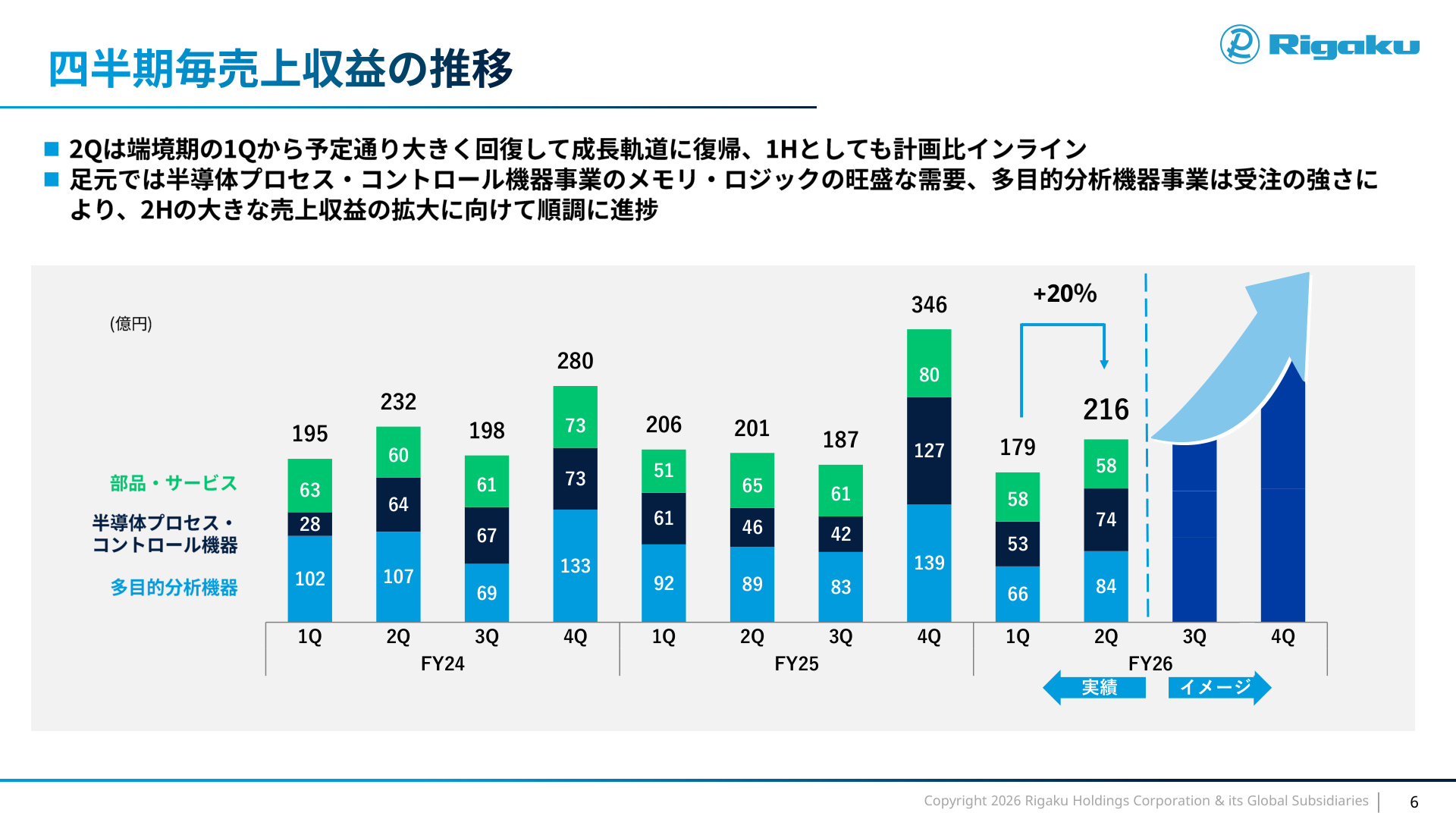
Why Slide 5 is Important
This slide provides clear data on the quarterly progression of the company's revenue. It visually demonstrates the ~20% sharp recovery from ¥17.9 billion in 1Q to ¥21.6 billion in 2Q. As seen in historical trends from FY24 and FY25, the company's earnings are structurally weighted toward the second half (particularly 4Q). This chart confirms that 1H progress is in line with the plan and that the significant expansion projected for 2H is not merely a target, but follows established historical patterns.
Regarding 2Q order trends, the company recorded extremely strong growth of over 50% YoY across the board. The pipeline (backlog and prospective projects) also showed growth of over 35% YoY , confirming that current demand momentum remains exceptionally robust.
3. Performance Dynamics by Category
The company's business is divided into three main categories, each showing a clear contrast in market environment and performance.
(1) Multipurpose Analytical Instruments
- 2Q Performance : Revenue ¥8.4 billion (-6.1% YoY) , Operating Profit ¥0.3 billion (-77.3% YoY)
- Environment/Background : Demand from academia and government sectors has remained sluggish due to policy impacts in the U.S. and other regions since last year.
- Current Signs : To offset academic stagnation, the company shifted focus toward industrial applications. As a result, 2Q orders showed signs of a rapid bottoming out and reversal, with growth of over 20% in Japan and over 50% in the Americas . Given the time lag between orders and revenue recognition, this is expected to contribute to significant revenue growth from 2H onwards.
(2) Semiconductor Process Control Instruments
- 2Q Performance : Revenue ¥7.4 billion (+60.0% YoY) , Operating Profit ¥1.4 billion (+69.4% YoY) , Operating Margin 18.9%
- Environment/Background : Strong tailwinds from memory production increases, including AI-related demand, and a recovery in demand from North American IDMs (Integrated Device Manufacturers).
- Product/Customer Progress : Products for advanced logic, foundries, and memory saw significant growth. The JEP (Joint Evaluation Program) , where equipment is installed and evaluated at customer sites, is progressing well, setting the stage for full-scale revenue from new products in the second half.
(3) Components & Services
- 2Q Performance : Revenue ¥5.8 billion (-11.3% YoY) , Operating Profit ¥0.6 billion (-60.1% YoY)
- Environment/Background : While the segment saw a decline due to the 2H shift in equipment shipments and installations, the service business alone secured an 11% revenue increase , demonstrating the effectiveness of price hikes and sales expansion measures.
4. Analysis of Operating Profit Factors and Strategic Investment Balance
The consolidated operating margin for FY26 2Q was 9.0% , a 5.3-point decline from 14.3% in the same period last year. It is crucial to determine whether this decline is a structural change in profitability or intentional upfront investment.
- Gross Margin : Despite downward pressure from rising raw material costs, this was offset by price increases and an improved product/customer mix, keeping the margin nearly flat ( -0.2pt ) YoY.
- SG&A Expenses (-5.1pt pressure) : The primary cause of the margin decline is an increase in SG&A expenses. Specifically, this is due to global talent acquisition and personnel costs (-3.5pt) associated with the rapid scaling of the semiconductor business, as well as planned overseas growth investments.
For the full year, the scenario is that as revenue scales significantly in 2H, these fixed strategic investment ratios will dilute , and the full-year operating margin will flatten and converge toward the high levels originally planned.
5. Technical Superiority and Market Roadmap for Semiconductor Process Control Instruments
The primary driver of the company's long-term value is its market share and technological innovation in metrology for advanced semiconductor manufacturing.
Rigaku maintains the #1 global market share in the X-ray Metrology market and the broader thin-film and composition measurement market. As advanced semiconductor manufacturing processes become 3D (GAA/CFET, 3D NAND, CoWoS, and other advanced packaging), reliance on the company's X-ray technology—which can accurately measure internal structures and ultra-thin films non-destructively—is increasing.
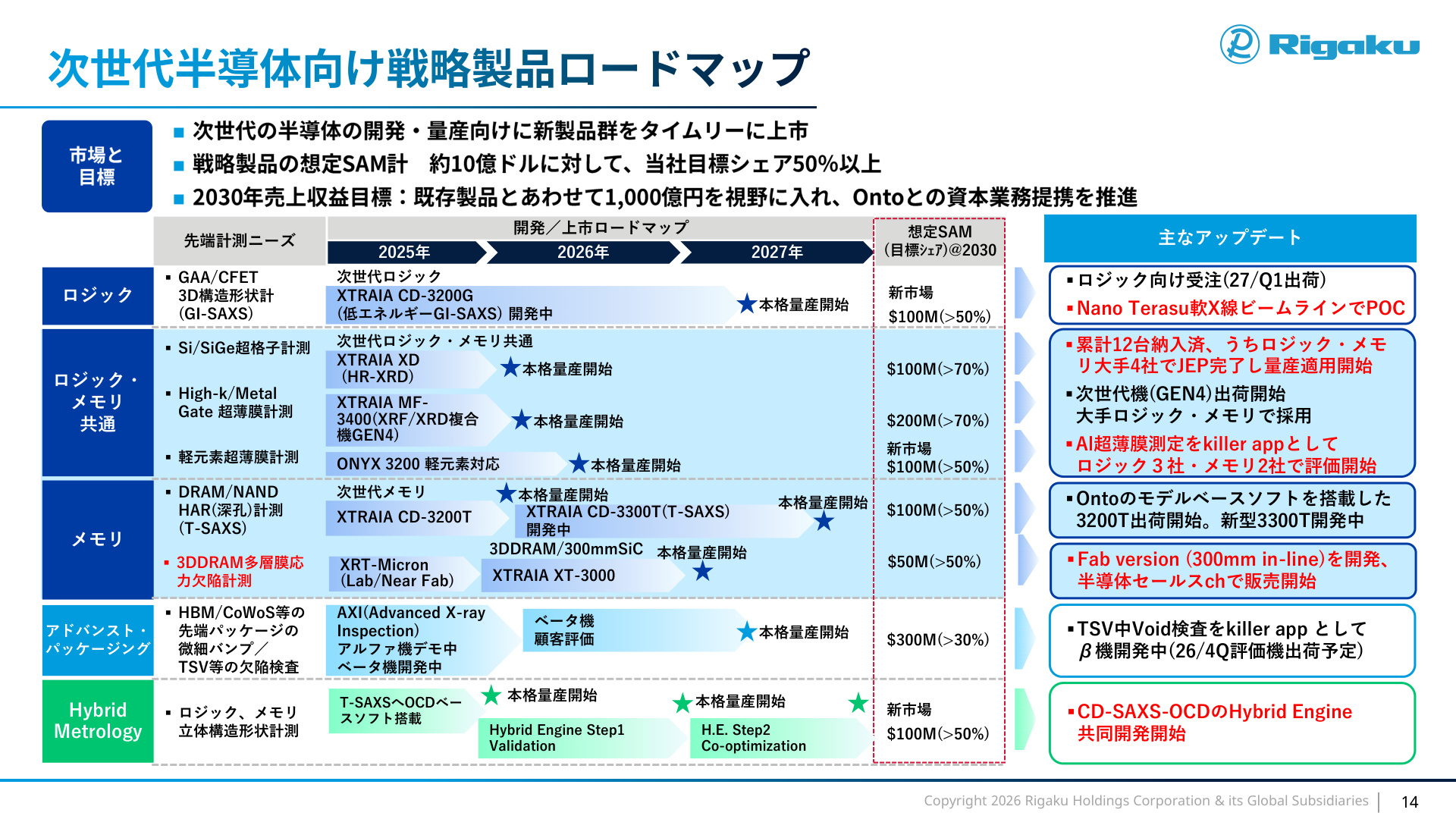
Why Slide 13 is Important
This slide provides an overview of the "Strategic Product Roadmap" showing how the company will capture the semiconductor market toward 2030. It highlights that for each cutting-edge node—Logic (e.g., XTRAIA CD-3200G for GAA/CFET), Memory (e.g., XTRAIA CD-3200T for 3D DRAM/3D NAND), and Advanced Packaging (e.g., AXI for TSV defect inspection)—the target SAM (Serviceable Available Market) reaches a total of approximately $1 billion , with a target share of over 50% . It is an essential slide that contains the rationale for the growth story of reaching ¥100 billion in revenue for the semiconductor PC business by 2030, supported by the promotion of Hybrid Metrology through the capital and business alliance with Onto Innovation.
To accompany customers in advanced process development from the early stages, the company plans to open a Global RTC (Rigaku Technology Center) in China (Shanghai) within FY2026, following those in Silicon Valley and Taiwan, to accelerate demo evaluations and application support.
6. Full-Year Outlook and 2H Recovery Story
The company has maintained its full-year FY26 consolidated earnings forecast as originally announced.
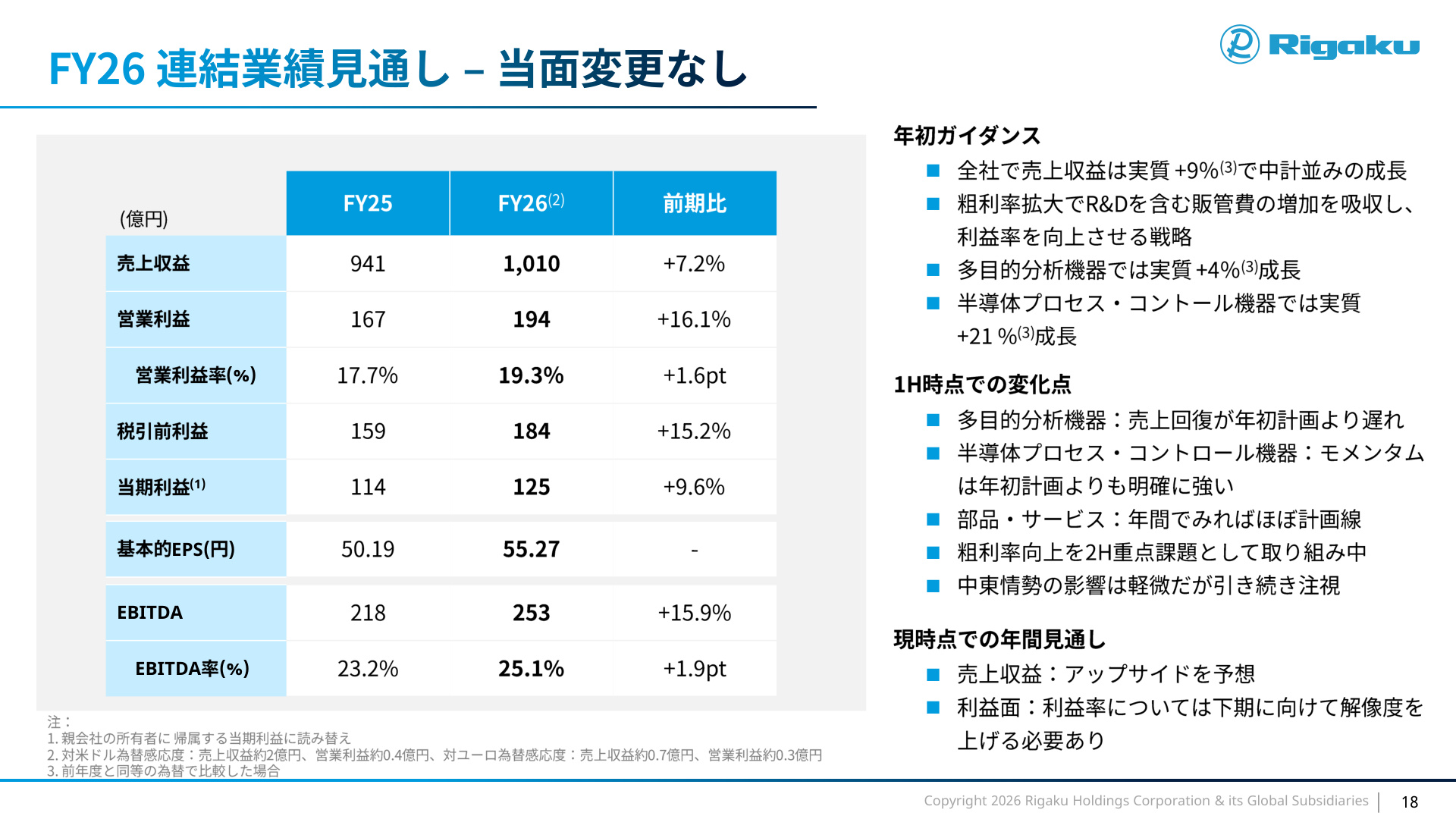
Why Slide 17 is Important
This slide summarizes the background for maintaining the full-year forecast at the end of 1H and the confidence in achieving it. It clearly presents a scenario of increased revenue and profit, with a full-year target of ¥101.0 billion in revenue (+7.2% YoY) , ¥19.4 billion in operating profit (+16.1% YoY) , and an operating margin of 19.3% (+1.6pt improvement) . It reconciles the reality of the "delayed recovery in multipurpose analytical instruments" with the "strong momentum in semiconductor equipment," and outlines the drivers for 2H: "margin improvement measures (price hikes, concentrated shipments of high-margin new products, and revenue recognition from JEP projects)."
Key Focus Areas for 2H
- Revenue Recognition from JEP (Joint Evaluation Program) : The contribution from new products and JEP-related sales, which was approximately ¥4 billion in 1H, is expected to expand rapidly to approximately ¥10 billion in 2H .
- Reflection of Multipurpose Analytical Instrument Orders : Industrial orders in Japan and the Americas, which grew significantly in 2Q, will begin to be recognized as revenue in the second half.
- V-shaped Recovery in Gross Margin : The increase in the ratio of new semiconductor products and the effect of company-wide price revisions are expected to drive the improvement in 2H gross margins toward the full-year target.
7. Conclusion: Summary of the Growth Story and Key KPIs
A comprehensive analysis of Rigaku Holdings' FY26 2Q/1H results points to the following key topics:
- Bottoming Out of Quarterly Earnings : Revenue recovered sharply to ¥21.6 billion in 2Q, confirming a 2H-weighted performance pattern.
- Overwhelming Driver in Semiconductor Business : 2Q revenue +60% and operating profit +69.4%, strongly leading company-wide growth.
- Strength in Order Trends : Company-wide 2Q orders are up over 50% YoY, with the pipeline up over 35%, rapidly expanding the future revenue base.
- Turning Point for Multipurpose Analytical Instruments : Despite continued academic stagnation, the shift to industrial applications has reversed and expanded orders in Japan and the U.S.
- Solid Technical Position : Maintaining the #1 global share in the thin-film and X-ray metrology market and steadily executing the roadmap for cutting-edge nodes.
- Upfront Strategic Investment : The 1H margin pressure is due to planned global personnel and R&D investments, primarily in the semiconductor sector, to facilitate business expansion.
- Maintenance of Full-Year Forecast : Targeting ¥101.0 billion in revenue and ¥19.4 billion in operating profit, focusing on 2H revenue concentration and margin improvement.
- Full-Scale JEP Revenue Recognition : Expecting approximately ¥10 billion in new product revenue in the second half.
- Strengthening Global RTC Structure : Deepening customer engagement by opening a center in Shanghai, in addition to Silicon Valley and Taiwan.
- Mid-to-Long-Term ¥100 Billion Goal : Building a structure to capture semiconductor technological innovation through 2030, including hybrid metrology via the partnership with Onto.
By synthesizing not only the short-term 1H profit trends but also the 2H-weighted earnings structure, the solid market share in the semiconductor sector, and strong order momentum, one can accurately grasp the full picture of the company's growth story.
This content is not intended as investment advice or a recommendation. Any opinions expressed are solely the personal views of each article.