


Cookpad Q2 FY2026 Earnings Deep Dive: Operating Profitability Through Structural Reform and Future Growth Outlook

StockClub
Published: Aug 07, 2026, 10:08 AM
Sentiment Analysis

Cookpad's financial results for the second quarter (interim period) of the fiscal year ending December 2026 mark a significant turning point in the company's business structure. Key highlights include the realization of cost-reduction effects from structural reforms , the achievement of operating profitability in Q2 alone , and a substantial increase in net profit driven by the valuation of held securities .
While revenue continues to trend downward due to a decline in paid subscribers, fixed costs such as personnel expenses have decreased significantly following the completion of workforce reductions at overseas offices in the first quarter. Consequently, the company saw a rapid recovery in Q2 (April-June), posting an operating profit of 140 million yen .
This report provides a multi-faceted analysis of the company's performance, financial position, and future strategy, focusing on 10 key topics derived from the disclosure materials.
① Corporate Mission and the Rationale Behind Withholding Earnings Forecasts
Guided by its mission to " make everyday cooking fun ," Cookpad has clarified its stance as a technology company dedicated to solving cooking-related challenges. The company maintains a policy of continuing product development investments to create new standards for the future, using generated profits as the funding source. Furthermore, to maintain the flexibility to make investment decisions aligned with market conditions and the pace of technological innovation, the company continues its practice of not disclosing full-year earnings forecasts .
② Overview of Consolidated Results for the Interim Period (H1) of FY2026
For the interim period (first half) of the fiscal year ending December 2026, consolidated revenue was 2.51 billion yen (down 7.8% YoY), operating profit was 3 million yen (down 98.1% YoY), and profit attributable to owners of the parent was 524 million yen (compared to 37 million yen in the same period last year).
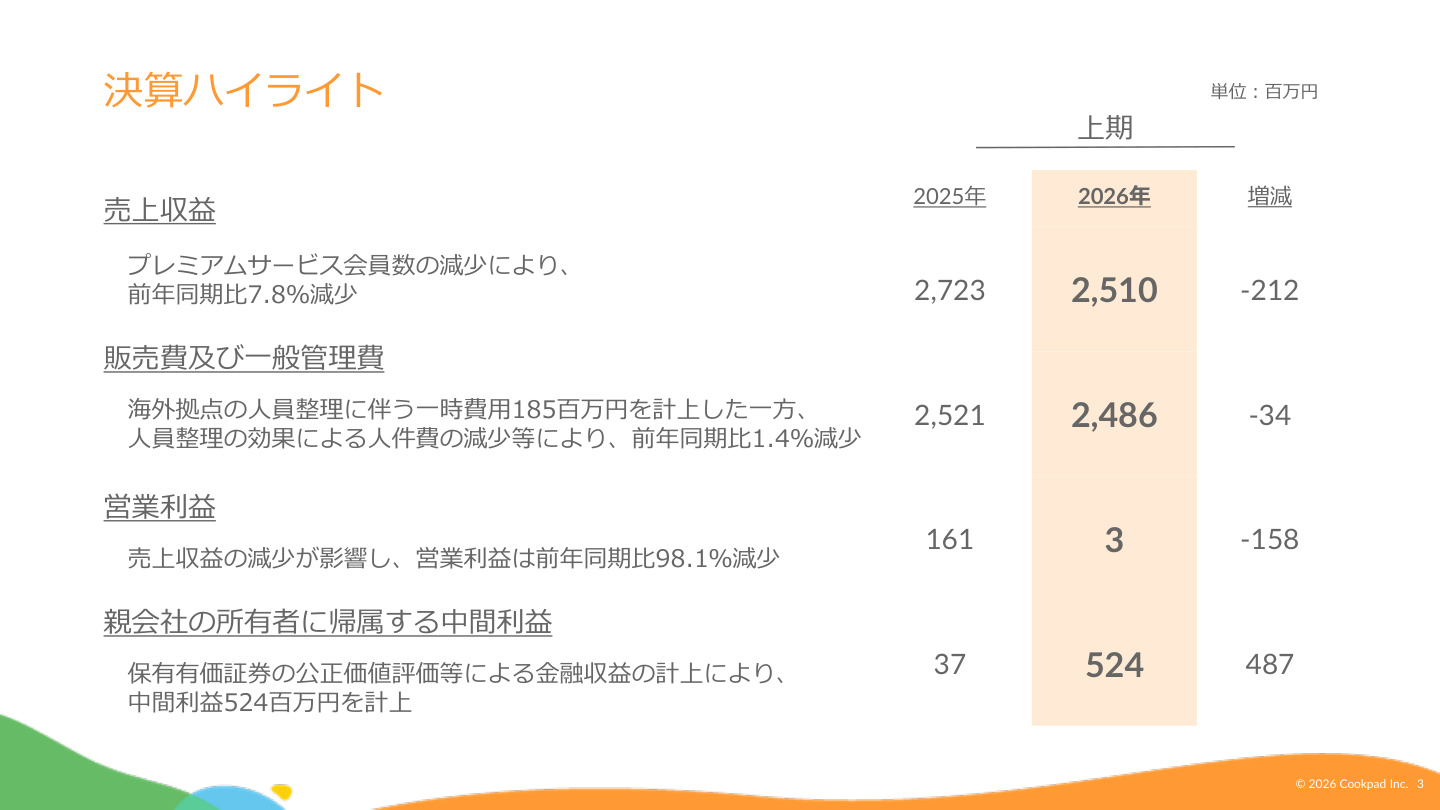
[Significance and Background of Slide 2] This slide is crucial for grasping the overall company performance for the first half of FY2026. While the operating profit of 3 million yen may appear low at first glance, it was heavily impacted by one-time expenses of 185 million yen recorded in Q1 related to workforce restructuring at overseas offices. Conversely, the surge in interim profit to 524 million yen is attributed to financial income recognized from the fair value assessment of held securities. The results highlight a structure where the interim performance was driven by two distinct factors: the structural reform of core business costs and financial gains from asset management and valuation.
③ Revenue Trends: Decline in Paid Subscribers and Downward Revenue Trajectory
Revenue has declined quarter-over-quarter from 1.35 billion yen in Q2 2025 to 1.243 billion yen in Q2 2026 (down 8.0% YoY and 1.9% QoQ). The primary cause is the decline in the number of Premium Service members , the company's core business. With the diversification of recipe searches on the web and the enrichment of free content, maintaining and acquiring paid members remains a challenge, making the stabilization of the top line the most critical issue moving forward.
④ Significant Reduction in SG&A Expenses and Changes in Composition
Selling, General and Administrative (SG&A) expenses decreased significantly from 1.397 billion yen in Q1 2026 to 1.089 billion yen in Q2, a reduction of 380 million yen (22.0%) quarter-over-quarter.
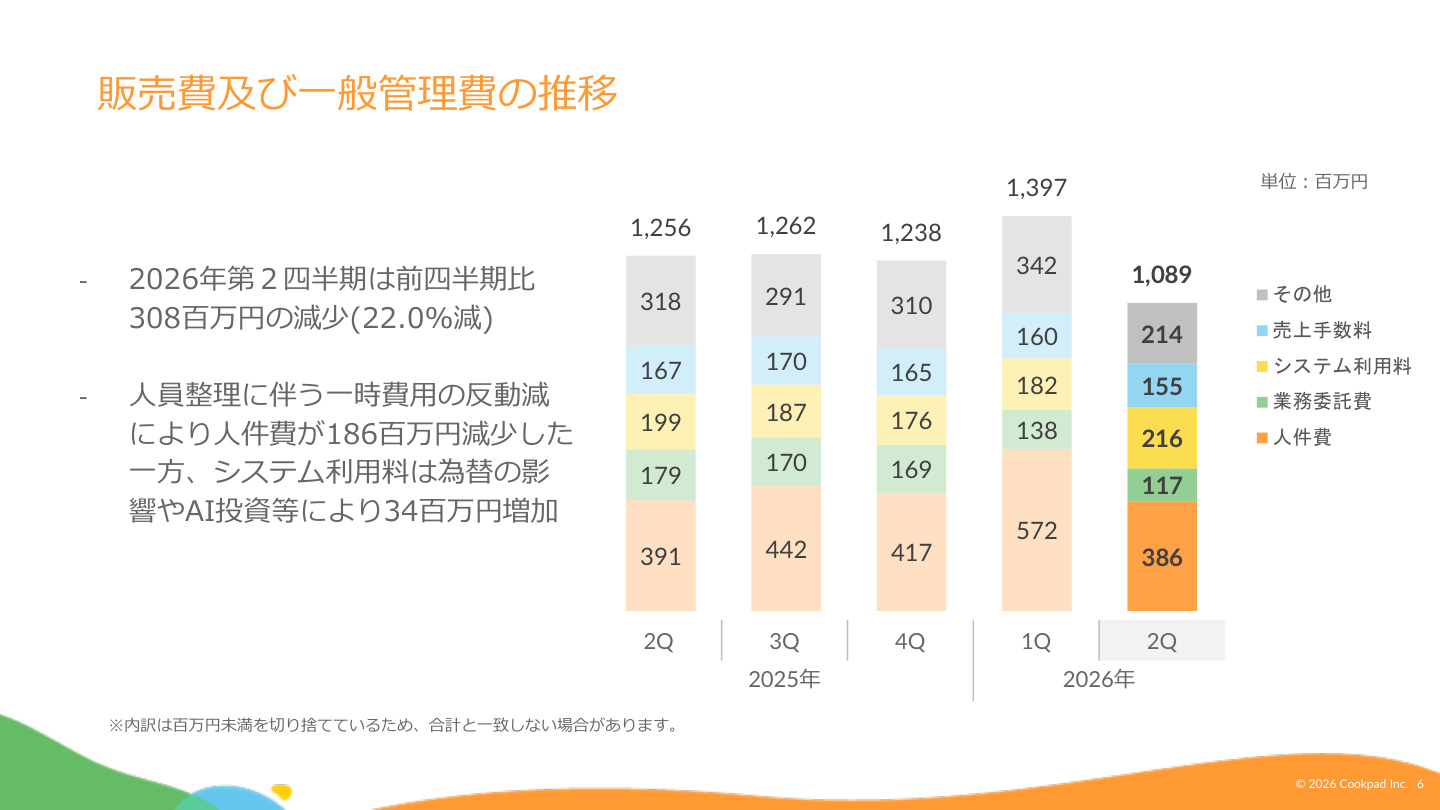
[Significance and Background of Slide 5] This slide is vital as it provides data supporting the company's thorough cost structure reform and resource reallocation. The increase in SG&A in Q1 was due to one-time expenses (185 million yen) associated with workforce reductions. In Q2, not only did these expenses drop off, but the restructuring also led to a 186 million yen decrease in personnel expenses (Q1: 572 million yen → Q2: 386 million yen). Meanwhile, system usage fees increased compared to Q1 (by 216 million yen) . This is due to foreign exchange impacts as well as investments in strengthening development infrastructure, such as AI-related initiatives , demonstrating a commitment to focusing resources on future technological investments rather than mere cost-cutting.
⑤ Trends in Employee Count: Organizational Slimming and Progress in Structural Reform
In line with organizational efficiency, the company's consolidated headcount (full-time and contract employees) has decreased significantly:
- End of Q2 2025: 101
- End of Q4 2025: 101
- End of Q1 2026: 94
- End of Q2 2026: 79 (down 21.8% YoY and 16.0% QoQ )
By pushing forward with the optimization of overseas personnel, the company has compressed personnel expenses—the core of fixed costs—and created an organizational structure that significantly lowers the break-even point.
⑥ Focus on AI Investment and Technology Infrastructure
The increase in system usage fees within SG&A reflects not only foreign exchange impacts on external cloud usage but also the company's development of new cooking and recipe suggestion features utilizing AI technology . While slimming the workforce to 79 employees, the company is focusing on automating and advancing service development through technology to maximize productivity per capita.
⑦ Mechanism of the V-Shaped Recovery in Operating Profit
Operating profit/loss shifted dramatically from a 137 million yen loss in Q1 2026 to a 140 million yen profit in Q2 alone.
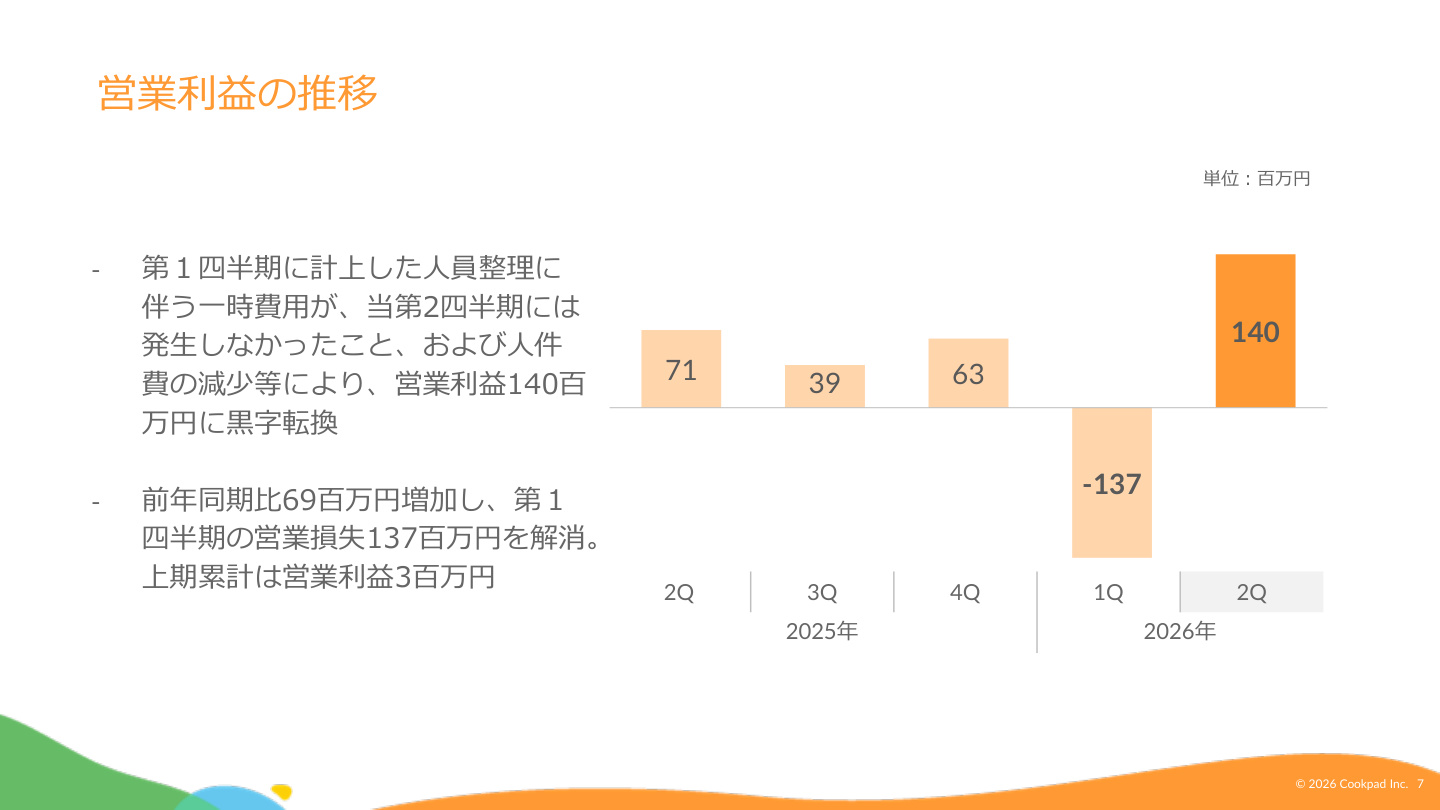
[Significance and Background of Slide 6] This slide clearly illustrates the dramatic V-shaped recovery in quarterly core business profitability. Since the Q1 operating loss was caused by one-time structural reform expenses, the Q2 results directly reflect the absence of those costs combined with the benefits of personnel expense suppression. Compared to the same period last year (Q2 2025: 71 million yen), operating profit increased by 69 million yen (up 96.0%) , confirming that the company's profitability has reliably improved on a quarterly basis following the structural reforms. This Q2 profit also enabled the company to achieve an operating profit for the first half of the year (3 million yen).
⑧ Boost in Net Profit (Interim Profit) via Financial Income
Profit attributable to owners of the parent for Q2 alone reached 942 million yen , bringing the interim profit for the first half to 524 million yen . The factor behind the net profit significantly exceeding operating profit (3 million yen) is the recognition of financial income from the fair value assessment of held securities. While this is a non-operating factor, it has significantly enhanced the company's net assets and liquidity.
⑨ Cash Position and Financial Soundness
As of the end of Q2 2026, the balance of cash and cash equivalents stands at 6.245 billion yen . This is a 4.5% increase (+270 million yen) quarter-over-quarter from 5.975 billion yen at the end of Q1, indicating that the company has maintained a robust cash position even after paying for workforce restructuring expenses. This substantial cash reserve, with virtually no debt, serves as a powerful foundation for future agile business investments and product development.
⑩ Future Growth Strategy and Challenges for Product Re-growth
For Cookpad, having established a path for fixed cost compression through structural reform, the next challenge is the top-line (revenue) re-growth scenario :
- Enhancing Premium Service Value : Stopping the decline in subscribers and rebuilding the foundation for recurring revenue.
- Adopting AI and New Technologies : Leveraging the elite team of 79 to provide products that innovate the user experience with high agility.
- Utilizing a Sound Financial Base : Executing effective growth investments using the cash reserves exceeding 6.2 billion yen.
Whether the company can transition from a lean, cost-conscious structure to the next phase of growth will be the major point of focus moving forward.
4. Conclusion
The Q2 FY2026 financial results clearly demonstrate that the results of Cookpad's structural reforms have manifested as improved profitability . With the completion of workforce reductions at overseas offices, personnel expenses have decreased, and the company achieved an operating profit of 140 million yen in Q2 alone. Net profit also expanded significantly, aided by financial income. The key to future success will be how the company leverages its slimmed-down organizational structure and abundant capital to drive service re-growth and the acquisition of premium members .
This content is not intended as investment advice or a recommendation. Any opinions expressed are solely the personal views of each article.