


West Japan Railway Company (9021) Q1 FY2027 Earnings & 'Medium-Term Management Plan 2030' Deep Dive Report

StockClub
Published: Aug 06, 2026, 11:11 AM
Sentiment Analysis
West Japan Railway Company (9021) Q1 FY2027 Earnings & 'Medium-Term Management Plan 2030' Deep Dive Report
This report provides an objective and detailed analysis of the Q1 FY2027 financial results (April 1, 2026 – June 30, 2026) and the progress of the "JR-West Group Medium-Term Management Plan 2030" for West Japan Railway Company (JR-West), based on the officially released earnings presentation materials.
In the first quarter, while the company saw a steady recovery in domestic demand and increased Shinkansen utilization, it recorded a year-on-year decline in both revenue and profit . This was primarily due to rising costs driven by inflation—including wage hikes and increased labor unit costs—as well as the reactionary decline following the previous year's Expo-related demand and real estate sales. However, overall performance remains largely within the initial projections, and the full-year earnings and dividend forecasts remain unchanged. Furthermore, the report highlights clear progress in various strategies under the "Medium-Term Management Plan 2030" aimed at sustainable group growth, such as the capital and business alliance with the Resona Group and investments in urban development and digital transformation (DX).
1. Q1 FY2027 Earnings Highlights
Performance Overview and Key Financial Indicators
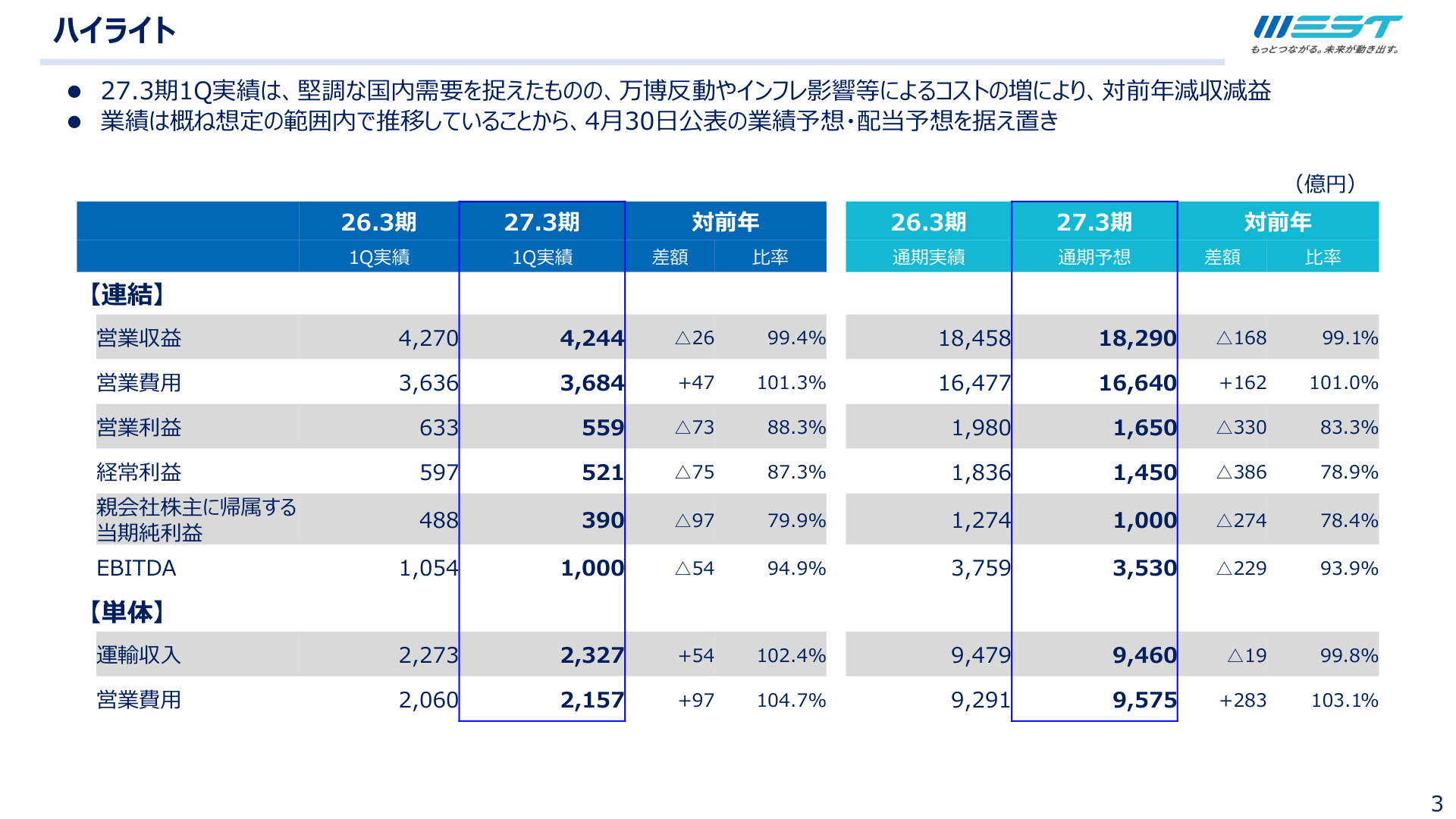
Consolidated results for the first quarter (1Q) were as follows: Operating Revenue of 424.4 billion yen (99.4% of the previous year, down 2.6 billion yen) , Operating Profit of 55.9 billion yen (88.3% of the previous year, down 7.3 billion yen) , Ordinary Profit of 52.1 billion yen (87.3% of the previous year, down 7.5 billion yen) , and Net Profit Attributable to Owners of the Parent of 39.0 billion yen (79.9% of the previous year, down 9.7 billion yen) .
Slide Commentary: Earnings Highlights and Full-Year Outlook
The slide above (P.3) provides an overview of the Q1 results and the full-year forecast for FY2027. Operating profit of 55.9 billion yen represents a decline from 63.3 billion yen in the same period last year, primarily due to increased costs, mainly in personnel and operating expenses (consolidated operating expenses were 368.4 billion yen, up 4.7 billion yen year-on-year), and the reactionary decline from high-profit businesses and events in the previous year. Looking at non-consolidated figures, transportation revenue reached 232.7 billion yen (102.4% of the previous year, up 5.4 billion yen) , securing growth. While the company successfully captured the rise in domestic travel demand, particularly for the Shinkansen, this was offset by an increase in non-consolidated operating expenses (215.7 billion yen, 104.7% of the previous year, up 9.7 billion yen). Regarding the full-year forecast, the company has maintained its targets of 1.829 trillion yen in operating revenue , 165 billion yen in operating profit , and 100 billion yen in net profit , indicating that the Q1 profit decline is being managed within the planned scope.
2. Segment Performance and Factor Analysis
The Q1 performance and profit impact for each business segment are as follows:
① Mobility
- Operating Revenue : 264.6 billion yen (+8.4 billion yen / 103.3% YoY)
- Operating Profit : 40.1 billion yen (▲3.3 billion yen / 92.4% YoY)
Operations for the Sanyo Shinkansen and Hokuriku Shinkansen remained robust, with Shinkansen transportation revenue expanding to 133.7 billion yen (+5.8 billion yen YoY). Conventional lines in the Kinki region also maintained or exceeded the previous year's levels for both commuter and non-commuter segments. Conversely, operating profit was pressured by inflation and investments for future growth, including increased personnel costs due to wage hikes (+3.0 billion yen) , higher repair costs due to rising labor unit costs (+1.4 billion yen), and IT-related operating expenses (+1.7 billion yen).
② Retail
- Operating Revenue : 53.9 billion yen (▲2.6 billion yen / 95.3% YoY)
- Operating Profit : 3.7 billion yen (▲1.3 billion yen / 73.6% YoY)
While convenience stores and restaurants maintained sales levels comparable to the previous year due to renovation effects, the segment saw a decline in both revenue and profit overall, largely due to the reactionary decline in souvenir shop demand related to the previous year's Expo.
③ Real Estate
- Operating Revenue : 58.5 billion yen (▲5.9 billion yen / 90.8% YoY)
- Operating Profit : 12.0 billion yen (▲2.3 billion yen / 83.4% YoY)
In the real estate leasing business, the company achieved revenue and profit growth (Real Estate Leasing Operating Profit of 4.7 billion yen, +0.9 billion yen) thanks to the consolidation of JR-West Real Estate Management, strong performance of flagship shopping centers like "LUCUA Osaka" (SC sales of 115.4 billion yen, 105% YoY), and contributions from newly opened properties. However, the segment as a whole saw a decline in revenue and profit due to the reactionary decline in high-profit residential and investor-focused real estate sales recorded in the previous year (Real Estate Sales Operating Profit ▲2.3 billion yen) and sluggish performance in the hotel business (impacted by the closure of Nara Hotel for renovations, the Expo reaction, and travel restraint).
④ Travel & Regional Solutions
- Operating Revenue : 40.5 billion yen (▲2.5 billion yen / 94.0% YoY)
- Operating Profit : ▲0.7 billion yen (Loss widened from ▲0.6 billion yen YoY)
This segment experienced a decline in revenue and profit due to sluggish inbound-related business caused by heightened international tensions and increased system costs aimed at strengthening the future business foundation.
3. Macro Environment and Inbound Demand
Preparing for External Risks such as Middle East Tensions
In formulating the full-year plan, the company has incorporated a total risk of ▲13.0 billion yen in consolidated operating profit , based on assumptions including a crude oil price of $100/barrel , increased electricity procurement costs and fuel prices (▲8.5 billion yen impact), and a decline in inbound foreign tourists (▲2.5 billion yen). As of Q1, the company has maintained its earnings forecast cautiously, considering the possibility that these concerns may materialize from Q2 onwards.
Resilience of Inbound Revenue
Although the number of foreign visitors to Japan has temporarily stabilized, the capture of inbound demand is proceeding steadily. Total inbound revenue for Q1 was 20.9 billion yen (12.7 billion yen in transportation revenue, 8.1 billion yen from group companies) . The company projects total inbound revenue of 83.5 billion yen (500 billion yen in transportation revenue) for FY2027, aiming to support profit growth through wide-area tourism measures for the Kansai International Airport express "Haruka" and the Hokuriku Shinkansen.
4. JR-West Group "Medium-Term Management Plan 2030" Strategic Roadmap
The "Medium-Term Management Plan 2030," released alongside the earnings, clearly outlines a long-term vision to break away from the traditional structure dependent on the railway business and realize a sustainable mobility society.
Slide Commentary: Basic Policy and Portfolio Transformation of the Medium-Term Management Plan 2030
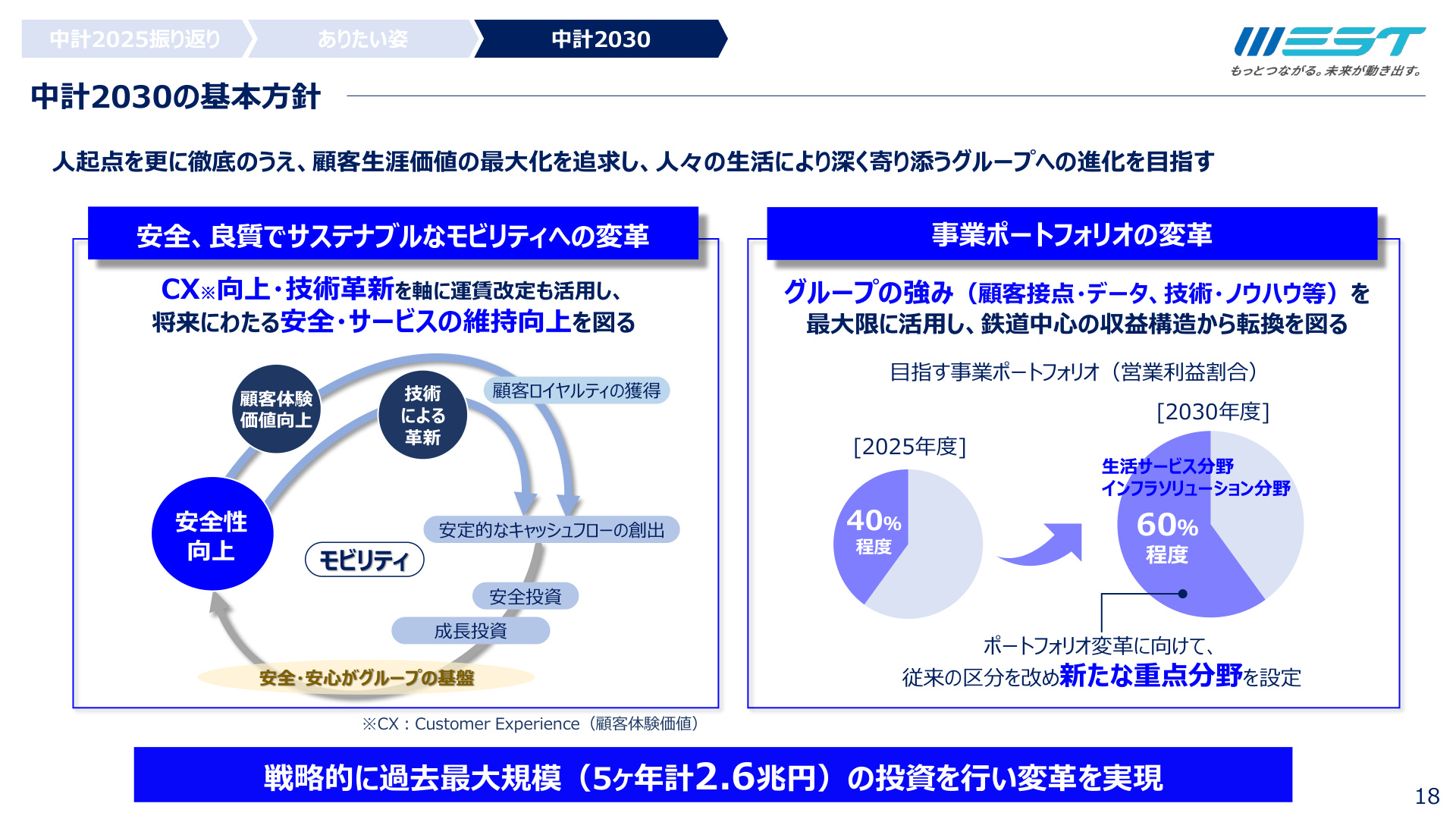
The slide above (P.18) illustrates the core of the management plan: "Business Portfolio Transformation." To address structural challenges such as the aging of early JNR/JR-era rolling stock, population decline, and labor shortages, the company is advancing mobility structural reforms with a primary focus on safety. Simultaneously, it aims to expand the "Life Service" and "Infrastructure Solution" sectors by leveraging the group's customer touchpoints, data, and real assets. Specifically, the plan aims to shift the operating profit composition from approximately 40% Mobility and 60% Life Services in FY2025 to a structure centered on non-railway and life services by FY2030 . To realize this transformation, the company will execute a record-high strategic investment of 2.6 trillion yen over five years .
Slide Commentary: Positioning and Financial Targets of the Medium-Term Management Plan 2030
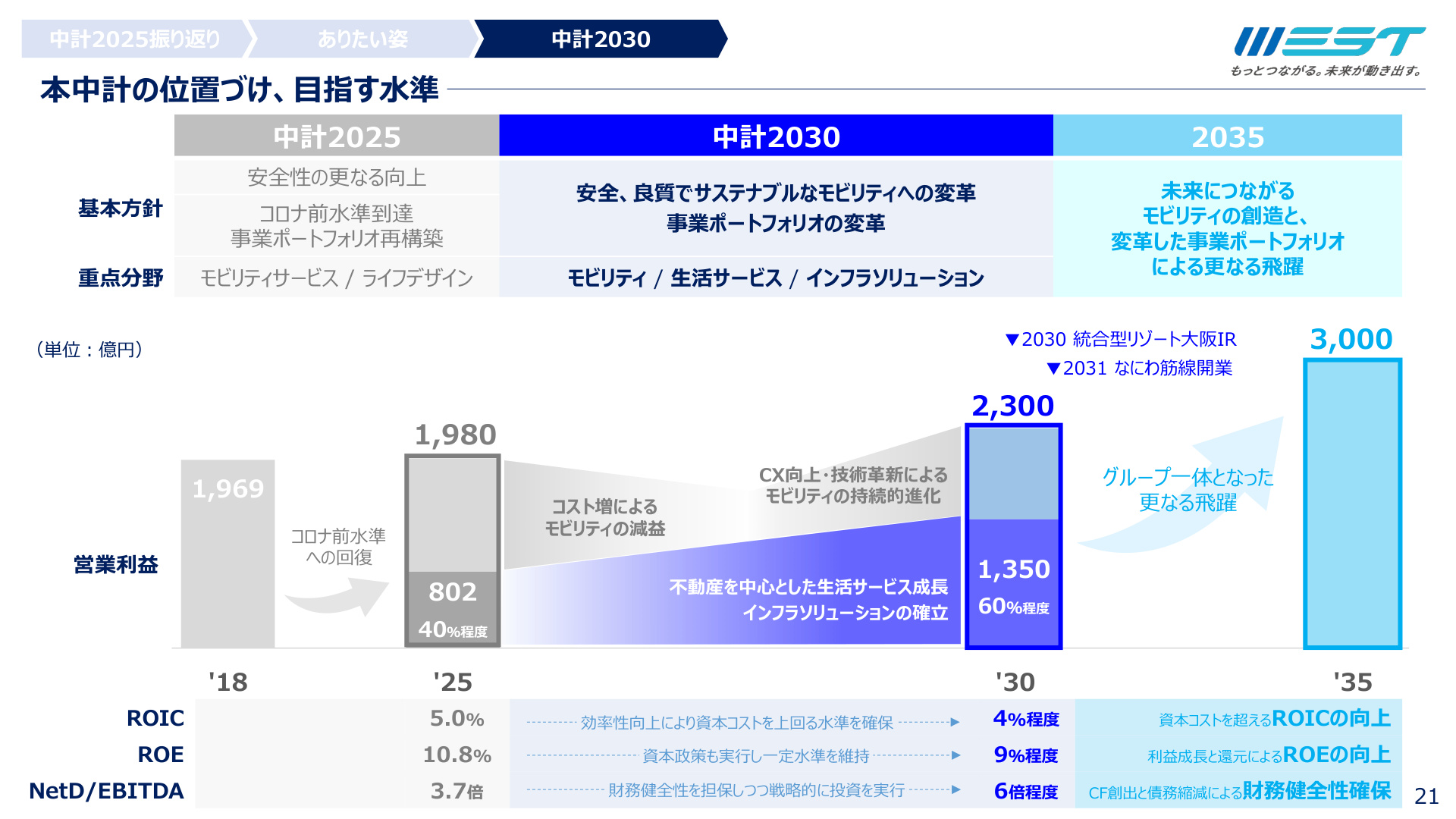
The slide above (P.21) is a key document showing the roadmap for profit levels and financial indicators (KPIs) for 2030 and beyond to 2035. Following a recovery from pre-COVID operating profit levels (approx. 198 billion yen), the company aims for consolidated operating profit of 230 billion yen by FY2030 and 300 billion yen by FY2035 , while absorbing inflation and cost increases. Notably, of the 230 billion yen operating profit target for FY2030, approximately 60% (approx. 135 billion yen) is planned to be generated from the Life Service and Infrastructure Solution sectors, centered on real estate. Regarding financial health and capital efficiency, the plan aims to maintain and achieve ROIC of around 4% , ROE of around 9% , and Net D/EBITDA of around 6x , balancing investment, shareholder returns, and financial discipline.
5. Five Cross-Company Strategies Driving Growth
To achieve the "Medium-Term Management Plan 2030," the following five priority strategies are being promoted:
- Transformation to Safe, High-Quality, and Sustainable Mobility
- Completion of the Railway Safety Action Plan 2027, maintenance structural reform, and expansion of the "SUWALOCA" paid seating service and EX reservation usage.
- Enhancing Sustainability and Appeal of Communities
- Osaka Area (full opening of Umekita Park, large-scale renovation of LUCUA), Hiroshima Area (opening of Hiroshima Station Building "minamoa"), and base development/improved mobility in Kobe, Kyoto, Hokuriku, and Setouchi areas.
- Enhancing Customer Experience (CX) and Ecosystem Building through Co-creation
- Strengthening 1-to-1 recommendations to reach the WESTER member transaction volume target of 470 billion yen (FY2030) .
- Capital and Business Alliance with Resona Group : Acquired 20.0% of Kansai Mirai Financial Group shares (90 billion yen) to make it an equity-method affiliate. Plans include joint development of a new BaaS function, "WESTER Mirai Bank (tentative)," and payment businesses.
- Strong Capture of Inbound Demand
- FY2030 Group Inbound Revenue Target of 111 billion yen . Development of reception systems and secondary access in anticipation of the 2030 Integrated Resort (Osaka IR) opening and the "Naniwasuji Line" completion.
- Area Expansion and Business Creation for Further Growth
- Launching office brands ("J.NODE," "AONA," etc.) and expanding rental apartment development in growth areas such as the Tokyo metropolitan area.
6. Deep Dive Summary and Future Focus Points
Although the Q1 earnings showed a year-on-year decline in profit, most of the factors— inflation response (wage hikes, etc.), upfront investments for future growth, and the reactionary decline from high-level real estate sales and events in the previous year —are in line with company expectations.
Key points to watch moving forward include:
- Transportation Revenue Momentum : Progress in capturing further domestic and inbound demand through increased summer temporary train services (+592 trains YoY) and tourism campaigns.
- Cost Control : Whether non-consolidated operating expenses can be kept within the plan through operational efficiency and DX promotion despite rising prices and labor costs.
- Non-Railway Business Pipeline Progress : The timing of monetization for large-scale development projects such as the Hiroshima Station Building "minamoa" and the Umekita development.
- Launch of Financial/Payment Platform : The extent to which new service deployments through the Resona Group alliance contribute to increasing Customer Lifetime Value (LTV).
JR-West is in the midst of a structural reform to expand its profit axis into real estate, life services, and digital while maintaining a solid railway foundation. The progress of these initiatives toward long-term corporate value enhancement will continue to be closely monitored.
This content is not intended as investment advice or a recommendation. Any opinions expressed are solely the personal views of each article.