

Yamaichi Electronics Q1 FY2027 Earnings Analysis: Record-High Sales and Profits Driven by AI and Data Center Demand; Full-Year Forecast and Dividends Revised Upward

Sentiment Analysis
Yamaichi Electronics (Securities Code: 6941) delivered an exceptionally strong performance in the first quarter of the fiscal year ending March 31, 2027 (Q1 FY2026), achieving record highs across all key metrics: net sales, operating profit, ordinary profit, and net income attributable to owners of the parent.
This report provides a detailed analysis of the company's business trends and growth trajectory, focusing on the 10 most critical topics identified in the disclosure materials: the record-breaking quarterly performance, revenue and profit growth in the Test Solutions (TS) segment, the dramatic profit surge in the Connector Solutions (CS) segment, the rapid increase in demand for AI and data center applications, robust performance in memory sockets, outperformance in smartphone sockets, the tailwind from a weaker yen, progress in capital expenditure, the upward revision of full-year earnings forecasts, and the increase in dividend projections.
1. Q1 Consolidated Financial Highlights
In Q1 FY2027, consolidated net sales reached 19.8 billion yen (up 35.8% YoY) , operating profit was 5.95 billion yen (up 55.8% YoY) , ordinary profit was 6.16 billion yen (up 63.0% YoY) , and quarterly net income was 4.32 billion yen (up 55.3% YoY) . The profit growth rate significantly outpaced top-line growth, clearly demonstrating the effects of high marginal profit ratios and improved capacity utilization.
The following slide illustrates the trends in key financial indicators for the first quarter compared to the same period last year.
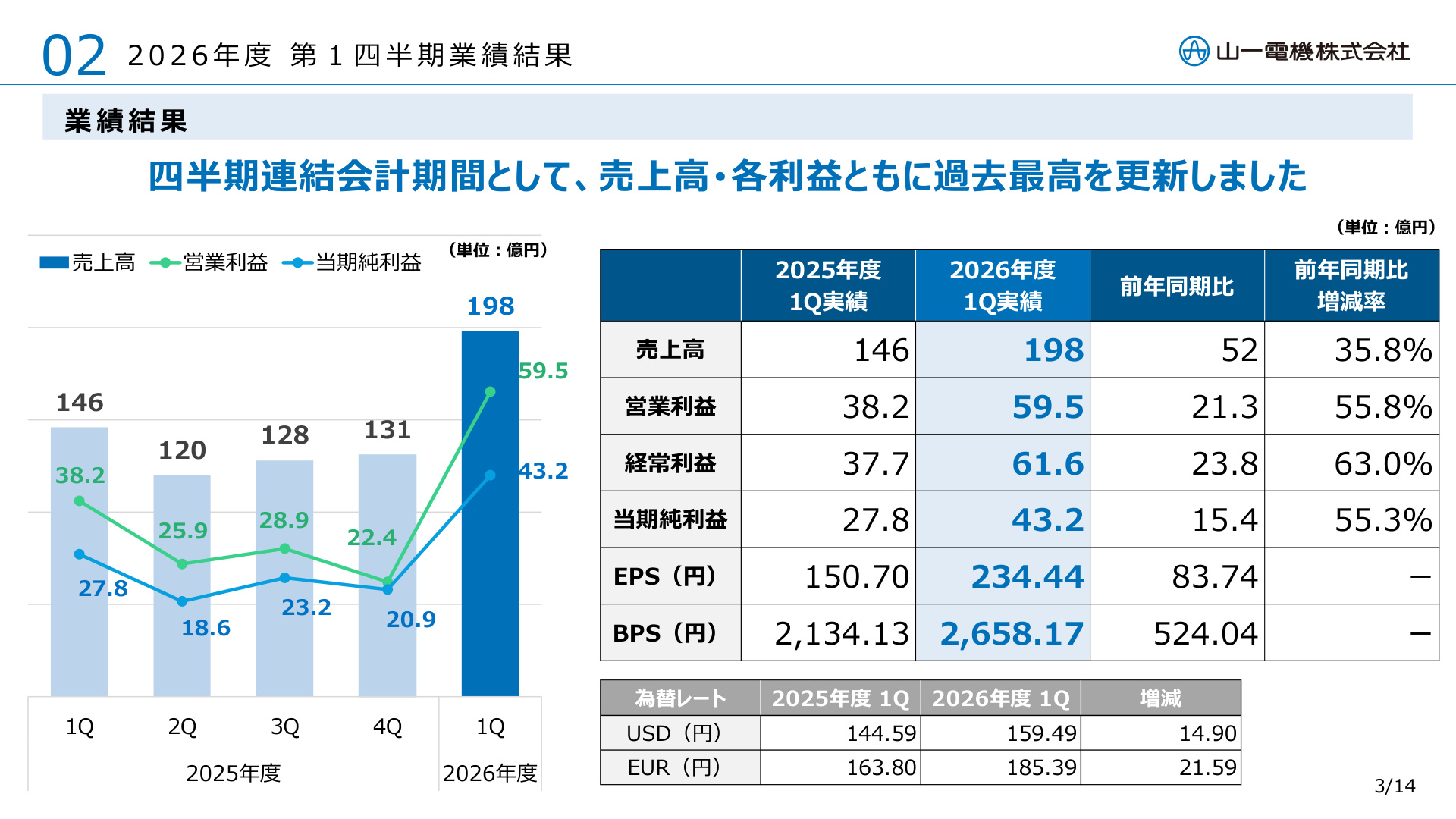
[Significance and Background of Slide 3 (Financial Results)]
This slide presents the most critical financial data symbolizing the strength of these earnings. The operating profit margin rose from 26.1% in the same period last year to 30.0% , confirming a further tightening of the profit structure. Furthermore, earnings per share (EPS) jumped from 150.70 yen to 234.44 yen . This was driven by a concentration of demand for high-value-added products in the core Test Solutions and Connector Solutions businesses. Currency tailwinds also played a role, with the yen weakening to 159.49 per USD (vs. 144.59 in the same period last year) and 185.39 per EUR (vs. 163.80), resulting in a positive impact of 1.84 billion yen on net sales and 1.09 billion yen on operating profit.
2. Segment Performance: Test Solutions (TS) Business
The TS business remains the primary pillar supporting the company's performance. In this quarter, net sales reached 11.2 billion yen (up 35.6% YoY) , and operating profit hit 4.64 billion yen (up 52.5% YoY) , marking a significant increase in both revenue and profit.
The following slide shows the trends by product category within the TS business.
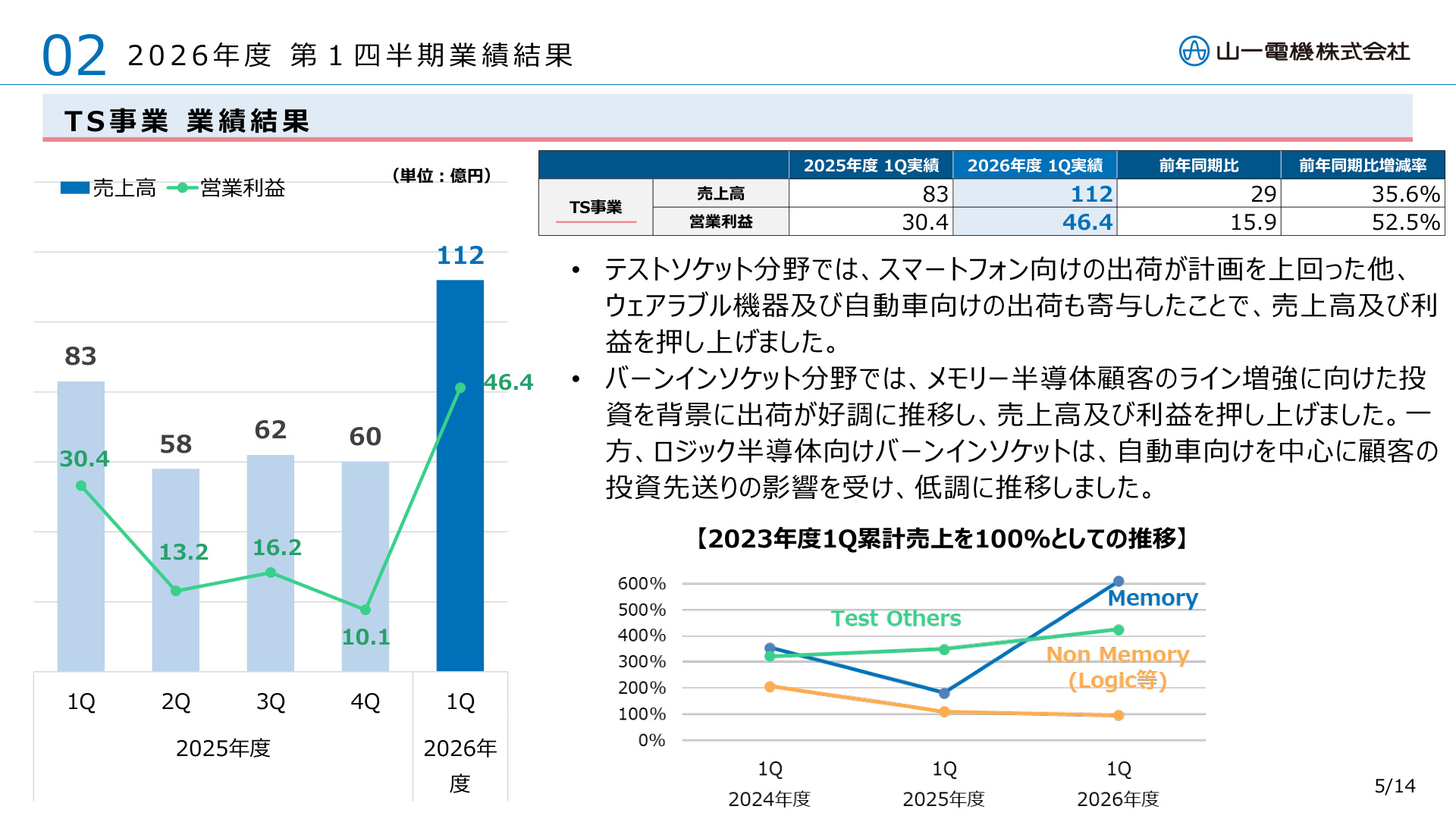
[Significance and Background of Slide 5 (TS Business Results)]
This slide clearly identifies the growth drivers within the TS business. Looking at the bottom-right chart, which tracks performance indexed to Q1 FY2023, it is evident that Memory (burn-in sockets for memory semiconductors) is rising at a steep angle. Driven by the explosive adoption of generative AI, demand for High Bandwidth Memory (HBM) and advanced DRAM for data centers has surged, leading to active investment in line expansions by customers and very strong shipment volumes. In the test socket field , shipments of new products for smartphones significantly exceeded initial plans, while wearable devices and automotive applications also contributed steadily. Conversely, burn-in sockets for logic semiconductors remained somewhat sluggish, reflecting customers' deferred investments amid a downturn in the automotive market.
3. Segment Performance: Connector Solutions (CS) and Optical (OPT) Businesses
The CS business saw remarkable growth, with net sales of 8.2 billion yen (up 39.3% YoY) and operating profit of 1.56 billion yen (up 103.4% YoY) , effectively more than doubling its operating profit year-on-year.
- Telecom/Datacom : Shipments for data centers, including AI-related applications, significantly exceeded initial plans. Shipments for core telecommunications equipment also remained steady, acting as a key driver for the CS business.
- FA/Industrial : In addition to a recovery in demand from European customers, which is a key market, increased shipments of connectors for semiconductor inspection equipment contributed to improved performance.
- Automotive : The segment continues to face headwinds due to the global slowdown in the EV (electric vehicle) market.
The OPT (Optical) business saw a minor contraction, with net sales of 0.3 billion yen (down 10.7% YoY) and operating profit of 0.04 billion yen (down 35.5% YoY).
4. Capital Expenditure, Depreciation, and Financial Foundation
Regarding capital expenditure to support business expansion, the company invested 0.82 billion yen in the first quarter. The full-year plan for FY2027 (FY2026) calls for 4.72 billion yen in capital investment (compared to 4.04 billion yen in the previous year), as the company pushes forward with production capacity expansion and advanced technology integration for medium- to long-term growth. Depreciation for the first quarter was 0.75 billion yen (full-year plan: 3.49 billion yen), indicating that the business foundation is being developed under appropriate control.
5. Upward Revision of Full-Year Forecasts and Growth Scenario
Based on the strong progress in the first quarter and future demand outlook, the company has revised its consolidated earnings forecasts for the interim and full-year periods upward.
Details of the full-year earnings forecast and the underlying exchange rate assumptions are shown in the slide below.
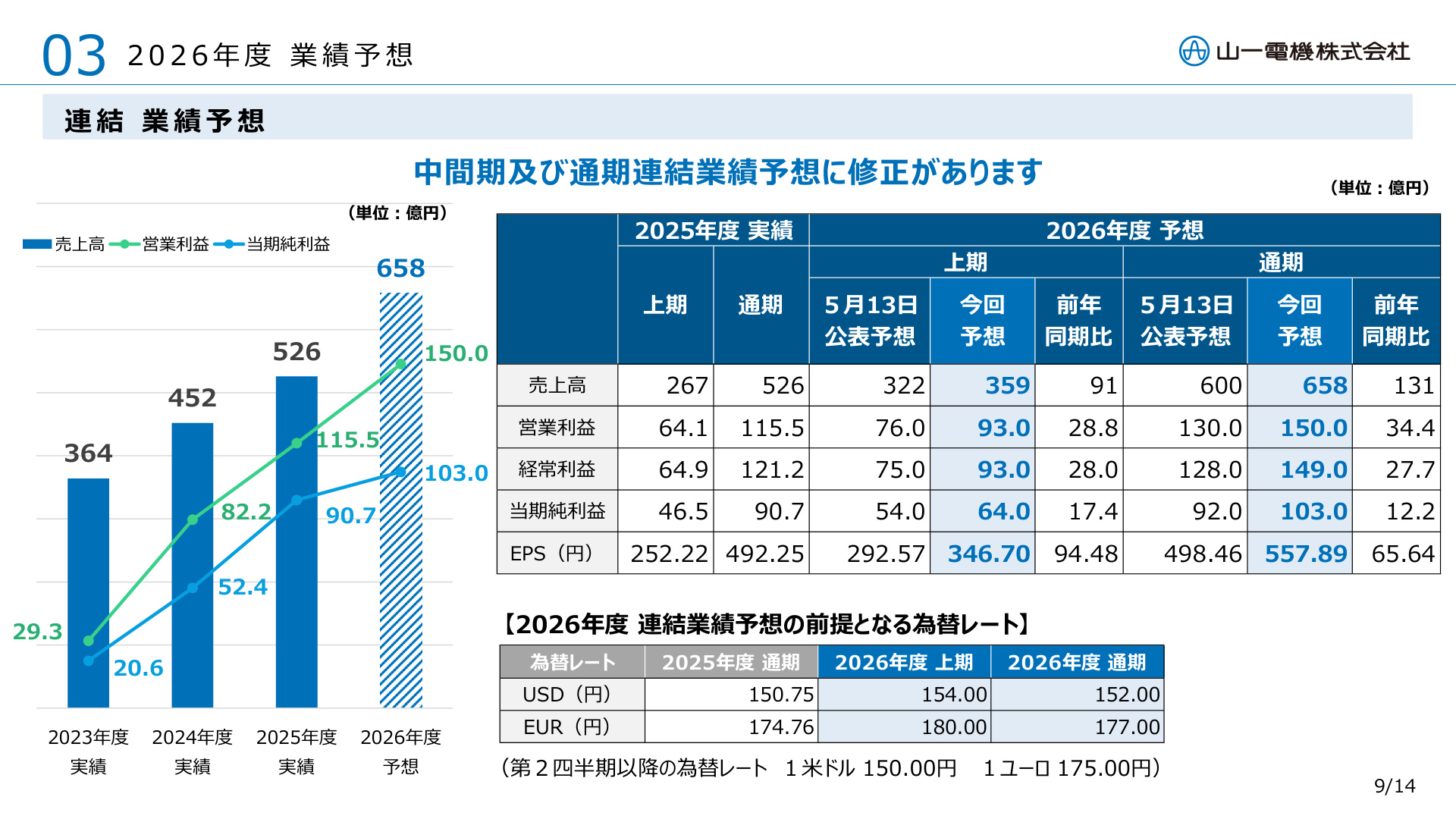
[Significance and Background of Slide 9 (Consolidated Earnings Forecast)]
This slide provides critical revised data indicating the company's future outlook and confidence in its growth. The full-year net sales forecast has been raised from 60.0 billion yen to 65.8 billion yen (up 25.1% YoY) , and the operating profit forecast from 13.0 billion yen to 15.0 billion yen (up 29.9% YoY) . Ordinary profit is projected at 14.9 billion yen , and net income at 10.3 billion yen (EPS: 557.89 yen ). The assumed exchange rates for the second quarter and beyond are set at 150.00 yen per USD and 175.00 yen per EUR , which are realistic levels, suggesting that the strength of underlying demand is the primary driver for the upward revision. By segment, the full-year operating profit forecast for the CS business has been significantly raised from 5.0 billion yen to 7.0 billion yen , reflecting strong expectations for sustained demand for data center connectors.
6. Shareholder Return Policy (Dividend Increase)
In line with the upward revision of earnings forecasts, shareholder returns will also be strengthened. The company maintains a target payout ratio of 30% under its medium-term management plan.
Consequently, the interim dividend forecast has been increased from 50 yen to 65 yen , and the year-end dividend forecast from 100 yen to 103 yen , bringing the annual dividend forecast to 168 yen per share (previous forecast: 150 yen; previous year: 148 yen). This clearly demonstrates a proactive stance toward profit distribution.
7. Summary and Key Points to Watch
This earnings report from Yamaichi Electronics demonstrates that the company is successfully capturing the structural tailwinds of the expanding generative AI and data center markets , with both the core TS and CS businesses exhibiting high profitability.
Moving forward, the following points warrant close attention:
- Sustainability of demand for AI servers and HBM : Whether the strong performance in memory burn-in sockets and communication connectors will continue into the second half.
- Timing of recovery in logic and automotive markets : When demand for automotive and logic semiconductors, currently sluggish, will bottom out and rebound.
- Currency trends and macroeconomic environment : Risk management regarding uncertainties such as exchange rate fluctuations, raw material prices, and trade policies.
This content is not intended as investment advice or a recommendation. Any opinions expressed are solely the personal views of each article.