


Nihon Kohden Corporation (6849) Q1 FY2027 Earnings Deep Dive Report

StockClub
Published: Aug 06, 2026, 11:00 AM
Sentiment Analysis

Nihon Kohden Corporation (6849) Q1 FY2027 Earnings Deep Dive Report
Nihon Kohden Corporation’s Q1 FY2027 earnings resulted in a temporary operating loss, driven by the revenue decline following the termination of the distribution agreement for Abbott products, alongside upfront increases in SG&A expenses related to personnel costs and IT investments. However, these factors represent a transitional phase in the company's structural reform, and the underlying performance, centered on proprietary products, remains robust once the impact of Abbott products is excluded.
This report provides a detailed and comprehensive analysis of the Q1 earnings highlights, profit and loss drivers, sales trends by region and product, progress in company-wide profit reforms, and the full-year outlook, structured around 10 key topics.
1. Q1 Earnings Highlights and the Impact of Abbott Product Termination
For the first quarter of the fiscal year ending March 2027, consolidated net sales were 47,405 million yen (down 5.2% YoY), with an operating loss of 983 million yen (compared to an operating profit of 1,400 million yen in the same period last year). Ordinary loss was 339 million yen , and net loss attributable to owners of the parent was 756 million yen .
[Key Performance Indicators (Q1 Results)]
- Net Sales : 47,405 million yen (down 5.2% YoY)
- Domestic Sales : 26,080 million yen (down 15.0% YoY / +0.3% excluding Abbott products)
- Overseas Sales : 21,325 million yen (up 10.3% YoY / +1.0% excluding currency effects)
- Gross Profit Margin : 53.7% (up 1.1% pts YoY)
- Operating Profit : △983 million yen (vs. 1,400 million yen in the same period last year)
The primary driver of the apparent sharp decline in domestic revenue and profit is the reduction in transactions following the termination of the distribution of Abbott’s cardiac catheterization equipment (Abbott product sales fell 70.2% from 6,658 million yen to 1,986 million yen). The handover of Abbott product operations is expected to be approximately 80% complete by the end of June 2026 and 95% by the end of September, concentrating the temporary impact in the first half of the fiscal year. Conversely, the shift from third-party products to higher-margin proprietary products has improved the gross profit margin to 53.7% .
2. Analysis of Operating Profit Variance
The decline into an operating loss in Q1 was significantly influenced by the decrease in gross profit due to the Abbott product exit, as well as rising costs from inflation, personnel expenses, and IT investments. The detailed breakdown and structure are summarized in the following variance analysis slide.
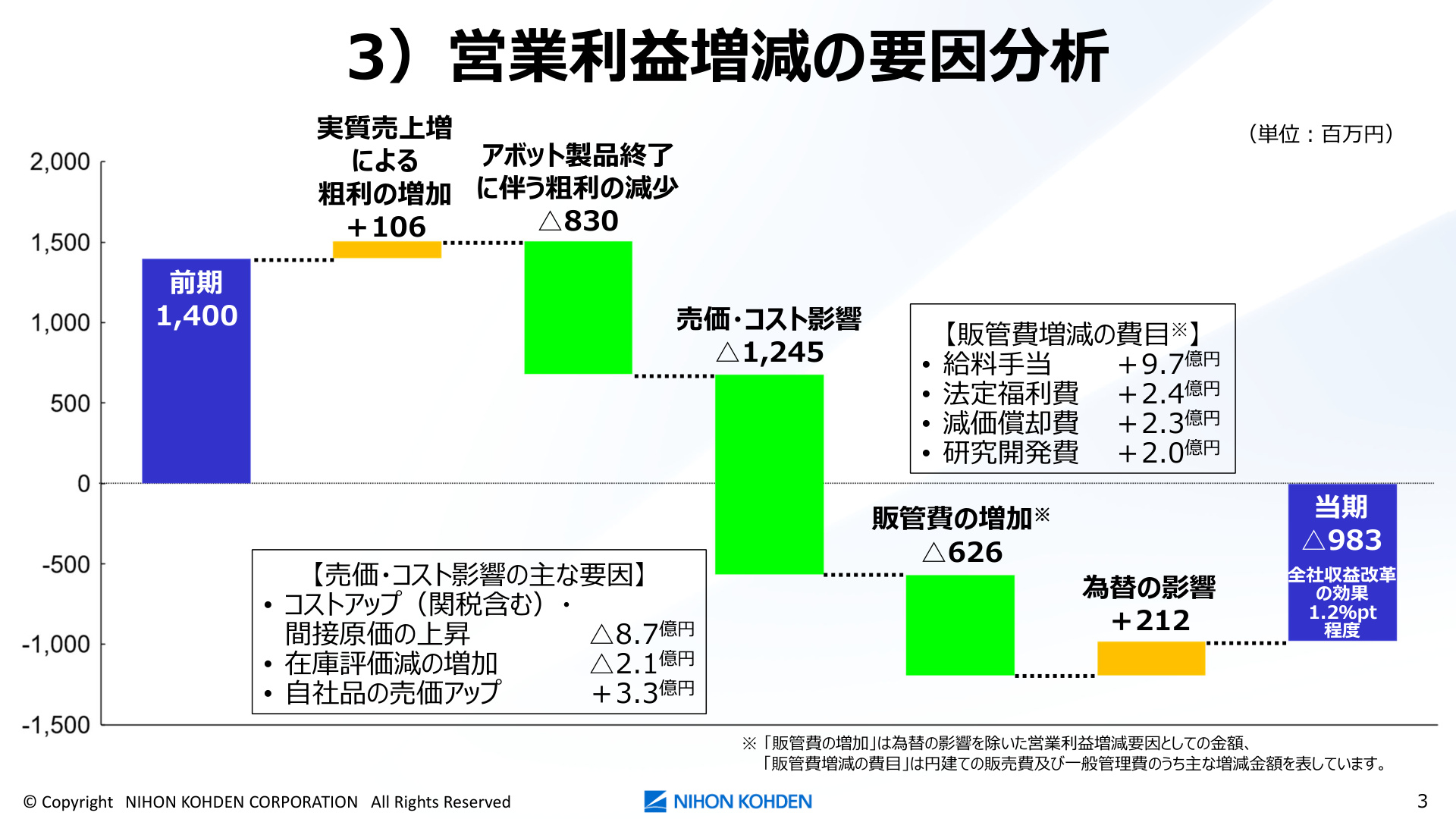
[Why this slide is important/Background]
It visually clarifies the P&L variance mechanism (waterfall) from the 1.4 billion yen operating profit in the previous year to the 983 million yen operating loss in the current period. It confirms that the majority of the profit decline is due to one-time structural changes and upfront investments for growth.
[Breakdown of Variance Factors]
- Gross Profit Increase from Underlying Sales Growth : +106 million yen (positive impact from proprietary product sales growth)
- Gross Profit Decrease from Abbott Product Exit : △830 million yen (one-time direct negative impact)
- Selling Price/Cost Impact : △1,245 million yen (indirect cost increases and cost-ups of △870 million yen, inventory valuation losses of △210 million yen, partially offset by +330 million yen in proprietary product price increases)
- Increase in SG&A Expenses : △626 million yen (increases in personnel costs such as salaries +970 million yen, statutory welfare expenses +2.4 billion yen, depreciation +230 million yen, and R&D expenses +200 million yen)
- Currency Effects/Profit Reform Impact : Currency effects contributed +212 million yen , and company-wide profit reforms yielded an improvement of approx. 1.2% pts (cost suppression effects, etc.).
Thus, the Q1 loss was primarily driven by fixed cost increases aimed at future productivity improvements , such as wage hikes and depreciation expenses associated with the introduction of new internal IT systems (new CRM, PLM/MES, etc.).
3. Domestic Market Trends: Resilience Led by Proprietary Products
Domestic sales were 26,080 million yen (down 15.0% YoY), but on an underlying basis excluding Abbott products, they remained flat at 24,093 million yen (up 0.3% YoY) .
- By Market : Sales to universities, public hospitals, and private hospitals were generally in line with the previous year, while sales to clinics declined.
- By Product Group :
- Physiological Measuring Equipment : Diagnostic information systems saw double-digit growth, and electrocardiographs and neurology systems remained solid, resulting in a 7.2% YoY increase (4,276 million yen).
- Patient Monitors : Driven by significant growth in clinical information systems and the impact of new transmitter products, sales rose 6.1% YoY (8,997 million yen).
- Therapeutic Equipment : Sales fell 10.9% YoY (4,697 million yen) due to the reactionary decline from strong AED sales in the same period last year.
The strategy of curbing third-party product procurement and concentrating resources on the sale of high-margin proprietary products is being steadily executed.
4. Overseas Market Trends: Europe and Asia Drive Double-Digit Growth
Overseas sales reached 21,325 million yen (up 10.3% YoY, +1.0% excluding currency effects) , with the overseas sales ratio rising from 38.7% in the same period last year to 45.0% .
[Regional Trends (Growth rates excluding currency effects)]
- Europe (Sales 3.8 billion yen / +32% in JPY / ** +18% ** excluding currency) : Achieved extremely high growth, supported by large-scale electrocardiograph deals in Greece, patient monitor deals in Poland, and significant AED sales growth in the Netherlands.
- Asia and Others (Sales 4.8 billion yen / +10% in JPY / ** +4% ** excluding currency) : Driven by large-scale defibrillator deals in Saudi Arabia and double-digit growth in Egypt, the UAE, and India.
- North America (Sales 11.6 billion yen / +6% in JPY / ** △3% ** excluding currency) : Despite significant growth in both mask-type and intubation-type ventilators, sales fell slightly in local currency terms due to the reactionary decline from strong neurology equipment sales in the previous year and a decrease in patient monitor equipment (though consumable sensors saw double-digit growth).
- Latin America (Sales 0.9 billion yen / △6% in JPY / ** △12% ** excluding currency) : While maintenance services grew in Mexico, the impact of reactionary declines from strong performance in Guatemala and Paraguay in the previous year was felt.
5. Product Sales Mix and Gross Margin Improvement Story
In the Q1 total sales of 47,405 million yen, patient monitors remained strong at 17,356 million yen (up 6.0% YoY) . Within the patient monitor group, the "clinical information systems group" grew rapidly by 88.8% YoY to 1,460 million yen.
The proprietary product ratio rose sharply from 72.6% in the same period last year to 81.6% , while the third-party product ratio fell from 27.4% to 18.4%. This improvement in product mix was the decisive factor that pushed the company-wide gross profit margin from 52.6% to 53.7% (+1.1% pts) , despite the revenue decline caused by the Abbott product exit.
6. Digital Healthcare (DHS) Initiative and Product Competitiveness
Nihon Kohden is advancing its transformation into a solution-based business (DHS initiative) , moving beyond the mere sale of medical hardware to solving challenges in clinical settings.
- Number of DX-adopted facilities (Japan) : Expanded to 256 facilities (a steady increase from 202 at the end of the previous fiscal year).
- Key New Products/Solutions :
- AlarmSense / QP-842N : Visualizes and analyzes alarm status across the entire hospital in real-time, reducing alarm fatigue and workload for medical staff.
- Admission/Discharge Support Software (QP-842N) : Automatically acquires and visualizes information necessary for bed management, supporting improved bed occupancy rates and shorter lengths of stay.
- Automated Hematology Analyzer (MEK-1303 Celltac α+) : Introduced a license for simultaneous measurement of D-dimer (thrombus formation index) and CBC (complete blood count).
These software and remote monitoring solutions contribute to hospital management efficiency while building a stable, stock-based revenue foundation for the company.
7. Company-wide Profit Reform and DX Promotion (Operational Efficiency)
In line with the medium-term goal of "5% pt improvement in operating profit margin (by FY27/3)," internal DX investments and process reforms are in full swing.
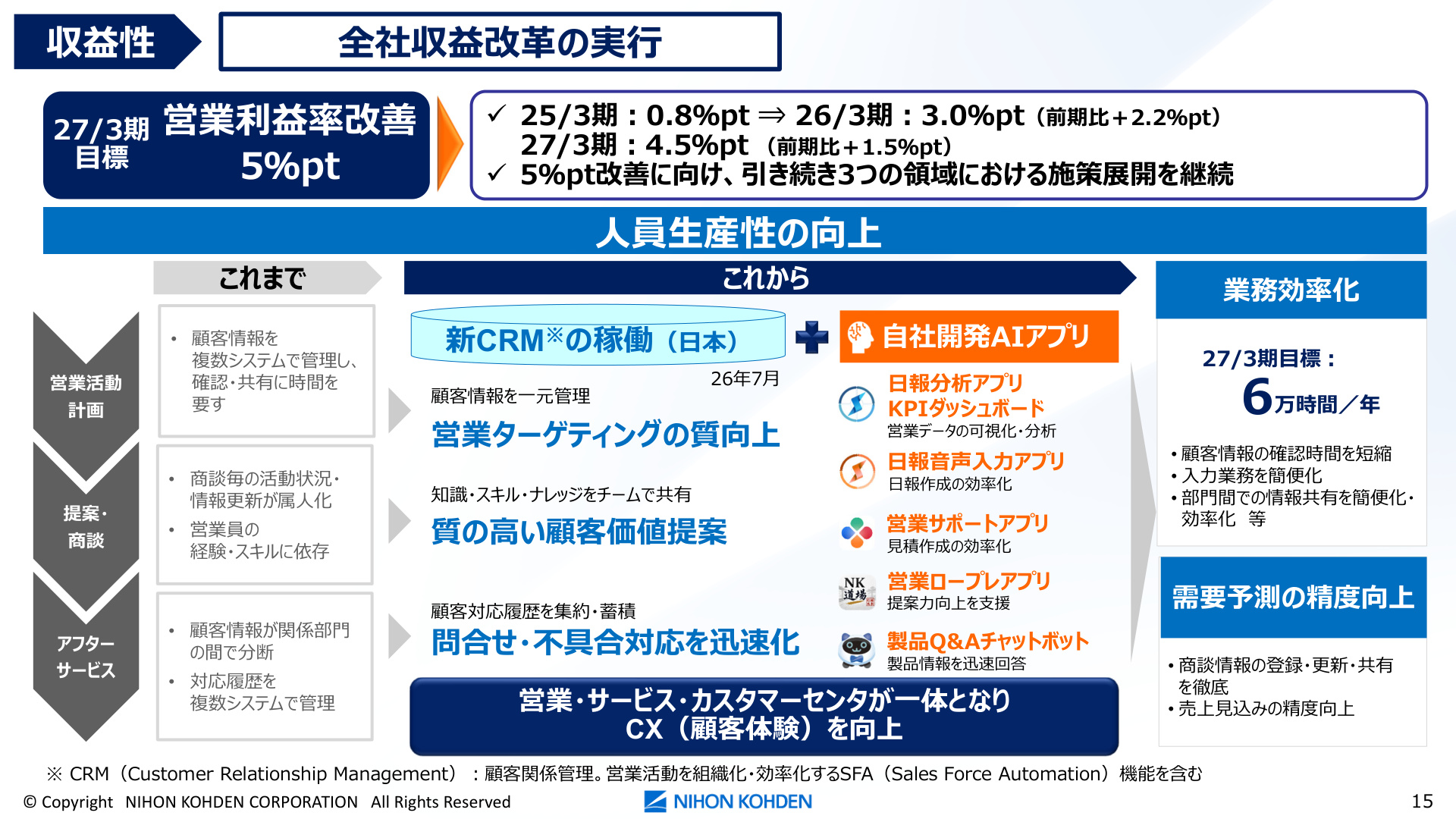
[Why this slide is important/Background]
It covers the specific measures for "improving personnel productivity" and "operational efficiency through DX tools," which are the core of the company-wide profit reform. It demonstrates how the integration of the new CRM with generative AI and proprietary apps will bring about a qualitative shift in sales operations.
[Specific Reform Measures and Effects]
- Launch of New CRM (including SFA functions) (July 2026) : Centralizes previously dispersed customer information and sales history to improve the quality of sales targeting.
- Introduction of Proprietary AI App Suite :
- Daily report analysis app and voice-input app (simplifying reporting tasks)
- Sales support app and quote creation efficiency tools
- Product Q&A chatbot and role-playing app (NK Dojo)
- Performance Goals : These initiatives aim to achieve 60,000 hours of annual operational time reduction while improving demand forecasting accuracy and sales projection precision through the thorough accumulation of sales information.
8. Financial Soundness (B/S)
As of the end of June 2026, the financial position shows a tightened balance sheet and a solid financial foundation.
- Total Assets : 246,158 million yen (down 10,380 million yen from the end of the previous fiscal year)
- Main change: Current assets such as notes and accounts receivable decreased by 16,100 million yen due to progress in sales collections.
- Liabilities : 68,867 million yen (down 7,847 million yen from the end of the previous fiscal year)
- Main changes: Decrease in notes and accounts payable (△3.5 billion yen) and bonuses payable (△3.1 billion yen).
- Net Assets : 177,291 million yen (down 2,533 million yen from the end of the previous fiscal year)
- Equity Ratio : Rose from 70.1% at the end of the previous fiscal year to 72.0% .
The equity ratio remains at an extremely high level in the 70% range, providing a rock-solid capital structure that can withstand temporary losses and large-scale capital investments.
9. Cash Flow, Capital Investment, and R&D Plan
Q1 operating cash flow was 8,141 million yen (up 2,229 million yen YoY) , demonstrating steady cash-generating capability as the collection of trade receivables progressed. Free cash flow (FCF) also improved significantly to a positive 7,812 million yen (up 3,061 million yen YoY) .
[Progress in Capital Investment and R&D]
- Q1 Results : Capital investment 395 million yen, depreciation 1,281 million yen, R&D expenses 1,791 million yen.
- Full-year Plan : Capital investment 6,000 million yen, depreciation 6,000 million yen, R&D expenses 7,700 million yen.
- Core Facility/Infrastructure Investment :
- Tsurugashima Production Center (Total investment approx. 11 billion yen) : Construction started in July 2024, building completion scheduled for October 2025, and operations on track for March 2026.
- New CRM and PLM/MES Systems : Scheduled to go live sequentially between September and November 2025.
Concentrated investment in the consolidation of production bases and the renewal of core systems will support future manufacturing cost reductions and operational accuracy improvements.
10. Maintaining Full-Year Outlook and V-shaped Recovery Scenario for H2
Despite the operating loss in Q1, Nihon Kohden has maintained its full-year earnings forecast announced at the beginning of the fiscal year.
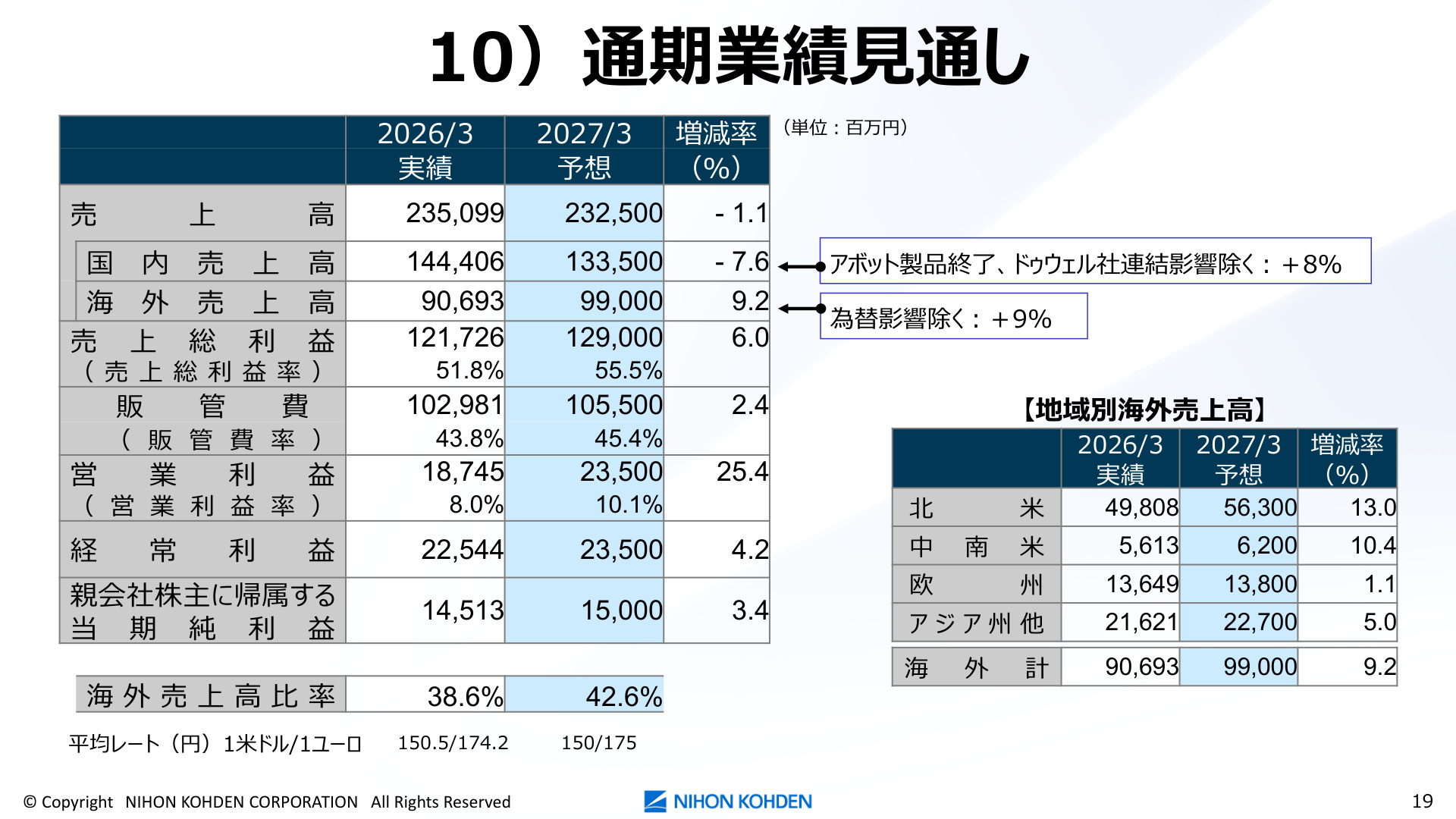
[Why this slide is important/Background]
It clearly outlines the company-wide plan to achieve a significant profit increase for the full year (operating profit up 25.4% YoY) , despite the transitional Q1 loss. It is the most important slide supporting the H1-weighted cost structure and the roadmap for sales recovery and product mix improvement toward the second half.
[Full-Year Consolidated Earnings Forecast (FY2027/3)]
- Net Sales : 232.5 billion yen (down 1.1% YoY / +8% excluding Abbott/Dowell impact)
- Operating Profit : 23.5 billion yen (up 25.4% YoY / Operating margin 10.1% )
- Ordinary Profit : 23.5 billion yen (up 4.2% YoY)
- Net Income Attributable to Owners of the Parent : 15.0 billion yen (up 3.4% YoY)
- Assumed Exchange Rates : 1 USD = 150 JPY, 1 EUR = 175 JPY
[Basis for Achieving Full-Year Targets]
- Completion of Abbott Impact : From Q2 (July-September) onwards, the revenue impact will ease as the Abbott product handover is completed, and the ratio of high-margin proprietary products will increase further.
- Sales Growth in All Overseas Regions : With North America (+13.0% YoY), Europe (+1.1%), Asia and Others (+5.0%), and Latin America (+10.4%), the company expects total overseas sales of 99 billion yen (up 9.2% YoY, +9% excluding currency) .
- Realization of Profit Reform Measures : Cost reduction effects from company-wide profit reforms (price optimization, reduction of idle costs, operational efficiency via DX tools) will accelerate toward the second half, aiming for an operating profit margin of 10.1%.
Summary
Nihon Kohden’s Q1 FY2027 earnings represented a temporary bottom , impacted by the transitional effects of the Abbott product exit and upfront costs from wage hikes and system investments. However, analysis reveals that structural reforms for the mid-to-long-term growth story are progressing steadily as planned, evidenced by improved gross margins from a higher proprietary product ratio, the strength of overseas operations in Europe and Asia, and the smooth expansion of DHS solutions.
Whether the company stays on track to achieve its full-year operating profit target of 23.5 billion yen (up 25.4% YoY) as the Abbott impact fades and profit reforms take full effect from Q2 onwards will be the key point to watch.
This content is not intended as investment advice or a recommendation. Any opinions expressed are solely the personal views of each article.