


Seiko Epson FY2026 Q1 Earnings & Full-Year Guidance Upgrade Deep Dive: Growth in High-Value Segments, Pricing Power, and Tariff Refunds Drive Performance

StockClub
Published: Aug 06, 2026, 10:59 AM
Sentiment Analysis

Seiko Epson Corporation’s FY2026 (ending March 31, 2027) Q1 financial results demonstrated significant year-on-year growth in both revenue and profit. This performance was driven by the tailwind of a weaker yen and robust demand in growth areas, particularly Precision Innovation. Furthermore, the company announced an upward revision to its full-year earnings and dividend forecasts , alongside a 30 billion yen share buyback program , citing successful price adjustments and the incorporation of U.S. tariff refunds. This report provides a comprehensive analysis of the company's performance structure, segment trends, growth strategies, and shareholder return policies based on the official earnings materials.
1. Q1 Earnings Overview: Strong Demand and FX Tailwinds Drive Growth
In the first quarter (Q1) of FY2026, consolidated results reached 367.2 billion yen in revenue (+14.4% YoY), 22.1 billion yen in business profit (+12.0% YoY), 20.6 billion yen in operating profit (+45.7% YoY), and 13.0 billion yen in profit attributable to owners of the parent (+96.4% YoY). These figures represent a strong start, significantly outperforming the same period last year.
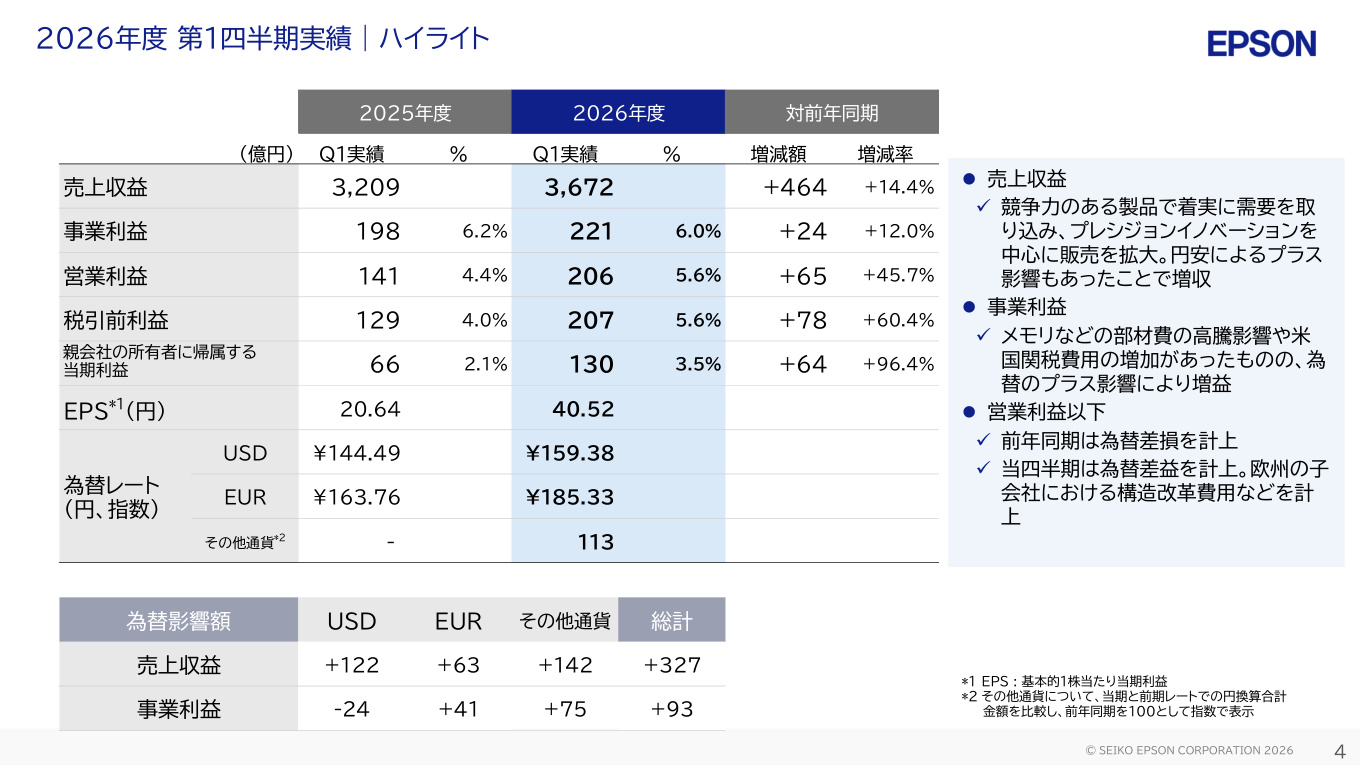
Slide 4 (Q1 Results Highlights) above serves as the foundational data for this earnings report. It is critical because it illustrates the offsetting structure between positive and negative factors in the business environment as revenue flows down to profit levels.
Specifically, the company faced cost pressures (negative factors) such as rising prices for components like memory and U.S. tariff expenses, which had a negligible impact in the same period last year. However, these were more than offset by strong demand for highly competitive product lines—particularly in Inkjet Solutions and Microdevices (volume growth effect)—and the positive impact of the weaker yen, which contributed +32.7 billion yen to revenue and +93 billion yen to business profit . Even after accounting for the shift from foreign exchange losses in the previous year to foreign exchange gains this quarter, and factoring in structural reform costs, the company achieved substantial growth across all profit levels from operating profit downward.
2. Business Profit Trends and Significant Full-Year Guidance Upgrade
Following the solid progress in Q1, Seiko Epson has revised its full-year earnings forecast for FY2026. According to the updated guidance, revenue is projected at 1.51 trillion yen (+60 billion yen from previous forecast, +6.8% YoY), business profit at 105 billion yen (+15 billion yen, +25.3% YoY), operating profit at 101 billion yen (+15 billion yen, +103.8% YoY), and net profit at 69 billion yen (+10 billion yen, +279.1% YoY).
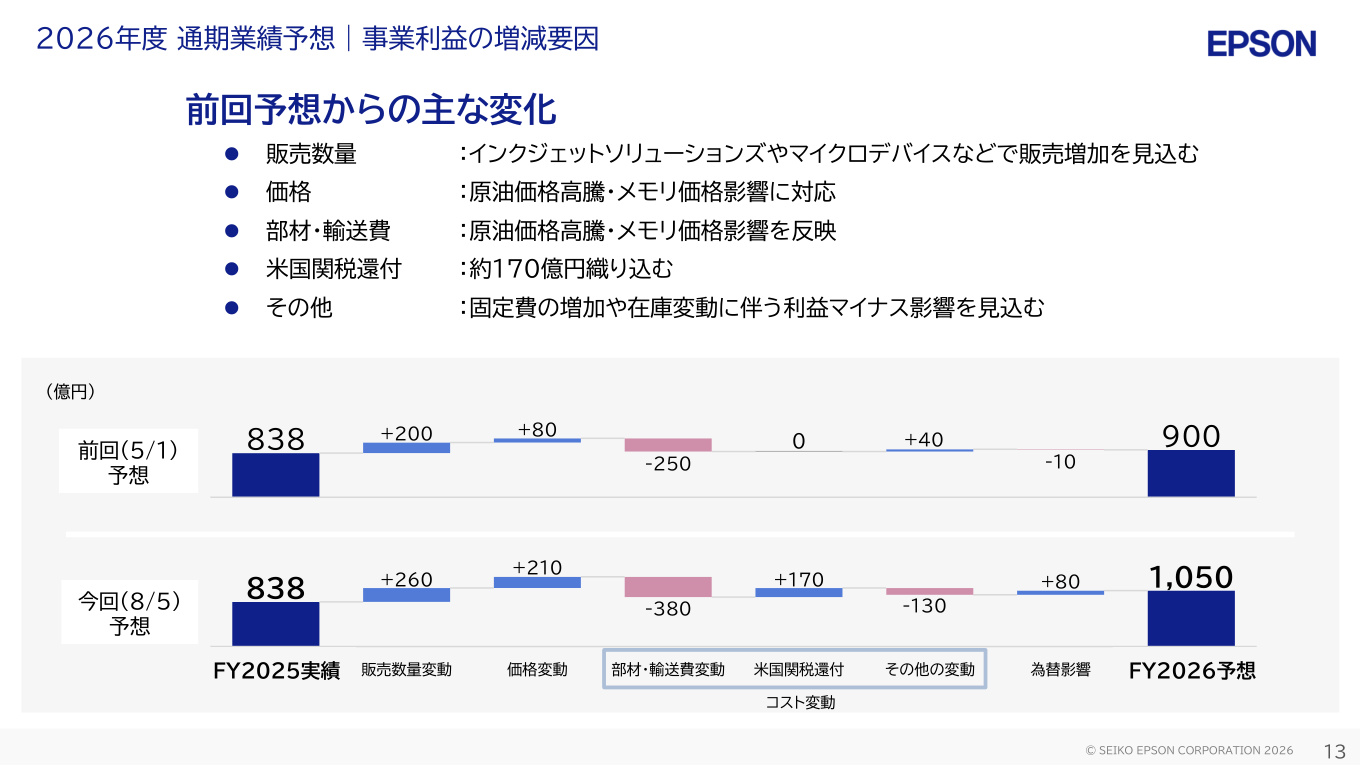
Slide 13 (Full-Year Business Profit Variance Analysis) clearly outlines the background and structure of this upward revision. This slide provides the essential analytical perspective for understanding the management decisions and external environmental changes that led to the increased profit targets.
The five key points in the full-year profit variance analysis are:
- Sales Volume Variance (+26 billion yen) : Anticipated growth in Inkjet Solutions and Microdevices within the Precision Innovation segment.
- Price Variance (+21 billion yen) : Successful implementation of price pass-throughs to offset cost inflation in crude oil and memory prices.
- Material and Logistics Cost Variance (-38 billion yen) : A more conservative outlook on the impact of rising crude oil and memory prices compared to previous forecasts, incorporating these cost pressures.
- U.S. Tariff Refunds (+17 billion yen) : Newly incorporated profit from the refund of previously incurred U.S. tariffs.
- FX Impact (+8 billion yen) : Revision of full-year exchange rate assumptions to 156.00 JPY/USD and 178.00 JPY/EUR to reflect current market conditions.
Against the negative impact of rising costs (-38 billion yen), the combined positive effects of volume growth, price pass-throughs, tariff refunds, and FX tailwinds have created a robust scenario, leading to an upward revision of business profit to 105 billion yen , surpassing the 100 billion yen milestone.
3. Segment Performance and Growth Strategy
Q1 results and full-year outlooks for each segment reflect the specific demand environments and strengths of each business.
(1) Precision Innovation (Core Growth Driver)
- Q1 Results : Revenue 49.8 billion yen (+23.5%), Segment Profit 15.5 billion yen (+62.1%), Profit Margin 31.2% .
- Full-Year Forecast : Revenue 195 billion yen (+16.4% YoY), Segment Profit 55 billion yen (+24.9% YoY).
- Key Trends : Growth is driven by Inkjet Solutions, which secured large-scale projects in China, and Microdevices (e.g., quartz devices) , which continue to see strong demand from data centers, industrial, and automotive sectors. Epson Atmix’s ultra-high-performance metal powders are also contributing to earnings through increased production capacity, making this the highest-margin segment.
(2) Industrial & Robotics (Expansion in Industrial Fields)
- Q1 Results : Revenue 82 billion yen (+17.9%), Segment Profit 5.5 billion yen (+44.1%).
- Full-Year Forecast : Revenue 325 billion yen (+9.1% YoY), Segment Profit 31 billion yen (+53.4% YoY).
- Key Trends : Commercial and industrial printing remains steady in photo, signage, and label applications. The robotics business is also steadily securing projects, and the segment expects a significant increase in full-year profit due to revised FX assumptions and the reflection of U.S. tariff refunds.
(3) Office & Home Printing (Structural Reform and Adaptation)
- Q1 Results : Revenue 167 billion yen (+12.3%), Segment Profit 11.4 billion yen (-21.7%).
- Full-Year Forecast : Revenue 712 billion yen (+2.8% YoY), Segment Profit 58 billion yen (-5.2% YoY).
- Key Trends : While Q1 saw a profit decline due to rising material/logistics costs, increased U.S. tariff expenses, and temporary inventory reductions, sales of high-capacity ink tank models and office shared models remain steady. The company plans to minimize the full-year profit decline through price revisions and tariff refunds.
(4) Visual & Lifestyle (Demand Recovery and Special Demand)
- Q1 Results : Revenue 67.2 billion yen (+7.2%), Segment Profit 4.2 billion yen (-30.1%).
- Full-Year Forecast : Revenue 271 billion yen (+8.0% YoY), Segment Profit 22 billion yen (+30.0% YoY).
- Key Trends : Visual Products (projectors) are expected to benefit from large-scale educational projects and FIFA World Cup-related demand . The segment is projected to turn around from the Q1 profit decline to a +30.0% increase in full-year segment profit .
4. Financial Position, Cash Flow, and Capital Efficiency
The company continues to maintain financial health and improve capital efficiency.
- Inventory Optimization : Total inventory reached 393.2 billion yen, with turnover days shortening to 98 days from 102 days in the previous quarter, indicating a normalization from supply chain disruptions.
- Cash Flow : FY2026 Free Cash Flow (FCF) is projected at 70 billion yen (Operating CF 140 billion yen, Investing CF -70 billion yen). The company maintains strong cash-generating capabilities while ensuring investments for future growth, such as 46 billion yen in R&D and 85 billion yen in capital expenditure.
- Capital Efficiency (ROIC/ROE) : Based on full-year forecasts, ROIC is expected to reach 6.8% (5.5% in the previous year), ROE 8.1% (2.2% in the previous year), and ROS 7.0% , marking steady progress toward long-term goals (FY2028 targets: ROIC 8.0%, ROE 10.0%).
5. Shareholder Return Policy: Dividend Increase and Large-Scale Share Buyback
Seiko Epson is presenting an aggressive shareholder return stance to improve capital efficiency and maximize shareholder value while continuing growth investments.
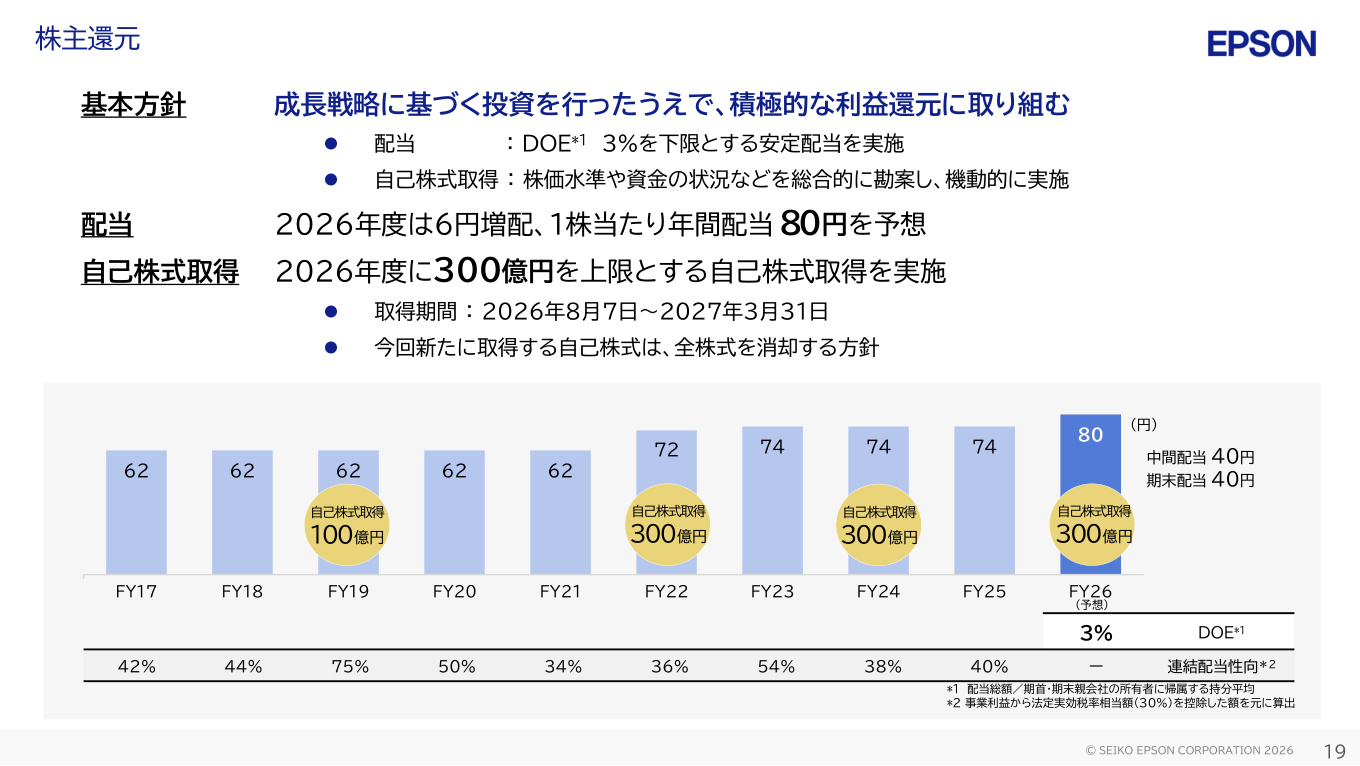
Slide 19 (Shareholder Returns) above is a key slide visualizing the company's commitment to executing its return policy and its dedication to returning profits to shareholders.
Specific elements of the return policy include:
- Dividend Increase Forecast : Maintaining a basic policy of "stable dividends with a DOE of 3% as a lower limit," the FY2026 annual dividend forecast is set at 80 yen per share (40 yen interim, 40 yen year-end), an increase of 6 yen from the previous year.
- Large-Scale Share Buyback : The company announced a share buyback program of up to 30 billion yen (period: August 7, 2026, to March 31, 2027). Furthermore, the company has established a policy to cancel all newly acquired shares , a measure directly linked to increasing value per share (preventing dilution).
- Return Track Record : The company has consistently combined flexible share buybacks with adherence to dividend payout ratios and DOE criteria, clearly demonstrating management's shareholder-centric approach.
6. Summary and Outlook
Despite facing headwinds in the macro environment, such as rising material costs and increased tariff expenses, Seiko Epson achieved earnings growth in Q1 FY2026 by leveraging product competitiveness to drive volume, agile price adjustments, FX tailwinds, and the incorporation of U.S. tariff refunds .
Key points to watch in future business development include:
- Penetration of Price Revisions : Whether the company can maintain profit margins through planned price pass-throughs in the face of high oil and memory prices.
- Continued Growth in High-Value Segments (e.g., Precision Innovation) : Whether strong demand for data center-related quartz devices and high-performance metal powders will persist.
- Realization of U.S. Tariff Refunds and Risk Management : Flexibility of the cost structure against external uncertainties.
- Progress of Share Buybacks (30 billion yen) and Cancellation : Steady execution of return measures to improve capital efficiency.
Armed with high technological capabilities and a global customer base, Seiko Epson’s focus on structural reform and concentrated investment in growth areas makes its future performance a key area to watch.
This content is not intended as investment advice or a recommendation. Any opinions expressed are solely the personal views of each article.