


Hokuriku Electric Industry (6524) H1 FY2026 Earnings Deep Dive: Strong Performance in Core Segments Drives Significant Upward Revision to Full-Year Guidance

StockClub
Published: Aug 06, 2026, 10:54 AM
Sentiment Analysis
Hokuriku Electric Industry Co., Ltd. (Ticker: 6524), a leading global manufacturer of lead terminals for aluminum electrolytic capacitors and components for subsea optical communications, has released its financial results for the first half of the fiscal year ending December 2026. This report provides a detailed analysis of the company's performance, segment-specific trends, shifts in the business environment, and its mid-to-long-term growth trajectory, organized into 10 key topics based on the disclosed materials.
1. H1 FY2026 Earnings Highlights: Achieving Significant Revenue and Profit Growth
For the first half of FY2026 (January–June 2026), the company reported consolidated net sales of 10,023 million yen (+27.3% YoY) , operating profit of 2,949 million yen (+62.7% YoY) , ordinary profit of 3,151 million yen (+142.9% YoY) , and net income attributable to owners of the parent of 2,123 million yen (+251.0% YoY) , marking a substantial increase compared to the same period last year.
The increase in marginal profit resulting from higher sales successfully absorbed rising costs in raw materials and labor, leading to a significant improvement in the operating profit margin from 23.0% in the previous year to 29.4% (+6.4 percentage points) . On a quarterly basis, the second quarter (April–June) showed an acceleration in growth, with sales up 20.5% and operating profit up 42.2% compared to the first quarter (January–March).
2. Significant Upward Revision to Full-Year Guidance and Its Background
Following the strong performance in the first half, the company has revised its consolidated full-year earnings forecast for FY2026.
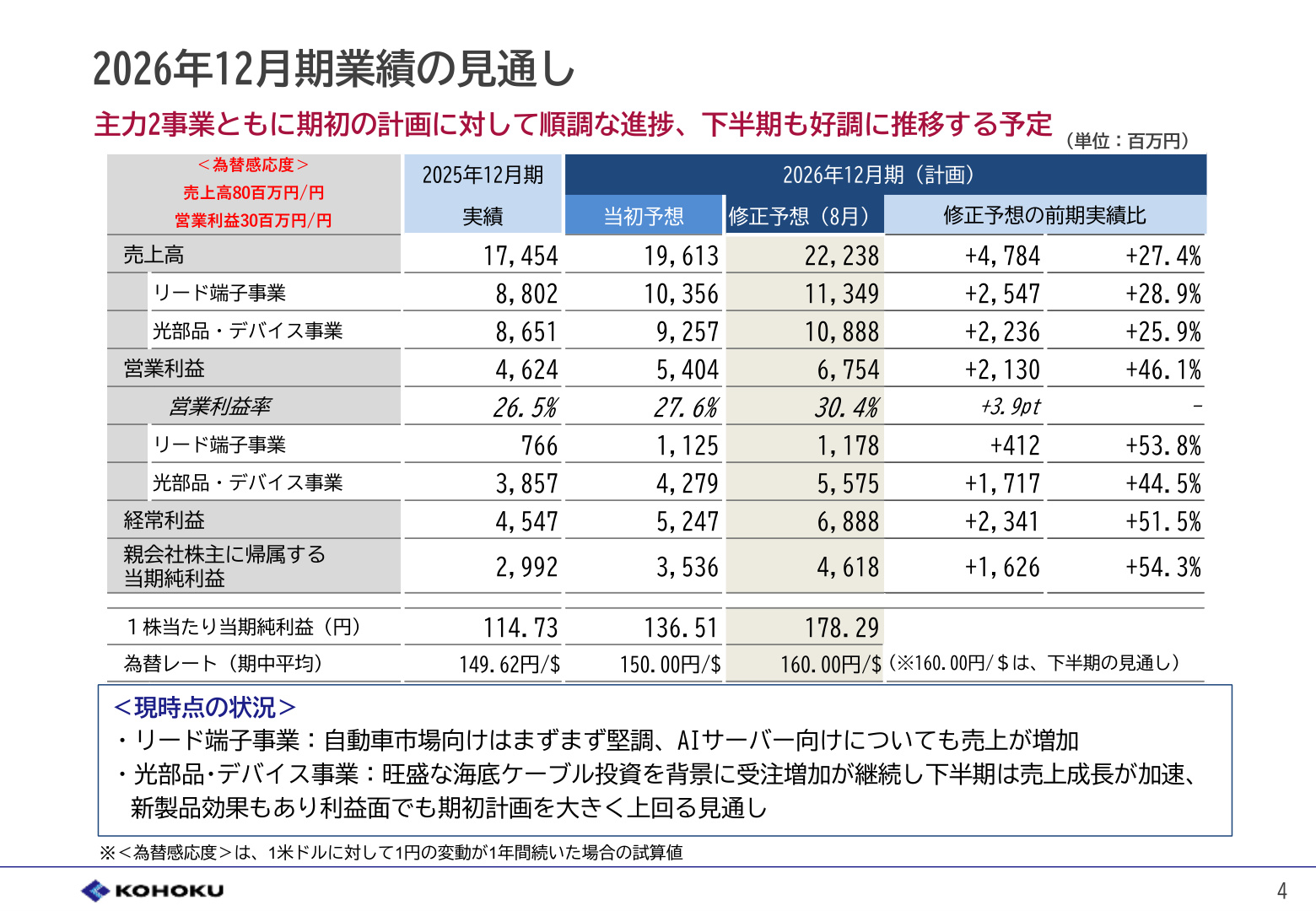
[Slide 4 Commentary: Revision of Full-Year Earnings Forecast]
The slide above is a critical document comparing the initial full-year plan for FY2026 with the revised forecast (announced in August) and the previous year's results. The revised plan projects net sales of 22,238 million yen (+27.4% YoY, +13.4% vs. initial forecast) , operating profit of 6,754 million yen (+46.1% YoY, +25.0% vs. initial forecast) , and an operating profit margin of 30.4% , significantly exceeding initial expectations.
The primary drivers for the revision are as follows:
- Lead Terminal Business : While the automotive market recovery remains gradual, it has stayed resilient, and sales of lead terminals for AI servers have surged . Price pass-throughs for rising material costs have also progressed.
- Optical Components & Devices Business : Orders have grown against the backdrop of active global investment in subsea cable projects . Contributions from new products and an improved product mix have also been significant.
- Exchange Rates : The full-year assumption has been adjusted from 1 USD = 150.00 JPY to 160.00 JPY (for the second half) . The exchange rate sensitivity (an impact of 80 million yen in annual sales and 30 million yen in operating profit per 1 yen fluctuation) has also acted as a tailwind.
3. Analysis of Profit Structure and Operating Profit Variance
A waterfall analysis of the operating profit variance for the first half (+1,137 million yen YoY) clarifies the growth drivers:
- Positive Factors : Increased sales volume contributed +1,580 million yen , and exchange rate effects contributed +567 million yen .
- Negative Factors : Higher cost of sales due to rising raw material prices ( -687 million yen ), increased labor costs ( -215 million yen ), higher expenses ( -267 million yen ), and increased personnel costs in SG&A ( -82 million yen ).
Real sales growth and favorable exchange rates have clearly outweighed the burden of rising costs, demonstrating the success of cost control measures and the shift toward high-value-added products.
4. Financial Position and Cash Flow Trends
Reflecting the strong performance, the company's cash-generating ability has improved dramatically.
- Assets : Total assets expanded from 28,319 million yen at the end of FY2025 to 31,213 million yen (+2,894 million yen) , primarily driven by a 2,487 million yen increase in cash and deposits to 10,905 million yen .
- Cash Flow : Operating cash flow surged from 803 million yen in the same period last year to 4,083 million yen . This was driven by higher pre-tax profit and a decrease in trade receivables (+1,261 million yen). With investment cash flow limited to -863 million yen, the company secured a substantial free cash flow of 3,220 million yen (compared to 461 million yen in the same period last year).
With a robust equity ratio (net assets of 25,489 million yen, equity ratio of approximately 81.7%), the company maintains a solid financial foundation for future capital investment and shareholder returns.
5. Segment Analysis ①: Lead Terminal Business Trends and AI Server Demand
The Lead Terminal business saw significant growth in the first half, with net sales of 5,360 million yen (+29.2% YoY) and operating profit of 549 million yen (+60.2% YoY) . Despite the delayed bottoming out of the consumer electronics and PC markets and the sluggish recovery in the European and Chinese automotive markets, demand for high-performance lead terminals for generative AI servers has been a strong driver.
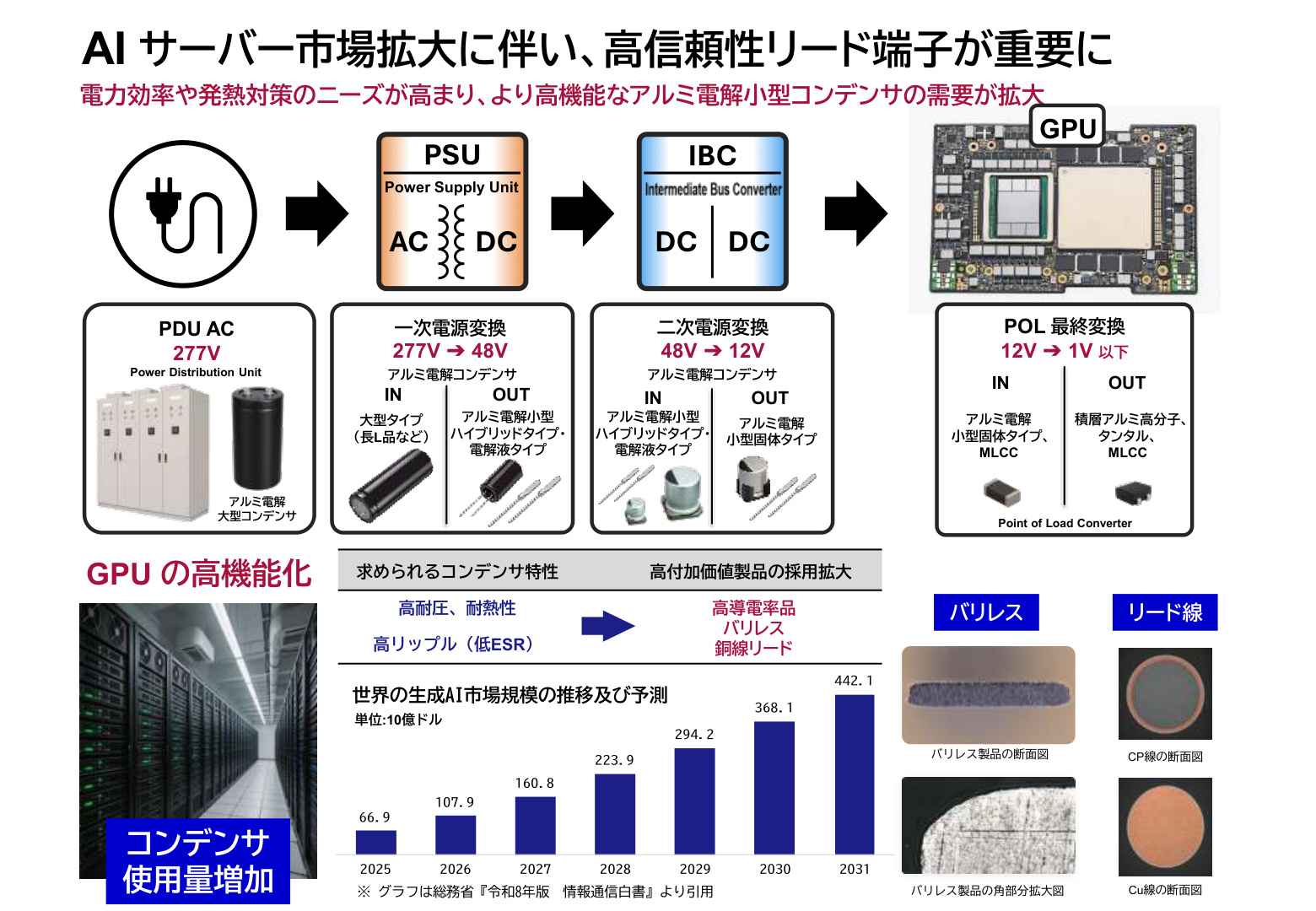
[Slide 24 Commentary: AI Server Market Expansion and High-Reliability Lead Terminals]
The slide above explains the structure of "AI server demand," the most significant announcement for the mid-to-long-term growth of the lead terminal business. Because GPUs in AI servers consume massive amounts of power, small aluminum electrolytic capacitors with high voltage resistance, heat resistance, and low ESR (Equivalent Series Resistance) are essential for the multi-stage power conversion (AC to DC, DC to DC) from power supply units to GPU cores.
The company supplies high-value-added products such as high-conductivity terminals, burr-less products, and copper wire leads used in these high-performance capacitors. As the global generative AI market expands, the share of AI servers in the small aluminum electrolytic capacitor market is estimated to grow from 1.9% in 2025 to 8.9% by 2030 . In the company's sales mix, this segment rose to approximately 7% as of June 2026 (up sharply from about 3% in March 2026).
6. Product Value-Add and Maintaining Automotive Market Share
The business is not only seeing volume growth but also product mix improvement (higher value-add) .
- High-Value-Added Ratio : Adoption of leakage current countermeasures (resin coating) and laser welding technology (nickel plating, etc.) is increasing. The ratio of high-value-added products to total sales is expected to rise from 5.1% in 2021 to 25.0% in FY2026 , with a target of 30.0% by FY2028 .
- Automotive Market : The company has maintained a 95% global market share in automotive (drivetrain) applications. With the increase in electrical components due to electrification (HEV/BEV), the automotive sales ratio remains above 50% (projected at 53% for FY2026).
- Production Efficiency : Automation and labor-saving at the headquarters plant have progressed, with consolidated OEE (Overall Equipment Effectiveness) improving from 82.9% in Q1 to 84.2% in Q2.
7. Segment Analysis ②: Structural Growth in Optical Components & Devices
The Optical Components & Devices business reported net sales of 4,662 million yen (+25.2% YoY) and operating profit of 2,400 million yen (+63.3% YoY) , highlighting the strength of its high-margin business model ( H1 operating profit margin of 51.5% ).
For the full year, the segment is expected to remain a powerful profit driver, with projected sales of 10,888 million yen (+25.9% YoY), operating profit of 5,575 million yen (+44.5% YoY), and an operating profit margin of 51.2% .
8. Rising CapEx by US Cloud Providers and Subsea Cable Demand
The strong performance of the Optical Components & Devices business is backed by global hyperscale data center investment and the resulting expansion of international communication infrastructure.
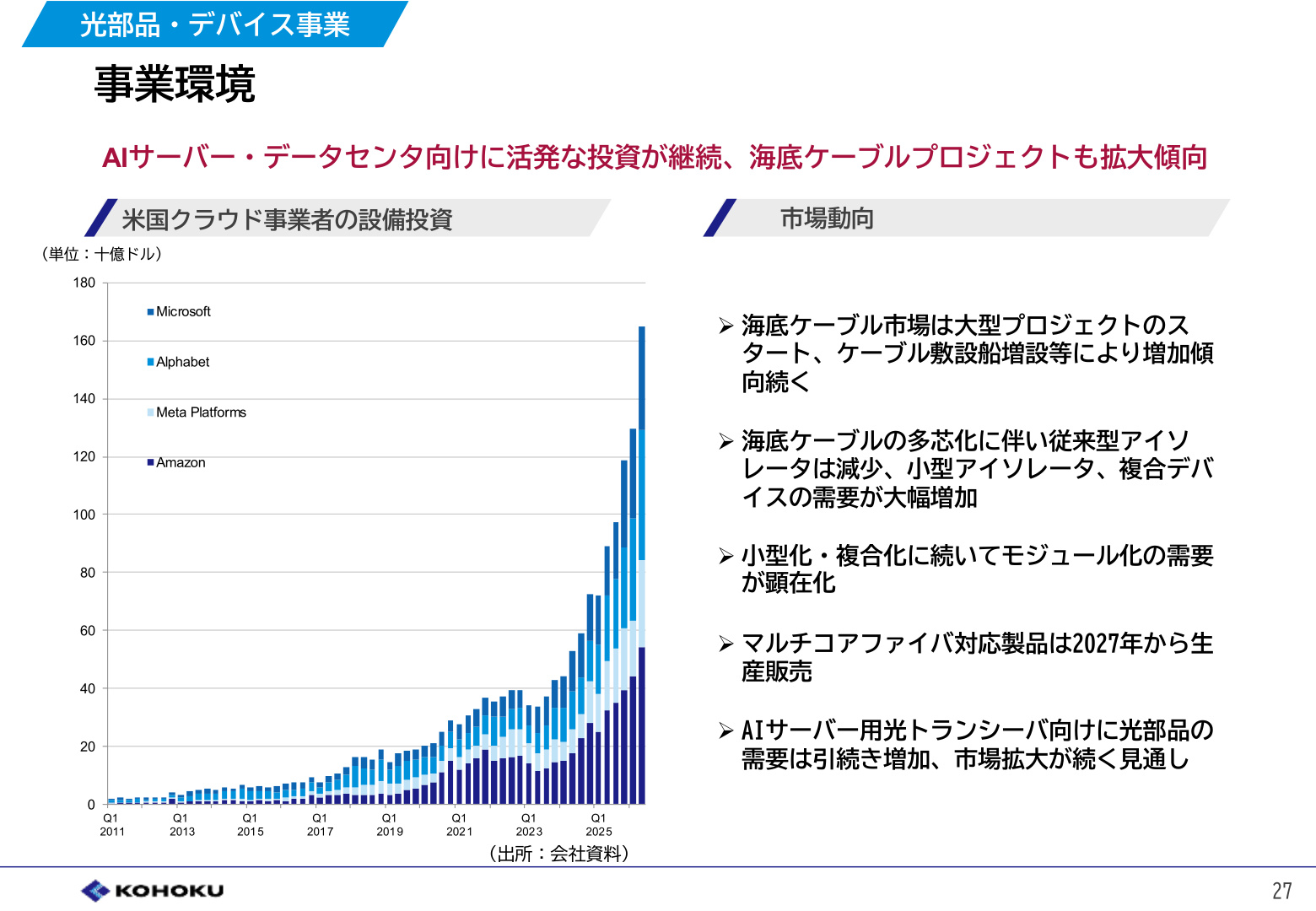
[Slide 27 Commentary: US Cloud Provider CapEx and the Optical Components Market]
This slide shows the trend in capital expenditure (CapEx) by major US cloud providers (Microsoft, Alphabet, Meta, Amazon) and the optical components market. With the spread of generative AI, cloud provider CapEx is expanding at record levels, leading to a surge in the following demands:
- Subsea Cable Expansion : To handle the explosive increase in intercontinental data traffic, large-scale projects (Project Waterworth, SeaMeWe-6, etc.) are launching in succession.
- Shift to Multi-Core and Composite Devices : As transmission capacity increases, demand is shifting from traditional single-function isolators to compact isolators and composite devices that integrate multiple functions .
- Demand for AI Server Optical Transceivers : Inquiries for optical components used in data center internal optical connections (transceivers) remain robust.
The company holds an extremely high global market share in optical isolators for subsea cables and is directly capturing the wave of infrastructure investment.
9. Technology Development and Production Capacity Expansion
To meet growing demand, the company is advancing technology development and production capacity.
- Product Development : In addition to starting production and sales of composite optical devices, the company is launching a production line for next-generation FIFO devices for multi-core fibers (scheduled to start production for terrestrial use from the end of 2026). Furthermore, it is expanding development of high-speed optical switches using PLZT and sales of high-purity synthetic silica glass (SSG®) products for semiconductor manufacturing equipment.
- Production Capacity : The Sri Lanka plant , which handles back-end processes, is increasing semi-automated equipment (the 3rd unit is scheduled for launch in 2027) and expanding floor space. The company is also improving yields and adding large sintering furnaces at the front-end (headquarters) plant.
10. Future Growth Strategy and Outlook for CapEx and R&D
The company continues to invest aggressively in facilities and R&D for sustainable future growth.
- Capital Investment Plan : Capital expenditure for FY2026 is planned at 1,093 million yen, focusing on increasing production capacity for high-purity synthetic silica glass and subsea cable optical components, as well as decarbonization investments. Note that part of the construction costs for the Maibara plant (scheduled for completion in 2028, approx. 600 million yen) has been deferred to 2027, resulting in a downward adjustment from the initial plan (2,177 million yen).
- R&D Expenses : The company plans to spend 741 million yen for the full year of FY2026 (+15.6% YoY), focusing on technologies that support next-generation communication and power infrastructure, such as leakage current countermeasures, laser welding technology, multi-core fiber-compatible devices, and high-speed optical switches.
Summary
Hokuriku Electric Industry's H1 FY2026 results demonstrate significant revenue and profit growth in both core segments, driven by two global structural shifts: the proliferation of generative AI servers and global investment in subsea optical communication infrastructure .
In the Lead Terminal business, profitability has improved through an increased ratio of high-value-added products for AI servers, price pass-throughs, and automation. In the Optical Components & Devices business, the company is capturing demand from large-scale subsea cable projects while maintaining an operating profit margin exceeding 50%. With an upward revision to full-year guidance, abundant operating cash flow, and a solid financial foundation, the company has demonstrated that its investment cycle for production capacity expansion and next-generation technology development is operating smoothly.
This content is not intended as investment advice or a recommendation. Any opinions expressed are solely the personal views of each article.