


SOLIZE Holdings FY2026 Q2 Earnings Deep Dive: A Growth Story Driven by Holding Company Transition and Human Capital Investment

StockClub
Published: Aug 06, 2026, 10:47 AM
Sentiment Analysis

1. Introduction: Mid-to-Long-Term Growth Vision and Strategic Goals
SOLIZE Holdings (Securities Code: 5871) operates as "The Generative Company," supporting the transformation of manufacturing and other enterprises through digital technology. In July 2025, the company transitioned to a holding company structure, clearly separating and optimizing group-wide strategic planning and resource allocation from the autonomous business operations of its subsidiaries. By combining the expansion of existing domains, the creation of new business areas, and an active M&A strategy, the company has set mid-to-long-term growth targets of JPY 40 billion in revenue by 2027 and JPY 100 billion by 2033 .
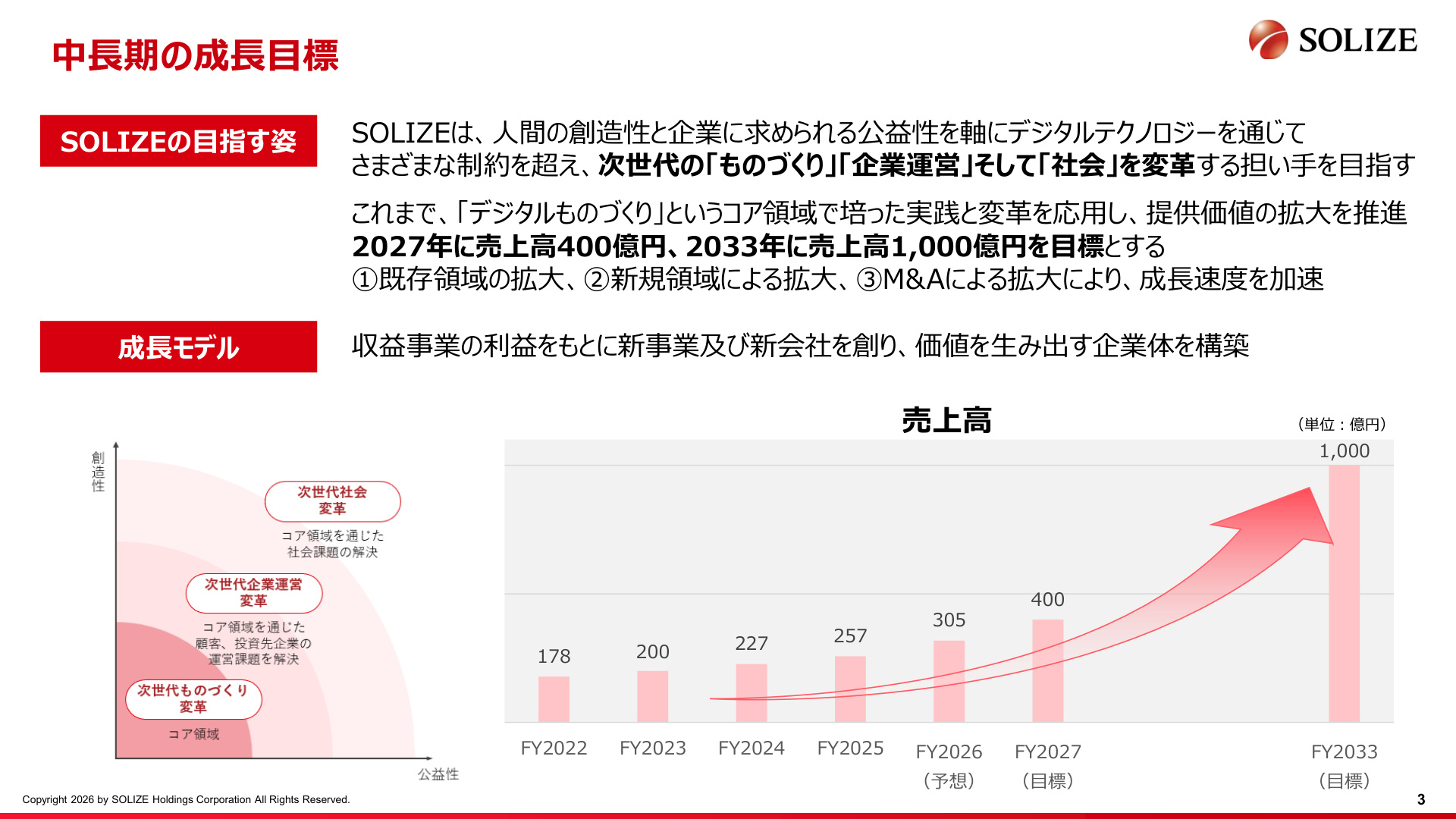
The slide above (Slide 3) is a critical chart illustrating the company's mid-to-long-term roadmap and growth targets. Revenue has grown steadily from JPY 17.8 billion in FY2022 to JPY 25.7 billion in FY2025, with projections of JPY 30.5 billion for FY2026, JPY 40 billion for FY2027, and ultimately a leap to JPY 100 billion by FY2033. The model clearly demonstrates a cyclical investment strategy where profits from established businesses are reinvested into new ventures and subsidiaries.
2. FY2026 Q2 Earnings Highlights
For the first half of the fiscal year ending December 2026, the company achieved record-high revenue and gross profit for a cumulative second-quarter period.
- Revenue : JPY 14,274 million ( +16.8% YoY)
- Gross Profit : JPY 3,822 million ( +19.0% YoY)
- Operating Profit : JPY 82 million (an improvement of +JPY 513 million from a loss of JPY 431 million in the same period last year)
- Net Profit (H1) : JPY 30 million (an improvement of +JPY 283 million from a loss of JPY 252 million in the same period last year)
Revenue trended favorably in line with business expansion, and operating profit exceeded the interim forecast. With the initial investment and administrative cost increases associated with the holding company transition now behind it, the company is entering a phase where revenue-driven gross profit growth is outpacing the increase in Selling, General, and Administrative (SG&A) expenses, leading to genuine operating profit generation.
3. Segment Trends and Structural Changes
The company's business is composed of three main segments. The performance trends and background for each are as follows:
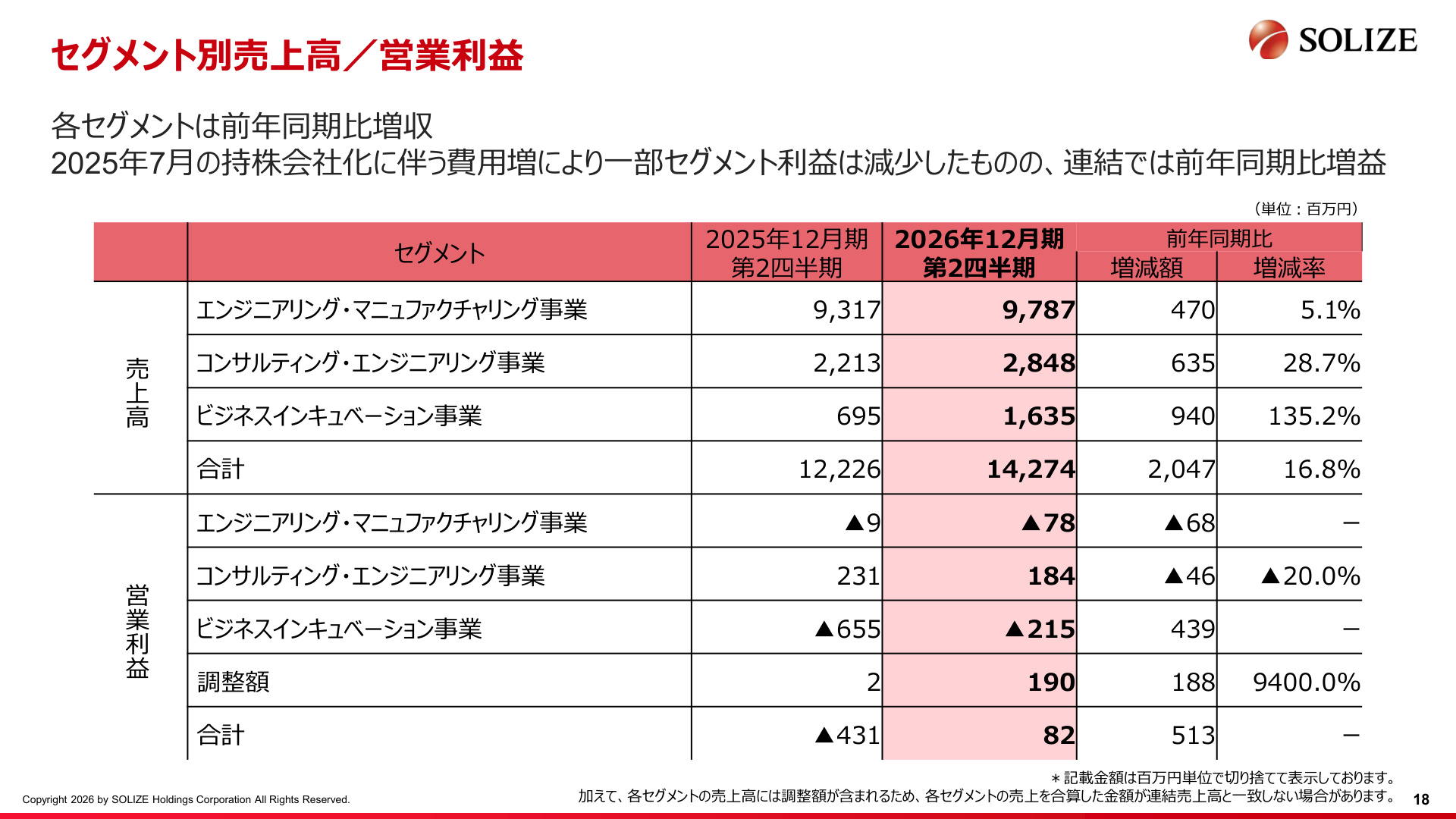
The slide above (Slide 18) shows the trends in revenue and operating profit by business segment. It confirms that all segments achieved year-on-year revenue growth . However, some segment profits have fluctuated due to the reallocation of costs and the transfer of management functions following the transition to a holding company in July 2025.
(1) Engineering & Manufacturing Business
- Revenue : JPY 9,787 million ( +5.1% YoY)
- Segment Profit : -JPY 78 million (down JPY 68 million YoY) Although there was a partial decline in demand for prototype manufacturing and sales of automotive parts in Japan, demand for design and development services remained robust due to the success of upfront investments in human capital , such as increasing the number of engineers and enhancing training. Overseas, software sales in the Indian market expanded. In terms of profit, the segment recorded a temporary loss due to administrative factors, including the transfer of certain management functions to the segment following the holding company transition.
(2) Consulting & Engineering Business
- Revenue : JPY 2,848 million ( +28.7% YoY)
- Segment Profit : JPY 184 million ( -20.0% YoY) The company captured strong demand for Software Defined Vehicle (SDV) projects and transformation consulting in the automotive industry. The progress of large-scale projects and industrial expansion into the heavy industry sector contributed to significant revenue growth. The decline in profit is due to the temporary factor of changes in the allocation method for head office and common expenses following the holding company transition.
(3) Business Incubation Business
- Revenue : JPY 1,635 million ( +135.2% YoY)
- Segment Profit : -JPY 215 million (an improvement of +JPY 439 million YoY) In addition to strong demand from the electrical machinery industry, the revenue contribution from Furex Co., Ltd., which was consolidated starting in Q2 of the fiscal year ending December 2025, contributed significantly to revenue growth. The expansion of outsourced software development and group synergies have led to a substantial reduction in the segment's deficit.
4. Analysis of Operating Profit Factors and SG&A Control
The primary driver behind the significant +JPY 513 million improvement in operating profit for the second quarter (from a loss of JPY 431 million to a profit of JPY 82 million) was the increase in profit from higher revenue (+JPY 609 million) .
Key factors for the change in SG&A expenses include:
- Increase in Personnel Expenses : -JPY 156 million (due to workforce expansion)
- Increase in Rent : -JPY 66 million (due to facility expansion and new office openings)
- Increase in Amortization of Goodwill : -JPY 52 million (due to M&A activities)
- Decrease in R&D Expenses : +JPY 58 million
- Decrease in Commission Fees : +JPY 90 million (due to the transition to a holding company structure)
- Decrease in Other SG&A : +JPY 30 million
As the costs for strengthening the management structure associated with the holding company transition were completed in the fiscal year ending December 2025, the pace of SG&A growth has been contained, evolving into a structure where revenue growth directly translates into operating profit.
5. Analysis of Key KPIs for Human Capital and Business Foundation
The trend in human capital, which is the source of the engineering and consulting businesses, is the most important indicator for assessing future growth potential.
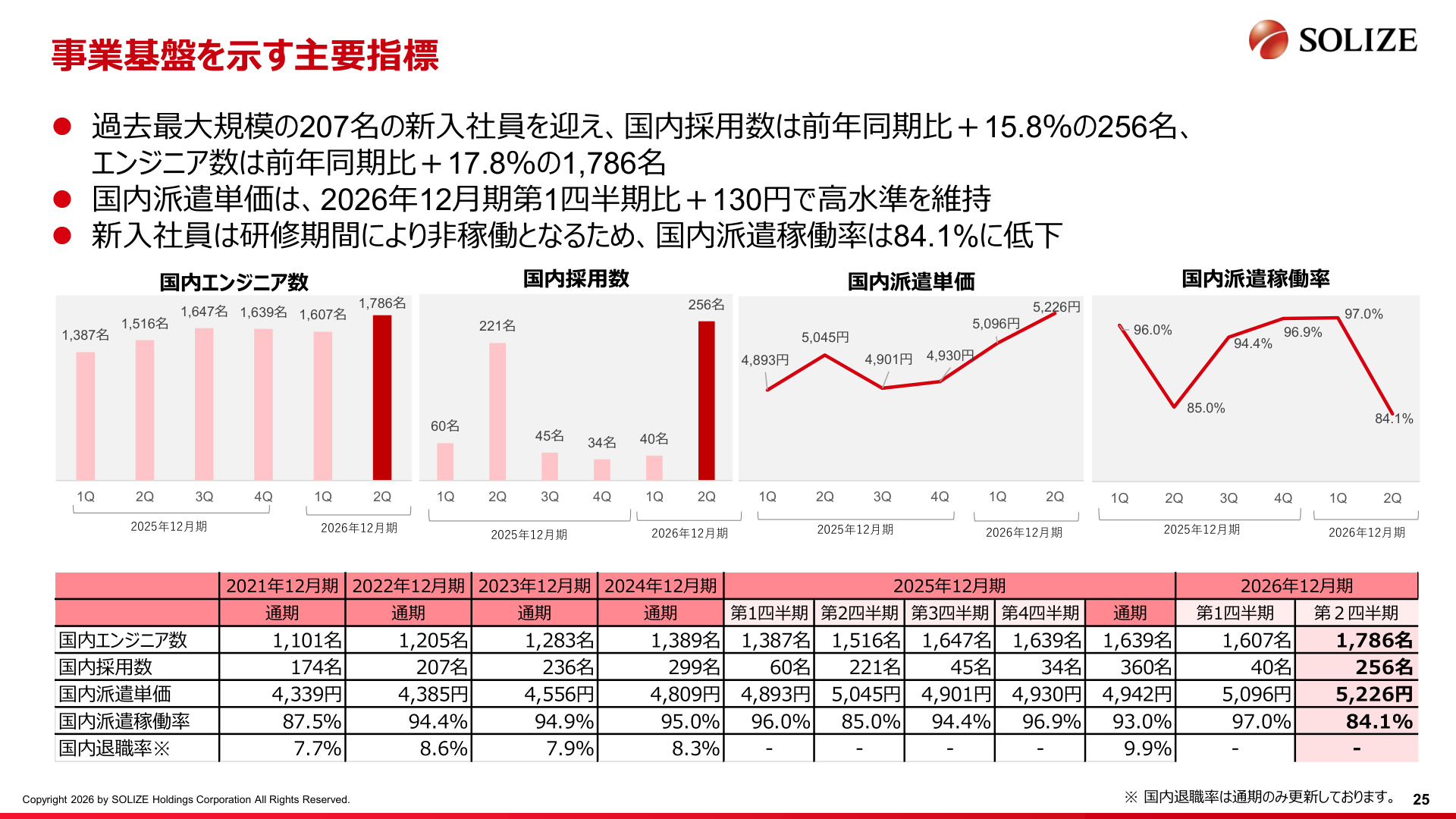
The slide above (Slide 25) lists the key indicators for human capital supporting the business foundation (number of engineers, number of hires, dispatch unit price, and utilization rate). It is clear that the company's growth is supported by the acquisition of high-quality talent and rising unit prices .
- Number of Domestic Engineers : 1,786 ( +17.8% YoY), continuing to expand.
- Number of Domestic Hires : 256 in Q2 FY2026 alone ( +15.8% YoY, including a record-high 207 new graduates).
- Domestic Dispatch Unit Price : JPY 5,226 ( +JPY 130 vs. Q1), maintaining a high level and continuing to rise.
- Domestic Dispatch Utilization Rate : 84.1% (vs. 85.0% in the same period last year). The second quarter typically sees a lower utilization rate due to the training period for new graduates. This is a seasonal factor, and they are scheduled to be assigned to projects sequentially after training concludes.
Although the non-utilization of new hires during their training period temporarily impacts the gross margin, the rise in dispatch unit prices and the expansion of the engineering base are factors that will enhance long-term profitability.
6. Full-Year Earnings Forecast, Risk Response, and Future Growth Strategy
The full-year consolidated earnings forecast for the fiscal year ending December 2026 remains unchanged from the initial plan.
- Revenue : JPY 30,500 million ( +18.3% YoY)
- Operating Profit : JPY 500 million ( +498.7% YoY)
- Ordinary Profit : JPY 500 million ( +525.7% YoY)
- Net Profit : JPY 300 million (vs. -JPY 35 million in the previous year)
External Environment and Risk Response
Some external risks are becoming apparent, such as the postponement or reduction of development projects by major automotive clients, geopolitical risks, and rising crude oil prices due to the worsening situation in the Middle East. The company is responding with the following measures:
- Diversification of Business Portfolio : Accelerating entry into non-automotive sectors such as heavy industry, energy, AI, aerospace, and healthcare to reduce dependence on specific clients and the automotive industry.
- Expansion of Target Processes : Expanding coverage from upstream design and development (SDV/transformation consulting) to downstream processes (3D printer final parts, after-sales support, etc.).
- Global and Regional Expansion : Strengthening business development in India, ASEAN, and North America.
- Thorough Management Control : Ensuring profit through appropriate management while continuing growth investments such as development and hiring.
7. Conclusion
SOLIZE Holdings' Q2 FY2026 earnings report indicates that the company has entered a phase where revenue growth directly translates into operating profit , as the initial costs associated with the transition to a holding company have subsided. Even as some external risks emerge, the rise in dispatch unit prices, the steady increase in the number of engineers, and the profit improvement in the Business Incubation segment provide a solid foundation. This earnings report demonstrates that the company is steadily strengthening its group-wide business foundation toward its ambitious goals of JPY 40 billion in revenue by 2027 and JPY 100 billion by 2033.
This content is not intended as investment advice or a recommendation. Any opinions expressed are solely the personal views of each article.