


Sumitomo Rubber Industries (5110) FY2026 Q2 Earnings Deep Dive Report

StockClub
Published: Aug 06, 2026, 10:38 AM
Sentiment Analysis
Sumitomo Rubber Industries (5110) FY2026 Q2 Earnings Deep Dive Report
Sumitomo Rubber Industries reported record-high revenue for the first half of the fiscal year ending December 31, 2026 (January 1 to June 30), driven primarily by its core tire business. However, while the company upwardly revised its full-year revenue forecast due to favorable exchange rates and successful price pass-throughs, it has lowered its business profit target, citing declining sales volumes in certain overseas markets and an unfavorable product mix.
This report provides a comprehensive analysis based on the company's disclosed financial materials, covering earnings highlights, the structure of profit fluctuations, regional and product strategies, and the progress of the structural reform project, "Project ARK."
1. Q2 Earnings Highlights and Full-Year Forecast Revision
For the first half of FY2026 (January–June), consolidated results showed revenue of 619.8 billion yen (up 8.0% YoY) , business profit of 39.8 billion yen (up 41.2% YoY) , operating profit of 38.1 billion yen (up 41.0% YoY) , and net income of 25.9 billion yen (up 80.2% YoY) , marking a significant increase in profitability.
By segment, the tire business reported revenue of 534.4 billion yen (up 9.4% YoY) and business profit of 34.1 billion yen (up 53.8% YoY) , both reaching record highs and serving as the primary driver of overall performance.
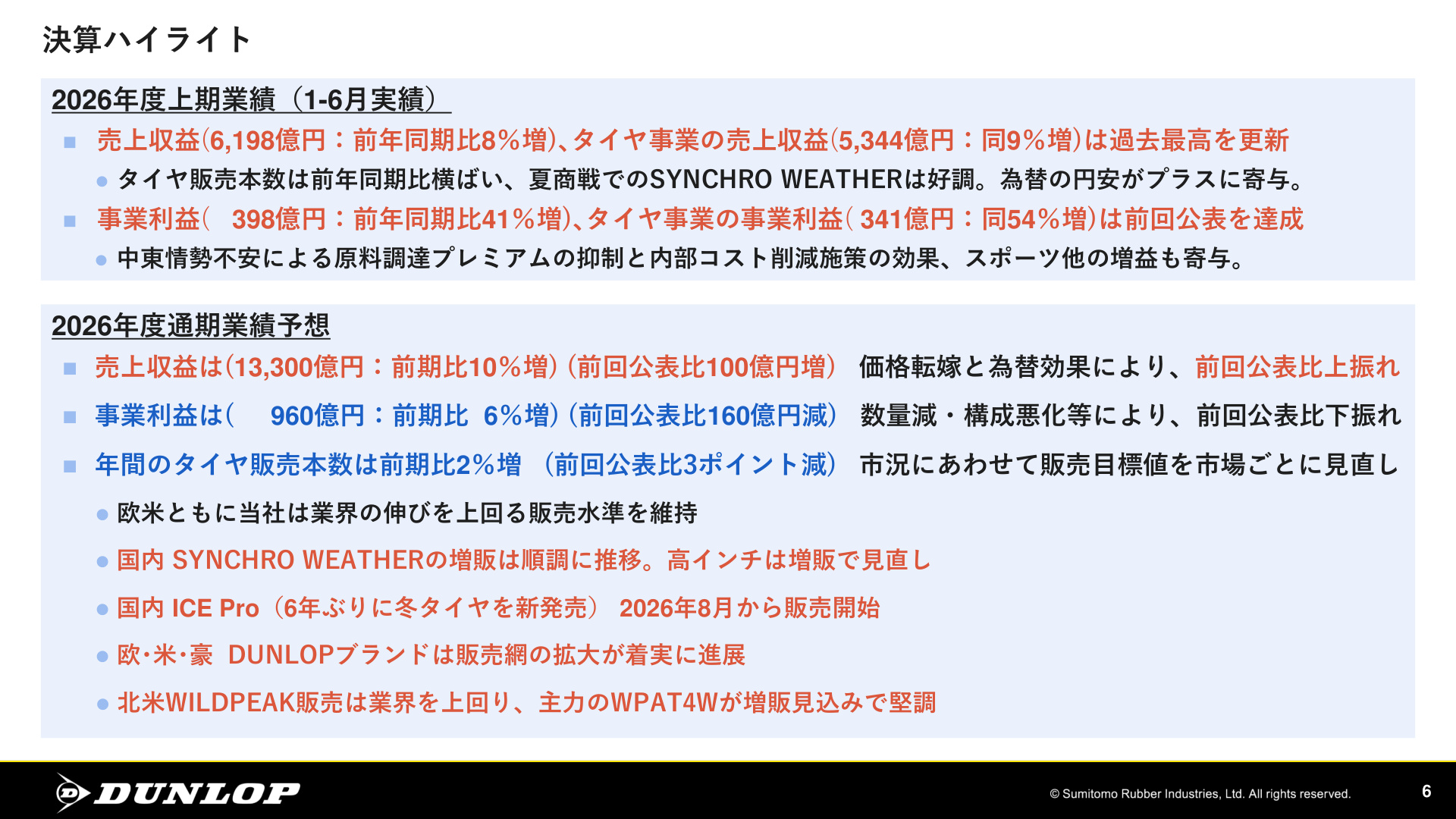
Slide Commentary: Importance of Earnings Highlights
The slide above (PAGE_5) serves as the most critical summary for grasping the overall picture of these results. The first-half performance was bolstered by strong sales of the next-generation all-season tire " SYNCHRO WEATHER " in the domestic market, the tailwind of a weaker yen, the mitigation of raw material procurement premiums amid Middle East instability, and internal cost-reduction measures.
Conversely, attention must be paid to the revision of the full-year earnings forecast shown at the bottom of the slide. While revenue is projected at 1.33 trillion yen (up 10.2% YoY) , an upward revision of 10 billion yen from the previous forecast, business profit has been revised downward by 16 billion yen to 96 billion yen (up 5.7% YoY) . The primary factor is the adjustment of the annual tire sales volume plan in response to market conditions (now projected at 2% growth YoY, a 3-point decrease from the previous forecast).
2. Analysis of Consolidated Business Profit Fluctuations (Jan–June)
The expansion of consolidated business profit by 11.5 billion yen in the first half—from 28.3 billion yen in the same period last year to 39.8 billion yen—was driven by a combination of external tailwinds and internal cost challenges.
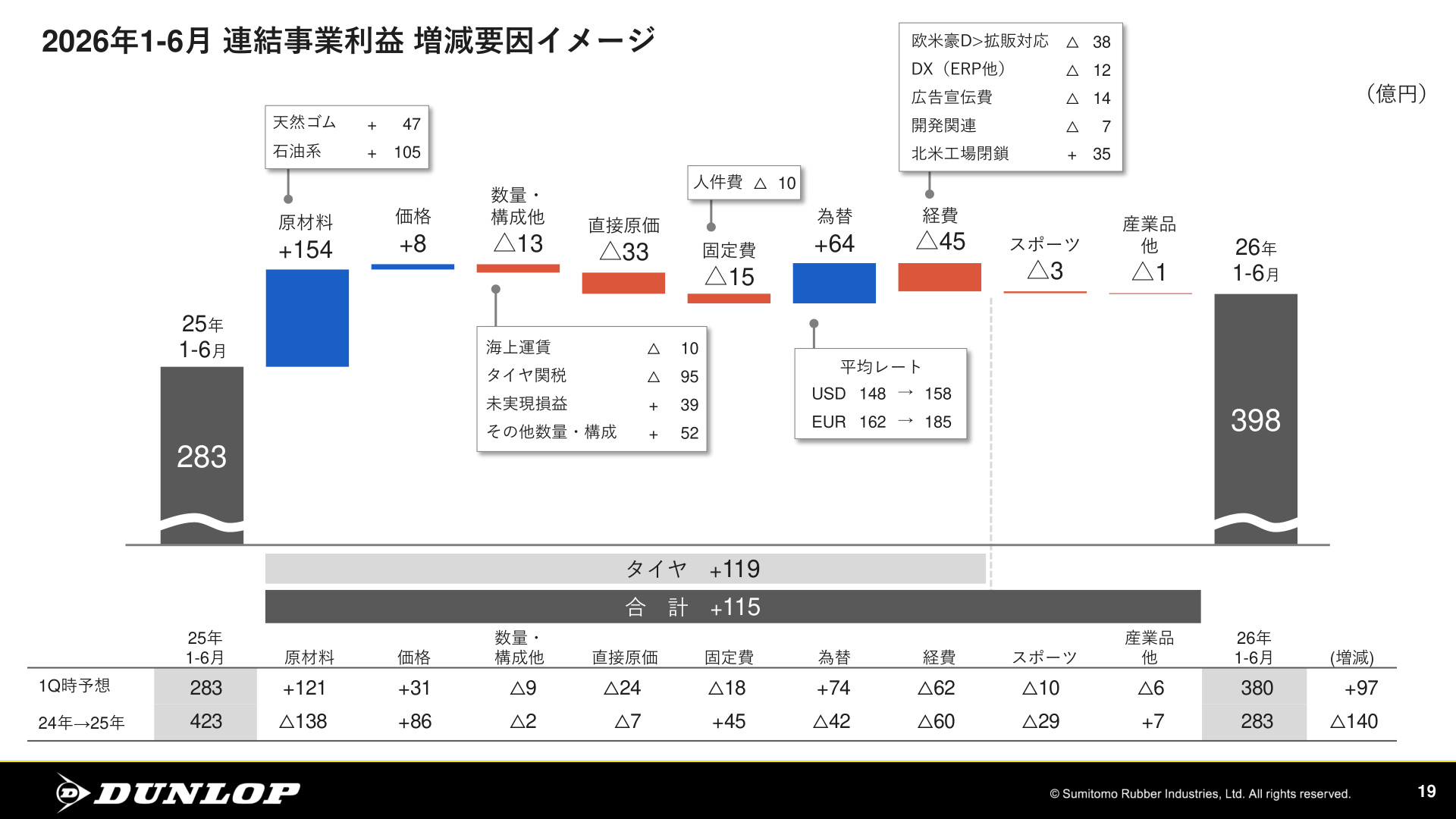
Slide Commentary: Visual Analysis of Profit Fluctuations
The slide on PAGE_18 presents a waterfall chart detailing the factors behind the year-on-year profit change. This data allows for a breakdown of the specific drivers that boosted or weighed on profits.
[Key Positive Factors]
- Lower Raw Material Costs (+15.4 billion yen) : Improvements in the natural rubber market (+4.7 billion yen) and a decline in petroleum-based raw material prices (+10.5 billion yen) significantly boosted profitability.
- Exchange Rate Effects (+6.4 billion yen) : The yen's depreciation against the US dollar (148 to 158 yen) and the Euro (162 to 185 yen) exceeded expectations, lifting profits.
- Price Pass-through (+0.8 billion yen) : Appropriate adjustments to sales pricing contributed to improved earnings.
[Key Negative Factors]
- Increased Expenses (△4.5 billion yen) : Costs included DX investments such as the core ERP system implementation (△1.2 billion yen), advertising and promotion for brand enhancement (△1.4 billion yen), and expansion-related costs in Western markets (△3.8 billion yen). These were partially offset by North American plant closure-related costs (+3.5 billion yen).
- Rise in Direct Costs (△3.3 billion yen) : Higher ocean freight rates (△1.0 billion yen) and the impact of tire tariffs in the US and other regions (△9.5 billion yen) pressured costs.
- Increase in Fixed Costs and Personnel Expenses (△2.5 billion yen) : Driven by rising labor costs (△1.0 billion yen) and higher fixed costs (△1.5 billion yen).
3. Domestic and Overseas Product and Market Strategies
Domestic Market: The Rise of SYNCHRO WEATHER
The most significant topic in the domestic tire business is the rapid growth of the next-generation all-season tire " SYNCHRO WEATHER ." Thanks to high brand awareness as a summer tire and effective TV commercial campaigns, first-half sales volume grew to approximately five times the level of the same period last year .
- In March 2026, 11 sizes were added to the 18-inch and larger categories, expanding the lineup to 112 sizes.
- The increased sales ratio of large-diameter, high-inch tires has improved margins, with sales profit significantly exceeding the plan , contributing greatly to product mix optimization.
- The product is on track to meet the annual sales target of 1 million units , with plans for a US and European rollout in FY2027.
- For the winter season, the company is employing a three-pillar strategy: the newly launched " ICE Pro ," the " WINTER MAXX 03 " studless tire, and "SYNCHRO WEATHER" to meet diverse customer needs.
Overseas Market: Trends and Challenges in Europe and North America
- European Market : Performance fell below the first-half plan (77% of target) due to struggles in launching off-take products, impacting business profit. However, the expansion of sales channels is progressing well, with over 1,000 new accounts acquired. The company aims to improve profitability in the second half through increased sales of winter tires and price hikes.
- North American Market : The flagship brand " FALKEN " achieved 94% of previous year's sales , outperforming the industry average (92%). The "WILDPEAK" series drove growth, and the number of retail outlets carrying the DUNLOP brand increased by 2.1 times .
- Regional Profit Structure : In the tire business (Jan–June), the Americas generated 16.2 billion yen , Asia/Oceania 9.3 billion yen , and Japan 8.1 billion yen in business profit. The previously struggling EMEA region turned a 0.6 billion yen profit (compared to a 5.8 billion yen loss in the same period last year).
4. Progress of Structural Reform Project "Project ARK"
" Project ARK ," the medium-to-long-term profitability improvement initiative led by Sumitomo Rubber, aims to generate 30 billion yen in cumulative benefits by the end of 2027.
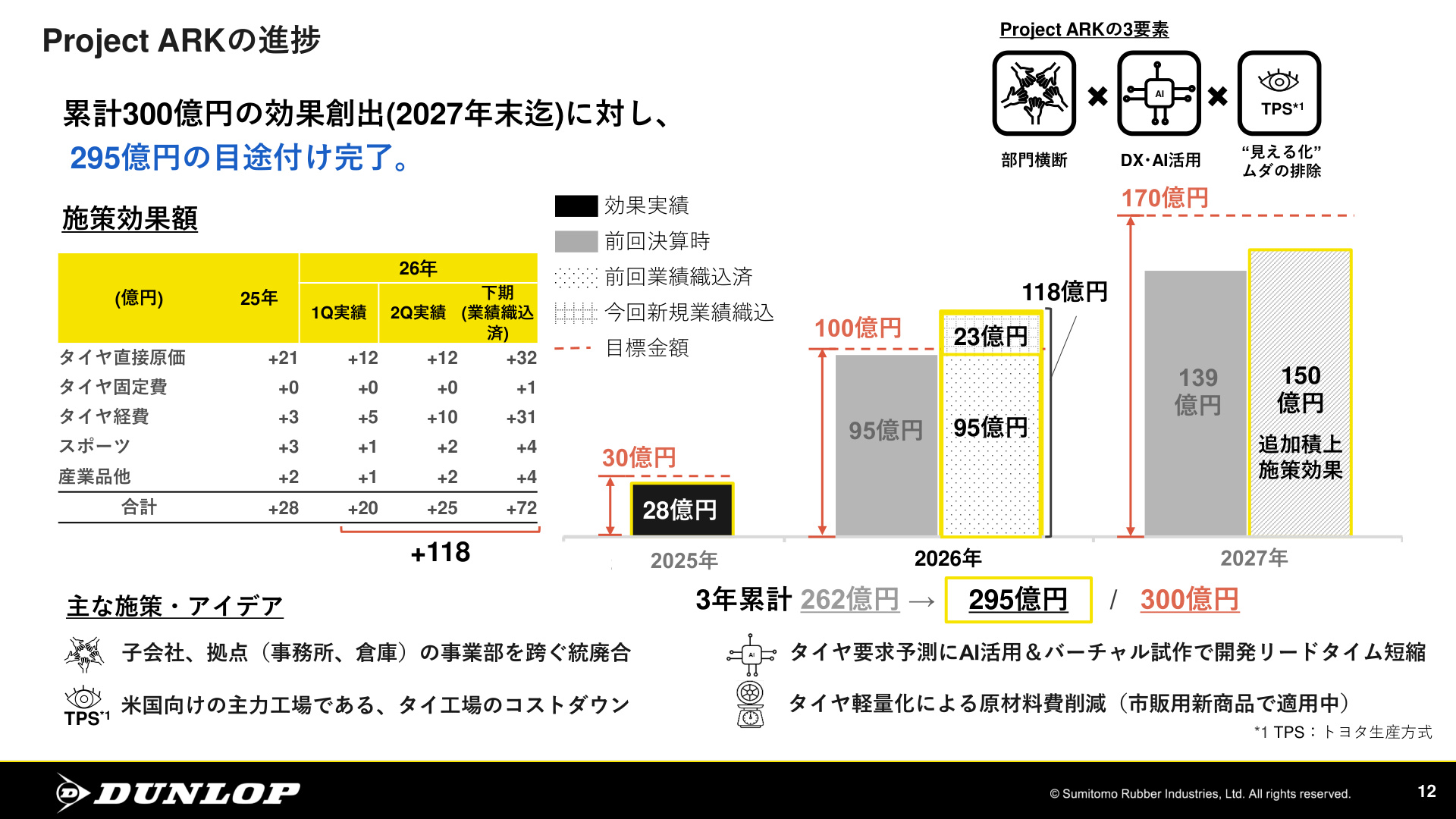
Slide Commentary: Project ARK Progress and Initiatives
The slide on PAGE_11 explains the progress of the structural reform both quantitatively and qualitatively. Against the ambitious target of 30 billion yen by 2027, the company has already secured measures totaling 29.5 billion yen (98% progress rate) .
[Annual Benefit Trends]
- FY2025 Actual : 2.8 billion yen (steady results against a 3 billion yen target)
- FY2026 Forecast : 11.8 billion yen (an additional 2.3 billion yen added to the previous forecast of 9.5 billion yen)
- FY2027 Forecast : 15.0 billion yen (an additional 1.1 billion yen added to the previous forecast of 13.9 billion yen)
[Specific Initiatives]
This project is driven by three pillars: "Cross-departmental collaboration," "DX/AI utilization," and "Elimination of waste based on the Toyota Production System (TPS)."
- Facility and Organizational Restructuring : Consolidating subsidiaries, offices, warehouses, and business divisions.
- Production Cost Reduction : Implementing thorough cost-cutting at the Thai plant, a key production hub for North America (contributing to lower direct tire costs).
- Development Efficiency : Significantly shortening development lead times through AI-driven tire demand forecasting and virtual prototyping.
- Raw Material Cost Reduction : Applying tire weight-reduction technology to new consumer products to decrease raw material usage.
5. Segment Outlook, Financial Foundation, and Capital Efficiency
Full-Year Forecast by Segment (FY2026)
- Tire Business : Revenue of 1.161 trillion yen (up 11.2% YoY), business profit of 83 billion yen (up 4.0% YoY). The plan incorporates volume declines in overseas new vehicle and Middle East replacement markets (impact of 15.7 billion yen) while still securing profit growth.
- Sports Business : Revenue of 131 billion yen (up 4.3% YoY), business profit of 8.5 billion yen (up 24.1% YoY). Maintaining high profit margins backed by stable demand for golf and tennis equipment.
- Industrial Products and Others : Revenue of 38 billion yen (up 0.5% YoY), business profit of 4.5 billion yen (up 9.2% YoY).
Financial Position and Capital Efficiency
According to the consolidated balance sheet as of June 30, 2026 (PAGE_21), total assets expanded to 1.5122 trillion yen . Despite an increase in inventories (+51.4 billion yen), equity reached 754.2 billion yen due to accumulated quarterly profits and foreign currency translation adjustments, maintaining a sound equity ratio of 49.9% (up 0.9 points from the end of the previous fiscal year).
Key capital efficiency targets for the full year include:
- ROE (Return on Equity) : 7.4% (steady improvement from 7.3% in the previous year)
- ROIC (Return on Invested Capital) : 5.8% (promoting management focused on efficiency of invested capital)
- D/E Ratio : 0.6 (continued control of interest-bearing debt)
6. Conclusion
Sumitomo Rubber Industries' Q2 FY2026 results demonstrate solid performance with record-high first-half revenue and significant profit growth, alongside a flexible revision of the full-year forecast in response to changing market conditions.
The company is addressing short-term overseas demand fluctuations and cost pressures through the expansion of high-value-added products like "SYNCHRO WEATHER," continued price pass-throughs, and the acceleration of structural reforms via "Project ARK." The steady execution of global expansion and cost structure reform remains the core pillar of the company's sustainable growth toward 2027.
This content is not intended as investment advice or a recommendation. Any opinions expressed are solely the personal views of each article.