

Carna Biosciences Q2 2026 Earnings Deep Dive: Rapid Growth in Drug Discovery Support and Steady Acceleration of Pipeline Out-licensing and Clinical Development

StockClub
Published: Aug 06, 2026, 10:33 AM
Sentiment Analysis
Carna Biosciences, Inc. (Securities Code: 4572) reported its Q2 2026 financial results, highlighting significant growth in its foundational drug discovery support business alongside key clinical and academic progress in its proprietary pipeline. This report provides a comprehensive analysis of the company's performance, detailed pipeline development and licensing progress, and future growth scenarios based on the latest earnings disclosure materials.
1. Earnings Highlights and Business Overview: Steady Progress Within Expectations and Rapid Growth in Core Business
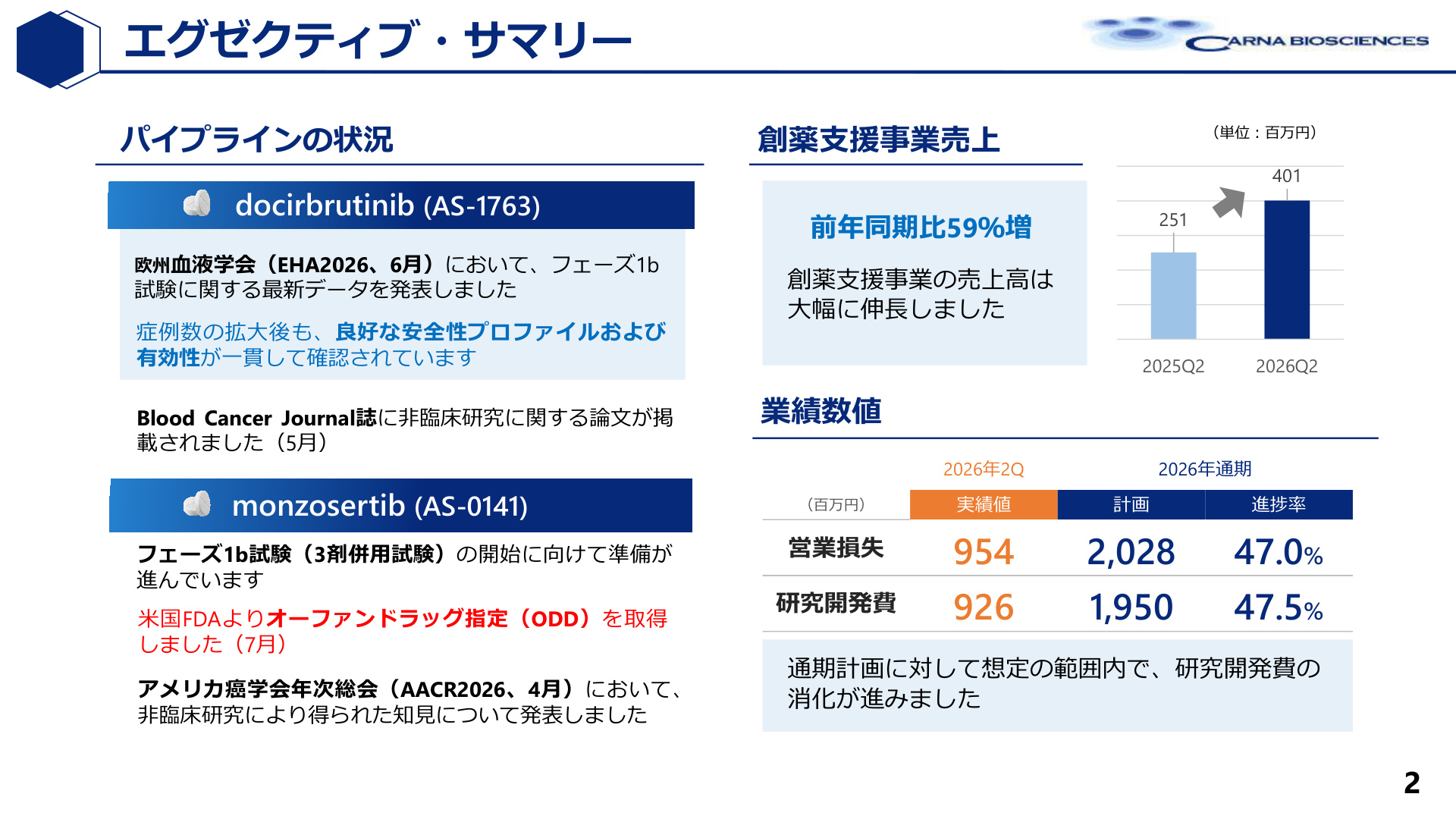
For the first half of 2026, the company’s financial results were in line with its plan as a drug discovery venture continuing to prioritize R&D investment. Operating loss was 954 million JPY (a 47.0% progress rate against the full-year plan of 2,028 million JPY), and R&D expenses were 926 million JPY (a 47.5% progress rate against the full-year plan of 1,950 million JPY), both tracking within the expected range for the fiscal year.
Meanwhile, the company’s core drug discovery support business revenue reached 401 million JPY , marking a significant 59% year-on-year increase . Strong demand for kinase protein sales and profiling/screening services is providing essential cash flow to support clinical development costs in the drug discovery business.
[Slide Analysis: The Importance of the Executive Summary]
The slide above (PAGE_1) is the most critical document, condensing the entire earnings picture into a single view. The bar chart showing the 59% year-on-year increase in drug discovery support revenue—from 251 million JPY to 401 million JPY—is evidence that the company's technical foundation continues to be highly valued by the market. Simultaneously, the 47% progress rates for both R&D expenses and operating losses demonstrate that investment in the proprietary pipeline is being executed systematically according to the annual plan. When viewed alongside the key events listed on the left (e.g., presentations at EHA2026, FDA Orphan Drug Designation), the correlation between capital allocation and value creation becomes clear.
2. Dramatic Strengthening of Global Licensing Structure: Appointment of a CBDO with Daiichi Sankyo Experience
On July 27, 2026, the company announced the appointment of Nobukazu Kurihara as Chief Business Development Officer (CBDO) . Mr. Kurihara previously served as Head of Business Development at Daiichi Sankyo, where he led global co-development and commercialization partnerships with AstraZeneca for the blockbuster antibody-drug conjugates (ADCs) "Enhertu" and "Datopotamab deruxtecan," as well as major collaborations with Merck & Co.
For a drug discovery venture, licensing out proprietary pipelines to major pharmaceutical companies under optimal terms is the key to exponential corporate value growth. With multiple pipelines currently in advanced licensing negotiations (particularly the renal disease indication for sofnobrutinib), the addition of Mr. Kurihara—a veteran of high-stakes negotiations with global pharma—is positioned as a major catalyst for the dramatic strengthening of the Business Development (BD) structure and the maximization of licensing terms.
3. Lead Pipeline ①: Competitive Advantage and Clinical Progress of docirbrutinib (AS-1763)
The company’s primary clinical asset is "docirbrutinib (AS-1763)," currently in development for hematologic malignancies such as Chronic Lymphocytic Leukemia (CLL) and Small Lymphocytic Lymphoma (SLL).
Currently, a Phase 1b study (dose-expansion part) is underway in the U.S. for patients who have developed resistance to existing BTK inhibitors (e.g., ibrutinib). Latest clinical data presented at the European Hematology Association (EHA2026) in June 2026 confirmed excellent safety and consistent efficacy even after expanding the patient cohort. Furthermore, a paper on its non-clinical research was published in the prestigious Blood Cancer Journal in May.
The BTK inhibitor market is a massive $12 billion (approx. 1.8 trillion JPY) space, but the emergence of drug-resistant mutations and treatment discontinuation due to side effects associated with first- and second-generation drugs remain significant challenges.
[Slide Analysis: docirbrutinib’s Overwhelming Safety and Inhibition Profile]
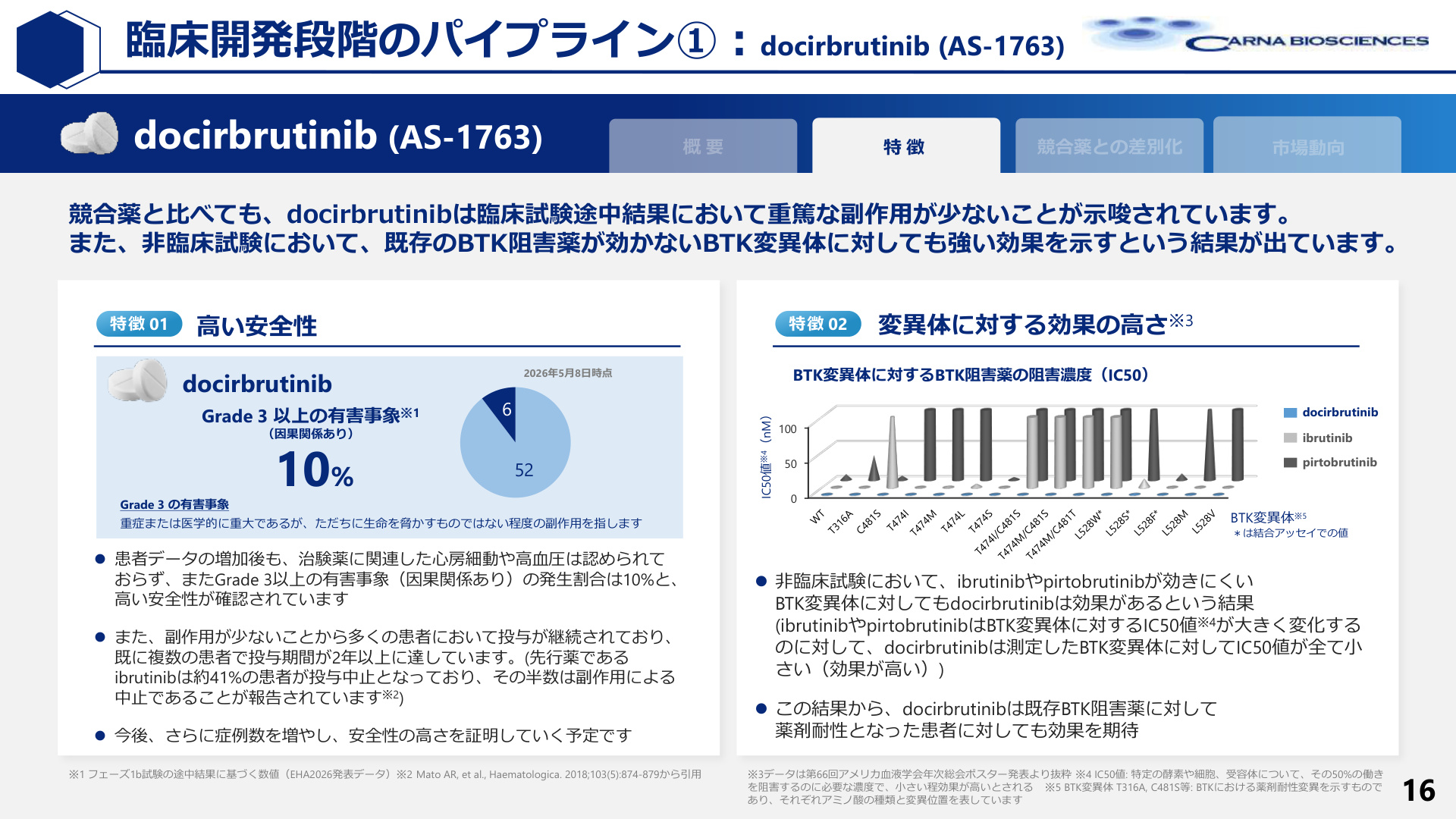
The slide above (PAGE_15) illustrates the overwhelming competitive advantage of docirbrutinib over its predecessors. As shown in the pie chart on the left, the incidence of Grade 3 or higher adverse events is only 10% , with no drug-related serious side effects such as atrial fibrillation or hypertension observed. Given that approximately 41% of patients discontinue existing ibrutinib treatment—half of which is due to side effects—this high safety profile is a decisive strength enabling long-term administration. As the right-hand graph shows, it maintains strong inhibitory activity (low IC50 values) against BTK mutants (e.g., T474I, L528W) that are resistant to ibrutinib and pirtobrutinib, proving its potential as a next-generation BTK inhibitor that addresses the "greatest unmet need" following existing therapies.
The company aims to secure a partnership (out-licensing) and initiate Phase 2 trials early within 2026.
4. Lead Pipeline ②: sofnobrutinib (AS-0871) and Tailwinds in the Renal Disease Sector
"sofnobrutinib (AS-0871)" is a non-covalent BTK inhibitor developed for immune and inflammatory diseases. After completing a Phase 1 study in the Netherlands (in healthy adults) and confirming high safety and pharmacodynamic effects, the company is now actively pursuing partnering activities with an eye toward Phase 2 and beyond.
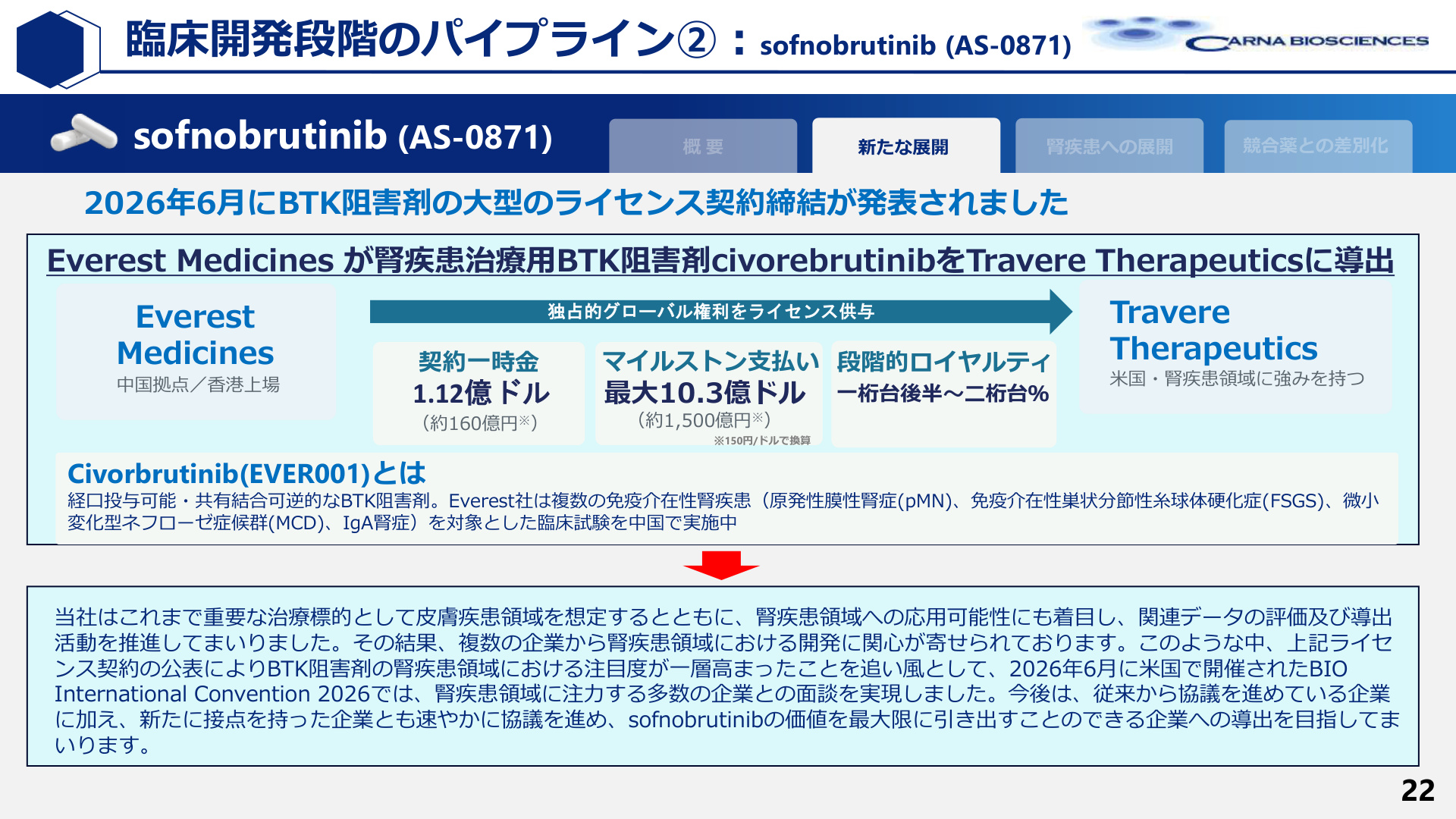
In recent years, the application of BTK inhibitors to intractable renal diseases such as "Primary Membranous Nephropathy (pMN)" has garnered significant global attention. In June 2026, the news that Everest Medicines licensed its renal disease BTK inhibitor, civorebrutinib, to Travere Therapeutics for an upfront payment of $112 million (approx. 16 billion JPY) and up to $1.03 billion (approx. 150 billion JPY) in milestones significantly heightened market interest.
[Slide Analysis: Changes in the External Environment and Rising Valuation of sofnobrutinib]
The slide above (PAGE_21) shows that the business environment surrounding sofnobrutinib is rapidly becoming a tailwind. The mega-deal between Everest and Travere objectively proved the extremely high market value of BTK inhibitors in the renal disease space. Capitalizing on this trend, the company held meetings with numerous major pharmaceutical companies focusing on renal disease at the "BIO International Convention 2026" held in the U.S. in June 2026. With its high selectivity and favorable safety profile, sofnobrutinib is positioned as a "best-in-class" oral treatment for renal diseases like pMN, providing a strong backdrop for successful licensing negotiations.
5. Lead Pipeline ③: Evolution of monzosertib (AS-0141) and Collaboration with MD Anderson
The third proprietary pipeline, "monzosertib (AS-0141)," is a first-in-class oral small-molecule compound that inhibits CDC7 kinase , which regulates the initiation of DNA replication in cancer cells. Development is primarily focused on Acute Myeloid Leukemia (AML) , a disease often affecting elderly or unfit patients.
Key progress and topics for this agent include:
- FDA Orphan Drug Designation (ODD) granted (July 2026): Received ODD from the U.S. FDA for AML, securing incentives such as development support and seven years of market exclusivity upon approval.
- High Anti-tumor Effect of Triple Combination Therapy: At AACR2026, the company presented non-clinical data showing that a triple combination therapy of monzosertib with standard AML treatments AZA/VEN (azacitidine/venetoclax) induces superior apoptosis (cell death).
- Joint Development with MD Anderson Cancer Center: Signed an MOU with the world-renowned MD Anderson Cancer Center. Under the leadership of Dr. Abhishek Maiti, a prominent leukemia specialist, the company is rapidly preparing to initiate a Phase 1b study (investigator-initiated, triple combination) in the U.S.
The AML treatment market is projected to reach $3.8 billion (approx. 570 billion JPY) . With no approved CDC7 inhibitors globally, monzosertib is transitioning into an attractive clinical trial scheme aimed at expedited approval.
6. Status of Out-licensed Pipelines and Summary of Mid-to-Long-Term Growth Story
In addition to its proprietary pipeline, the company holds programs previously licensed to major pharmaceutical companies:
- Gilead Sciences: Licensed a DGKα inhibitor program for oncology/immunotherapy in 2019 ($20M upfront, $450M total milestones). Although Gilead paused new patient enrollment in August 2025 due to portfolio prioritization, the license agreement remains in effect, and discussions regarding future R&D direction are ongoing under the company's leadership.
- Sumitomo Pharma: Conducting joint research in the field of neuropsychiatric disorders, with the selection of development candidate compounds currently underway.
[Summary: Carna Biosciences' Growth Story]
The growth story highlighted by the Q2 2026 earnings materials can be summarized in the following logical steps:
- Stable Revenue Base: The rapidly growing drug discovery support business (up 59% YoY) provides the cash flow necessary for R&D.
- Strong Development Momentum: The three major pipelines—docirbrutinib (hematologic cancer), sofnobrutinib (immune/renal disease), and monzosertib (AML)—are consistently delivering tangible results, including academic presentations, publications, and FDA Orphan Drug Designations.
- Entry into the Licensing Phase: With the appointment of Mr. Kurihara—who successfully led major global partnerships at Daiichi Sankyo—as CBDO, the company is aiming to conclude large-scale partnerships to maximize licensing terms and transition to Phase 2 and beyond, precisely as market interest peaks.
It is evident that the company is not merely an R&D-focused venture, but is steadily executing a strategic roadmap to enhance long-term corporate value by balancing revenue from its own technology (drug discovery support) with the maximization of pipeline value (out-licensing).
This content is not intended as investment advice or a recommendation. Any opinions expressed are solely the personal views of each article.