


Tokyo Ohka Kogyo (TOK) Q2 FY2026 Earnings Analysis: Upward Revision Driven by Generative AI Demand and Early Achievement of Mid-Term Plan Targets

StockClub
Published: Aug 06, 2026, 10:29 AM
Sentiment Analysis
Tokyo Ohka Kogyo (4186) Q2 FY2026 Earnings Deep-Dive Report
Tokyo Ohka Kogyo’s (TOK) Q2 FY2026 financial results demonstrated exceptionally strong performance, fueled by a surge in demand for AI servers in data centers, which significantly boosted the company’s core Electronics Functional Materials and High-Purity Chemicals segments. Consequently, the company announced an upward revision to its full-year earnings forecast and revealed that it is on track to achieve its mid-term management plan targets one year ahead of schedule .
This report provides a detailed analysis based on key topics extracted from the earnings presentation materials, covering current performance outcomes, structural growth drivers, technical strengths, and future growth strategies and shareholder return policies.
1. Earnings Highlights and Overview: Strong Revenue and Profit Growth Led by Semiconductor Materials
For the first half (H1) of the fiscal year ending December 2026, consolidated net sales rose 25.1% year-on-year to 139.67 billion yen , while operating profit surged 45.4% year-on-year to 28.85 billion yen . The company achieved high progress rates against its H1 targets, reaching 111.7% in net sales and 118.7% in operating profit.
H1 Key Performance Indicators (YoY)
- Net Sales : 139.67 billion yen (+25.1%)
- Operating Profit : 28.85 billion yen (+45.4%)
- Ordinary Profit : 30.27 billion yen (+48.5%)
- Net Income Attributable to Owners of Parent : 20.41 billion yen (+49.9%)
- EBITDA : 34.31 billion yen (+43.0%)
Following these strong results, the full-year earnings forecast was revised upward. Full-year net sales are now projected to reach 291 billion yen (+22.8% YoY) , and operating profit is expected to hit 60.6 billion yen (+27.9% YoY) , marking the third consecutive year of record-breaking performance .
2. Early Achievement of "tok Mid-Term Plan 2027" Targets
One of the most significant highlights of this earnings revision is the announcement regarding the achievement timeline for the quantitative targets of the "tok Mid-Term Plan 2027."
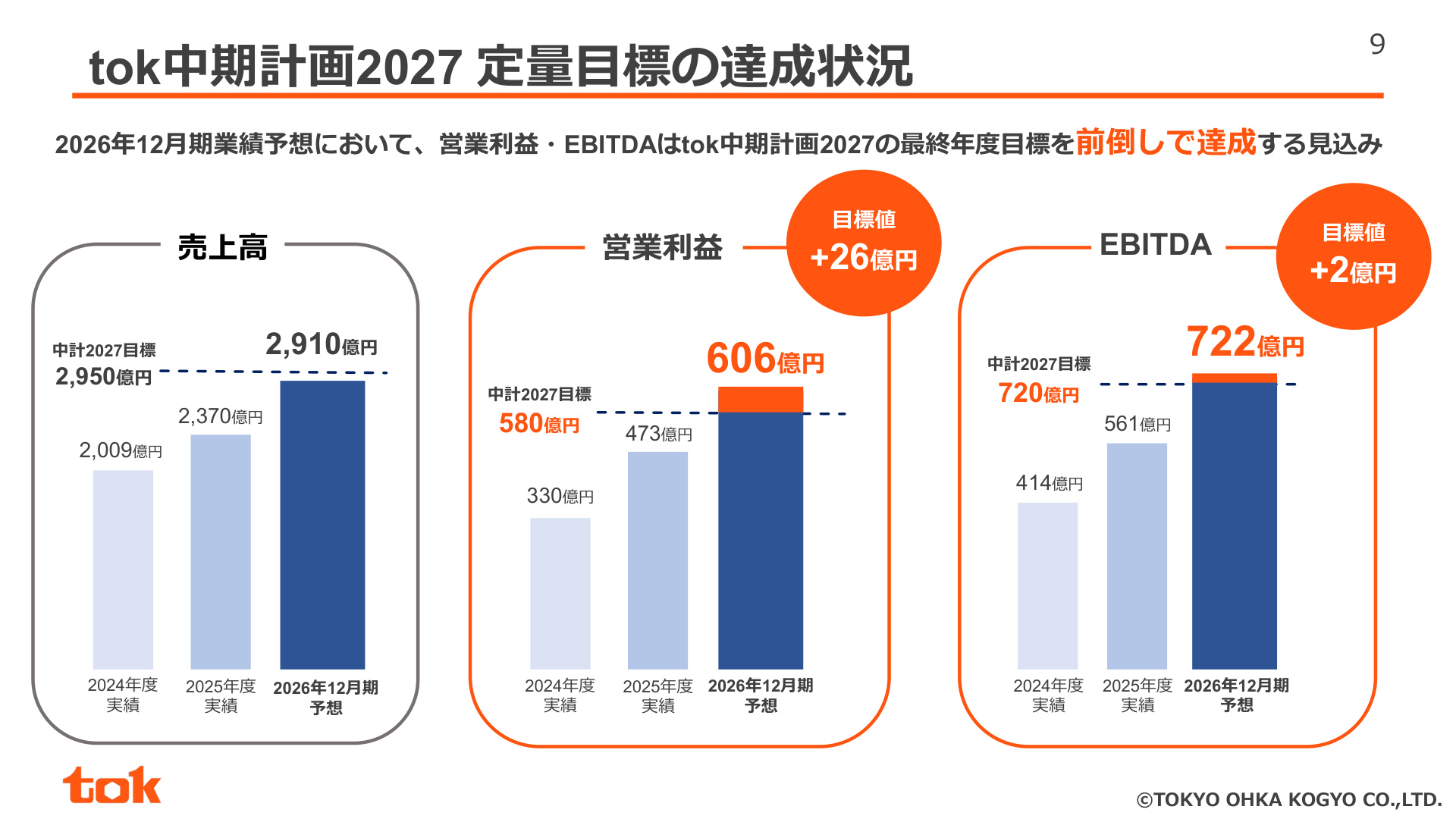
[Significance and Background of Slide 9]
This slide is a critical document illustrating the current progress against the key quantitative indicators of the "tok Mid-Term Plan 2027." It visually demonstrates that the original final targets for FY2027— 58 billion yen in operating profit and 72 billion yen in EBITDA —are now expected to be achieved one year ahead of schedule based on the FY2026 full-year forecast ( 60.6 billion yen in operating profit and 72.2 billion yen in EBITDA ).
Regarding net sales, the FY2026 forecast of 291 billion yen is nearly reaching the mid-term plan target of 295 billion yen . The rapid expansion of the generative AI market has accelerated the adoption of photoresists and back-end materials at a pace far exceeding the initial assumptions of the mid-term plan, serving as the primary driver for this early achievement.
3. Segment/Product Performance and Operating Profit Breakdown
Trends by Segment and Product
The core Electronics Functional Materials segment saw H1 sales grow significantly by 27.5% year-on-year to 74.16 billion yen . The breakdown is as follows:
- Photoresists for Semiconductor Front-End (71% of total) : +30% YoY
- Advanced Materials (EUV/ArF resists) : +35% YoY
- KrF resists : +30% YoY
- Legacy materials (g-line/i-line resists) : +15% YoY
- Semiconductor Back-End Materials (22% of total) : +25% YoY
- Strong performance in packaging materials, MEMS materials, and WHS materials.
- Display Materials and Others (7% of total) : +15% YoY
Additionally, High-Purity Chemicals recorded H1 sales of 63.01 billion yen (+21.2% YoY) , supported by the recovery in customer semiconductor fab utilization rates and increased demand for advanced processes.
Analysis of Full-Year Operating Profit Variance
The +15.3 billion yen increase from the previous year's actual (45.3 billion yen) to the current full-year forecast (60.6 billion yen) is driven by the following factors:
- Sales Volume/Product Mix : A powerful +30 billion yen boost, driven by a higher proportion of high-margin advanced resists and back-end materials.
- Forex/Price Adjustments : +2.6 billion yen (assumed exchange rate adjusted from 150.0 JPY/USD to 155.0 JPY/USD).
- Increase in Expenses : -17.3 billion yen . This absorbs increased R&D costs (19.2 billion yen projected for the full year), depreciation from capital investment, and rising labor costs to support future growth.
4. The Core of the Growth Story: Expanding Reach Amid AI Demand
The primary engine supporting TOK's growth story is the expansion of AI infrastructure and the increasing sophistication and integration of semiconductor devices.
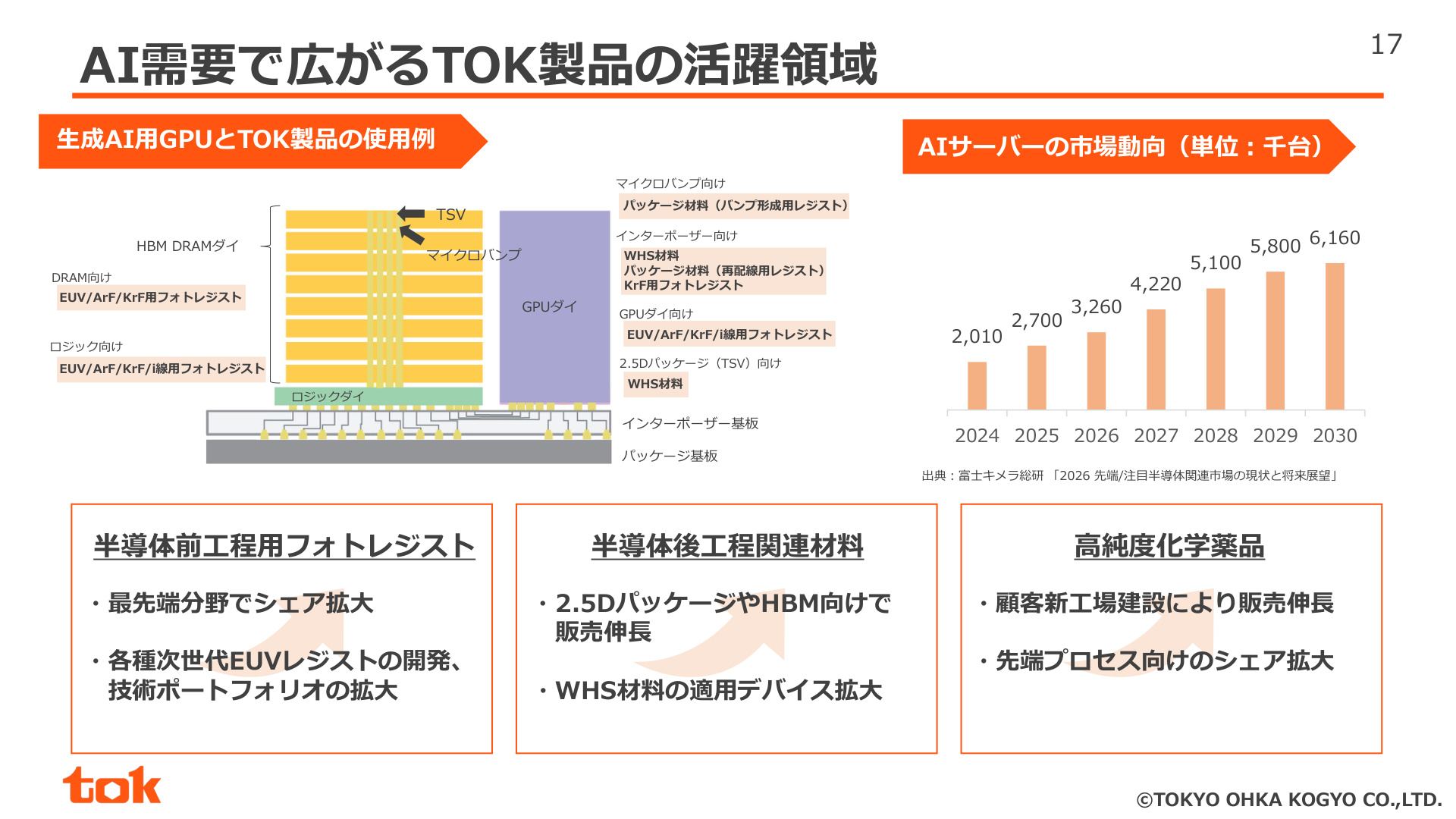
[Significance and Background of Slide 17]
This slide provides a conceptual diagram summarizing which processes in cutting-edge semiconductor packaging—such as GPUs for generative AI and HBM (High Bandwidth Memory)—utilize the company's product lineup. With the AI server market projected to grow from 2.01 million units in 2024 to 6.16 million units by 2030, the slide illustrates how TOK's areas of strength are diversifying.
Specifically, the company's products play an indispensable role in three areas:
- Photoresists for Semiconductor Front-End : Holding a high market share in EUV and ArF resists that support the miniaturization of HBM DRAM dies and logic dies.
- Semiconductor Back-End Materials : Supplying packaging materials and WHS materials essential for 2.5D packaging, TSV (Through-Silicon Via) technology, and micro-bump formation.
- High-Purity Chemicals : Providing ultra-high-purity cleaning and developing chemicals that support yield improvement in advanced processes.
TOK's major strength lies in capturing the wave of AI demand from both front-end (miniaturization) and back-end (stacking/high-density packaging) perspectives.
5. Key Focus Product: Rapid Growth of WHS (Wafer Handling System) Materials
Among back-end materials, WHS (Wafer Handling System) materials are showing particularly high growth rates.
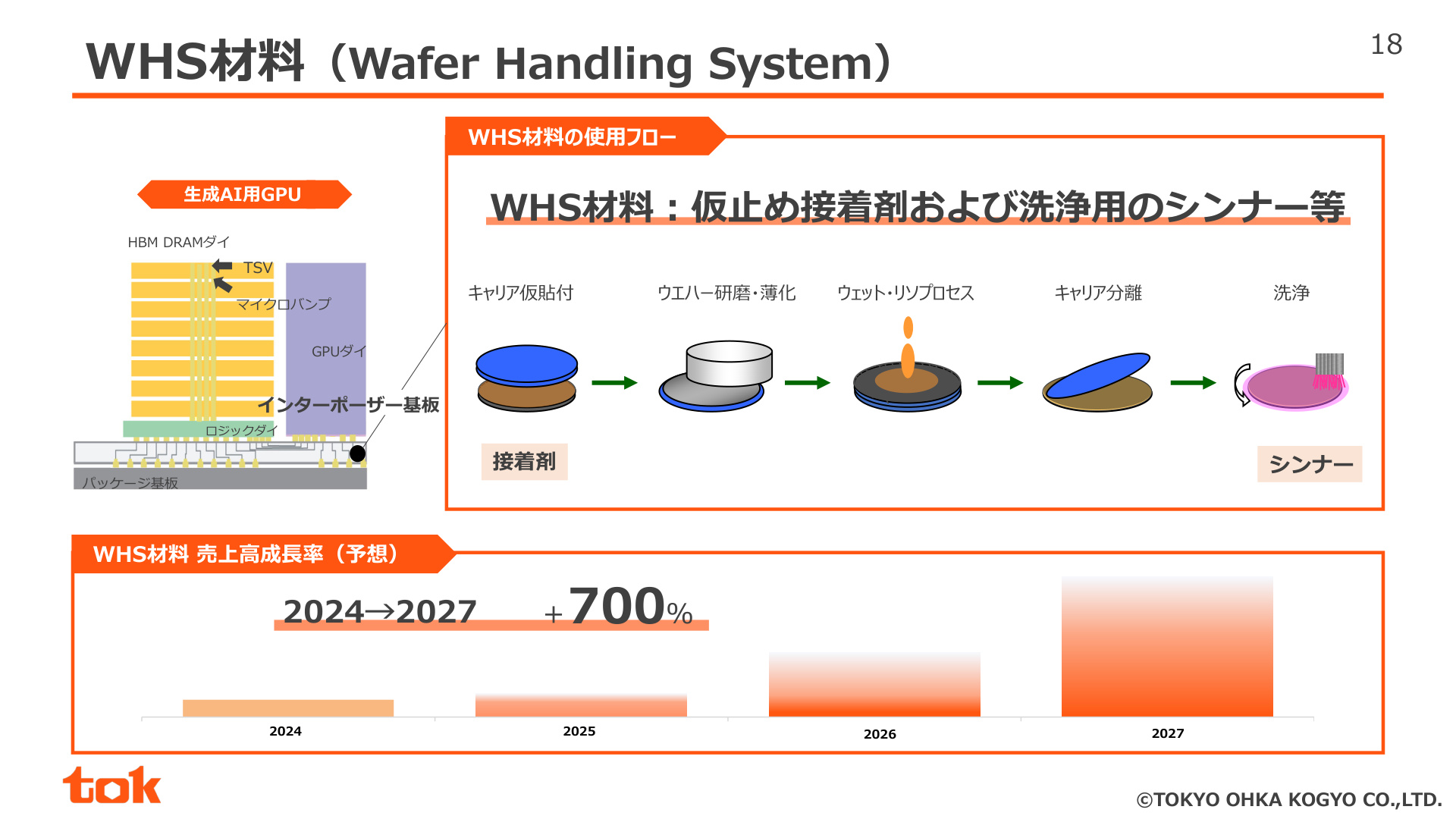
[Significance and Background of Slide 18]
This slide shows the usage flow and future sales growth projections for WHS materials , which are essential for manufacturing HBM and 2.5D packages.
WHS materials refer to temporary bonding adhesives used to fix thinned wafers to support substrates during processing, as well as cleaning thinners used for debonding and cleaning after processing. In device manufacturing where thin DRAM dies are stacked in multiple layers, such as HBM, WHS technology is critical for preventing wafer breakage and ensuring precision processing.
The materials indicate that WHS material sales are expected to increase explosively by +700% (approximately 8-fold) between 2024 and 2027 . This dramatic growth is underpinned by the surge in HBM demand resulting from the rapid development of the generative AI market.
6. Strengthening Manufacturing Capital and Global Investment to Enhance Cash Generation
To meet the rapidly increasing global demand for semiconductors, the company is pursuing aggressive capital investment and the global expansion of its manufacturing footprint.
Key Investment Trends (EBITDA Expansion Outlook toward 2030)
- Aso Kumamoto Site (Japan) : New manufacturing base for high-purity chemicals (approx. 13 billion yen investment). Operations began in H1 FY2026.
- Incheon Plant (South Korea) : Construction of a new inspection building (approx. 7 billion yen investment).
- Koriyama Plant (Japan) : Constructing the world's largest photoresist manufacturing building (investment exceeding 20 billion yen). Additionally, acquired a new factory site of approximately 90,794 sqm.
- Pyeongtaek Plant (South Korea) : Opened a new plant and is constructing a high-purity chemical manufacturing building (approx. 12 billion yen investment).
While these investments will temporarily increase depreciation (11.6 billion yen in the revised plan) and R&D expenses (19.2 billion yen in the revised plan), the strategy aims to expand long-term EBITDA and cash generation capabilities toward 2030 through significant production capacity enhancement.
7. Shareholder Returns and Management Efficiency (Earning Power)
Enhanced Shareholder Returns
Backed by a solid financial foundation, the company implements shareholder returns with a focus on capital efficiency. The dividend policy targets a Dividend on Equity (DOE) ratio of 4.0% , and the company has continued to increase dividends in line with earnings growth.
- FY2026 Forecast Dividend : 80 yen per share annually (40 yen interim, 40 yen year-end forecast).
- Dividend Continuity : This marks the 9th consecutive year of dividend increases .
- Share Buybacks : Flexible execution of share buybacks based on the number of outstanding shares and financial position (with a history of 10 billion yen scale acquisitions).
Evolution of Earning Power (EBITDA per Employee)
The company balances human capital management with productivity improvements. Consolidated EBITDA per employee has increased significantly from 9.71 million yen in 2019 to 26.36 million yen in 2025 . Automation of production processes, quality stabilization through AI/digital utilization, and an increased sales ratio of high-value-added products have substantially boosted the "earning power" per employee.
Conclusion
Tokyo Ohka Kogyo's Q2 FY2026 results are the direct outcome of overwhelming product competitiveness that captured the wave of generative AI and HBM demand . In addition to its technical superiority in front-end photoresists, the rapid acquisition of demand in the back-end field, led by WHS materials, has positioned the company to achieve its mid-term management plan targets one year early and set new record-high earnings . The earnings report clearly demonstrates a structure committed to continuous corporate value enhancement and shareholder returns through sustained global manufacturing capital investment and R&D.
This content is not intended as investment advice or a recommendation. Any opinions expressed are solely the personal views of each article.