


Resonac Holdings H1 FY2026 Earnings Analysis: Record-High Semiconductor Materials Profits and Portfolio Reform Drive Significant Full-Year Guidance Upgrade

StockClub
Published: Aug 06, 2026, 10:26 AM
Sentiment Analysis
Resonac Holdings (Ticker: 4004) reported its H1 FY2026 financial results (January–June 2026) , demonstrating exceptionally strong performance. The results were driven by an explosive recovery and growth in the core Semiconductor and Electronic Materials segment , alongside the successful realization of structural reforms, leading to significant increases in both revenue and profit.
This report provides a deep dive into the company's business environment, profit drivers, segment trends, and the rationale behind the major upward revision of its full-year earnings forecast, focusing on 10 key topics essential for interpreting the company's growth story and Key Performance Indicators (KPIs).
1. H1 Consolidated Highlights: Significant Profit Growth and Enhanced Profitability
For the first half of FY2026, consolidated revenue reached 676.9 billion yen (up 5% YoY) , core operating income hit 88.8 billion yen (up 157% YoY, 2.6x) , and net income attributable to owners of the parent was 48.5 billion yen (up 147% YoY) , marking a substantial increase in profitability.
Despite revenue headwinds from business divestitures (such as the automotive molded parts business), the rapid expansion of the Semiconductor and Electronic Materials segment powerfully drove company-wide growth. The primary financial metric, the EBITDA margin, surged to 19.8% (from 12.8% in the same period last year), and reached 23.4% excluding the Kurasa Chemical (petrochemicals) business, clearly demonstrating a structural improvement in earnings power.
2. Core Operating Income Variance Analysis: Volume and Pricing Offset Rising Costs
A detailed breakdown of the 54.2 billion yen increase in core operating income (from 34.6 billion yen to 88.8 billion yen) highlights the company's strong market position and the success of its structural reforms.
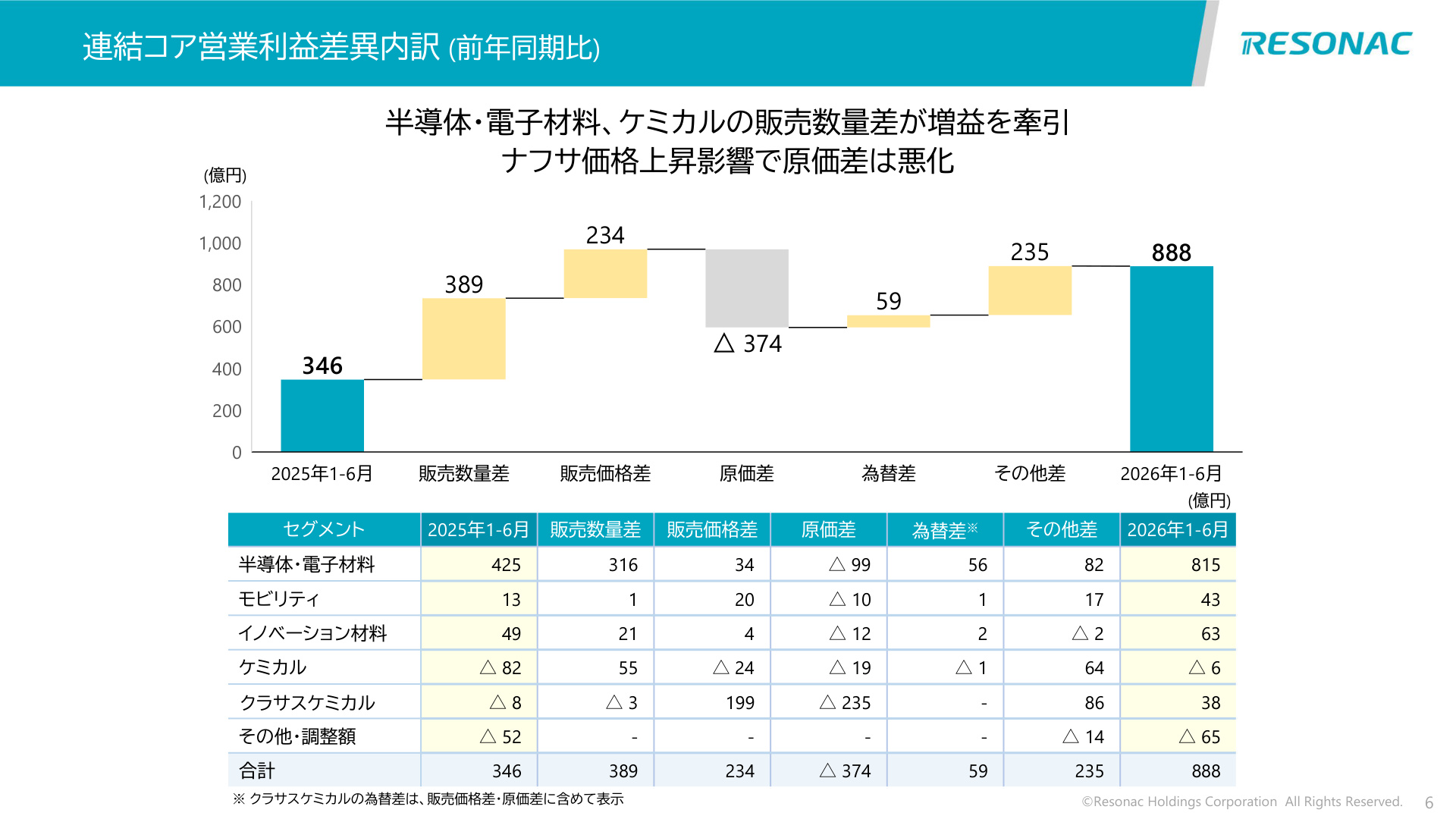
The slide above provides a detailed breakdown of the core operating income variance. This is critical because it demonstrates the business's resilience: despite the strong headwind of soaring raw material costs, the company achieved significant profit growth by far exceeding those costs through increased sales volume and price revisions.
Specific profit drivers include:
- Sales Volume (+38.9 billion yen): Driven by robust demand in the Semiconductor and Electronic Materials segment (+31.6 billion yen) and a recovery in graphite electrode volume in the Chemicals segment (+5.5 billion yen).
- Sales Price (+23.4 billion yen): Successful price pass-throughs in response to rising raw material costs across all segments.
- Cost of Goods Sold (-37.4 billion yen): Increased raw material and fuel costs, particularly naphtha, negatively impacted costs, notably in Kurasa Chemical (-23.5 billion yen) and Semiconductor and Electronic Materials (-9.9 billion yen).
- FX and Other (+29.4 billion yen): Benefited from the weak yen, as well as efforts in structural reform costs and fixed cost reductions.
In this way, the company has established a structure where volume growth and price pass-throughs (totaling +62.3 billion yen) fully cover the 37.4 billion yen in cost deterioration, generating substantial profit growth.
3. Semiconductor and Electronic Materials: Record-High Quarterly Performance
The core Semiconductor and Electronic Materials segment reported revenue of 299.0 billion yen (up 30% YoY) and core operating income of 81.5 billion yen (up 92% YoY) , achieving record-high quarterly performance. The segment EBITDA margin reached an extremely high level of 35.2% .
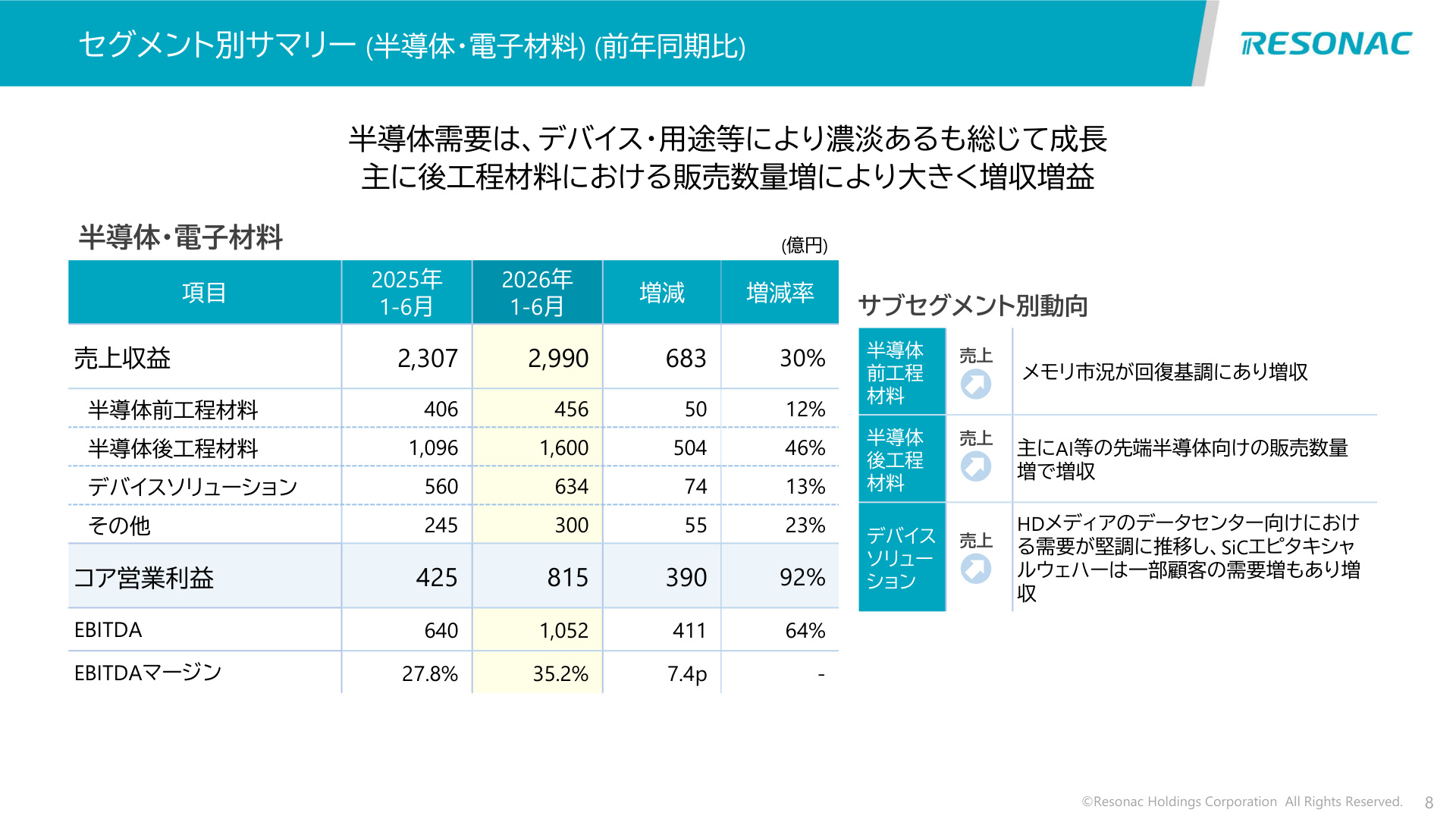
This slide details the Semiconductor and Electronic Materials segment, the core of the company's future growth. Of particular note is that the expansion of the advanced semiconductor market, including for generative AI, is directly translating into earnings growth.
Trends by sub-segment:
- Front-end Semiconductor Materials (Revenue 45.6 billion yen, up 12%): Steady revenue growth as the memory market recovers.
- Back-end Semiconductor Materials (Revenue 160.0 billion yen, up 46%): Explosive growth in revenue and profit driven by a surge in sales volume for advanced semiconductors, such as those for AI (epoxy encapsulants, die-bonding materials, high-thermal conductivity materials, etc.).
- Device Solutions (Revenue 63.4 billion yen, up 13%): Extremely strong demand for HD (hard disk) media for data centers, with SiC epitaxial wafers also growing due to increased demand from specific customers.
This demonstrates the company's success in capturing the wave of advanced semiconductor trends, centered on back-end materials where it holds a global market share.
4. Chemicals Segment: Recovery in Graphite Electrodes and Path to Profitability
The Chemicals segment reported revenue of 91.8 billion yen (up 17% YoY) and core operating income of -0.6 billion yen (an improvement of 7.5 billion yen YoY).
The primary driver was the progress in price revisions for basic chemicals, combined with a recovery in sales volume for the long-struggling Graphite business (graphite electrodes) . Furthermore, the effects of structural reforms have begun to manifest, significantly narrowing the deficit and driving a V-shaped recovery in the EBITDA margin to 7.4%.
5. Other Segment Trends (Mobility & Innovation Materials)
- Mobility Segment: Revenue 84.6 billion yen (down 6%), core operating income 4.3 billion yen (up 227%). Despite the negative impact of the automotive molded parts business divestiture, the segment secured a significant profit increase through higher demand from certain customers and profitability improvement measures.
- Innovation Materials Segment: Revenue 50.0 billion yen (up 11%), core operating income 6.3 billion yen (up 27%). While performance varied by product, resin materials and functional chemicals performed steadily.
6. Kurasa Chemical Partial Spin-off Progress and Discontinued Operations
The partial spin-off of Kurasa Chemical (petrochemicals business) , a centerpiece of the company's portfolio reform, is proceeding as planned.
- Scheduled Spin-off Date: October 1, 2026 (Scheduled listing date on the TSE: September 29, 2026).
- Progress: The company has completed the listing application to the Tokyo Stock Exchange, obtained certification for its business reorganization plan under the Industrial Competitiveness Enhancement Act, and expects to meet tax-qualified requirements.
Following the finalization of this spin-off policy, in accordance with IFRS accounting standards, the Kurasa Chemical segment will be classified as "discontinued operations" starting from the Q3 FY2026 earnings. Consequently, from Q3 onwards, the segment's revenue and core operating income will be excluded from the company's continuing operations in the P/L, and will be consolidated into a single line item (profit from discontinued operations) at the bottom of the income statement.
7. Full-Year FY2026 Guidance Upgrade: Core Operating Income to 196 Billion Yen
Based on the strong H1 results and the continued robust demand for semiconductor materials, the company has significantly upgraded its consolidated full-year FY2026 earnings forecast.
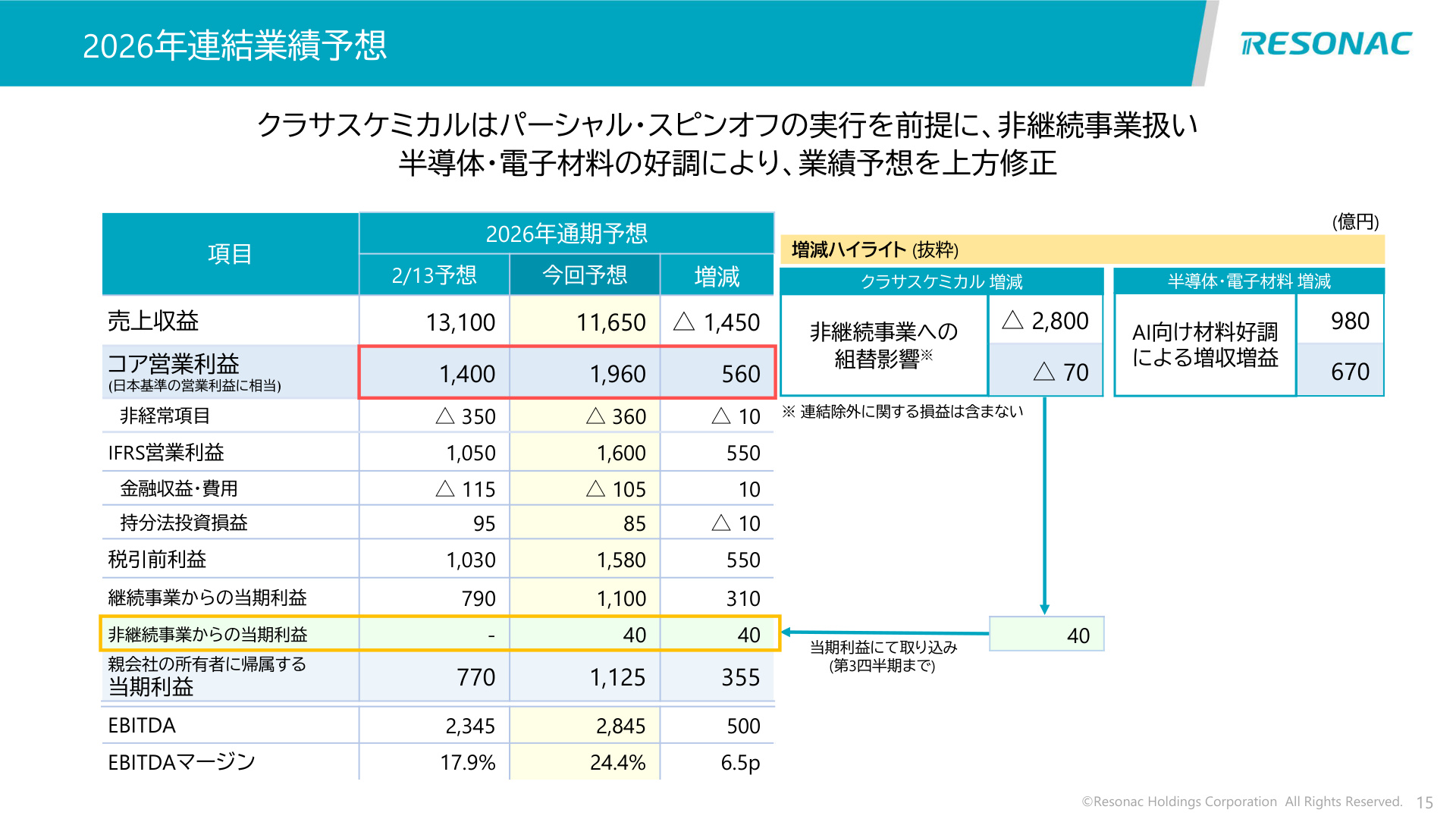
This slide illustrates the "upward revision of the full-year earnings forecast," the most significant topic of this earnings announcement. It is crucial because it shows that despite the reclassification impact of excluding Kurasa Chemical as a discontinued operation (e.g., -280 billion yen in revenue), the overwhelming growth in Semiconductor and Electronic Materials (+67 billion yen upside in core operating income) has pushed the company-wide core operating income forecast from 140 billion yen to 196 billion yen (up 40%).
Key points of the revision:
- Revenue: 1,165 billion yen (down 145 billion yen from initial forecast. Excluding the -280 billion yen impact from the Kurasa Chemical spin-off, this represents a substantial real increase).
- Core Operating Income: 196 billion yen (up 56 billion yen / +40% from the initial 140 billion yen forecast).
- Full-Year Core Operating Income Forecast for Semiconductor and Electronic Materials: 195 billion yen (upward revision of 67 billion yen from the initial 128 billion yen forecast).
- EBITDA Margin: 24.4% (+6.5 points vs. initial forecast).
- Net Income Attributable to Owners of the Parent: 112.5 billion yen (up 35.5 billion yen / +46% vs. initial forecast).
This validates the strategy of separating the volatile petrochemical business while concentrating on high-profit semiconductor materials.
8. Steady Improvement in Financial Health and Net D/E Ratio
Driven by expanded business profits and the conversion of bonds with stock acquisition rights, the company's financial position has been dramatically strengthened.
- Net D/E Ratio: Decreased from 0.83x at the end of December 2025 to 0.65x at the end of June 2026. The company expects further improvement to 0.55x by the end of the fiscal year.
- Equity: Total equity increased to 805 billion yen (+77.4 billion yen from the end of the previous fiscal year) due to the accumulation of retained earnings and increases in capital stock and capital surplus.
- ROIC (Return on Invested Capital): Expected to rise to 9.8% for the full year (up 2.3 points from the initial 7.5% forecast), progressing steadily toward capital efficiency targets.
9. Cash Flow and Growth Investment Strategy
Operating cash flow for H1 was a 84.4 billion yen inflow (compared to 34.6 billion yen in the same period last year), and free cash flow turned positive at 27.4 billion yen (compared to -13.3 billion yen in the same period last year). For the full year, the company expects 215 billion yen in operating CF and 100 billion yen in free CF.
The generated cash is being allocated to aggressive investments in growth areas. The materials disclose the following key topics:
- Additional Investment in HD Media: To meet the surge in storage demand accompanying the spread of generative AI, the company decided on an additional investment of approximately 15 billion yen to increase production capacity for hard disk media.
- High-Purity Hydrogen Fluoride Gas for Semiconductors: Strengthening the production system for advanced semiconductor manufacturing processes.
- Shareholder Returns: The full-year dividend forecast is maintained at 65 yen per share.
10. Summary and Key KPIs to Watch
The H1 FY2026 earnings highlight Resonac's clear growth story: "Transformation into a high-profit company with semiconductor and electronic materials as the growth engine" and "Optimization of the business portfolio through the separation of the petrochemical business."
Key KPIs to watch moving forward include: (1) Sustainability of demand for back-end materials for generative AI and HD media , (2) Completion of the Kurasa Chemical spin-off scheduled for October 2026 , and (3) Establishing an EBITDA margin of over 20% and ROIC of around 10%. The ability to accurately capture the growth wave of the semiconductor market while completing structural reforms will be the key to sustainable corporate value enhancement.
This content is not intended as investment advice or a recommendation. Any opinions expressed are solely the personal views of each article.