


Adsol Nissin (3837) Q1 FY2027 Earnings Deep Dive: Record-Breaking Performance and AI-Driven Next-Gen SI Strategy

StockClub
Published: Aug 06, 2026, 10:22 AM
Sentiment Analysis

1. Executive Summary
Adsol Nissin Corporation (Securities Code: 3837) delivered a robust start to the fiscal year, with its Q1 FY2027 results marking record highs for both revenue and profit at the first-quarter stage. Driven by persistent demand for digital transformation (DX), AI integration, and system modernization for social infrastructure, the company reported revenue of 4,195 million yen (+1.2% YoY) and an operating profit of 562 million yen (+2.3% YoY) .
To support business expansion under its medium-term management plan, the company hired a record-high 73 new graduates (compared to 49 in the previous year), leading to a 72 million yen increase in SG&A expenses, including personnel and training costs. However, the company successfully absorbed these costs through high-profitability initiatives, such as expanding consulting projects and increasing unit prices, which significantly improved the gross profit margin to 32.1% .
Looking toward the medium-to-long term, as the first year of its long-term vision " New Canvas 2031 "—which targets 30 billion yen in revenue and 5 billion yen in operating profit by FY2031—the company is advancing a dual-engine strategy of next-generation SI and offering businesses, alongside a fundamental efficiency drive in development through generative AI.
2. Performance Highlights and Profitability Analysis
Key Q1 Consolidated Financial Indicators
Key P&L indicators for Q1 FY2027 are as follows:
- Revenue : 4,195 million yen ( +1.2% YoY )
- Gross Profit : 1,346 million yen ( +6.7% YoY , margin 32.1% )
- Operating Profit : 562 million yen ( +2.3% YoY , margin 13.4% )
- Ordinary Profit : 565 million yen ( +2.6% YoY , margin 13.5% )
- Quarterly Net Income : 383 million yen ( +5.1% YoY , margin 9.1% )
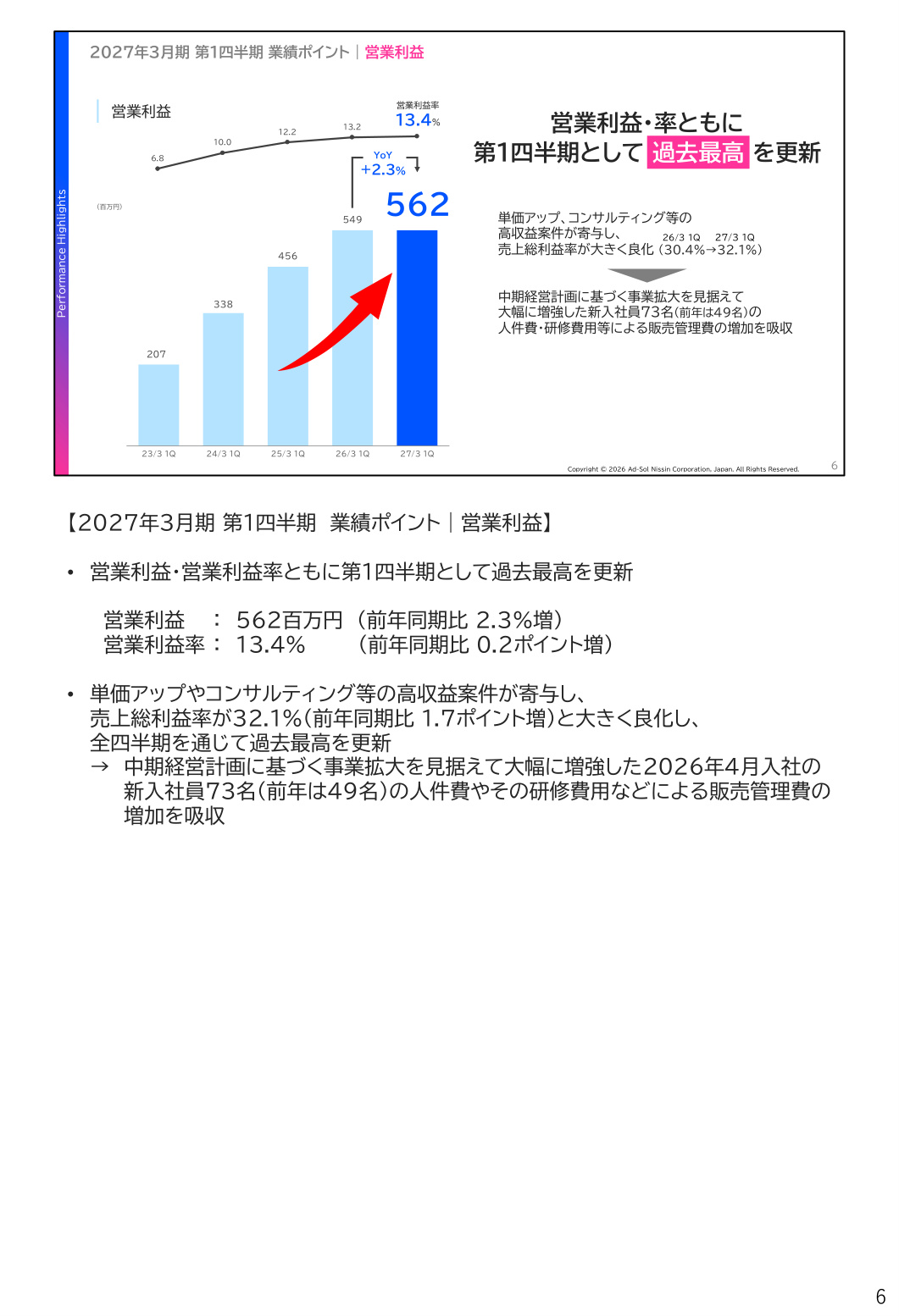
Slide Commentary (Page 5): Operating Profit Trends Reflecting Enhanced Profitability
This slide is a critical document illustrating the quarterly trends in operating profit and operating margin. Its significance lies in providing clear evidence that the company is not merely expanding its scale but is successfully executing a qualitative reform of its profit structure .
As shown in the graph, operating profit reached 562 million yen, with the operating margin rising to 13.4% , both setting records for a first quarter. This was driven by a 1.7 percentage point increase in the gross profit margin (from 30.4% to 32.1% ), resulting from a higher ratio of high-profit projects, such as upstream consulting and those utilizing proprietary assets. This growth in gross profit (+85 million yen) more than offset the increase in SG&A expenses (+72 million yen) caused by the surge in new graduate hiring.
Analysis of Factors Affecting Ordinary Profit
The breakdown of the 14 million yen increase in ordinary profit (565 million yen) is as follows:
- Revenue Growth Effect : +16 million yen
- Improvement in Cost Ratio : +69 million yen (due to high-value projects and strengthened project management)
- Increase in SG&A Expenses : -72 million yen (upfront investment in new personnel and training)
- Other : +1 million yen
This confirms the establishment of a virtuous cycle where profit growth is maintained through improved cost ratios, even while executing aggressive investments in human capital.
3. Segment Trends and Order Status
The company operates through two reporting segments: "Social Infrastructure" and "Advanced Industry."
(1) Social Infrastructure: A Powerful Growth Driver
- Revenue : 2,928 million yen ( +9.6% YoY , 69.8% of total)
- Orders Received : 3,049 million yen ( +11.2% YoY )
- Order Backlog : 2,547 million yen ( +16.1% YoY )
The Social Infrastructure segment strongly drove overall growth. Key trends by sector include:
- Energy : New large-scale projects in the power sector, cloud migration (modernization) in the gas sector, and system construction using the proprietary "AgileLeap" platform performed well.
- Transportation : Revenue surged to 425 million yen ( +35.1% YoY ) due to increased orders for railway-related systems.
- Public Sector : Rapid growth to 409 million yen ( +41.1% YoY ) driven by strong performance in security-related systems.
(2) Advanced Industry: Transitioning Through Structural Reform
- Revenue : 1,266 million yen ( -14.0% YoY , 30.2% of total)
- Orders Received : 1,014 million yen ( -26.8% YoY )
- Order Backlog : 985 million yen ( -4.7% YoY )
Revenue declined due to the reactionary impact of large-scale project completions in the previous year and the ongoing shift toward specializing in data management and AI. However, financial DX projects (such as payments and cards) and data management remain steady as the company pivots toward next-generation SI business.
Record-High Order Backlog
The company-wide order backlog reached 3,533 million yen (+9.4% YoY) , a record high for a first quarter . With full-scale development of multiple large projects, including those in the power sector, scheduled to begin in the second half, a solid backlog is secured to drive further performance growth.
4. Long-Term Growth Strategy "New Canvas 2031" and Business Model Transformation
The company has established the medium-term management plan " New Canvas 2031 " as its long-term vision.
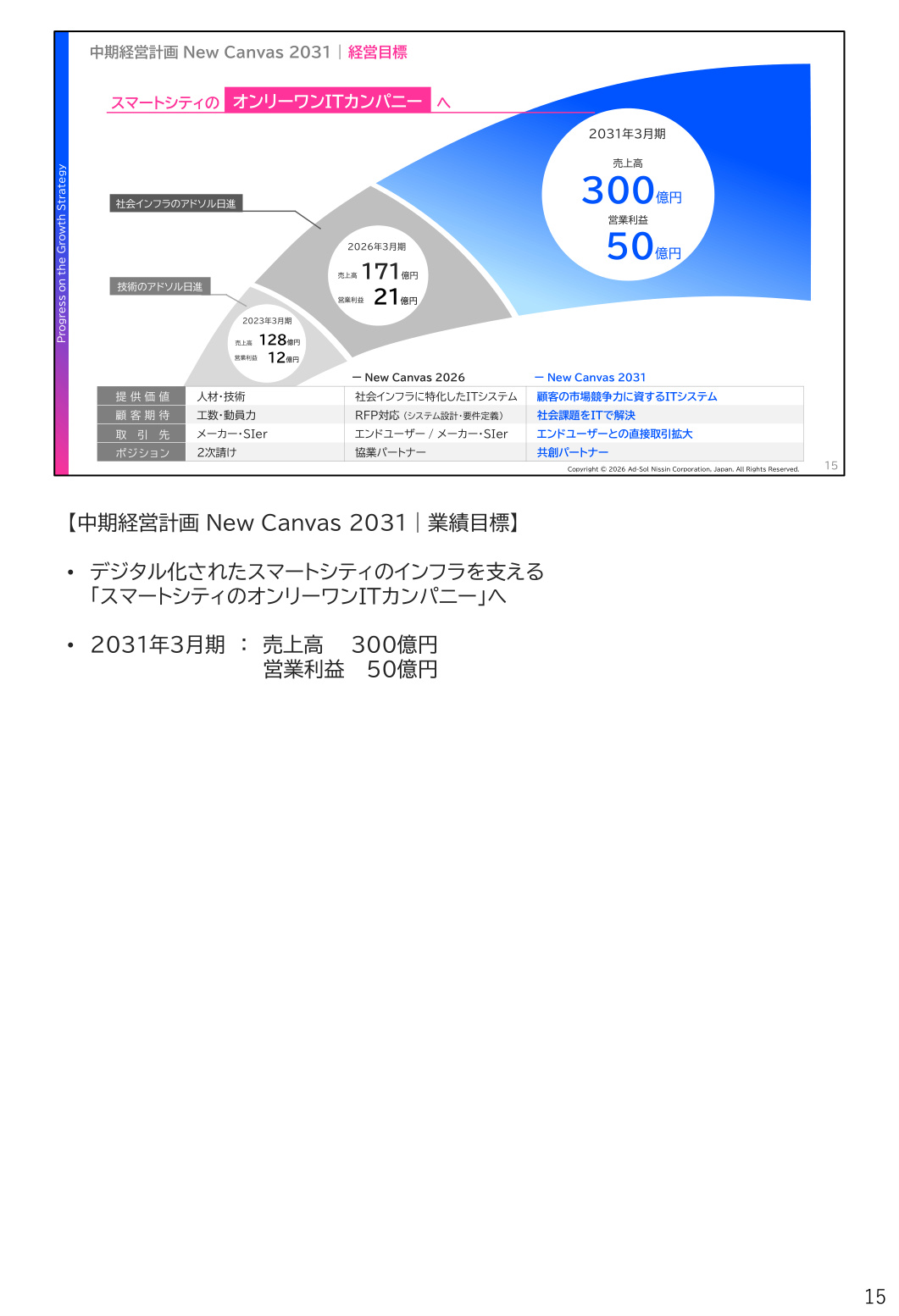
Slide Commentary (Page 14): Long-Term Vision and Performance Roadmap
This slide outlines the company's growth vision and performance targets through FY2031. It visualizes the scale and direction of the company's transformation.
Adsol Nissin has evolved from "Adsol Nissin of Technology" in its founding era to "Adsol Nissin of Social Infrastructure" (with a base of 17.1 billion yen in revenue and 2.1 billion yen in operating profit) in the previous medium-term plan. The current plan aims to elevate the company into a " One-of-a-Kind IT Company for Smart Cities ."
By the final year, FY2031 , the company targets 30 billion yen in revenue and 5 billion yen in operating profit . To achieve this, it plans to shift from a position centered on secondary contracting based on man-hours to becoming a " Co-creation Partner " that solves social issues through IT, while expanding direct transactions with end-users.
Building a Circular Business Model
The core of this growth is a circular model driven by Next-Generation SI and Offering Businesses :
- Next-Generation SI (Base Load) : Addressing complex customer needs through DX, AX (AI Transformation), and mission-critical system construction.
- Assetization and Proposals (Offering Business) : Standardizing and productizing the achievements, skills, and technologies cultivated in SI to provide upstream consulting and solutions to management.
- Reinvestment Cycle : Reinvesting cash and knowledge generated from high-profit offering businesses into developing top-tier IT talent (consultants and PMs) and cutting-edge technology (AI-native development).
5. Accelerating New Technology and AI Adoption
The company is leveraging the generative AI wave to innovate its development capabilities and enhance service value.
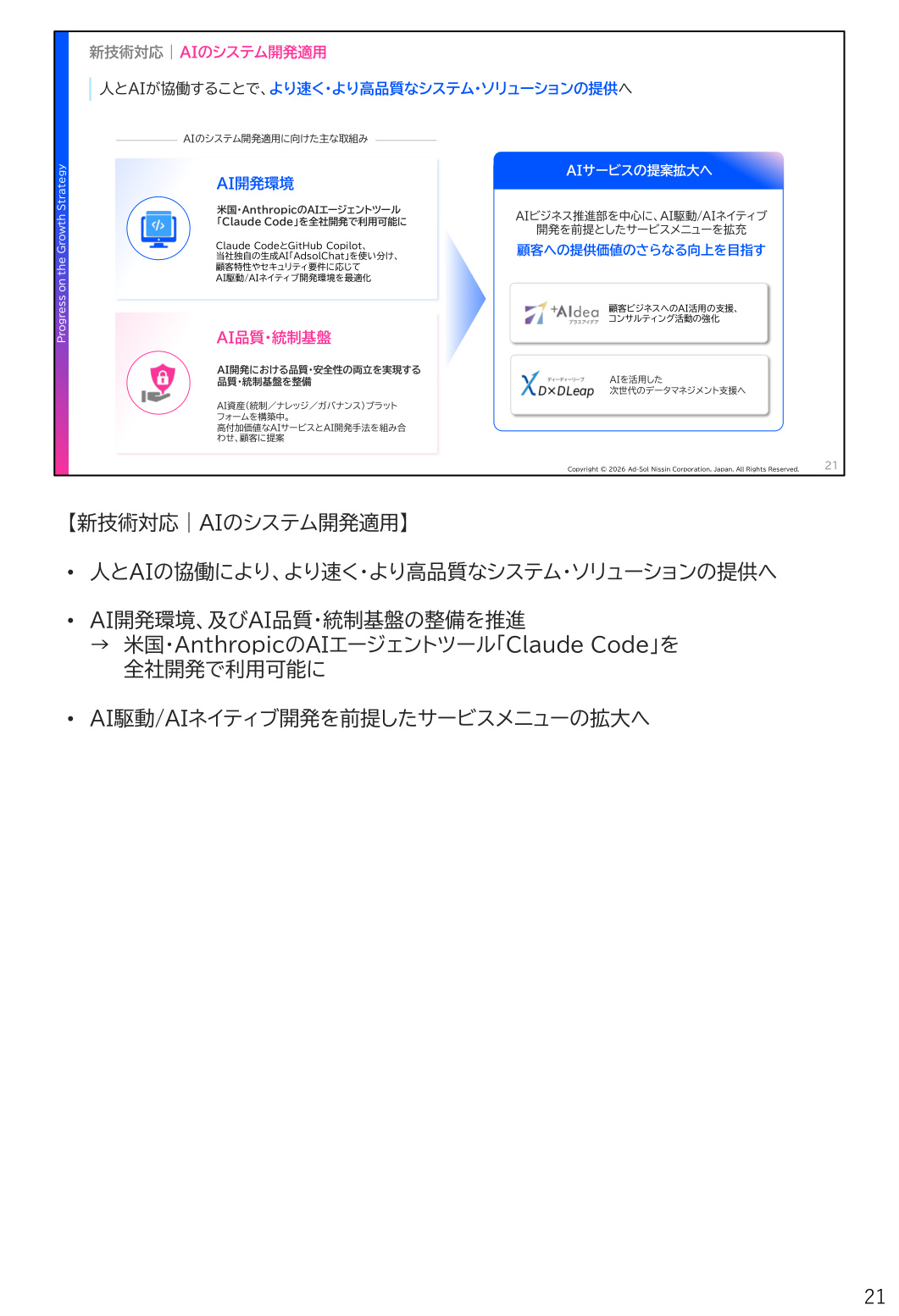
Slide Commentary (Page 20): Full-Scale Application of Generative AI in System Development
This slide illustrates the "AI-centered system development application areas and promotion structure" that form the source of the company's competitiveness. It shows how the company is updating its development processes and converting them into customer value.
Specifically, the company has implemented an AI-native development environment by enabling the use of Anthropic's advanced AI agent tool " Claude Code " company-wide, combined with GitHub Copilot and the internal AI "AdsolChat." To address quality and security concerns, it is simultaneously building a governance foundation through the AI platform " +Aldea " and " XDxLeap ."
By fostering collaboration between engineers and AI, the company is prepared to deliver both dramatically faster development speeds and high-quality solutions as AI-driven service offerings.
6. Full-Year Forecast and Shareholder Return Policy
FY2027 Full-Year Forecast
The full-year consolidated forecast for FY2027 remains unchanged from the initial plan, with the company expecting to set record-high results for the fourth consecutive year .
- Revenue : 18,200 million yen (+6.1% YoY)
- Operating Profit : 2,400 million yen (+11.9% YoY, margin 13.2%)
- Ordinary Profit : 2,470 million yen (+11.5% YoY, margin 13.6%)
- Net Income : 1,610 million yen (+6.5% YoY, margin 8.8%)
Performance is expected to be weighted toward the second half due to the full-scale development of large projects. Q1 progress is in line with expectations.
Shareholder Returns (Aiming for 17 Consecutive Dividend Increases)
The company prioritizes shareholder returns and maintains a policy of stable dividend growth.
- Annual Dividend Forecast : 48 yen (+2 yen YoY)
- Interim: 24 yen (ordinary)
- Year-end: 24 yen (previous year included a 5 yen commemorative dividend)
This marks a steady increase in ordinary dividends, and if achieved, it will be the 17th consecutive year of dividend increases . The projected dividend payout ratio is 50.2% , and ROE is 22.7% , reflecting high capital efficiency and a strong commitment to shareholders.
7. Conclusion
Adsol Nissin's Q1 FY2027 results are highly commendable, as the company achieved record-high performance by absorbing increased costs from mass hiring through improved gross profit margins . Backed by strong demand in social infrastructure and a record-high order backlog, the foundation for achieving the full-year plan is extremely solid.
Furthermore, the company is steadily advancing structural reforms that anticipate future IT industry shifts, such as the transition to an offering business model under "New Canvas 2031" and the company-wide adoption of Claude Code. The progress of this growth transformation will be a key point to watch.
This content is not intended as investment advice or a recommendation. Any opinions expressed are solely the personal views of each article.