


Asahi Net, Inc. Q1 FY2027 Earnings Report: Temporary Profit Decline Due to Strategic Upfront Investment and Strengthening of Mid-to-Long-Term Growth Foundations

StockClub
Published: Aug 06, 2026, 10:21 AM
Sentiment Analysis

This report provides a detailed analysis of the financial results and business trends for Asahi Net, Inc. (Securities Code: 3834) for the first quarter of the fiscal year ending March 31, 2027 (April 1, 2026, to June 30, 2026), based on disclosed materials.
In the first quarter, while the company maintained a steady upward trend in its top line with year-on-year revenue growth, operating profit declined compared to the same period last year. This was primarily due to increased depreciation expenses resulting from aggressive capital investment aimed at future business expansion, as well as increased SG&A expenses to strengthen member acquisition .
Below, we provide a multifaceted analysis of the overall performance, factors behind revenue and operating profit, trends in key performance indicators (KPIs) regarding the customer base, and shifts in the business structure.
1. Earnings Summary and Key Topics (10 Analytical Perspectives)
The key analytical points for this quarter are summarized in the following 10 items:
- Steady Top-Line Growth : Q1 revenue reached 3,402 million yen (+1.3% YoY) , maintaining a growth trend.
- Strong Traction of "v6 Connect" : The flagship IPoE connection service, "v6 Connect," contributed to a revenue increase of +41 million yen YoY.
- Expansion in Hikari Collaboration and Apartment-wide Services : Capturing demand for FTTH lines, Hikari Collaboration grew by +20 million yen and apartment-wide services by +11 million yen .
- Negative Impact of Legacy and Peripheral Services : ADSL (-5 million yen), LTE/WiMAX (-2 million yen), and the educational support system "manaba" (-14 million yen) acted as headwinds.
- Strategic Decline in Operating Profit : Q1 operating profit was 284 million yen (-43.6% YoY) , with the operating margin falling to 8.4%.
- Surge in Depreciation Burden : Due to capital investments such as network infrastructure reinforcement, depreciation expenses within the cost of sales increased by 124 million yen .
- Investment in Member Acquisition : An additional 40 million yen was invested in SG&A (advertising and promotion) to drive future stock revenue growth.
- Increase in Personnel and Operational Costs : Costs rose by 27 million yen for outsourcing and personnel, and 15 million yen for line procurement and other costs.
- Steady Growth in FTTH Connections : The number of fiber-optic (FTTH) connections grew to 516,000 IDs (+16,000 IDs YoY) .
- Maintenance of Extremely Low Churn Rate : The monthly churn rate remained at a low level of 0.63% , upholding a stable stock-based business structure.
2. Revenue Trends and Analysis of Growth Drivers
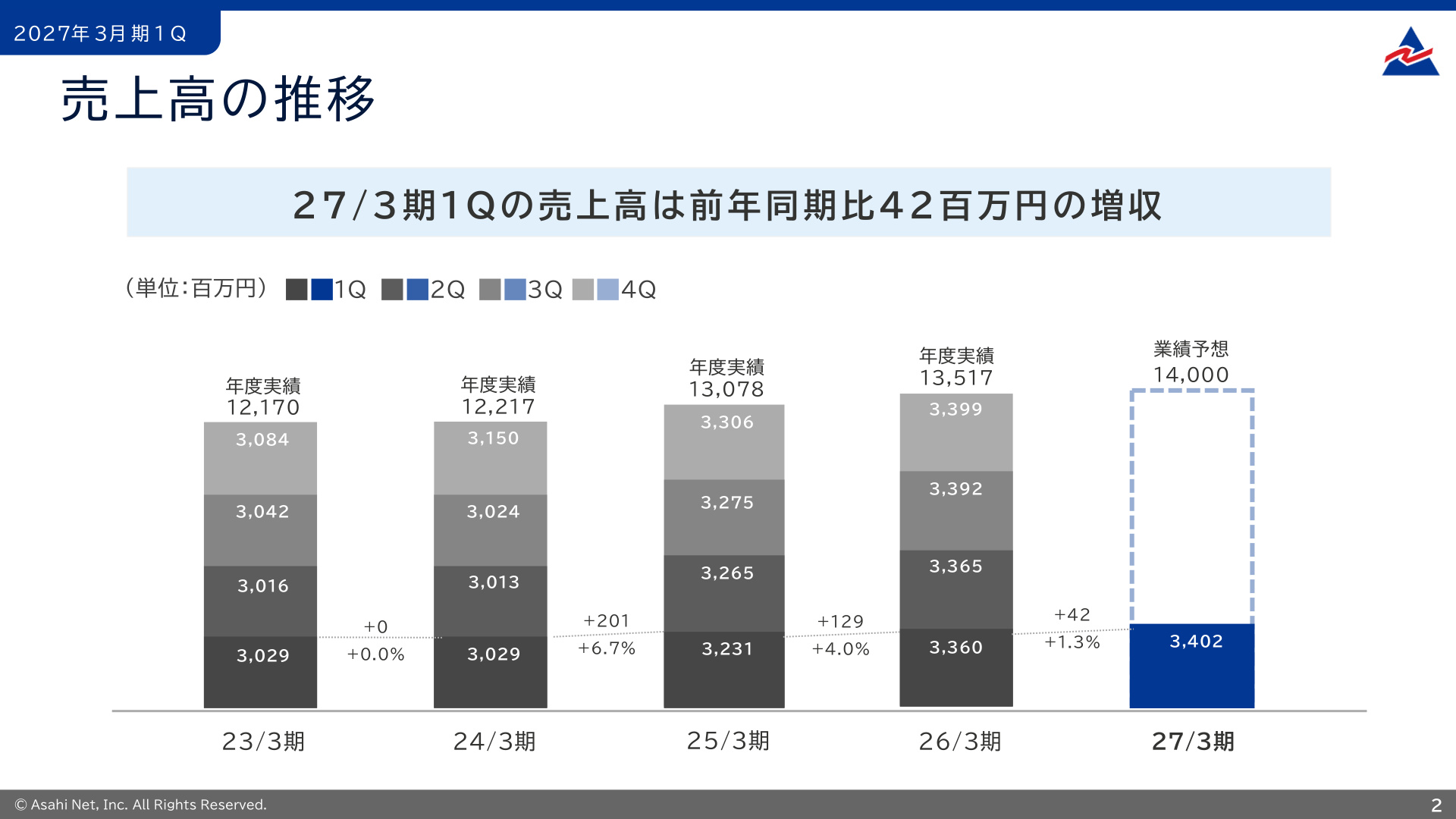
Revenue for the first quarter reached 3,402 million yen , marking a 42 million yen increase (+1.3%) from 3,360 million yen in the same period last year. Looking at quarterly revenue trends, the company has consistently increased its Q1 revenue for several years, confirming the steady accumulation characteristic of its stock-based business model.
[Significance and Background of the Slide Above]
This slide is crucial as it illustrates the accumulation of Q1 revenue over the past five years and the progress toward the full-year earnings forecast. One can see at a glance the upward trend in quarterly revenue , growing from 3,029 million yen in Q1 FY23/3 to 3,231 million yen (FY25/3), 3,360 million yen (FY26/3), and 3,402 million yen (FY27/3). It also shows a solid start toward the full-year revenue forecast of 14,000 million yen .
A detailed breakdown of the revenue changes shows that the primary driver of growth is "v6 Connect," which provides IPv6 connections (+41 million yen YoY). In addition, the company's own fiber-optic service, Hikari Collaboration (+20 million yen), and the service for multi-dwelling units, Apartment-wide services (+11 million yen), are expanding steadily.
While there were revenue declines in areas shrinking across the market, such as ADSL (-5 million yen), mobile services (LTE/WiMAX: -2 million yen), and the cloud-based educational support service "manaba" (-14 million yen), the growth in the core FTTH-related business was sufficient to absorb these, resulting in overall positive growth.
3. Operating Profit Trends and Cost Dynamics
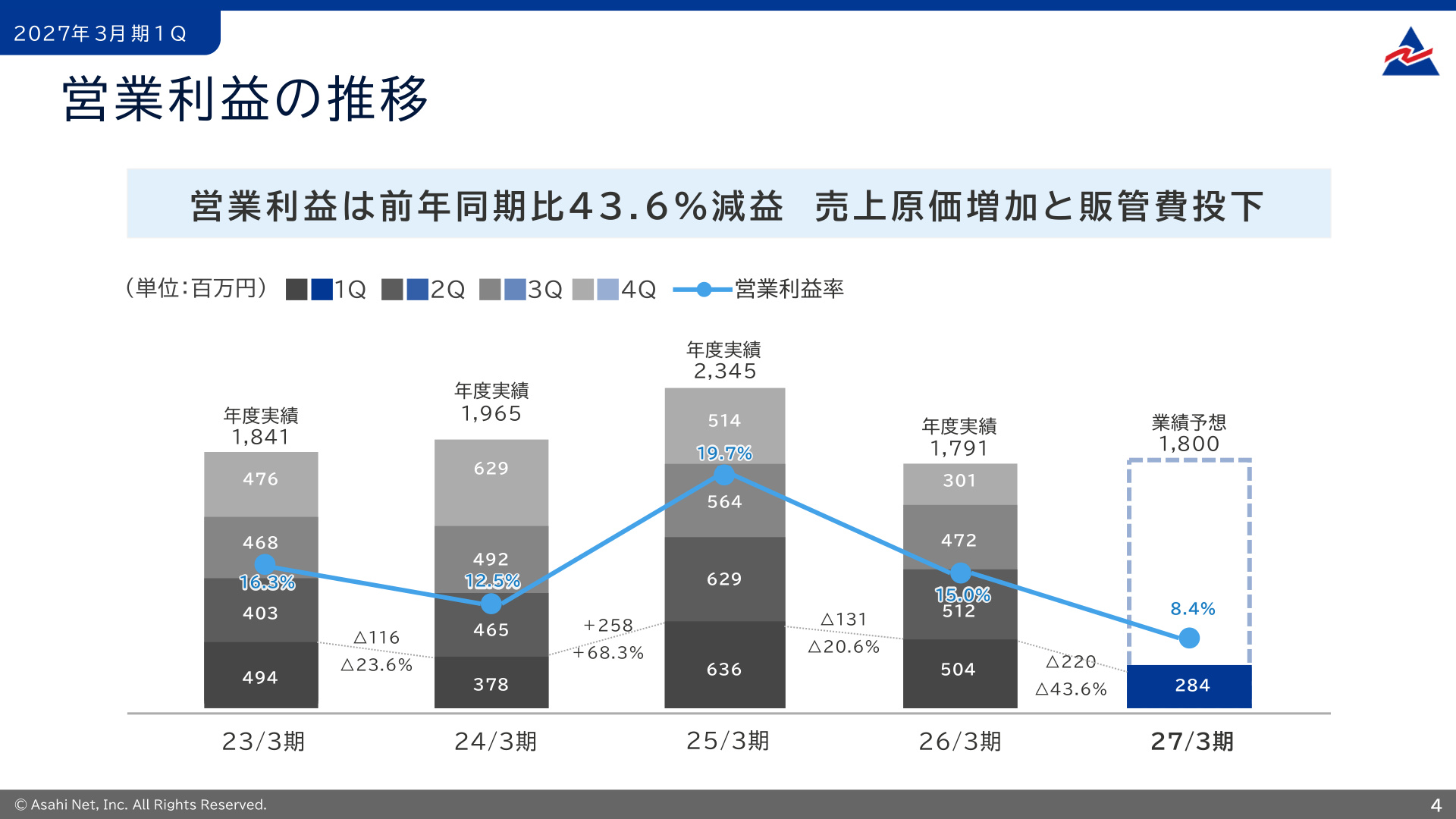
While revenue remained solid, operating profit for the first quarter was 284 million yen , a decrease of 220 million yen (-43.6%) compared to 504 million yen in the same period last year. The operating margin also temporarily contracted from 15.0% in the same period last year to 8.4% .
[Significance and Background of the Slide Above]
This slide is vital as it visually clarifies the changes in the company's profit structure and the degree of profit pressure this quarter. While the company recorded a high operating margin of 19.7% in Q1 FY25/3, the margin has fallen to 8.4% this quarter due to increased cost of sales and aggressive SG&A spending. This graph does not merely indicate deteriorating performance but presents structural data suggesting the company has entered a "cost-upfront phase to build future revenue foundations."
The specific background and factors behind the 220 million yen year-on-year decline in operating profit can be more clearly understood through the following expense breakdown slide.
[Significance and Background of the Slide Above]
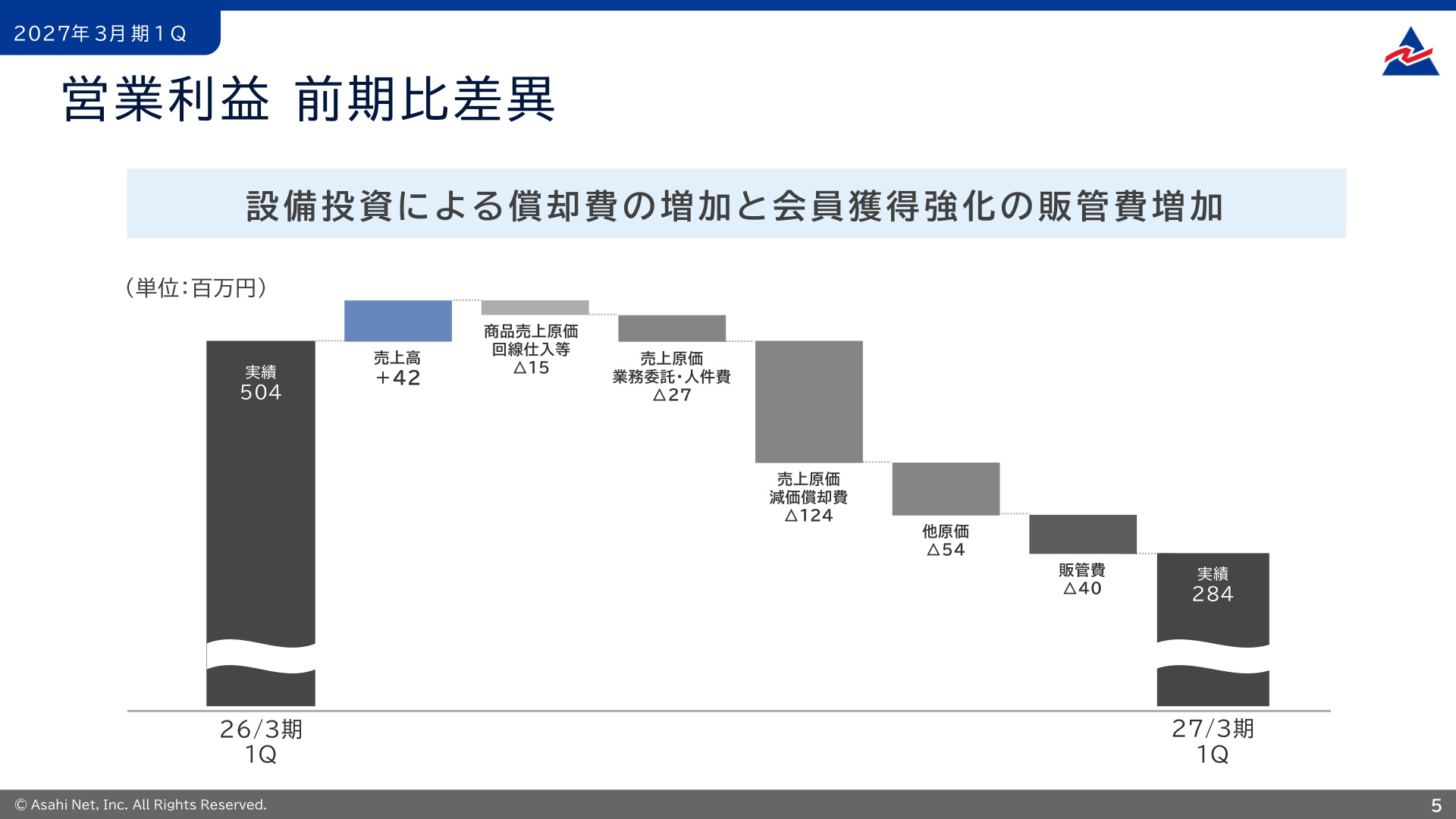
This slide shows the specific factors behind the cost increase (waterfall chart) that led to the profit decline and is a core document for this earnings analysis. It allows for a detailed understanding of not just the fact of a "profit decline," but which expenses occurred and by how much.
The analysis of specific variance factors is as follows:
- Increase in Revenue (+42 million yen) : Profit-boosting effect from top-line expansion.
- Increase in Cost of Sales (Total -220 million yen) :
- Increase in Depreciation (-124 million yen) : The most significant factor. Depreciation burden surged due to capital investment for the expansion and renewal of in-house network equipment.
- Increase in other costs (-54 million yen).
- Increase in outsourcing and personnel costs (-27 million yen): Due to the strengthening of support systems and system operations.
- Increase in product cost of sales and line procurement (-15 million yen): Higher line costs due to increased traffic.
- Increase in SG&A Expenses (-40 million yen) : Active investment in promotional activities and marketing aimed at member acquisition.
As described above, the main cause of the profit decline is not a slowdown in sales, but rather intentional upfront spending for building a network capable of withstanding future internet traffic growth (depreciation -124 million yen) and promotional campaigns to expand the number of new members (SG&A -40 million yen) , both of which are necessary measures for mid-to-long-term growth.
4. KPI Analysis: Growth Foundations (Contract Numbers and Churn Rate)
Continuous growth is observed in the customer base (number of members), which is the source of revenue.
The number of FTTH (fiber-optic) connections , the mainstream of the "ASAHI Net" ISP, reached 516,000 IDs , achieving an increase of 16,000 IDs (+3.2%) from the same period last year (500,000 IDs). Mobile connection contracts also remained steady at 48,000 IDs (+2,000 IDs YoY) .
Furthermore, the low churn rate , which indicates customer retention, is noteworthy. The churn rate for this quarter was 0.63% , maintaining the same extremely low level as the same period last year (0.63%). Looking at the trends over the past few years (June '22: 0.74% → June '23: 0.75% → June '24: 0.64% → June '25: 0.63% → June '26: 0.63%), the trend of low and stable churn is firmly established, confirming a high-quality stock-based model where members stay for long periods once acquired .
5. Summary and Future Outlook
Analyzing Asahi Net's Q1 FY2027 earnings comprehensively, it can be viewed as a "quarter where the core business expanded steadily and the stock base was strengthened, while infrastructure investment and member acquisition costs aimed at future growth temporarily pushed down profits."
High-demand areas such as "v6 Connect" and Hikari Collaboration are reliably increasing revenue, and the growth in contract numbers combined with a low churn rate demonstrates high customer appreciation for the company's service quality. While the increased burden of depreciation (-124 million yen) and SG&A expenses (-40 million yen) due to upfront investment lowers the operating margin in the short term, these are necessary measures that will lead to future expansion of network capacity and further accumulation of members .
How these investment effects will contribute to the further acceleration of contract numbers and improvement in profitability against the full-year earnings forecast will be the focus for enhancing corporate value over the mid-to-long term.
This content is not intended as investment advice or a recommendation. Any opinions expressed are solely the personal views of each article.