


E-Seikatsu Co., Ltd. Q1 FY2027 Earnings Deep Dive Report

StockClub
Published: Aug 06, 2026, 10:20 AM
Sentiment Analysis

Executive Summary
E-Seikatsu Co., Ltd. (Securities Code: 3796) , a provider of vertical SaaS and BPaaS (Business Process as a Service) specialized for the real estate industry, has announced its financial results for the first quarter (Q1) of the fiscal year ending March 2027.
In Q1, the company achieved revenue of 767 million yen (up 2.3% YoY) and an operating profit of 3 million yen (compared to an operating loss of 13 million yen in the same period last year), marking a successful increase in both revenue and profit, alongside a return to operating profitability . Despite a reactionary decline in solution revenue due to the completion of large-scale implementation projects from the previous year, the core subscription revenue grew steadily by 9.4% YoY , effectively absorbing the shortfall.
Furthermore, profitability improved significantly, driven by a reduction in total expenses compared to the same period last year, attributed to productivity gains from AI integration . EBITDA grew to 145 million yen (up 16.2% YoY) , and the EBITDA margin reached 19.0% (an improvement of 2.3 percentage points) , confirming the company's strengthening cash-generating capabilities.
1. Q1 FY2027 Earnings Highlights and Overview
First, we examine the overall performance of the company's key metrics for the first quarter. The results strongly reflect the company's focus on expanding recurring revenue and improving profit margins.
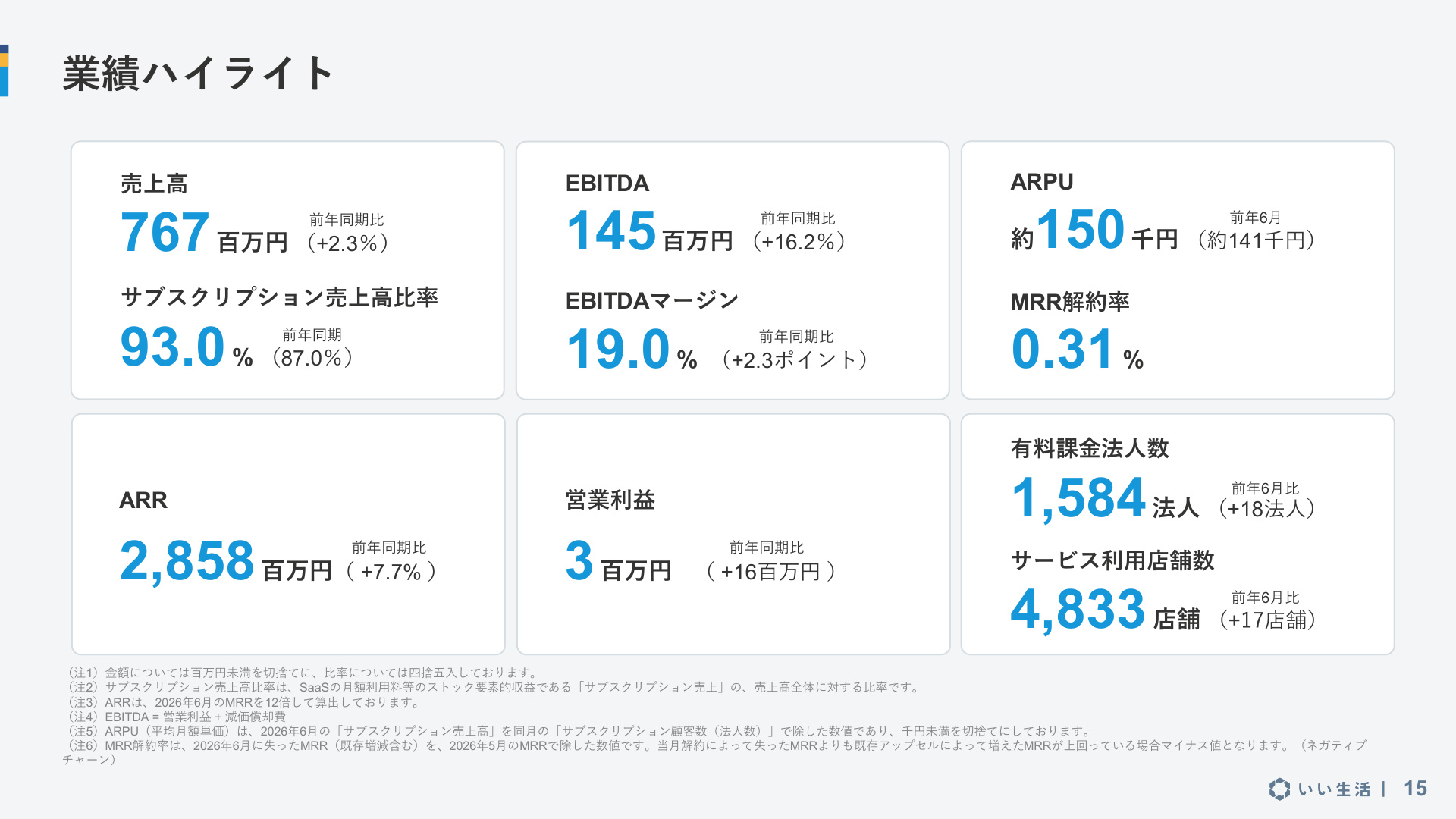
[Image Explanation: Earnings Highlights Slide (P.14)]
The slide above provides a comprehensive overview of the company's key performance indicators and critical SaaS metrics for Q1 FY2027. It covers the most essential data for understanding the core of these financial results.
- Revenue and Composition : Revenue reached 767 million yen (+2.3% YoY) , with the subscription revenue ratio rising to 93.0% (up from 87.0% in the same period last year), further solidifying the stock-based revenue structure.
- Profitability Metrics : EBITDA grew to 145 million yen (+16.2% YoY) , with the EBITDA margin rising to 19.0% . Operating profit also turned around from a loss in the previous year to a profit of 3 million yen .
- Stock Scale and Customer Metrics : ARR (Annual Recurring Revenue) reached 2,858 million yen (+7.7% YoY) . The average monthly revenue per corporate client (ARPU) rose to approximately 150,000 yen (up from 141,000 yen), while the MRR churn rate remained at an exceptionally low level of 0.31% . Additionally, the number of paying corporate clients grew to 1,584 (+18 since June of the previous year) , and the number of service-utilizing locations reached 4,833 (+17) .
These highlights demonstrate that the company is not merely increasing revenue, but achieving high-quality growth supported by a shift toward a high-margin subscription model, rising customer unit prices, and a low churn rate.
2. Revenue Structure Analysis: Subscription Growth vs. Solution Reactionary Decline
A detailed analysis of the revenue breakdown clarifies the shift in the business structure. Revenue is categorized into "Subscription" and "Solution."
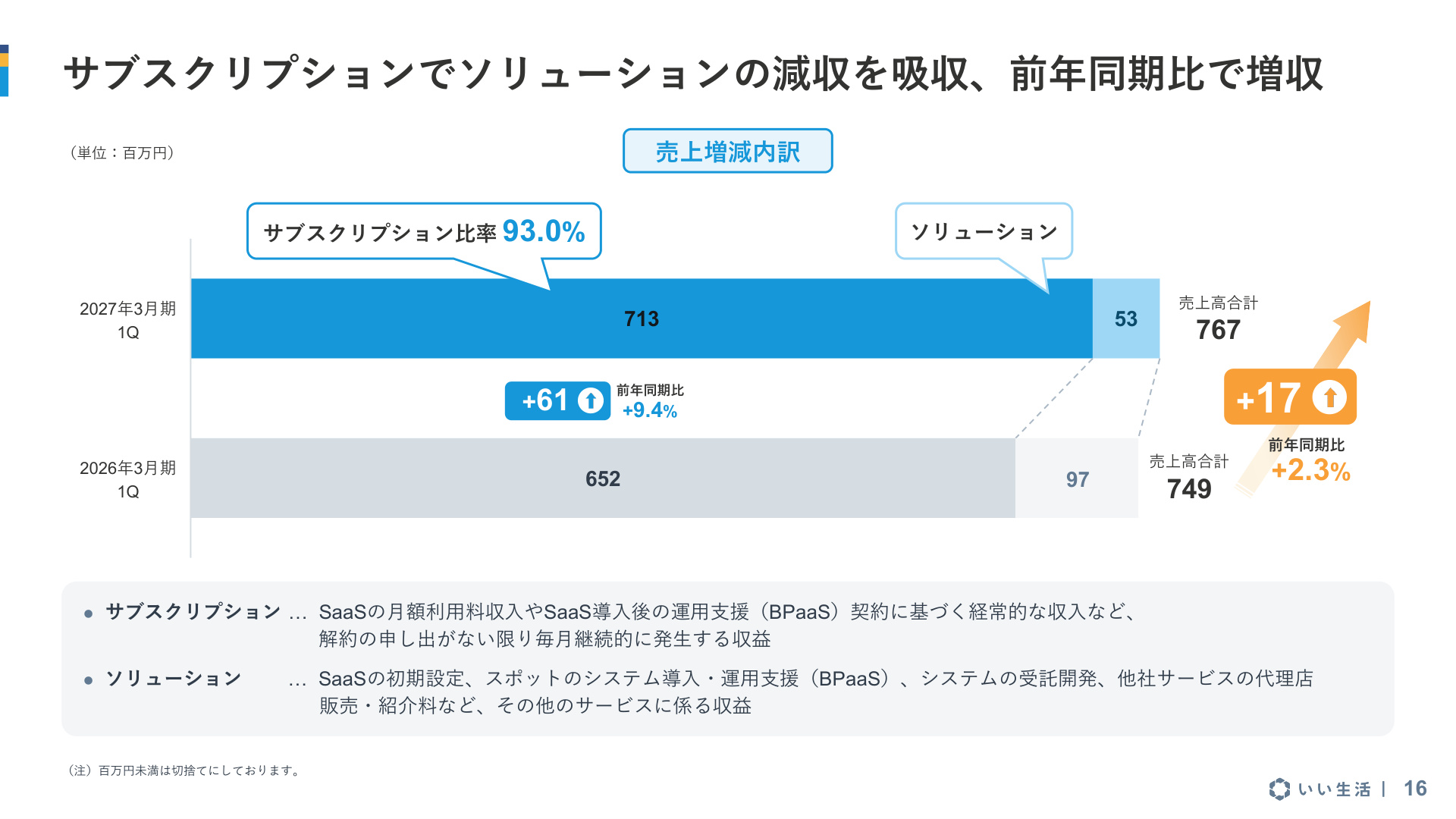
[Image Explanation: Revenue Breakdown Slide (P.15)]
This slide visually explains the factors behind the year-on-year changes in revenue. It is essential data for understanding the dynamics of revenue growth for the period.
- Subscription Revenue : Increased significantly from 652 million yen in the same period last year to 713 million yen (+61 million yen, +9.4% YoY) , driven by the accumulation of recurring income from SaaS monthly fees and BPaaS contracts.
- Solution Revenue : Decreased significantly from 97 million yen in the same period last year to 53 million yen (-45.4% YoY) . This is a temporary reactionary decline due to the concentration of large-scale implementation projects in the same period last year.
Although the decline in solution revenue created a -44 million yen headwind, the +61 million yen increase in subscription revenue (SaaS stock revenue) resulted in a total revenue increase of +17 million yen (+2.3%) . The robustness of a business model that relies on recurring subscription revenue rather than spot-based solution revenue is clearly evident. The company expects solution revenue to increase year-on-year for the full fiscal year, planning a recovery from this temporary decline.
3. Cost Structure Reform and Productivity: Personnel Optimization via AI
A major factor in achieving a return to profitability was the success in reducing total expenses (cost of sales + SG&A expenses) in addition to revenue growth. Total expenses for the period decreased to 736 million yen (down from 763 million yen in the same period last year) , reflecting improved cost structure efficiency.
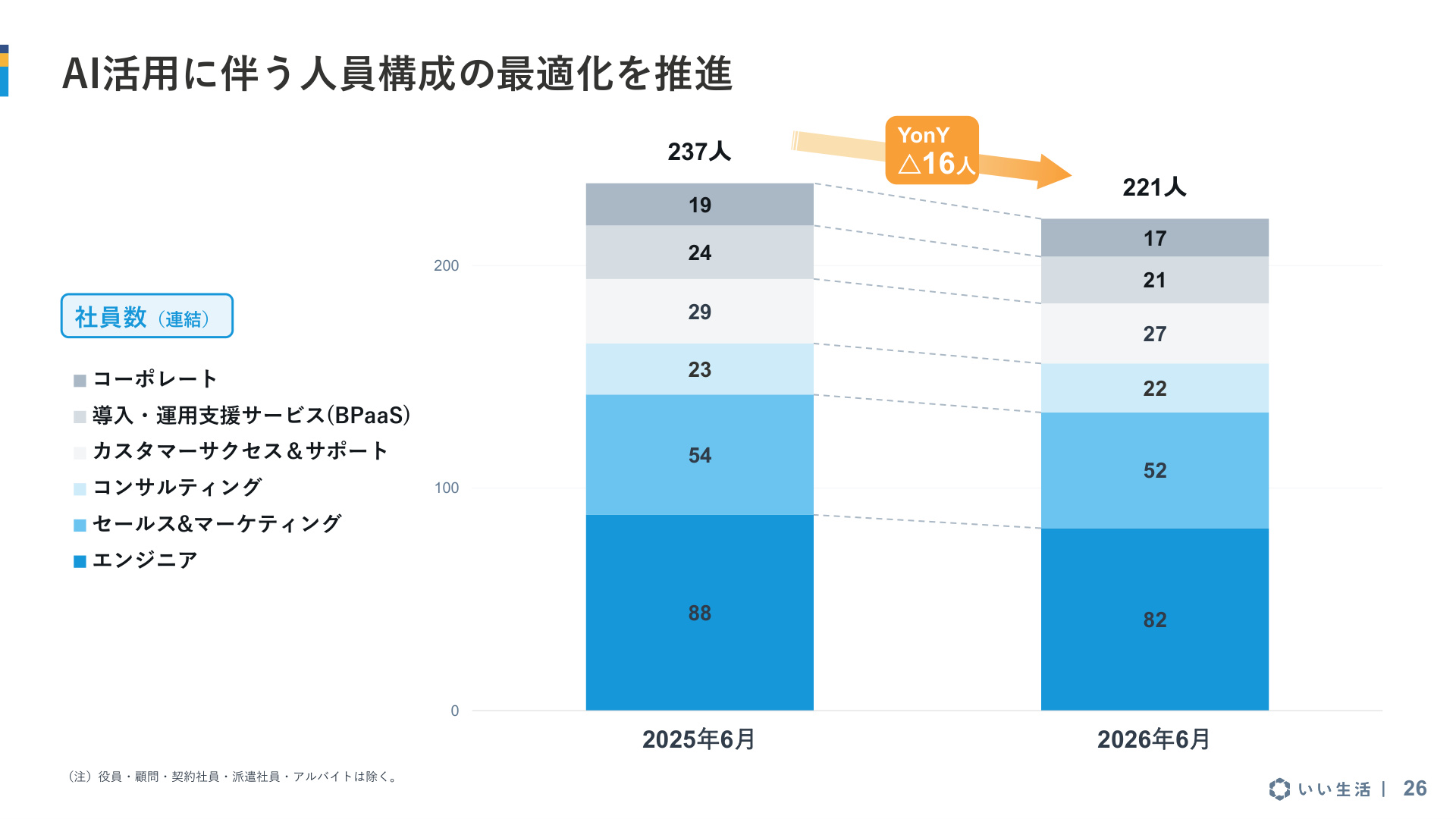
[Image Explanation: Personnel Optimization via AI Integration Slide (P.25)]
At the core of cost reduction and productivity improvement is the optimization of personnel structure shown in this slide. The results of the company's AI initiatives are quantified here.
- Personnel Trends : The headcount was optimized from 237 at the end of June 2025 to 221 at the end of June 2026 (-16 YoY) .
- Departmental Changes : Key departments achieved personnel optimization through operational efficiency, including Engineering (88 to 82), Sales & Marketing (54 to 52), and Customer Success & Support (29 to 27).
Rather than simple payroll cuts, the company promoted the introduction and utilization of AI in internal operations and development processes , significantly improving operational productivity. This has built a system capable of maintaining and expanding high-quality service delivery and operational support with fewer personnel, directly contributing to the suppression of cost of sales and SG&A expenses, and ultimately, the return to operating profit (3 million yen) and the expansion of EBITDA (145 million yen).
4. Deep Dive into Key KPIs: ARPU Growth and Customer Base Stability
We further analyze the key KPIs that underpin the company's sustainable growth.
① Growth in ARPU (Average Monthly Revenue per Corporate Client)
ARPU for the period was approximately 150,000 yen (+6.5% YoY) . Looking at historical trends, there has been a gradual upward trend from 133,000 yen in June 2023. This is driven by the establishment of a multi-product, phased adoption structure (cross-selling/up-selling) , where customers move from initial sales support and property advertising SaaS to rental management cloud, BPaaS, and smartphone apps for owners and tenants.
② MRR Churn Rate Maintained at Low Levels
The MRR churn rate for the period was 0.31% , an exceptionally low level even within the SaaS industry. Because the company's core systems are deeply integrated into the daily operational processes of real estate companies (rental management, brokerage, accounting, customer support, etc.), switching costs are high, resulting in very high customer retention.
5. Financial Soundness and Cash Flow Status
The soundness of the company's management foundation is also confirmed from the perspective of the balance sheet and cash flow.
- Assets and Equity Ratio : Total assets as of the end of June 2026 were 2,496 million yen, and the equity ratio rose to 78.2% (up 3.7 points from 74.5% at the end of March 2026), maintaining an extremely sound financial position.
- Cash Flow Trends : Operating cash flow secured a surplus of 78 million yen , despite the impact of corporate tax payments. Meanwhile, investment cash flow was -134 million yen due to active investment in software development, resulting in a temporary negative free cash flow (FCF) of -56 million yen . However, the company holds sufficient cash and deposits (496 million yen) to cover continuous investment in growth areas.
6. Mid-to-Long-Term Growth Strategy and Market Environment
The company's competitive advantage and future growth story lie in the combination of "SaaS x Vertical x Multi-Product x AI."
- Synergy between Vertical SaaS and BPaaS : By combining SaaS (subscription) specialized for the real estate industry with "BPaaS" (Business Process as a Service) consulting for implementation and operation support to compensate for labor shortages, the company provides end-to-end DX support for small and medium-sized real estate companies (where 83.9% have 5 or fewer employees) that lack IT talent.
- Tailwinds from Legal Reform Trends : Following the Rental Housing Management Business Act, the legalization of electronic contracts, and the invoice system, the real estate industry faces continuous legal reforms, including the start of "anti-hoarding" regulations in January 2025 and the planned application of "new lease accounting standards" in April 2027. Compliance with these changes strongly encourages the migration to cloud-based core systems.
7. Full-Year Earnings Forecast and Shareholder Returns
Full-Year Consolidated Earnings Forecast and Progress
The Q1 results and progress against the full-year consolidated earnings forecast for the fiscal year ending March 2027 are as follows:
- Revenue : Forecast 3,415 million yen / Q1 Actual 767 million yen (Progress 22.5% )
- Operating Profit : Forecast 319 million yen / Q1 Actual 3 million yen (Progress 1.0% )
- Ordinary Profit : Forecast 317 million yen / Q1 Actual 10 million yen (Progress 3.2% )
- Net Income : Forecast 195 million yen / Q1 Actual 4 million yen (Progress 2.2% )
While profit progress at the end of Q1 appears low, this is due to seasonal fluctuations, the accumulation of project-based revenue toward the second half, and the planned layering effect of subscriptions. The company characterizes this as a "smooth start at the expected pace."
Shareholder Returns (Dividends/Perks)
- Dividend Forecast : The year-end dividend forecast for the fiscal year ending March 2027 is 3.00 yen per share (effectively maintained considering the 1:2 stock split on April 1, 2026; equivalent to 6.00 yen pre-split). The company maintains its policy of stable dividend payments.
- Shareholder Perks : The company has announced the establishment of a shareholder benefit program to increase brand awareness and attract a broader range of investors.
Conclusion
E-Seikatsu Co., Ltd.'s Q1 FY2027 earnings report marks a strong start, with the temporary decline in solution revenue reliably covered by growth in stock-based subscription revenue (+9.4% YoY) , resulting in a return to profitability and a 16.2% increase in EBITDA .
With the optimization of internal operations through AI, the suppression of total expenses, the accumulation of recurring revenue supported by a low churn rate (0.31%), and the tailwind of industry DX demand driven by legal reforms, the company is steadily laying the groundwork to achieve its full-year plan.
This content is not intended as investment advice or a recommendation. Any opinions expressed are solely the personal views of each article.