


Roadstar Capital (3482) FY2026 Q2 Earnings Deep Dive Report

StockClub
Published: Aug 06, 2026, 10:17 AM
Sentiment Analysis

Roadstar Capital (3482) FY2026 Q2 Earnings Deep Dive Report
Roadstar Capital K.K. delivered a robust performance in the second quarter of the fiscal year ending December 2026. Driven by the successful sale of large-scale office buildings and strong property acquisitions centered on prime central Tokyo offices, the company achieved its interim targets (with a progress rate exceeding 50%) across both revenue and all profit tiers. This report provides a comprehensive analysis of the earnings highlights, segment-specific trends, financial strategies, and the progress of the medium-term management plan as evidenced by the financial results.
1. Earnings Highlights and Overview: On Track with Over 50% Progress
Key Consolidated Financial Indicators
The following are the key performance figures for the first half of the fiscal year ending December 2026 and the progress rate against the full-year plan:
- Revenue : 28,293 million JPY (YoY +36.0% / Full-year progress: 50.4% )
- Operating Profit : 7,887 million JPY (YoY +4.5% / Full-year progress: 49.4% )
- Profit Before Tax : 6,777 million JPY (YoY +2.2% / Full-year progress: 50.1% )
- Net Profit : 4,589 million JPY (YoY +1.3% / Full-year progress: 50.0% )
- Balance of Real Estate for Sale : 98,681 million JPY (vs. previous year-end +6.6% )
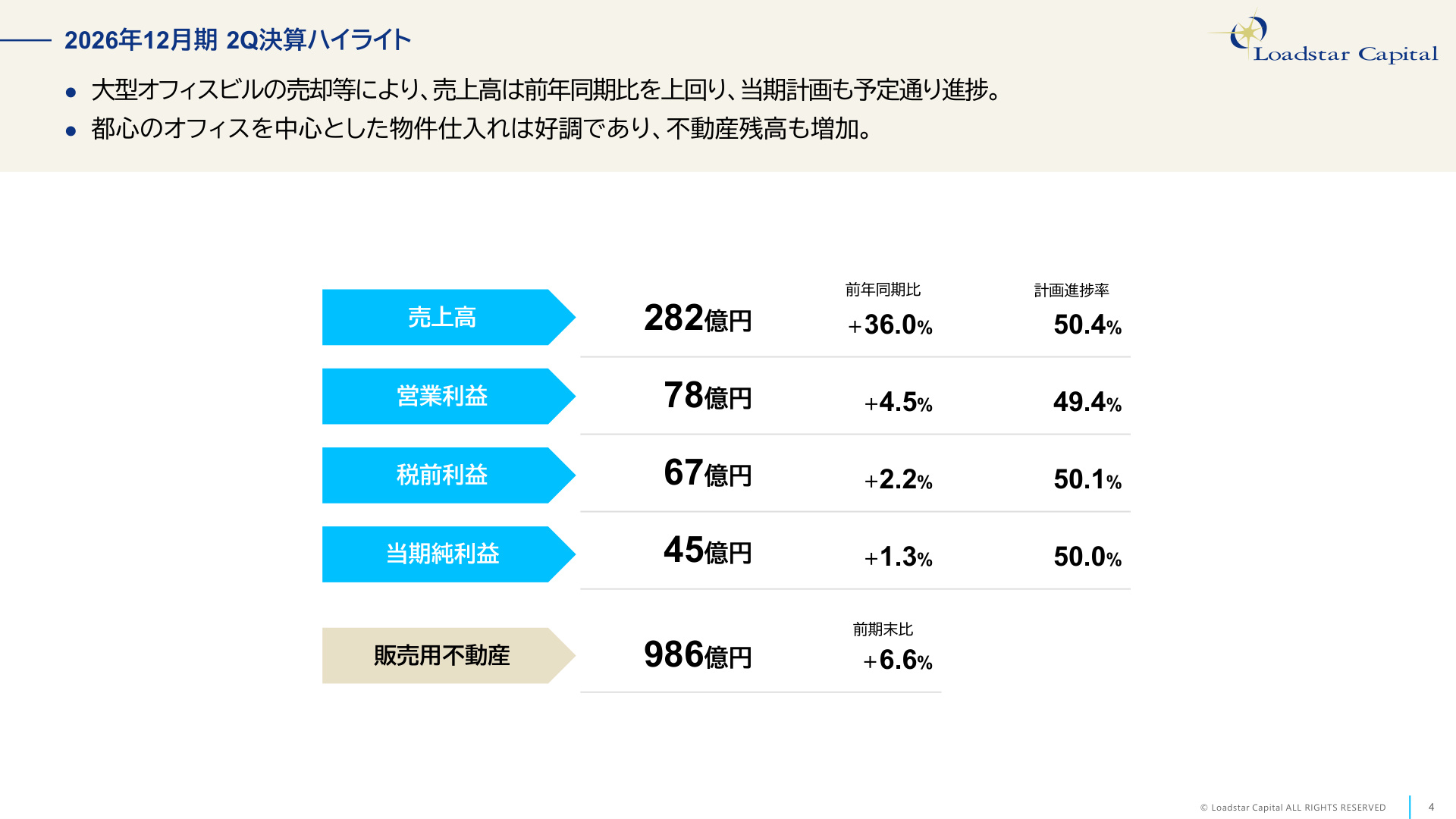
Significance of the Slide and Numerical Context
The slide above provides a concise overview of the company's performance for Q2 FY2026. The primary driver behind the significant 36.0% YoY increase in revenue was the completion of the sale of two properties, including a large-scale office building, within the core Corporate Funding business.
Notably, the company has demonstrated precise control over its business plan, with progress rates for all profit tiers—operating profit, profit before tax, and net profit—falling within the 50.0% to 50.1% range against full-year targets. Furthermore, the balance of real estate for sale has grown to 98.6 billion JPY (+6.6% from year-end) , confirming that the company is effectively building a pipeline for future profit opportunities.
2. Earnings Topics and Shareholder Return Measures
Three key qualitative topics and shareholder return measures were highlighted in the second quarter:
- Acquisition of Large-scale Recently Built Property (Ms Cross Ningyocho)
- The company acquired "Ms Cross Ningyocho," a recently built office building in central Tokyo with excellent visibility and transport accessibility, from Mitsubishi Estate Co., Ltd. This is part of a portfolio enhancement strategy to meet high investment demand for prime, modern properties.
- Effective 20% Dividend Increase via Free Allotment of Shares
- To improve stock liquidity and enhance shareholder returns, the company implemented a free allotment of 0.2 shares per common share effective July 1, 2026. As the annual dividend forecast per share ( 98 JPY ) was maintained, this represents an effective dividend increase of approximately 20% for existing shareholders.
- Launch of Digital Securities Service "OwnersBook+"
- As part of strengthening its real estate Security Token (ST) business, the company released the first project under the new "OwnersBook+" framework in July 2026.
3. In-depth Analysis of Profit Structure and Financial Foundation
Trends in P/L and Cash Generation Capability
The following chart shows the trends in EBITDA and Earnings Per Share (EPS), which are key indicators of the company's profit structure and cash-generating ability.
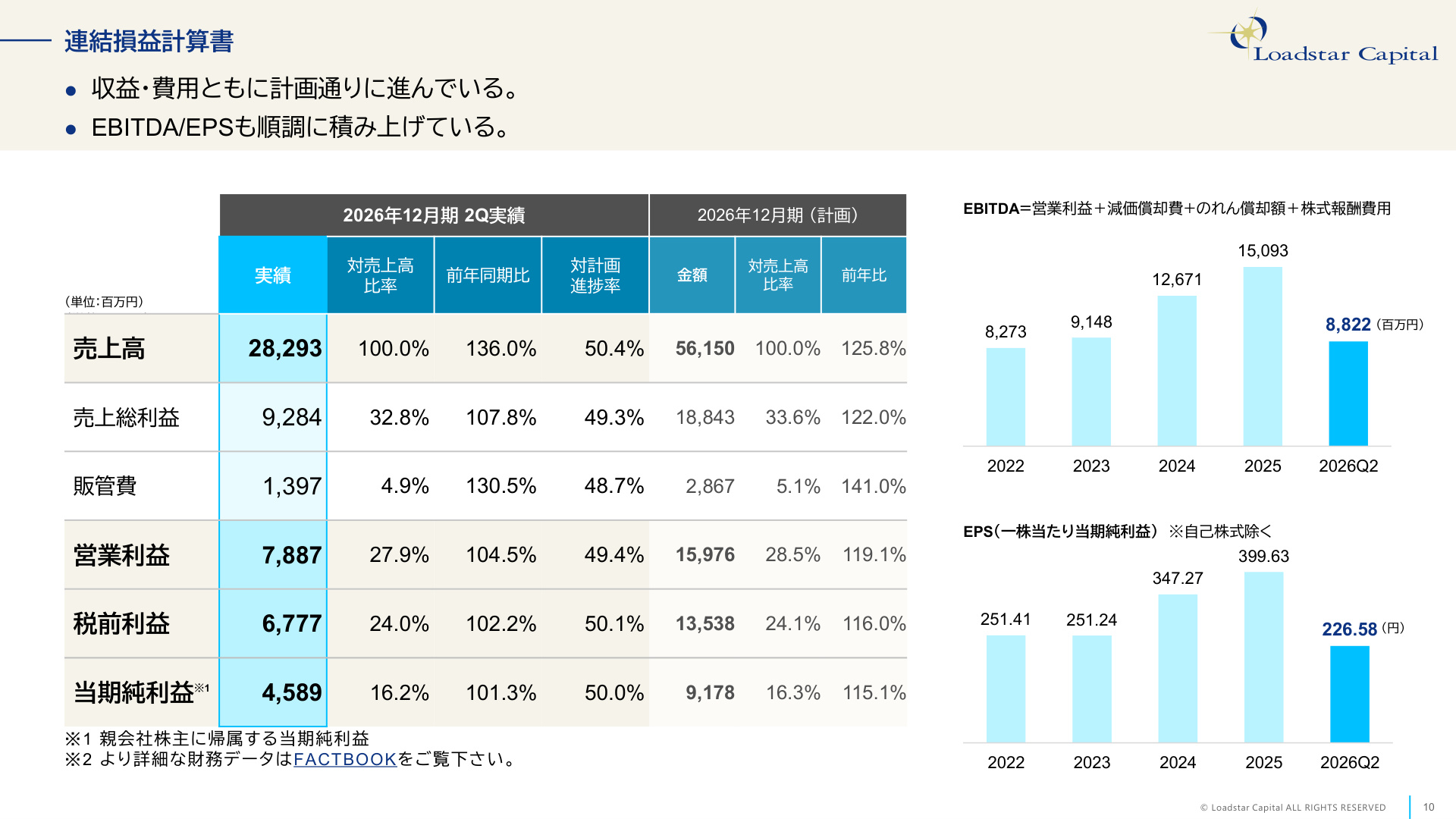
Significance of the Slide and Numerical Context
This slide goes beyond a standard P/L comparison, featuring critical graphs that illustrate the company's intrinsic cash-generating power (EBITDA) and shareholder value creation (EPS) .
As of Q2 FY2026, the company achieved gross profit of 9,284 million JPY (49.3% of plan) and operating profit of 7,887 million JPY (49.4% of plan) . The SG&A ratio is kept at an extremely low level of 4.9% , supporting a high operating profit margin of 27.9% . The EBITDA trend in the top right shows a sharp upward trajectory, growing from 8,273 million JPY in 2022 to 15,093 million JPY in 2025 , with 8,822 million JPY generated in Q2 2026 alone. EPS reached 226.58 JPY (pre-allotment basis), proving the increase in profitability accompanying business expansion.
Balance Sheet (B/S) and Financial Stability
The company is successfully balancing balance sheet expansion with financial stability:
- Total Assets : 131,775 million JPY (+6.2% from previous year-end)
- Net Assets : 36,240 million JPY (+10.0% from previous year-end)
- Equity Ratio : 27.1% (B/S basis) / 39.6% (including unrealized gains on properties, net of tax)
While interest-bearing debt rose to 75,313 million JPY (+8.1% from previous year-end), the company is extending the duration of its borrowings, with 42.4% of debt having a maturity of 10 years or longer (26.6% between 10-20 years, 15.8% over 20 years). Furthermore, interest rate swap agreements are already in place to hedge against future interest rate hike risks.
4. Detailed Segment Performance
The company's business consists of two main pillars: "Real Estate Investment" and "Fintech."
(1) Corporate Funding Business (Real Estate Investment, Leasing, Hotel)
- Real Estate Investment (Sales) : Revenue of 23,460 million JPY (YoY +44% )
- The core segment, accounting for 82.9% of consolidated revenue. Two property sales were completed, securing a high profit margin (31.6% revenue profit margin).
- Real Estate Leasing : Revenue of 1,826 million JPY (YoY +10% )
- Rental income from held properties continues to rise due to the return-to-office trend and limited new supply of mid-sized offices. The leasing profit margin remains exceptionally high at 52.9% .
- Hotel Operations : Revenue of 2,103 million JPY
- Revenue from the operation of six luxury resort hotels (e.g., Hiramatsu). While competition remains intense, the company is restructuring pricing strategies to improve room rates and occupancy.
- Portfolio : The book value of real estate for sale is 98,681 million JPY (27 properties) . The majority are located in the five central wards of Tokyo (Chiyoda, Chuo, Minato, Shibuya, Shinjuku), with a focus on office properties.
(2) Asset Management (AM) Business
- Revenue : 450 million JPY (YoY +36% )
- AUM (Assets Under Management) : Over 140 billion JPY
- Successfully increased new AUM, recovering significantly from the 110 billion JPY level in the same period last year, contributing to higher fee income.
(3) Crowdfunding Business (Fintech)
- Revenue : 441 million JPY (YoY +14% )
- OwnersBook Loans : 11,578 million JPY (+25% from previous year-end)
- In "OwnersBook," Japan's first real estate-specialized crowdfunding platform, both project supply and investor demand remain solid, with annual investment execution expanding to a 14.4 billion JPY pace.
5. Medium-Term Management Plan (FY2025-2027) Goals and Progress
The company is executing a three-year medium-term management plan based on the policy of "leading real estate investment through the fusion of high expertise and IT, becoming a one-of-a-kind independent enterprise."
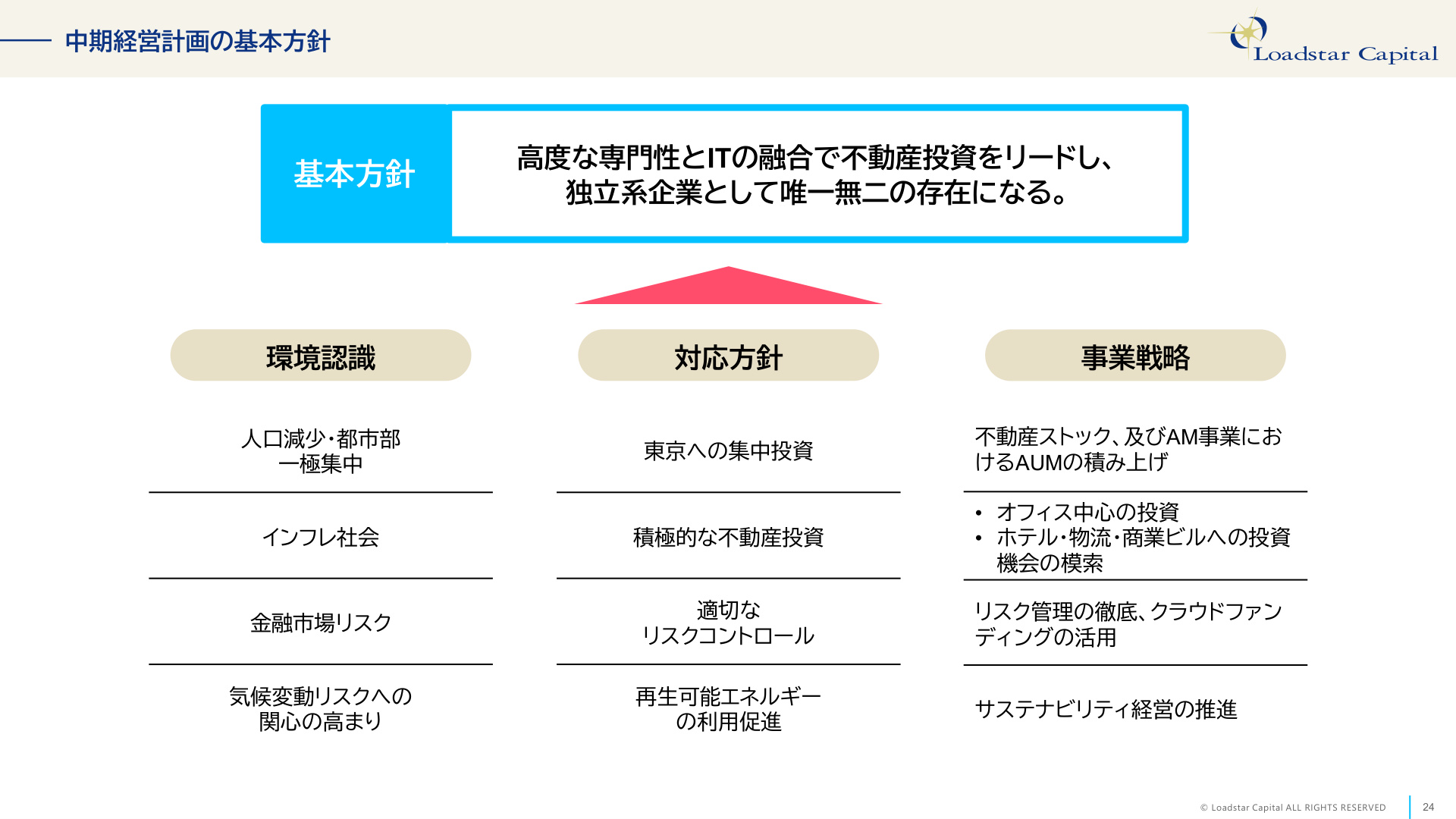
Significance of the Slide and Numerical Context
This slide is a critical management target table that quantitatively outlines the final destination for FY2027 and the roadmap for the current fiscal year (2026).
The company has set ambitious targets for FY2027: 60 billion JPY in revenue, 16.7 billion JPY in profit before tax, and an ROE of 25% or higher . Given that the company has already achieved 28.2 billion JPY in revenue and 6.77 billion JPY in profit before tax by Q2, it is clearly on track to meet these goals.
Furthermore, as leading indicators of growth, the company plans to nearly double its real estate book value to 150 billion JPY , AUM to 300 billion JPY , and OwnersBook investment volume to 20 billion JPY , demonstrating a clear strategy for long-term corporate value enhancement through both balance sheet growth and stock-based revenue.
6. Real Estate Market Outlook and Conclusion
Market Environment and Response Policy
- Market Outlook : With the global recovery in real estate investment, active capital inflows continue into the Japanese market (especially Tokyo offices). Rising rents due to tight office supply-demand are expected to absorb the impact of interest rate hikes.
- Preparation for Interest Rate Trends : While the Bank of Japan's rate hike policy requires close monitoring, the company is managing interest rate risk through long-term, fixed-rate financing and interest rate swaps .
- Capital Allocation : Using operating cash inflows (approx. 134 billion JPY) and borrowings (approx. 50 billion JPY), the company plans to allocate approx. 169 billion JPY to growth investments such as real estate, while balancing the remainder between shareholder returns (4-5 billion JPY) and liquidity (10 billion JPY).
Conclusion
Roadstar Capital's Q2 FY2026 earnings were extremely solid , characterized by the steady execution of core real estate sales, the accumulation of stable income from leasing, AM, and crowdfunding, and appropriate financial risk management. The company is expected to continue expanding its acquisitions and optimizing its assets to achieve the goals of its medium-term management plan.
This content is not intended as investment advice or a recommendation. Any opinions expressed are solely the personal views of each article.