


Earnings Deep Dive: Daiwabo Holdings (3107) Q1 FY2027 Results – Record Revenue and Strategic Inventory Buildup; Growth Driven by iKAZUCHI and AI Demand

StockClub
Published: Aug 06, 2026, 10:14 AM
Sentiment Analysis
Daiwabo Holdings Co., Ltd. kicked off the fiscal year ending March 2027 with a strong Q1 performance, recording record-high Q1 revenue of 313.148 billion yen (+7.8% YoY) . While operating profit declined to 7.701 billion yen (-22.0% YoY) , the results were in line with the company's internal plan, and measures to recover profitability from Q2 onwards are progressing steadily.
This report provides a multi-faceted analysis of the company’s business structure, current performance drivers, trends in the digital sector, and future growth and shareholder return strategies, based on 10 key topics extracted from the earnings presentation materials.
1. Earnings Highlights and Overview: Record-Breaking Top Line
In Q1 FY2027, Daiwabo Holdings saw significant revenue growth in its IT Infrastructure Distribution business, driven by increased sales of servers, network equipment, and software. The revenue progress rate reached 55.2% against the H1 forecast (567.05 billion yen) and 26.3% against the full-year forecast (1.189 trillion yen) , indicating a robust trajectory.
Although operating profit decreased YoY, this was due to the high-profit margin recorded in the same period last year, a temporary decline in gross profit margin due to strategic inventory procurement in anticipation of future price hikes, and upfront investment costs such as base salary increases and rebranding. The company has maintained its H1 and full-year earnings forecasts, expecting profit margins to improve from Q2 onwards.
2. Analysis of Consolidated Operating Profit: The Path to Recovery from Q2
The 2.17 billion yen decline in operating profit (from 9.87 billion yen in Q1 last year to 7.70 billion yen) is attributed to clear fluctuations in gross profit and SG&A expenses.
The following waterfall chart visualizes the factors behind the operating profit variance.
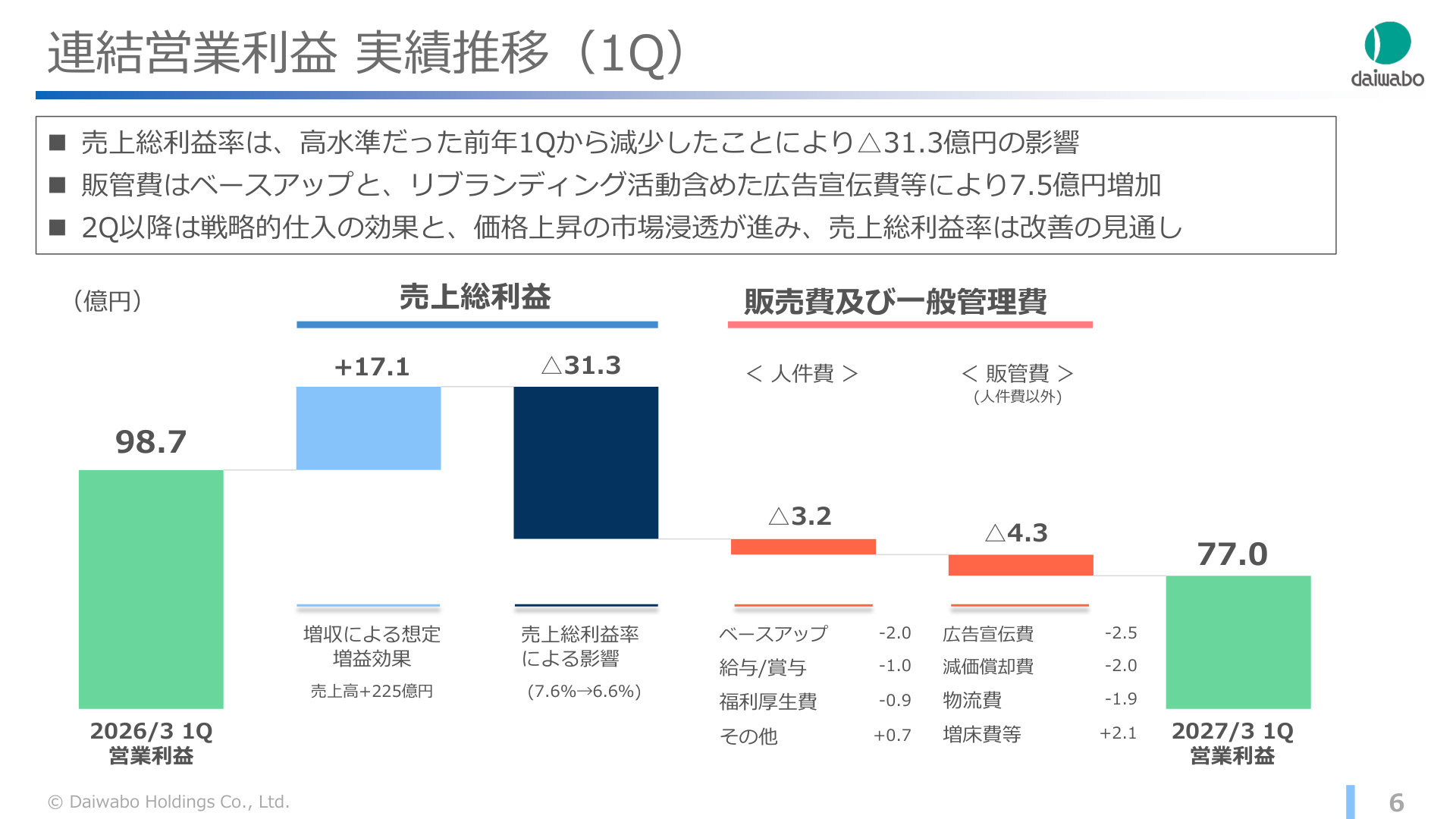
Slide Commentary: Background of Operating Profit Variance
This slide clearly shows that while there was a profit-increasing effect (+1.71 billion yen) from higher revenue, it was offset by the impact of a lower gross profit margin (-3.13 billion yen) and increased SG&A expenses (-0.75 billion yen) .
The decline in gross profit margin (from 7.6% last year to 6.6% this period) was driven by "proactive strategic procurement" in anticipation of rising component prices (such as memory) and a higher ratio of large-scale, lower-margin data center projects. Regarding SG&A, the company recorded personnel costs due to base salary increases (-0.32 billion yen) and advertising/rebranding expenses to refresh the group's image (-0.43 billion yen). The narrative for Q2 and beyond is one of expected gross profit margin improvement as price pass-throughs take effect and procurement benefits materialize.
3. Structural Changes in IT Infrastructure Distribution: Surge in Servers and Networking
The IT Infrastructure Distribution business, the company's core, reported Q1 revenue of 310.098 billion yen (+8.1% YoY) and operating profit of 7.461 billion yen (-21.4% YoY) .
Looking at the breakdown by product category, the shift away from PC-centric business toward infrastructure and software is evident:
- PC Hardware : While standalone PC sales saw a slight decline of 4.1% YoY, server sales surged by 61.0% YoY . Consequently, the overall PC category (161.47 billion yen) achieved a 5.8% YoY growth.
- Peripherals & Services : Driven by data center investments and corporate network upgrades, network equipment grew by 38.3% YoY and storage by 24.5% YoY .
- Software : Cloud-related software maintained high growth at 28.5% YoY .
4. End-User Trends and the Acceleration of Generative AI/SaaS
By end-user, the corporate market accounts for 56% of the total , serving as the primary growth engine. In this segment, the acquisition of large-scale data center projects and the migration to high-security SaaS and IaaS (AWS, Azure, etc.) are accelerating.
Particularly noteworthy is the trend toward full-scale adoption of generative AI . The introduction of generative AI services, centered on Microsoft Copilot, is progressing rapidly, with AI-related revenue within the total SaaS segment recording explosive growth of 175% (2.75x) YoY . This shift from trial usage to full-scale integration into actual workflows is reflected in the figures. Additionally, the education market (16% of the total) contributed to revenue growth through large-scale projects for high schools and administrative systems.
5. Explosive Growth of the Subscription Management Portal "iKAZUCHI"
The cornerstone of the company's stock-based business model is the subscription management portal "iKAZUCHI."
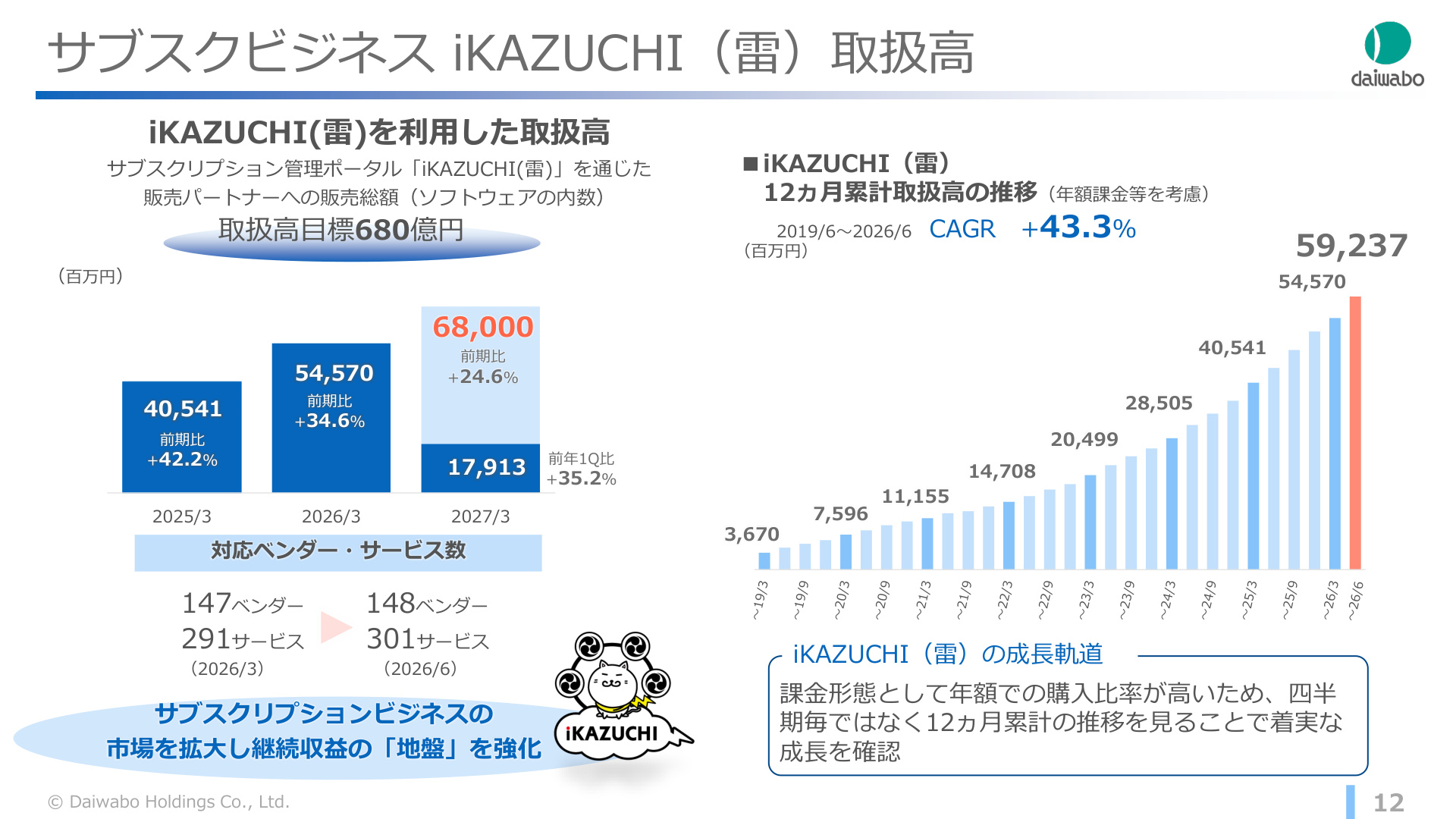
Slide Commentary: The Importance of iKAZUCHI and Business Model Transformation
This slide clearly illustrates the progress of the company's shift from a "one-off sales model" to a "recurring revenue (stock) model." Transaction volume via iKAZUCHI in Q1 reached 17.913 billion yen (+35.2% YoY) . As shown in the 12-month cumulative transaction volume graph, it continues to expand at an astonishing CAGR of 43.3% .
The number of vendors has expanded to 148, with 301 services offered (as of June 2026). By accumulating annual and monthly recurring revenue as a base load, iKAZUCHI has become a vital strategic platform that contributes to the stabilization and higher gross margins of the entire IT Infrastructure Distribution business.
6. Strategic Procurement and Balance Sheet (B/S) Changes
A characteristic feature of the Q1 balance sheet is the increase in inventories and the decrease in cash and deposits. Inventories increased by 47.056 billion yen , from 58.72 billion yen at the end of March 2026 to 105.776 billion yen at the end of June 2026 .
This is the result of planned "strategic procurement (preemptive inventory securing)" in anticipation of global memory price hikes and supply chain fluctuations. This inventory ensures a stable supply and consistent gross profit when demand surges from Q2 onwards. While this involved financing working capital through short-term borrowings (+18.4 billion yen), the equity ratio remains healthy at 35.6% .
7. Industrial Machinery Business Trends: Significant Increase in Orders (+42.2%)
The Industrial Machinery business, the group's other pillar, reported Q1 revenue of 3.05 billion yen (-21.1% YoY) and operating profit of 236 million yen (-37.7% YoY) . Despite the decline due to the reaction from large-scale machine deliveries in Q1 of the previous year, orders received showed a significant recovery, reaching 3.61 billion yen (+42.2% YoY) .
In the machine tool division, demand from the shipbuilding and energy industries remains extremely strong, in addition to the continued recovery in the aircraft industry. Orders in the North American market and the Chinese market, where data center-related investments are active, are also growing, building up a substantial backlog for future revenue recognition.
8. Full-Year Forecast and Mid-to-Long-Term Growth Drivers (Win10 EOS & GIGA 2nd)
The company has maintained its full-year consolidated earnings forecast for FY2027: revenue of 1.189 trillion yen (-12.0% YoY) , operating profit of 36.5 billion yen (-17.4% YoY) , and net income attributable to owners of the parent of 25.3 billion yen (-21.0% YoY) .
Although this plan reflects a temporary decline due to the reaction to the previous year's special demand, the mid-to-long-term IT demand wave remains robust. The massive catalysts supporting the company's growth are "Windows 10 EOS (End of Support)" and the "GIGA School Concept Phase 2 (Device Refresh)."
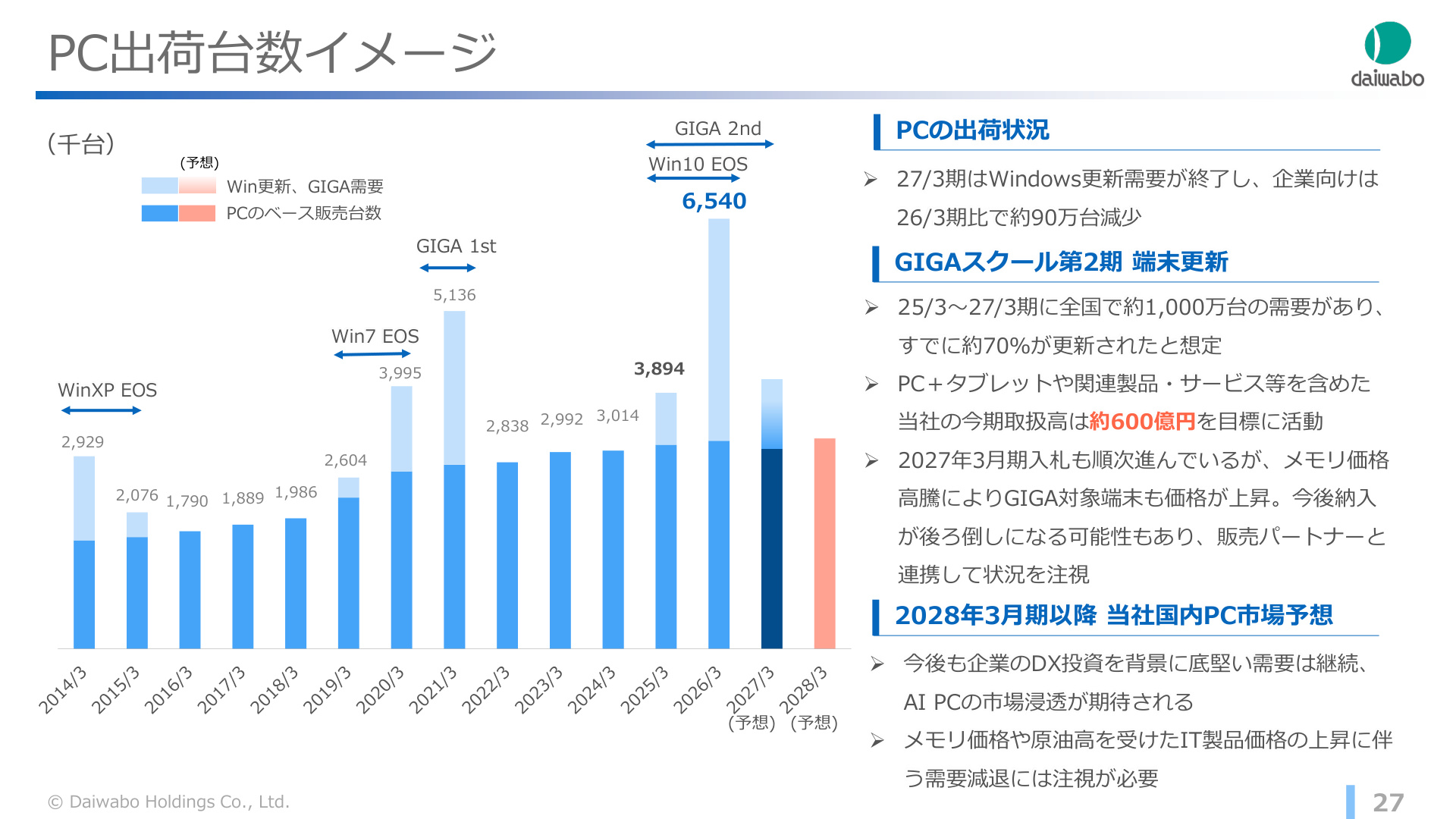
Slide Commentary: PC Shipment Trends and Future Demand Peaks
This slide provides critical data comparing past Windows OS update cycles (WinXP, Win7) with the demand waves of GIGA School Phase 1 and Phase 2.
From FY2025 to FY2027, there is a demand for approximately 10 million units for the GIGA School Phase 2 refresh nationwide, and the company has set a transaction volume target of approximately 60 billion yen for this fiscal year. Furthermore, with the end of Windows 10 support (October 2025) coinciding with corporate PC replacements and the emergence of AI PCs, domestic demand for PC and IT environment upgrades is expected to remain firm through FY2028 and beyond.
9. Shareholder Return Policy: Progressive Dividends and Share Buybacks for a Total Return Ratio of 61.6%
Daiwabo Holdings presents a very clear and proactive policy regarding shareholder returns:
- Dividend Policy : During the current medium-term management plan, the basic policy is "progressive dividends (maintaining or increasing dividends without cuts)," aiming for a dividend payout ratio of 30% or higher. The annual dividend forecast for FY2027 is 110 yen per share (55 yen interim, 55 yen year-end) , an increase of 5 yen from the previous year's 105 yen (marking the 6th consecutive year of dividend increases).
- Share Buybacks : The company is planning and executing flexible share buybacks with a cap of 6 billion yen .
- Total Return Ratio : The total return ratio for the full year is expected to be 61.6% , highlighting the company's strong commitment to shareholder returns.
10. Conclusion and Summary
At first glance, Daiwabo Holdings' Q1 FY2027 results show an operating profit decline. However, the reality is that the company achieved record-high revenue through the acquisition of data center, cloud, and AI projects , while simultaneously securing future profits through strategic procurement and executing investments for the future .
With multiple growth drivers ahead—including the penetration of price pass-throughs from Q2, the accumulation of iKAZUCHI stock revenue, the recovery of industrial machinery orders, and the full-scale launch of GIGA School Phase 2—the company's business structure transformation and mid-to-long-term growth story are progressing steadily.
This content is not intended as investment advice or a recommendation. Any opinions expressed are solely the personal views of each article.