


Earnings Deep Dive: MIC (300A) Q1 FY2027 Results – 17% 'Real' Revenue Growth Following Accounting Changes and a Strategy of 'Aggressive Investment and Shareholder Returns'

StockClub
Published: Aug 06, 2026, 10:01 AM
Sentiment Analysis

Executive Summary
MIC Co., Ltd. (Securities Code: 300A) delivered a Q1 FY2027 earnings report that clearly demonstrates its dual strategy of "Aggressive Investment and Shareholder Returns," aimed at building a foundation for sustainable growth while significantly enhancing shareholder value.
Excluding the impact of a major accounting change implemented this fiscal year (reclassifying direct mail postage from revenue to advance payments), the company achieved a robust 17.0% year-on-year increase in real revenue to 3.374 billion yen . Even after absorbing significant upfront investments in facility expansion, human capital, and AI/DX initiatives, the company posted an operating profit of 348 million yen (+8.4% YoY) and an EBITDA of 415 million yen (+9.7% YoY) .
This report extracts 10 key topics from MIC’s disclosure, providing a comprehensive analysis of the underlying business structural changes, the proprietary profit-creation model, key KPI trends, and the noteworthy shareholder return policies.
1. Performance Highlights and the Real Impact of "Accounting Changes"
While reported Q1 revenue appears to have declined slightly to 3.374 billion yen (-1.8% YoY), this is entirely due to the accounting change . The company reclassified approximately 2 billion yen in direct mail postage costs from revenue and cost of sales to advance payments (other current assets).
This change has no impact on actual profit figures and was implemented to more accurately reflect the company's underlying business growth. When comparing real growth rates excluding postage, the strong top-line expansion becomes evident.
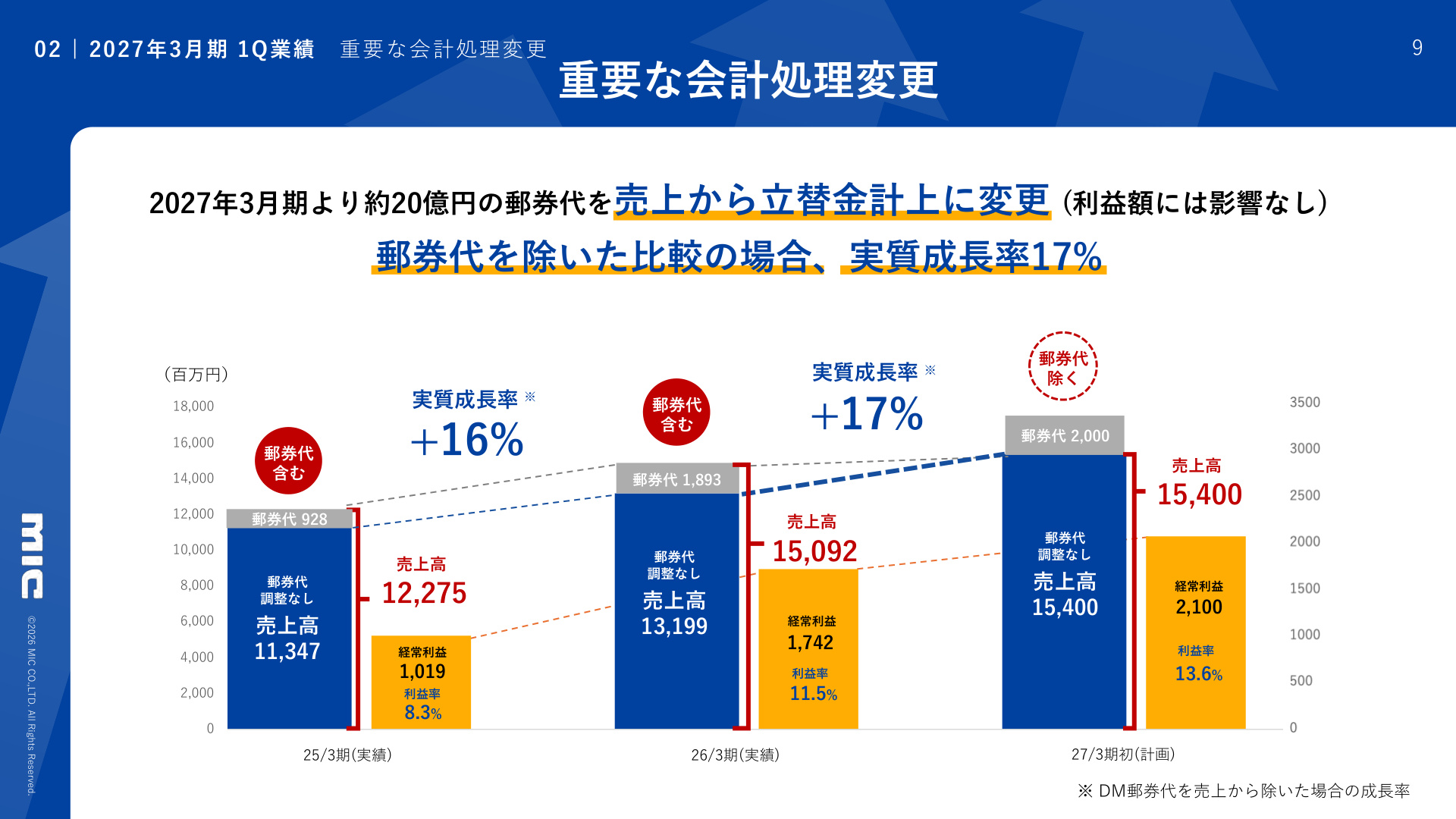
[Slide Analysis: Significant Accounting Changes and Real Growth Rate]
The slide above (PAGE_8) illustrates the most critical change in accounting structure for understanding these results. The graph on the left shows historical data (FY25/3, FY26/3) with postage costs included and excluded. The transition from Q1 FY26/3 (2,884 million yen) to Q1 FY27/3 (3,374 million yen) clearly shows a 17% real growth rate . Progress toward the full-year target (15.4 billion yen, +16.7% real revenue growth) is extremely steady, and this accounting change has established a framework where the company's cost-to-sales and profit margin metrics can be evaluated more clearly and accurately .
2. Segment Trends and Seasonality
MIC’s revenue is categorized into three sectors: "IT & Services," "Retail," and "Manufacturing." In Q1, the company achieved year-on-year revenue growth across all segments , validating the depth of its customer base and the effectiveness of its cross-selling strategies.
- IT & Services : Revenue of 901 million yen ( +252 million yen / +39% YoY )
- Driven by the expansion of digital media services and support for IT/SaaS solution implementation.
- Manufacturing : Revenue of 1.096 billion yen ( +141 million yen / +15% YoY )
- Growth was fueled by sales optimization centered on the proprietary "PromOS" solution, particularly among major pharmaceutical clients.
- Retail : Revenue of 1.377 billion yen ( +97 million yen / +8% YoY )
- Benefited from expanded transactions with existing clients and increased utilization of fulfillment functions.
Notably, the company’s revenue typically exhibits second-half seasonality . Based on historical trends and current forecasts, the split is approximately 47% in the first half and 53% in the second half (FY2027 forecast: 46.9% H1, 53.1% H2). A strong start in Q1 provides significant momentum for performance expansion in the second half.
3. Proprietary Metric "V/(BI+SR)" and Aggressive Upfront Investment
MIC utilizes a proprietary profit-creation model called "V/(BI+SR)" to visualize its growth and profitability:
- V (Value) : Gross value added (Revenue minus purchases, outsourcing, and shipping costs; 2.142 billion yen in Q1, +15.6% YoY).
- BI (Business Infrastructure Cost) : Costs for maintaining and operating manufacturing/service infrastructure (1.126 billion yen).
- SR (Strategic Resource Cost) : Strategic personnel and expenses for sales expansion and production innovation (292 million yen).
Currently, the "V/(BI+SR)" ratio stands at 1.19 , with a long-term target of 1.30 . An analysis of Q1 operating profit shows that the company actively engaged in "aggressive upfront investment" to drive future ratio improvements.
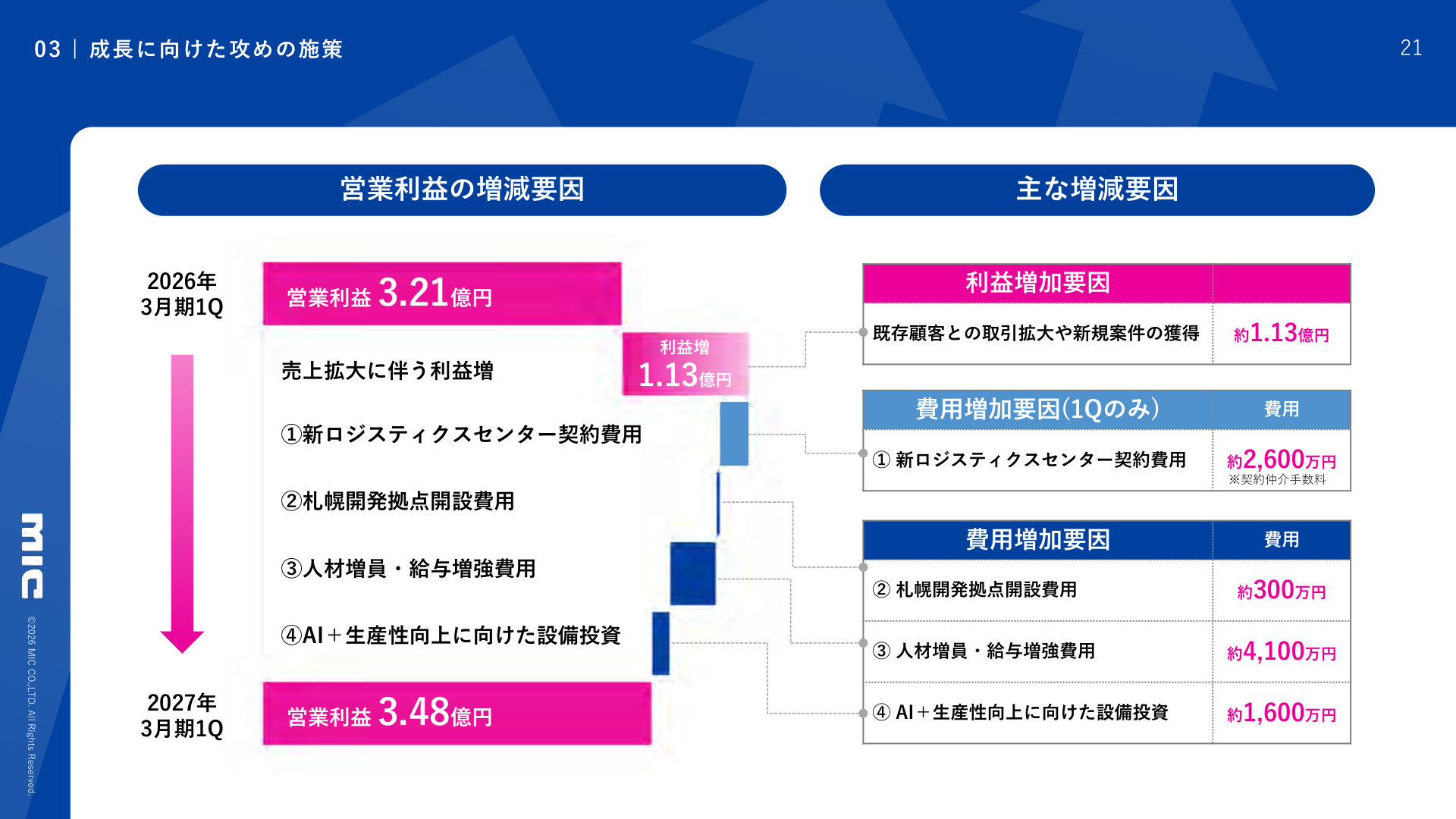
[Slide Analysis: Factors Affecting Operating Profit]
The slide above (PAGE_20) clearly visualizes the transition from 321 million yen in operating profit in the same period last year to 348 million yen this period, breaking down profit growth factors and one-time expense increases . While expanding transactions with existing clients and acquiring new ones generated +113 million yen in profit , the company absorbed the following four future-oriented investments:
- New Logistics Center Contract Costs : Approx. 26 million yen (brokerage fees, etc.)
- Sapporo Development Center Opening Costs : Approx. 3 million yen
- Personnel Expansion/Salary Increases : Approx. 41 million yen (new graduates, mid-career hires, and salary revisions)
- AI & Productivity-Related Capital Investment : Approx. 16 million yen
Achieving an 8.4% increase in operating profit while executing these investments (totaling approx. 86 million yen) underscores the immense strength of the company's core profit-generating capability (expansion of Value V).
4. Key KPI "PromOS" and Strengthening the Business Foundation
The core of MIC’s growth story is "PromOS," a platform that realizes total optimization of promotional activities through DX. It is positioned as a key KPI for building a stock-based customer foundation.
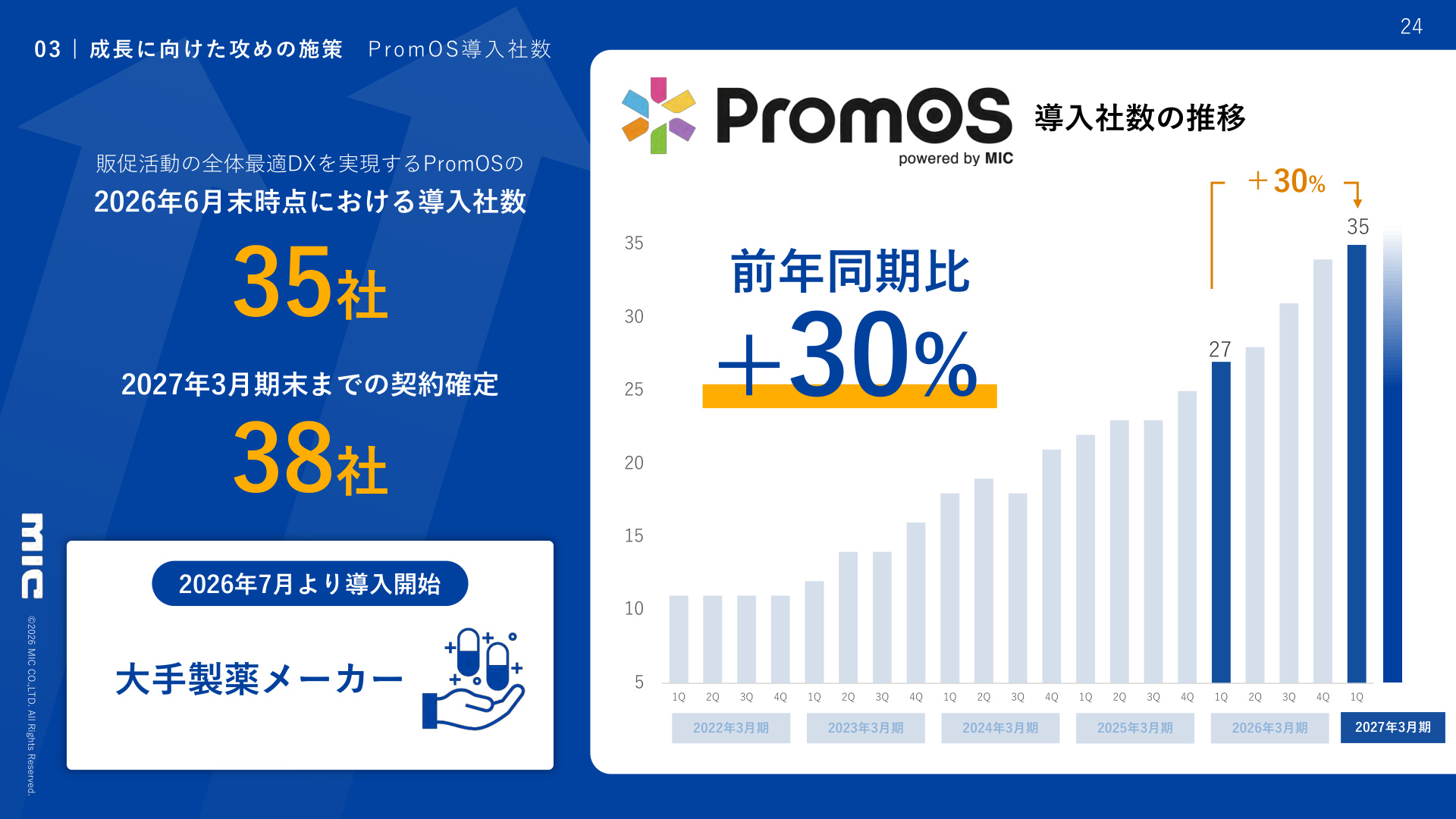
[Slide Analysis: Growth in PromOS Adoption]
The slide above (PAGE_23) shows the upward trend in PromOS adoption. As of the end of June 2026, the number of adopting companies reached 35 (+30% YoY) , with contracts already secured for 38 companies by the end of FY2027. Penetration into enterprise firms is accelerating, notably with adoption by a major pharmaceutical manufacturer starting in July 2026. Since PromOS adoption creates ripple effects for the company's BPO and fulfillment businesses, it remains a high-priority KPI.
To strengthen the development structure for PromOS, the company opened the Sapporo Development Center (investment of approx. 3 million yen), accelerating the speed of product feature expansion.
Facility Expansion and Labor Cost Ratio Improvement
To handle increased logistics volume, the company expanded its flagship facility and contracted a new logistics center, increasing total floor space from 10,500 tsubo to 14,000 tsubo (over 30% expansion) . By streamlining and consolidating facilities, the company expects a cost reduction of approx. 100 million yen in facility operating expenses over the medium to long term. Furthermore, the introduction of AI and proprietary automation systems (e.g., MONSTER DESK) has improved efficiency. The fulfillment labor cost ratio in Q1 was 9.8% , a 1.0 percentage point improvement from Q4 of the previous fiscal year (10.8%).
5. Dramatic Expansion of Shareholder Returns and Mid-to-Long-Term Policy
Another major topic that captured market attention is the dramatic enhancement of shareholder returns .
- Dividend Policy : Maintaining the basic policy of a 40% dividend payout ratio .
- New Shareholder Benefit Program : Starting with the record date of September 30, 2026, the company will launch a shareholder point program .
- Points are awarded based on the number of shares held and can be exchanged for Amazon e-money or over 5,000 types of goods.
- Shareholders holding 700 shares or more will receive a flat 90,000 points annually .
- The maximum total yield (dividends + benefits) reaches 7.02% (based on the closing price of 2,929 yen on June 30, 2026).
Mid-to-Long-Term Growth Guidelines
The company has set the following targets for mid-to-long-term growth:
- Compound Annual Growth Rate (CAGR) of Revenue : Over 10%
- Ordinary Profit Margin : Over 10% (Q1 current margin is already at a high level of 13.6%)
- Early Achievement of Prime Market Listing Criteria
The expansion of shareholder returns is part of a capital policy aimed at improving stock liquidity and encouraging long-term shareholding, as the company works toward meeting Prime Market listing criteria.
Conclusion
MIC’s Q1 FY2027 results were highly robust in both quality and quantity, characterized by strong top-line growth of 17.0% (real revenue growth after accounting changes) and profit growth achieved while absorbing upfront investments in new facilities, the Sapporo development hub, human capital, and AI/DX.
The structure of increasing value-added creation while improving operational efficiency, based on the proprietary "V/(BI+SR)" model, is functioning effectively, and the key KPI "PromOS" is showing steady adoption. Furthermore, the introduction of generous shareholder returns with a maximum total yield of 7.02% reflects the company's confidence in its future. Even considering the second-half seasonality, it can be concluded that the first quarter has laid a solid foundation for achieving the full-year plan (16.7% real revenue growth, 2.004 billion yen in operating profit).
This content is not intended as investment advice or a recommendation. Any opinions expressed are solely the personal views of each article.