


Tokunichi Co., Ltd. H1 FY2026 Earnings Deep Dive: Navigating Rice Market Shifts and the Blueprint for Structural Reform

StockClub
Published: Aug 06, 2026, 09:59 AM
Sentiment Analysis
Introduction
Major rice wholesaler Tokunichi Co., Ltd. (TSE Standard: 2700) released its financial results for the second quarter of the fiscal year ending December 2026 on August 6, 2026. Driven by persistently high rice prices, the company achieved record-high interim net sales of 88.428 billion yen (up 5.3% YoY) . However, in response to rapid market shifts, rising distribution inventories, and a price correction phase, the company prioritized inventory normalization through aggressive pricing and sales promotion measures. Consequently, operating profit fell significantly to 880 million yen (down 83.3% YoY) .
This report provides a detailed analysis of the structural changes in the rice market, the progress of each business segment, and the key initiatives driving the company's future growth.
Overview of H1 Consolidated Financial Results
The interim results present a contrasting picture of top-line growth and bottom-line adjustment.
- Net Sales : 88,428 million yen (+5.3% YoY / Record High)
- Gross Profit : 4,251 million yen (-51.4% YoY)
- Operating Profit : 880 million yen (-83.3% YoY)
- Ordinary Profit : 851 million yen (-84.1% YoY)
- Interim Net Income Attributable to Owners of Parent : 732 million yen (-80.2% YoY)
While sales increased due to higher unit prices resulting from elevated rice market prices, the company prioritized mitigating future loss risks and normalizing inventory ahead of the 2026 crop harvest. This strategic pricing led to a sharp decline in the gross profit margin (from 10.4% in the previous year to 4.8%), which weighed heavily on operating profit.
Segment Analysis: Challenges in the Rice Business and Support from Non-Rice Segments
Understanding the company's performance requires a look at segment-specific trends. While the rice business suffered a significant profit decline, the Feed and Egg businesses performed steadily, demonstrating the effectiveness of the company's diversified portfolio.
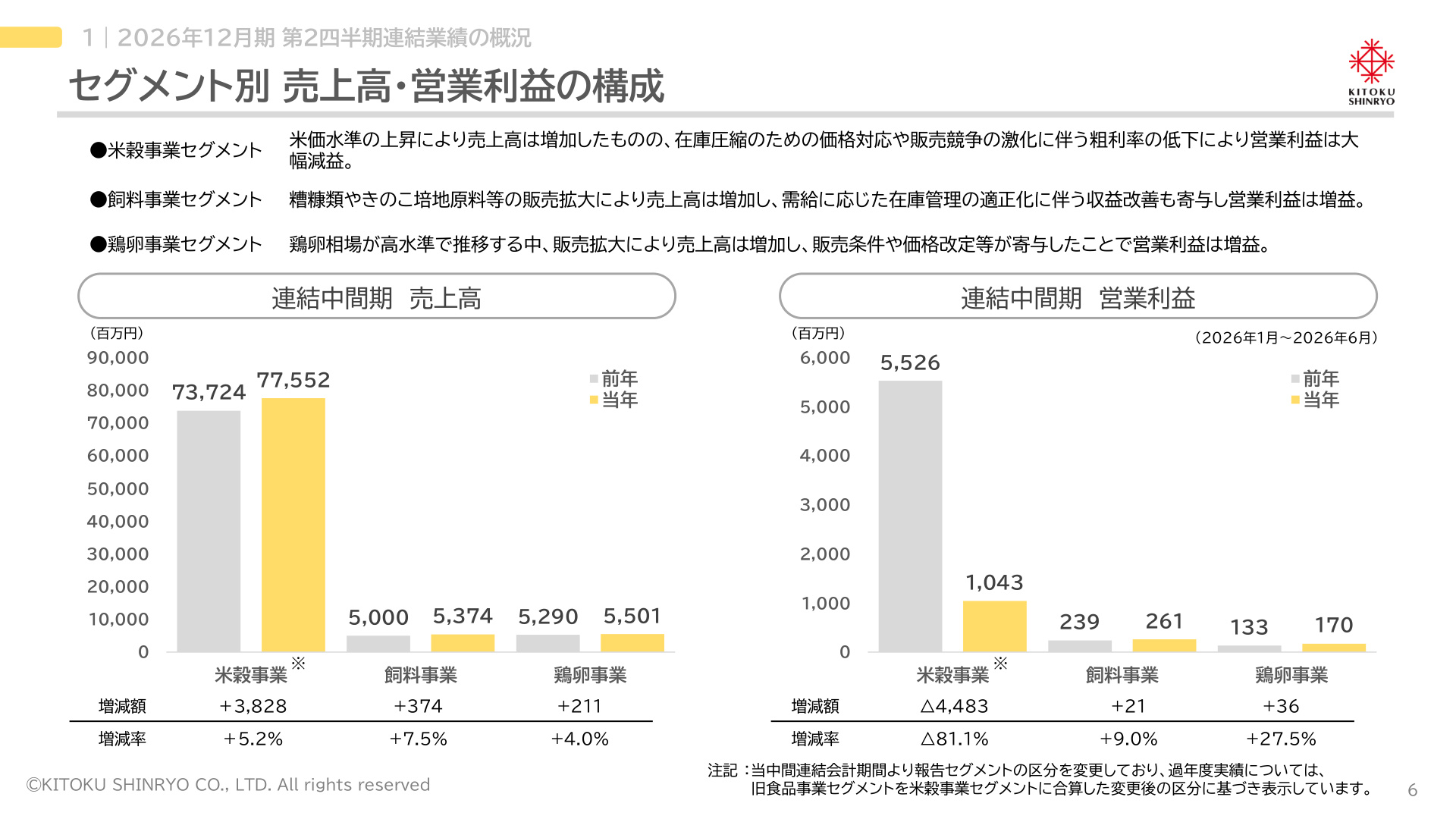
The slide above provides critical data on the composition of net sales and operating profit by segment. It visually confirms that the operating profit of the rice business, which accounts for nearly 90% of total sales, plummeted from 5,526 million yen in the previous year to 1,043 million yen (-81.1%) , serving as the primary driver of the company-wide profit decline. Conversely, the feed and egg businesses successfully increased their profits, validating the company's portfolio diversification strategy.
Key Trends by Segment
-
Rice Business Segment
- Net Sales : 77,552 million yen (+5.2% YoY)
- Operating Profit : 1,043 million yen (-81.1% YoY)
- Factors : High rice prices led to reduced consumption in household and some food-service sectors, causing inventory buildup. Profit margins were squeezed by pricing strategies aimed at reducing distribution inventory. While overseas business, including Minimum Access (MA) rice and exports of Japanese rice, remained steady, it was insufficient to offset the domestic market downturn.
-
Feed Business Segment
- Net Sales : 5,374 million yen (+7.5% YoY)
- Operating Profit : 261 million yen (+9.0% YoY)
- Factors : The segment achieved growth in both sales and profit by expanding sales of sugar-related products and mushroom cultivation media. Despite higher costs for imported dry hay due to the weak yen, the company succeeded in managing inventory and controlling storage costs.
-
Egg Business Segment
- Net Sales : 5,501 million yen (+4.0% YoY)
- Operating Profit : 170 million yen (+27.5% YoY)
- Factors : Egg prices remained high due to delayed recovery from avian influenza. In addition to increased volume and sales of specialty eggs, the segment saw a significant 27.5% increase in operating profit through revised procurement terms and sales price adjustments.
Rice Market Environment and Structural Analysis of Private Inventory and Demand
The sharp decline in the rice business is rooted in a rapid shift in the supply-demand balance of the Japanese rice market.
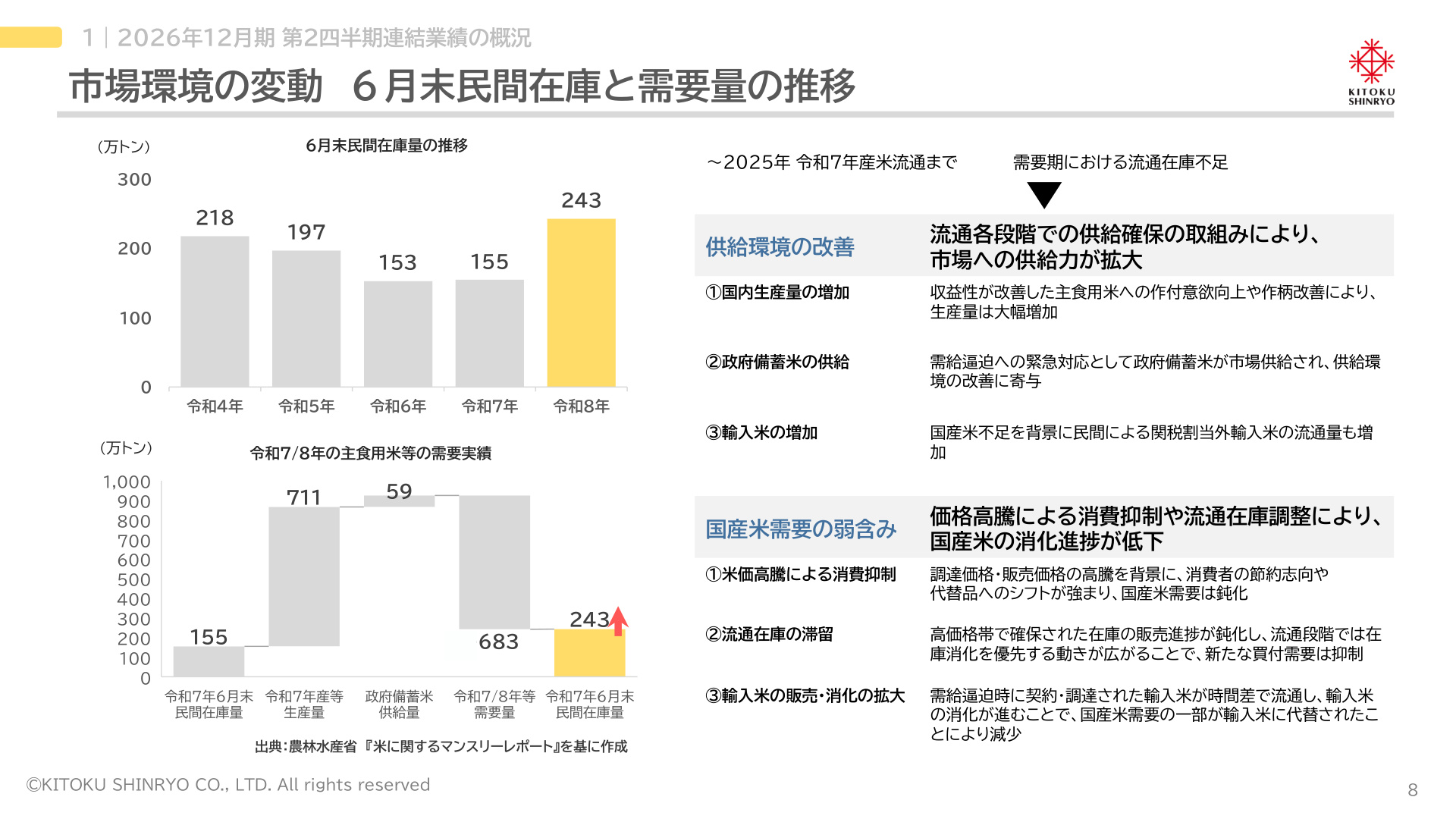
This slide provides a detailed analysis of private inventory levels at the end of June and demand trends , which is essential for understanding the current market structure. Until 2025, the market faced a shortage of distribution inventory due to tight supply and demand. However, heading into 2026, three factors converged to increase market supply: (1) increased domestic production , (2) supply of government-reserved rice , and (3) increased rice imports .
Meanwhile, consumer frugality and shifts toward substitutes in response to high prices caused demand for domestic rice to decline to 6.83 million tons . Consequently, private inventory at the end of June surged from 1.55 million tons the previous year to 2.43 million tons . This sense of oversupply and sluggish demand led to inventory stagnation in the distribution channel, forcing the company to accelerate inventory reduction.
Furthermore, while spot transaction prices for the 2025 crop remain high, they have recently shown signs of softening, with trading activity becoming notably stagnant.
Financial Position and Cash Flow Analysis
Despite the significant decline in profit, the company is steadily maintaining a sound financial base and improving asset efficiency .
- Balance Sheet (B/S) Trends : Total assets as of the end of June 2026 were 48.18 billion yen , a decrease of 8.432 billion yen from 56.612 billion yen at the end of December 2025. This was driven by the reduction of inventories (-6.15 billion yen) and accounts receivable. With the reduction in current liabilities, the equity ratio improved significantly from 36.1% to 42.6% .
- Cash Flow (C/F) Trends : Despite the sharp decline in operating profit, the company maintained a positive operating cash flow of +812 million yen by focusing on inventory reduction and collection of trade receivables. While free cash flow was negative at -638 million yen due to investment cash flow (e.g., investments in equity-method affiliates), the company secured 3.957 billion yen in cash and deposits, ensuring stability in funding.
Management has made a firm decision to prioritize "reducing future loss risks" and "normalizing the rice business foundation" over short-term profit maximization.
Mid-to-Long-Term Management Plan and Growth Strategy
While responding to immediate market fluctuations, the company is accelerating structural reforms and growth investments to enhance corporate value over the mid-to-long term.
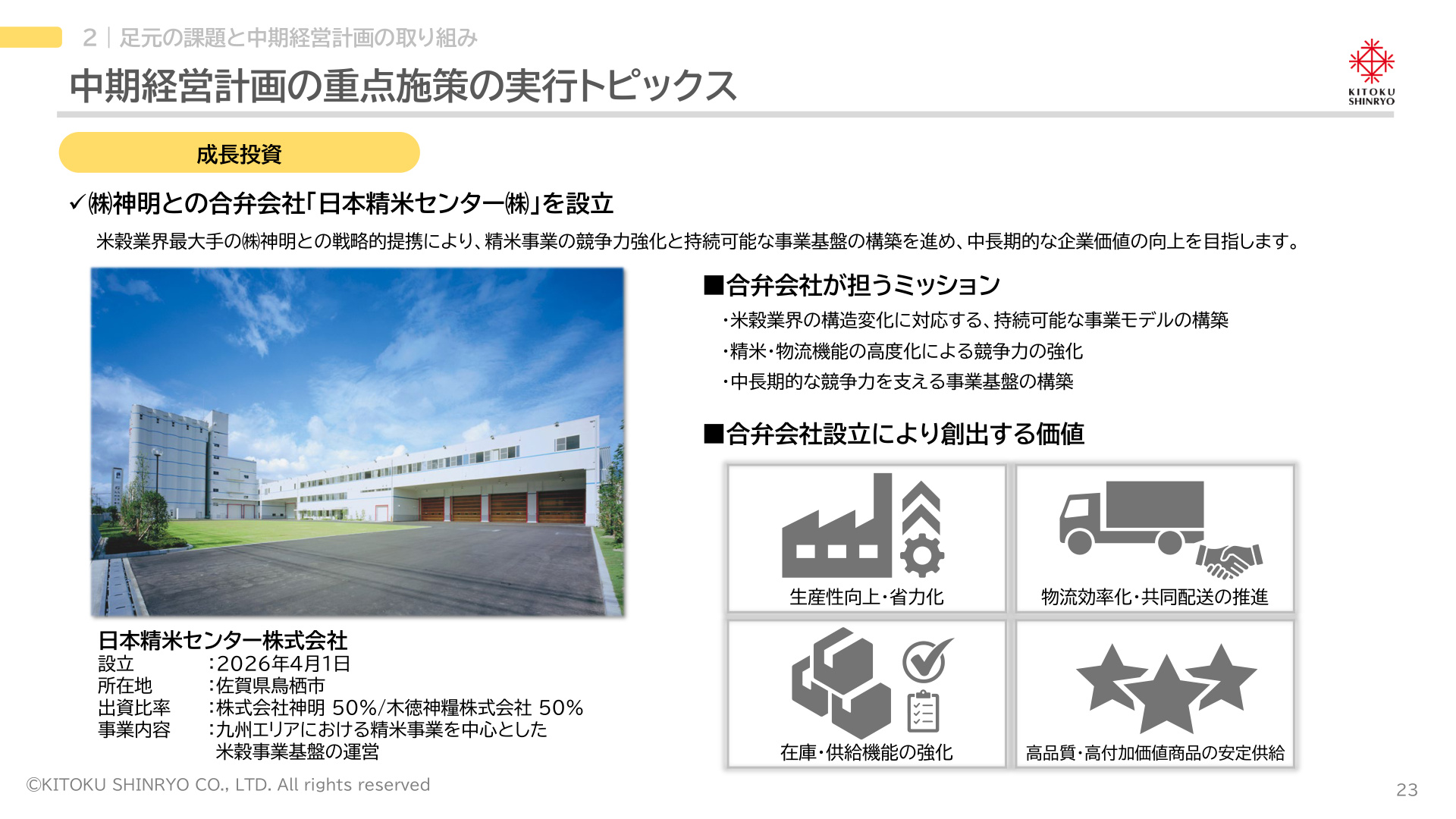
A pivotal initiative symbolizing the future growth strategy is the establishment of "Nihon Seimai Center Co., Ltd.," a joint venture with Shinmei Co., Ltd. , the industry leader (established April 1, 2026, with a 50:50 ownership ratio).
By operating a business foundation centered on rice milling in the Kyushu region, the company aims to create value through:
- Productivity Improvement & Labor Saving : Reducing manufacturing costs through shared state-of-the-art facilities.
- Logistics Efficiency & Joint Delivery : Strengthening the supply chain through advanced milling and logistics functions.
- Enhanced Supply Capabilities : Building a stable supply network for high-quality, high-value-added products.
Other Key Initiatives
- Strengthening Sustainable Procurement : Promoting the adoption of new rice varieties (e.g., "Niji no Kirameki") that are heat-resistant and high-yielding to improve producer profitability and secure procurement volumes. Direct procurement from agricultural cooperatives and production corporations has expanded from 16,000 tons (2023 crop) to approximately 22,000 tons (2025 crop).
- Value Creation from Unused Resources (Circular Business) : Commenced development and sales of agricultural materials (e.g., UMBP Nuka Bokashi) utilizing rice washing byproducts and rice bran from milling plants, promoting sustainable agriculture.
- Expansion of Global Rice Business : Setting an overseas sales volume target of 34,500 tons for the fiscal year ending December 2026, the company is responding to global demand by not only exporting Japanese rice (to North America, Europe, the Middle East, etc.) but also engaging in the import and triangular trade of Thai fragrant rice and Basmati rice.
Dividend Policy and Shareholder Returns
The company maintains a basic policy of "continuous and stable dividends" for shareholder returns, targeting a consolidated Dividend on Equity (DOE) ratio of 2% or higher .
- FY2026 Forecasted Annual Dividend : 50 yen per share (projecting a DOE of 2.03%)
- Mid-term Goal : Planning to increase dividends to 60 yen (DOE 2.07%) in FY2027 and 70 yen (DOE 2.08%) in FY2028.
Even in a period of declining performance, the adoption of the DOE metric demonstrates a commitment to stable shareholder returns that are less susceptible to short-term earnings volatility, reflecting the company's resolve to enhance corporate value over the long term.
Conclusion
Tokunichi's H1 FY2026 results were significantly impacted by the external environment, characterized by rapid supply-demand shifts and downward price pressure in the rice market. However, this decline is the result of proactive inventory reduction and price adjustments to eliminate future risks early. The company's financial health remains intact, evidenced by an improved equity ratio and positive operating cash flow.
Furthermore, key initiatives for long-term competitiveness—such as structural reform of the milling business through the joint venture with Shinmei, the introduction of high-yield rice varieties, and the expansion of overseas operations—are progressing steadily. The focus moving forward will be on how the company overcomes short-term market turmoil to rebuild its foundation as a sustainable food infrastructure enterprise.
This content is not intended as investment advice or a recommendation. Any opinions expressed are solely the personal views of each article.