

Suntory Beverage & Food: H1 2026 Earnings Deep Dive Report

StockClub
Published: Aug 06, 2026, 09:57 AM
Sentiment Analysis
Suntory Beverage & Food (Ticker: 2587) achieved revenue and profit growth in its H1 2026 (January-June) financial results . Despite an uncertain external environment characterized by soaring raw material costs and logistics cost hikes due to the Middle East situation, the company benefited from increased sales volume of core brands , the impact of price revisions , and favorable currency tailwinds . The group is currently tracking ahead of the full-year performance forecasts announced in February 2026.
Below, we provide a detailed analysis of the earnings highlights, segment performance, profit drivers, and strategies for strengthening the business foundation and future growth, focusing on 10 key topics derived from the financial materials.
1. H1 2026 Consolidated Earnings Highlights
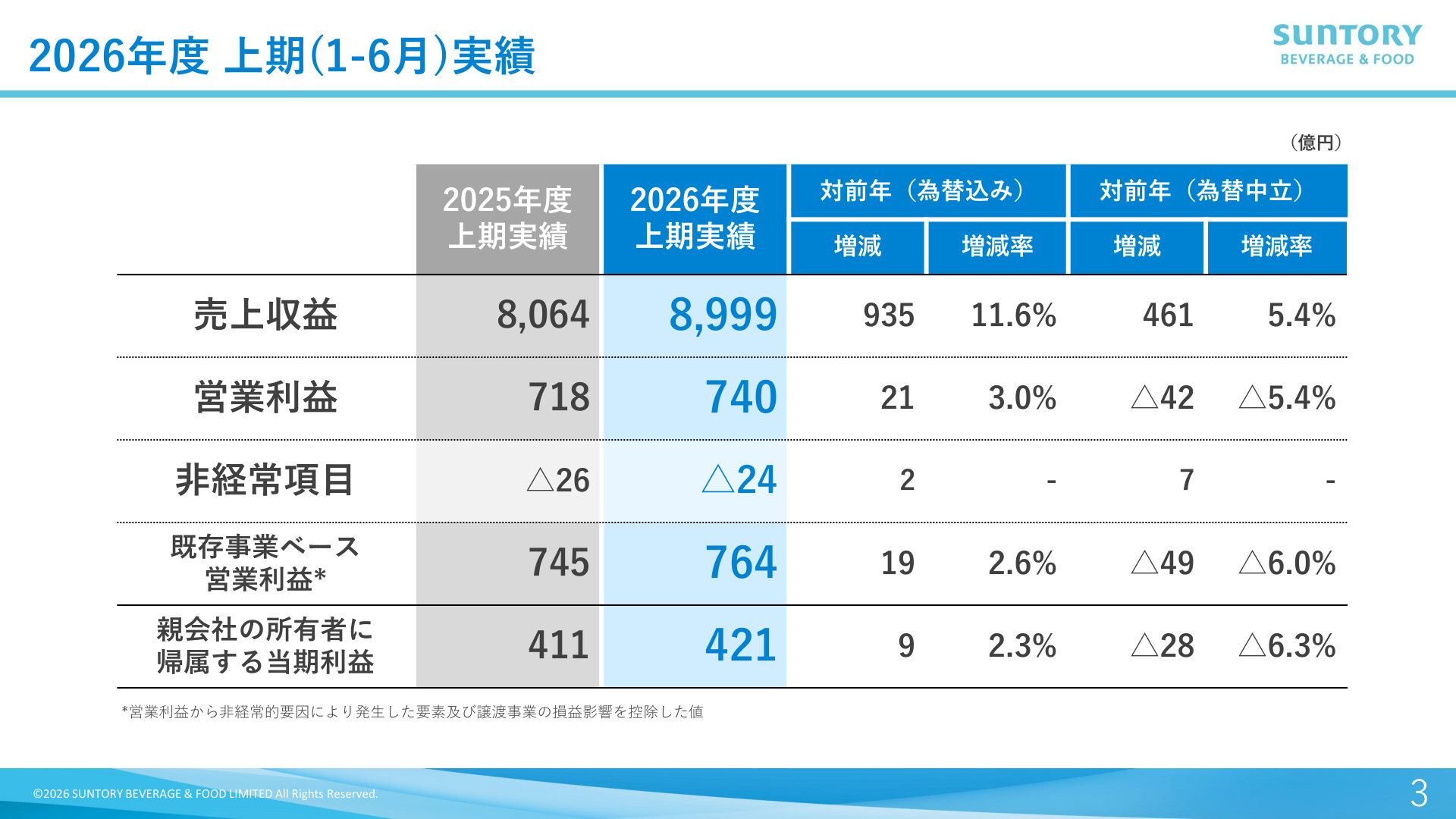
In H1 2026, revenue reached 899.9 billion yen (+11.6% YoY) , and operating profit was 74.0 billion yen (+3.0% YoY) . On a currency-neutral basis, revenue maintained steady growth at +5.4% YoY . While operating profit declined by 5.4% YoY on a currency-neutral basis , the company successfully offset aggressive marketing investments and rising costs through revenue growth and currency effects, securing a solid position relative to its published forecasts.
Slide Analysis
The slide above (PAGE 2) provides an overview of the consolidated performance for H1 2026. It highlights a significant revenue increase of 93.5 billion yen , rising from 806.4 billion yen in the same period last year to 899.9 billion yen. Furthermore, operating profit from existing businesses (excluding non-recurring factors and divested businesses) was 76.4 billion yen (+2.6% YoY, -6.0% currency-neutral) , and profit attributable to owners of the parent was 42.1 billion yen (+2.3% YoY) , demonstrating a structure capable of delivering bottom-line results even under challenging external conditions.
2. Segment Performance and Global Expansion
Looking at performance by region, all major regions achieved revenue growth (including currency effects) . The Japan and Oceania businesses were particularly strong drivers of overall performance.
Slide Analysis
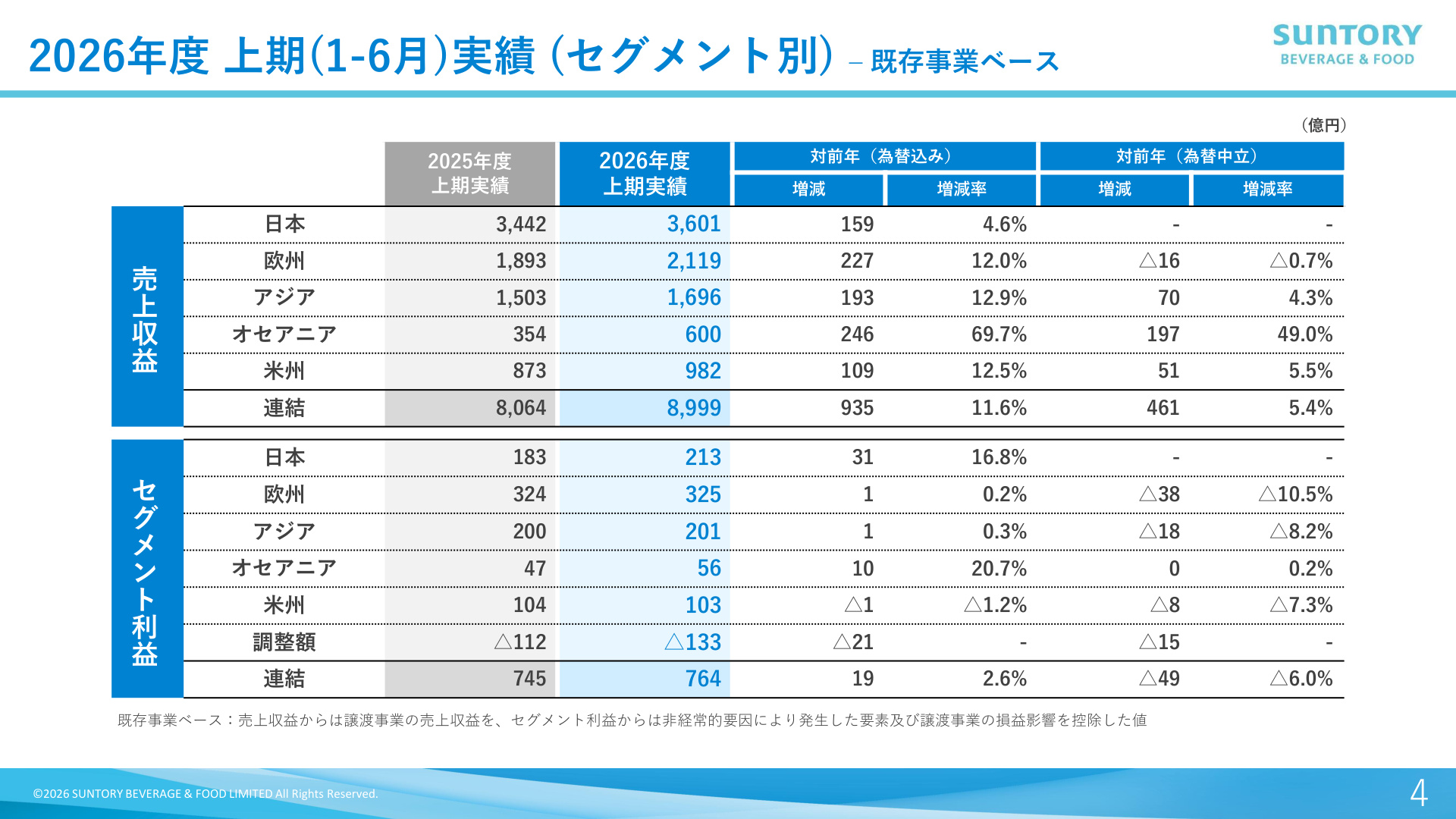
The slide above (PAGE 3) details revenue and segment profit (existing business basis) by region. The highlights are as follows:
- Japan : Revenue of 360.1 billion yen (+4.6% YoY), segment profit of 21.3 billion yen ( +16.8% YoY ). Profitability improved significantly despite a sluggish overall market.
- Europe : Revenue of 211.9 billion yen (+12.0% YoY), segment profit of 32.5 billion yen (+0.2% YoY). On a currency-neutral basis, revenue was -0.7% and profit was -10.5%, reflecting the impact of sugar tax hikes and unfavorable weather.
- Asia : Revenue of 169.6 billion yen (+12.9% YoY), segment profit of 20.1 billion yen (+0.3% YoY), supported by strong performance in the Vietnam beverage business.
- Oceania : Revenue of 60.0 billion yen ( +69.7% YoY ), segment profit of 5.6 billion yen ( +20.7% YoY ). Growth was driven by the energy category and the launch of alcoholic RTDs.
- Americas : Revenue of 98.2 billion yen (+12.5% YoY), segment profit of 10.3 billion yen (-1.2% YoY). While price revisions and sports drinks grew, rising costs pressured profits.
3. Structural Strengths and Profit Analysis of the Japan Business
The domestic soft drink market was estimated at 98% of the previous year's level. However, Suntory Beverage & Food’s domestic sales volume reached 102% YoY , achieving market share expansion . This was driven by the continuous strengthening of core brands and hits such as the new product "Guilty Carbonated NOPE."
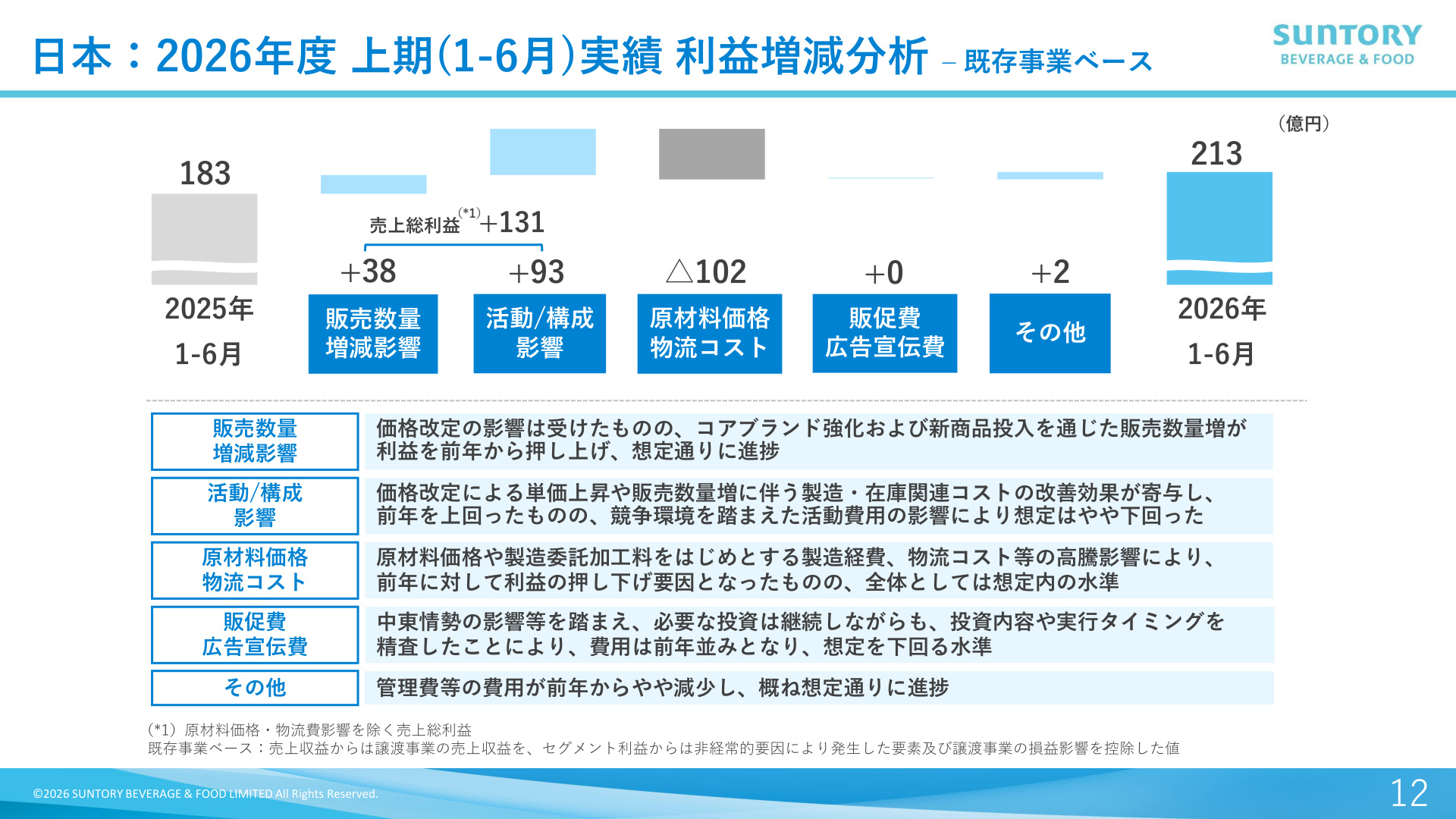
Slide Analysis
The slide above (PAGE 11) is a waterfall chart breaking down the 3.1 billion yen increase in operating profit for the Japan business, from 18.3 billion yen to 21.3 billion yen. The data reveals the following:
- Sales Volume Impact (+3.8 billion yen) : Aggressive marketing and core brand development directly boosted profits.
- Activity/Mix Impact (+9.3 billion yen) : Contributed significantly by the price revisions implemented in October 2025 and an improved mix of high-price/value-added products.
- Raw Material/Logistics Costs (-10.2 billion yen) : Rising costs for raw materials, manufacturing, and logistics acted as a strong headwind.
- Promotion/Advertising Expenses (±0 yen) : Maintained necessary marketing investments while keeping costs flat through timing optimization and efficiency.
As a result, the increase in gross profit (+13.1 billion yen) from price revisions and volume growth completely absorbed the 10.2 billion yen in cost hikes, leading to a significant segment profit increase (+16.8%) .
4. Core Brand Strengthening and Innovation
To achieve sustainable global growth, the company is promoting diverse product development based on consumer insights:
- UK/France : Enhanced brand value for "Lucozade Sport" and "Schweppes" through promotions linked to global sports events (e.g., Roland-Garros).
- Vietnam : Expanded the core category by launching "BOSS Coffee Energy" under the flagship "BOSS" brand.
- Japan : Launched " Guilty Carbonated NOPE ," a new type of carbonated drink, and daily health-value products like " Locomoa WATER " and " Sesamin 1000 ."
- Thailand : Developed the new hydration market with "Suntory Hy! Water Lock," applying Japanese moisture-retention technology.
5. Vending Machine Restructuring and Strategic Capital Investment
The company is driving strong structural reforms in the domestic vending machine market, including enhanced corporate services (e.g., Boss Mart), the "Pijihanpi" app for better customer engagement, and an expanded lineup of vending-exclusive products.
Internationally, strategic capital investments are underway to expand production and logistics. The Vietnam Tay Ninh Plant (formerly Long An Plant) has been completed, featuring AGVs (Automated Guided Vehicles) and advanced automated warehouses to streamline the entire process from storage to shipping, preparing for future demand.
6. Regional Analysis and Challenges
- Europe : France saw a delayed market recovery following last year's sugar tax hike, while the UK and Spain were affected by poor weather early in the year. However, the company maintained stability by expanding the "Schweppes" fruit carbonated portfolio.
- Asia : In Vietnam, flagship products like "Pepsi" drove the market, while in Thailand, the company responded to sugar tax hikes and intense competition by strengthening functional products and adjusting pricing/sizing.
- Oceania/Americas : Oceania saw rapid growth from energy drinks and new alcoholic RTDs. In the Americas, despite a decline in the water category, sports drink growth and price revisions supported revenue.
7. Middle East Situation and H2 Outlook
The escalating situation in the Middle East remains a major source of uncertainty. In H1, the impact on the group totaled approximately 6.0 billion yen (primarily due to rising costs for oil-derived packaging, energy, and transport).
For H2, assuming current market conditions persist through the end of 2026, the company anticipates an impact of 8.0 to 12.0 billion yen . The company plans to minimize this by reviewing marketing expenses and improving operational efficiency across all segments.
8. Capturing Peak Demand and H2 Priorities
To achieve annual targets, the company is accelerating four key activities in H2, when soft drink demand peaks:
- Core Brand Strengthening : Promoting product strategies for sustainable brand value and profit growth.
- New Value Creation : Nurturing new products and expanding them globally.
- Strategic Capital Investment : Fully utilizing new supply bases like the Tay Ninh Plant to improve productivity.
- Structural Reform : Evolving management based on consumer insights and strengthening cross-business value creation.
9. Mid-to-Long-Term Vision
The company aims to be a " global beverage company that grows worldwide, leveraging value creation rooted in local communities. " It is evolving a hybrid management model that develops products tailored to local needs while flexibly utilizing group-wide resources and technologies (e.g., deploying Japanese technology overseas).
10. Summary and Conclusion
The H1 2026 results demonstrate that even under the headwinds of soaring raw material, energy, and logistics costs , the company achieved solid revenue and profit growth through successful price revisions , hit innovation products , and expansion in overseas growth markets like Oceania and Vietnam.
While cost pressures from the Middle East (8.0–12.0 billion yen) are a concern for H2, the company has shown the resilience to meet its full-year forecast through production automation, vending machine restructuring, and concentrated investment in core brands.
This content is not intended as investment advice or a recommendation. Any opinions expressed are solely the personal views of each article.