


Daidan Q1 FY2027 Earnings Analysis: Industrial Facilities and Overseas Projects Drive Record-High Backlog

StockClub
Published: Aug 06, 2026, 09:55 AM
Sentiment Analysis
Daidan Q1 FY2027 Earnings Deep Dive Report
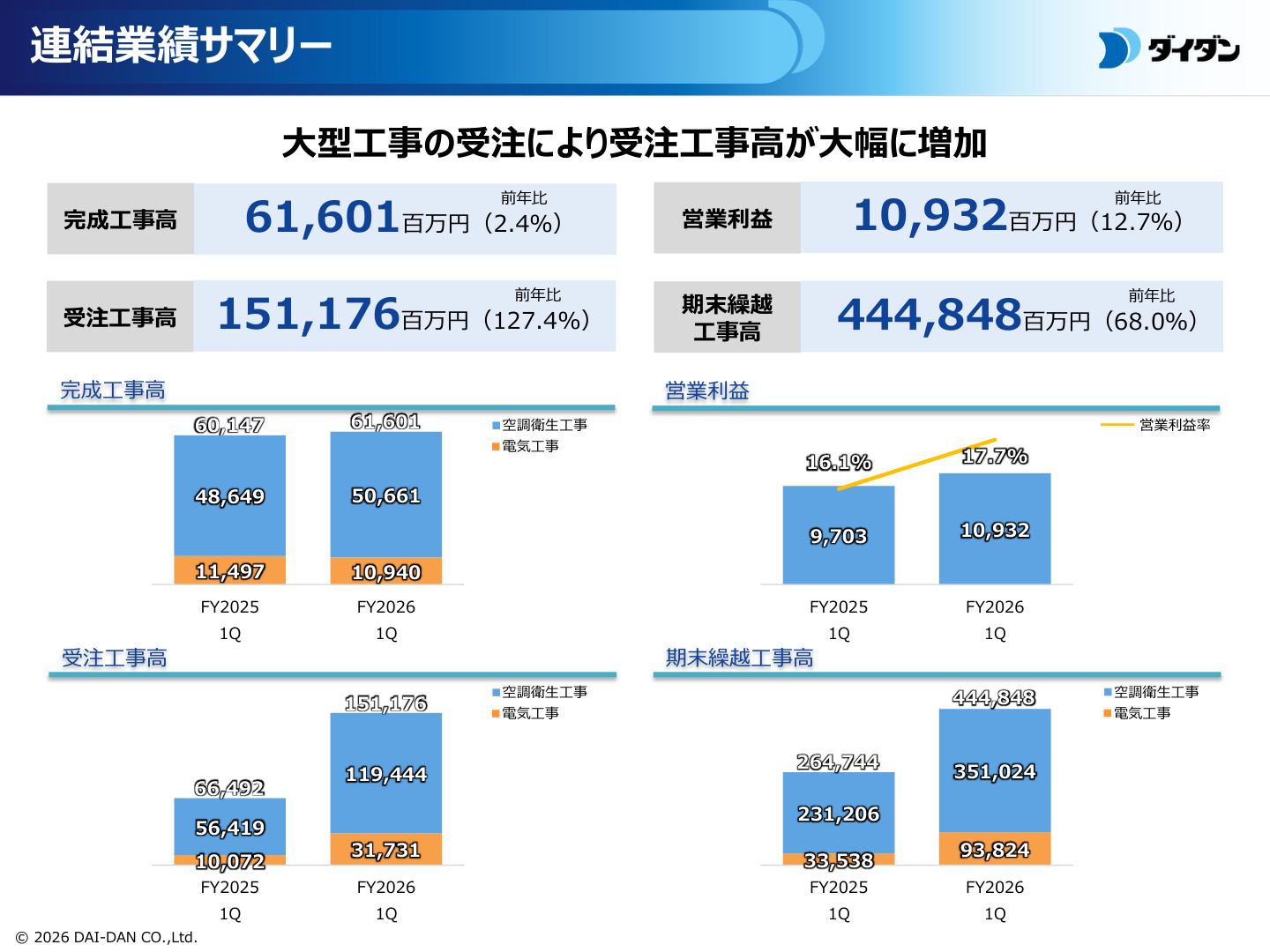
Daidan Corporation (Securities Code: 1980), a major comprehensive facility engineering firm, reported exceptionally strong results for the first quarter of the fiscal year ending March 2027 (announced August 5, 2026). Orders received surged 127.4% year-on-year to 151.176 billion yen , driving the year-end construction backlog to a record high of 444.848 billion yen, an increase of 68.0% year-on-year .
This performance is largely attributed to robust demand for industrial facility construction, particularly data centers and semiconductor plants, alongside the acquisition of major projects in overseas markets such as Singapore. This report extracts 10 key topics from the earnings materials to provide a detailed analysis of the company's performance structure, growth drivers, and future outlook.
1. Earnings Summary: Key Indicators and Robust Performance Trends
In the first quarter, consolidated net sales (completed construction contracts) reached 61.601 billion yen (up 2.4% YoY) , with operating profit rising to 10.932 billion yen (up 12.7% YoY) . While the growth in completed construction appears modest compared to the explosive expansion in orders, this is due to the lead times inherent in construction and facility engineering (the period from order to commencement and completion). This indicates that profitability is improving and a solid foundation for future revenue is being built at an extremely high level.
[Why this slide is important: A snapshot of earnings and proof of growth momentum]
This slide contains the most critical data summarizing the Q1 performance highlights. Of particular note is the phenomenal growth rate, with orders received at 151.176 billion yen (+127.4% YoY) and construction backlog at 444.848 billion yen (+68.0% YoY) . Furthermore, operating profit grew to 10.932 billion yen (+12.7%) , significantly outpacing the growth in sales (+2.4%), while the operating profit margin improved by 1.6 percentage points, from 16.1% to 17.7% . This confirms that not only has the scale of orders expanded, but the profitability per project is also steadily increasing.
2. Profitability Drivers: Cost Reduction and Established Price Pass-Through
The primary driver of the increase in operating profit was the gross profit margin on completed construction contracts, which rose 2.4 percentage points from 24.3% in the same period last year to 26.7% . In monetary terms, this improvement in the gross margin contributed a positive factor of 1.492 billion yen .
The background to this margin improvement includes three key initiatives:
- Advanced Construction Processes : Utilization of off-site facilities for prefabrication and unit processing, and thorough front-loading to identify issues before on-site construction begins.
- Company-wide Construction Support : Establishment of a support system that allows for the fluid allocation of personnel across business offices to handle the recent increase in large-scale projects.
- Appropriate Price Pass-Through : Success in reflecting and passing on the rising costs of labor and materials to construction prices.
Although selling, general and administrative (SG&A) expenses increased by 616 million yen due to higher personnel costs from increased headcount and rising R&D expenses, the profitability improvements at project sites significantly outweighed these costs, boosting overall profit.
3. Explosive Growth in Industrial Facility Construction: Led by Data Centers and Semiconductor Plants
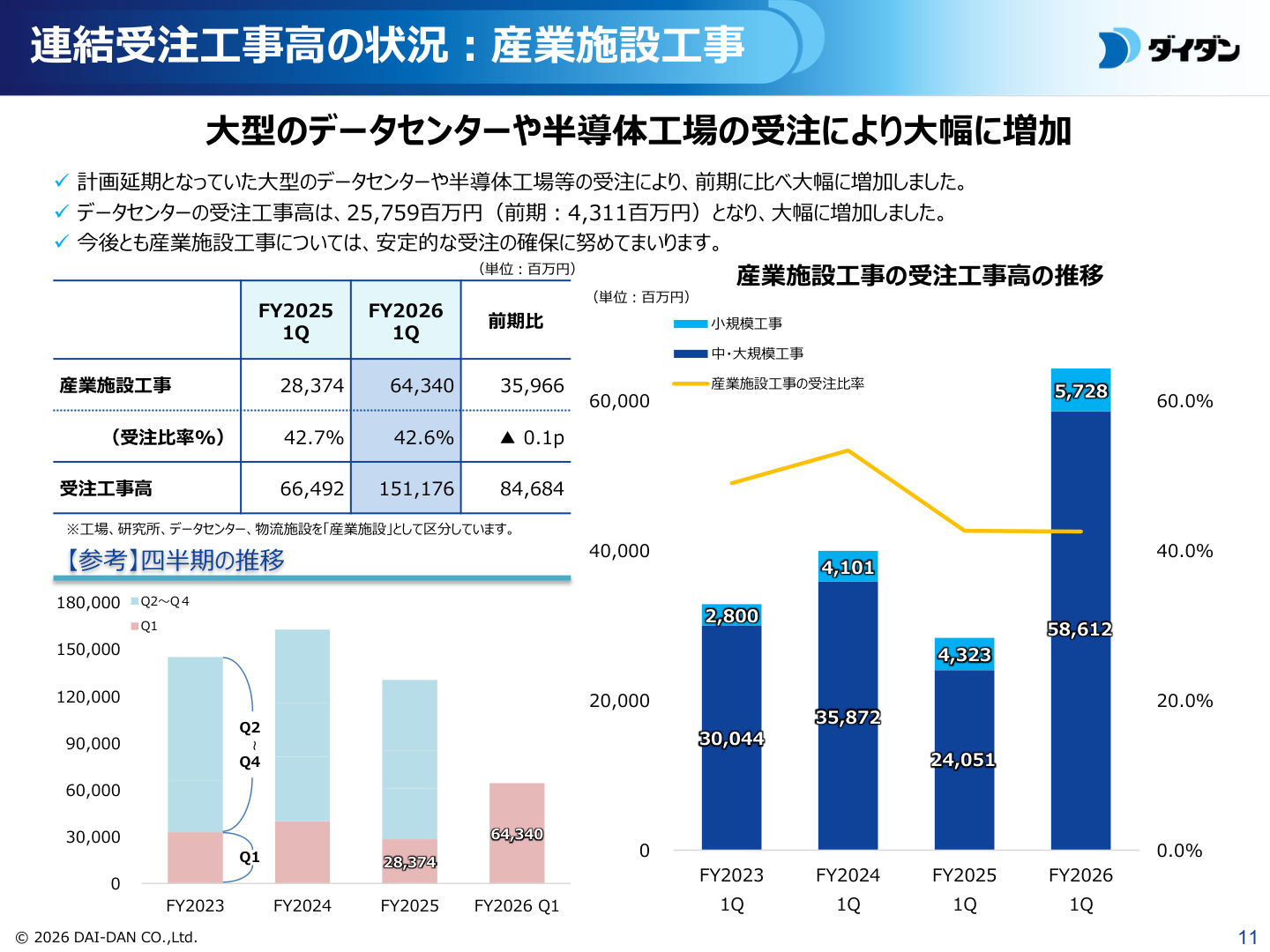
The primary engine driving the company's growth is industrial facility construction (data centers, factories, research laboratories, logistics facilities, etc.) . In the first quarter, orders for industrial facility construction reached 64.340 billion yen (up 125.4% YoY) , accounting for 42.6% of total orders.
[Why this slide is important: The structure of industrial facility orders as the core growth engine]
This slide clearly illustrates the sectors where the company is achieving overwhelming growth. Of particular note is the resumption of large-scale projects that had been postponed, as well as the surge in data center orders to 25.759 billion yen , a six-fold increase from 4.311 billion yen in the same period last year. As shown in the graph, the ratio of medium-to-large-scale construction has expanded significantly, demonstrating that the company is successfully capturing demand for data center infrastructure and domestic semiconductor plant investment driven by DX and the spread of AI.
4. Leap in Overseas Business: Securing Major Projects in Singapore and Beyond
Another major topic is the rapid expansion of overseas construction . Overseas orders in the first quarter reached 27.651 billion yen (up 222.9% YoY) , with the overseas order ratio rising sharply from 12.9% to 18.3% .
Factors behind overseas expansion:
- Acquisition of major projects at the Singapore base : Secured large-scale construction projects including resort facilities, medical-related facilities, and office buildings.
- Steady growth of local consolidated subsidiaries : Improved order-taking capabilities through locally-rooted structures such as DAI-DAN INTERNATIONAL ASIA and Presico Engineering.
The company is evolving from a structure centered on the domestic market to a global construction framework capable of directly capturing robust infrastructure and construction demand overseas.
5. Record-High Orders in Both New Construction and Renovation
Looking at orders by construction type, both new construction and renovation projects have achieved record-high levels.
- New Construction : Orders reached 110.253 billion yen (up 210.2% YoY) , significantly contributed to by new large-scale data center and factory projects.
- Renovation : Orders reached 40.923 billion yen (up 32.2% YoY) . Driven by demand for energy conservation and building retrofits, both large/medium and small-scale renovations performed steadily.
While the renovation ratio fell to 27.1% due to the significant growth in new construction orders, the absolute amount of renovation work is well above the previous year, forming a highly balanced project pipeline.
6. Backlog Securing Future Performance: The Impact of a Record 444.8 Billion Yen
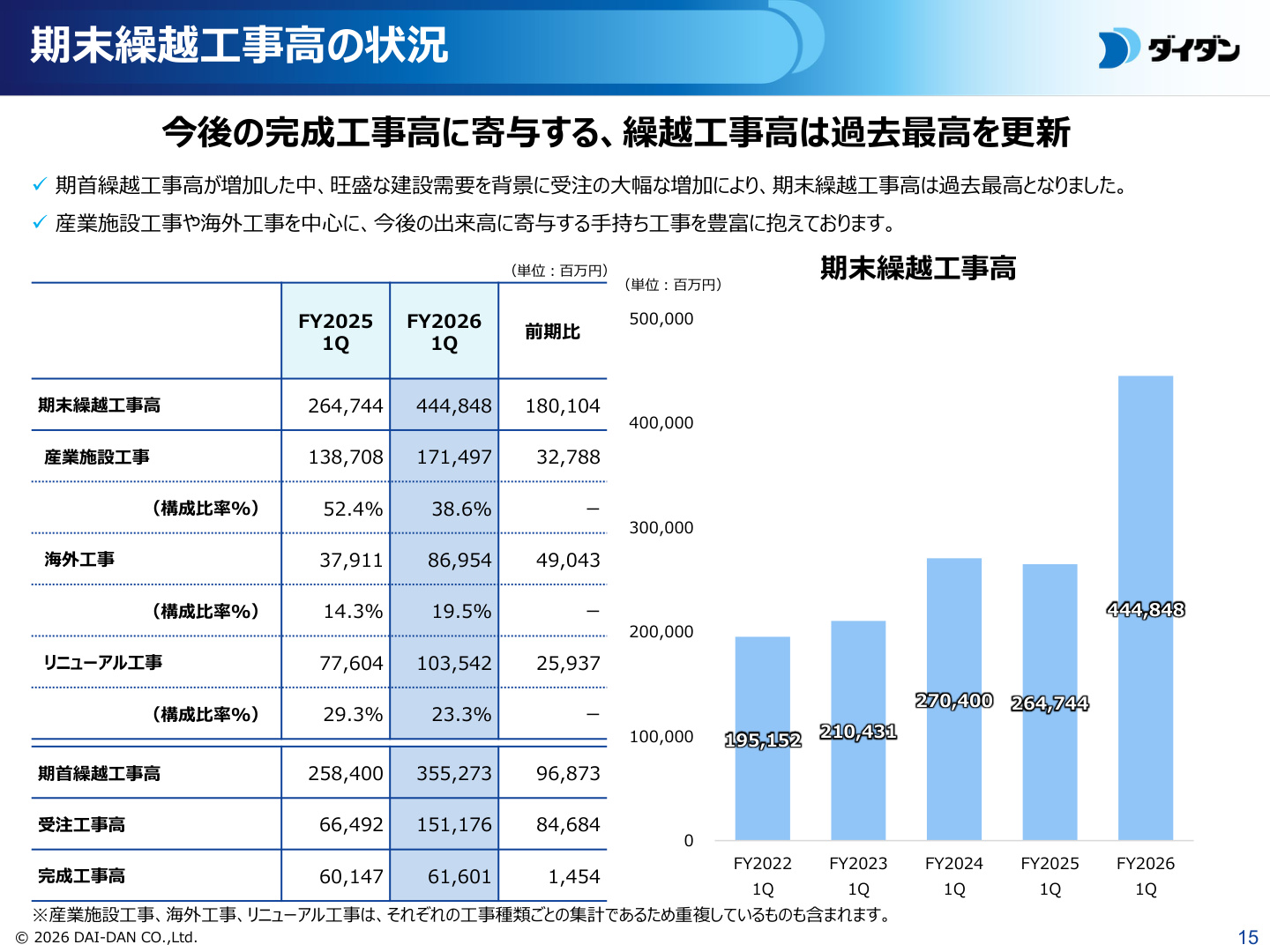
For facility engineering firms, the year-end construction backlog is the most important leading indicator, serving as the source of future net sales (completed construction contracts) and profit.
[Why this slide is important: Backlog supporting mid-to-long-term growth]
This slide provides the most critical backlog data, showing how much work the company has secured for the future. The construction backlog at the end of the first quarter reached 444.848 billion yen , an increase of 180.104 billion yen (+68.0%) year-on-year. As shown in the bar graph on the right, this is an unprecedented level in recent years. A breakdown reveals that industrial facility construction accounts for 171.497 billion yen (38.6% of the total) and overseas construction for 86.954 billion yen (19.5%) , confirming that growth areas are steadily accumulating. This massive backlog provides strong assurance for performance not only in the current fiscal year but also in the years to come.
7. Sound Financial Foundation and Cash Flow Generation
In line with business expansion, the financial position has become even more robust.
- Asset Status : Total assets were 217.7 billion yen (down 14.3 billion yen from the end of the previous fiscal year). Current assets decreased due to the collection of trade receivables.
- Equity Ratio : Improved by 3.7 percentage points from 56.2% at the end of the previous fiscal year to 59.9% , maintaining a very high level of financial safety.
- Cash Flow (CF) :
- Operating CF : Generated +7.421 billion yen due to profit before income taxes of 11.296 billion yen and the collection of trade receivables.
- Investing CF : -1.271 billion yen due to capital expenditures.
- Free CF : Demonstrated strong generation of +6.150 billion yen .
- Financing CF : -7.469 billion yen due to dividend payments (-7.290 billion yen).
A cycle is confirmed where cash generated from core operations is reliably allocated to shareholder returns such as dividends.
8. Full-Year Forecast and Progress on the Mid-Term Management Plan
The company has maintained its full-year earnings forecast for the fiscal year ending March 2027, as announced on May 13, 2026. As the final year of the mid-term management plan " Stage2030 Phase2《Polishing Stage》 ," the company aims to achieve record-high levels.
Key Figures for FY2027 Full-Year Forecast
- Orders Received : 360 billion yen (+2.0% YoY)
- Completed Construction Contracts : 265 billion yen (+3.4% YoY)
- Operating Profit : 36 billion yen (+4.4% YoY)
- Ordinary Profit : 36.5 billion yen (+2.0% YoY)
- Net Income Attributable to Owners of Parent : 27.3 billion yen (+2.0% YoY)
- Year-end Construction Backlog : 450.273 billion yen (+26.7% YoY)
As of the first quarter, the company has already secured 151.1 billion yen, approximately 42% of the annual order target (360 billion yen), indicating very smooth progress. This progress suggests a seamless transition to "Phase 3《Shining Stage》" through the achievement of Phase 2 goals.
9. Shareholder Return Policy: Strong Commitment and Dividend Levels
Daidan positions shareholder returns as one of its most important management policies and has established clear return criteria.
- Basic Policy : "Dividend payout ratio of 40% or more and a lower limit of 4.8% for Dividend on Equity (DOE)."
- FY2027 Annual Dividend Forecast : 85.00 yen per share (Interim 42.00 yen, Year-end 43.00 yen)
- Forecast Payout Ratio : 40.2%
- Forecast DOE : 8.0% (Significantly exceeding the policy lower limit of 4.8%)
Even when compared on a basis adjusted for the 1-for-3 stock split implemented on January 1, 2026, the dividend amount has steadily increased over time, demonstrating high capital efficiency and a proactive stance on shareholder returns.
10. Comprehensive Analysis and Future Focus Points
The strengths, challenges, and focus points identified through these earnings results are summarized as follows:
Strengths and Tailwinds
- Solid Spillover of Industrial Facility Demand : Successfully converting the expansion of investment in data centers and semiconductor/electronic component plants into orders.
- Realization of Overseas Expansion Results : Acceleration of growth speed through increased orders in Southeast Asia, centered on Singapore.
- High Profitability : Improvement in on-site productivity and gross profit margins through the use of off-site construction, BIM, and front-loading.
Points to Watch
- Speed of Backlog Execution : How efficiently and according to plan the company can convert the 444.8 billion yen backlog into completed construction contracts amidst labor shortages and material procurement constraints.
- Labor Cost and Material Price Inflation Risks : Whether the company can maintain appropriate price pass-through and cost control through construction efficiency as inflationary trends continue.
Despite the external environment of structural labor shortages and rising construction material costs, Daidan is emerging as a company that achieves both high profitability and growth through thorough productivity improvements and a shift toward high-value-added areas (data centers, overseas, and renovations).
This content is not intended as investment advice or a recommendation. Any opinions expressed are solely the personal views of each article.