


Yamaura Corporation (1780) Q1 FY2027 Earnings Analysis Report: Stable Business Expansion Driven by Improved Gross Margins and Future-Oriented Investments

StockClub
Published: Aug 06, 2026, 09:53 AM
Sentiment Analysis
Yamaura Corporation (1780) Q1 FY2027 Earnings Analysis Report
This is a deep-dive report on the Q1 FY2027 (fiscal year ending March 2027) financial results for Yamaura Corporation (Securities Code: 1780), a company based in Nagano Prefecture specializing in construction and engineering. This report provides a comprehensive analysis of earnings highlights, detailed breakdowns of the P/L and B/S, segment performance, and progress toward full-year targets.
1. Executive Summary: Key Figures and Overall Performance
Yamaura’s Q1 consolidated results showed a slight year-on-year decline in both revenue and profit at all levels. However, this decline in revenue and profit remains within the company’s initial projections , marking a steady start toward achieving its full-year goals.
【Q1 Consolidated Earnings Highlights】
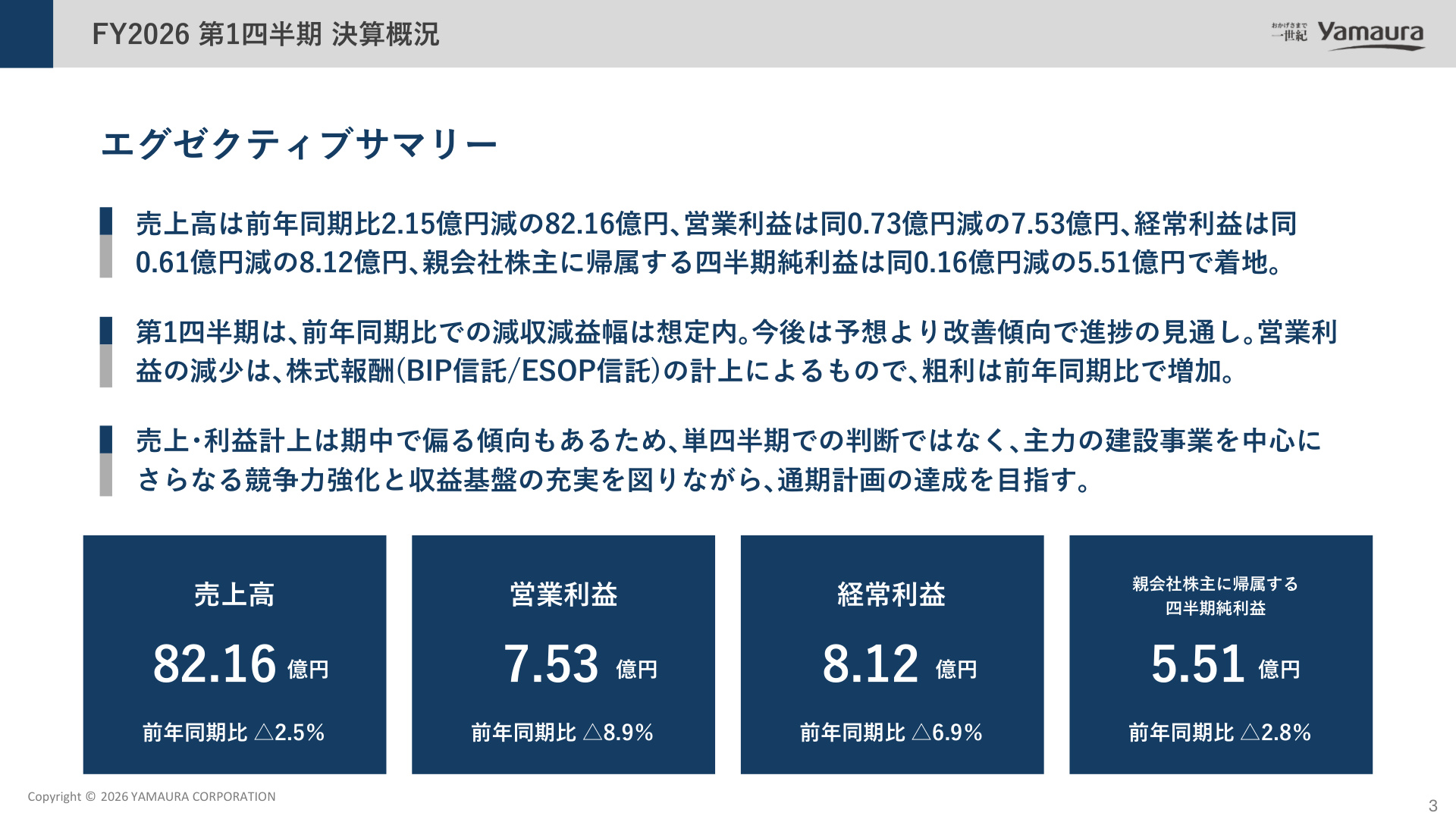
- Net Sales : ¥8.216 billion (YoY -2.5% / -¥215 million)
- Operating Profit : ¥753 million (YoY -8.9% / -¥73 million)
- Ordinary Profit : ¥812 million (YoY -6.9% / -¥61 million)
- Quarterly Net Income Attributable to Owners of Parent : ¥551 million (YoY -2.8% / -¥16 million)
【Why this slide is important: Overall context of the earnings】
The slide above (PAGE_2) summarizes the key management indicators and the core of the financial results. Beyond the surface-level "decline in revenue and profit," it clarifies that "the decrease in operating profit is primarily due to the recording of stock-based compensation (BIP/ESOP trusts), and that gross profit itself has increased year-on-year."
In the construction industry, revenue and profit recognition often exhibit "seasonal bias," where figures are skewed toward specific periods or quarters. Therefore, rather than overreacting to single-quarter figures, it is essential to monitor the progress of project-specific margins and cost management. In this first quarter, the increase in gross profit despite a slight decline in the top line indicates that project profitability is being successfully maintained and improved.
2. Detailed P/L Analysis: Improved Gross Profit and Increased SG&A Expenses
A detailed analysis of the P/L statement reveals a significant shift in the quality of Yamaura’s earnings structure.
【Why this slide is important: Gross margin improvement and SG&A breakdown】
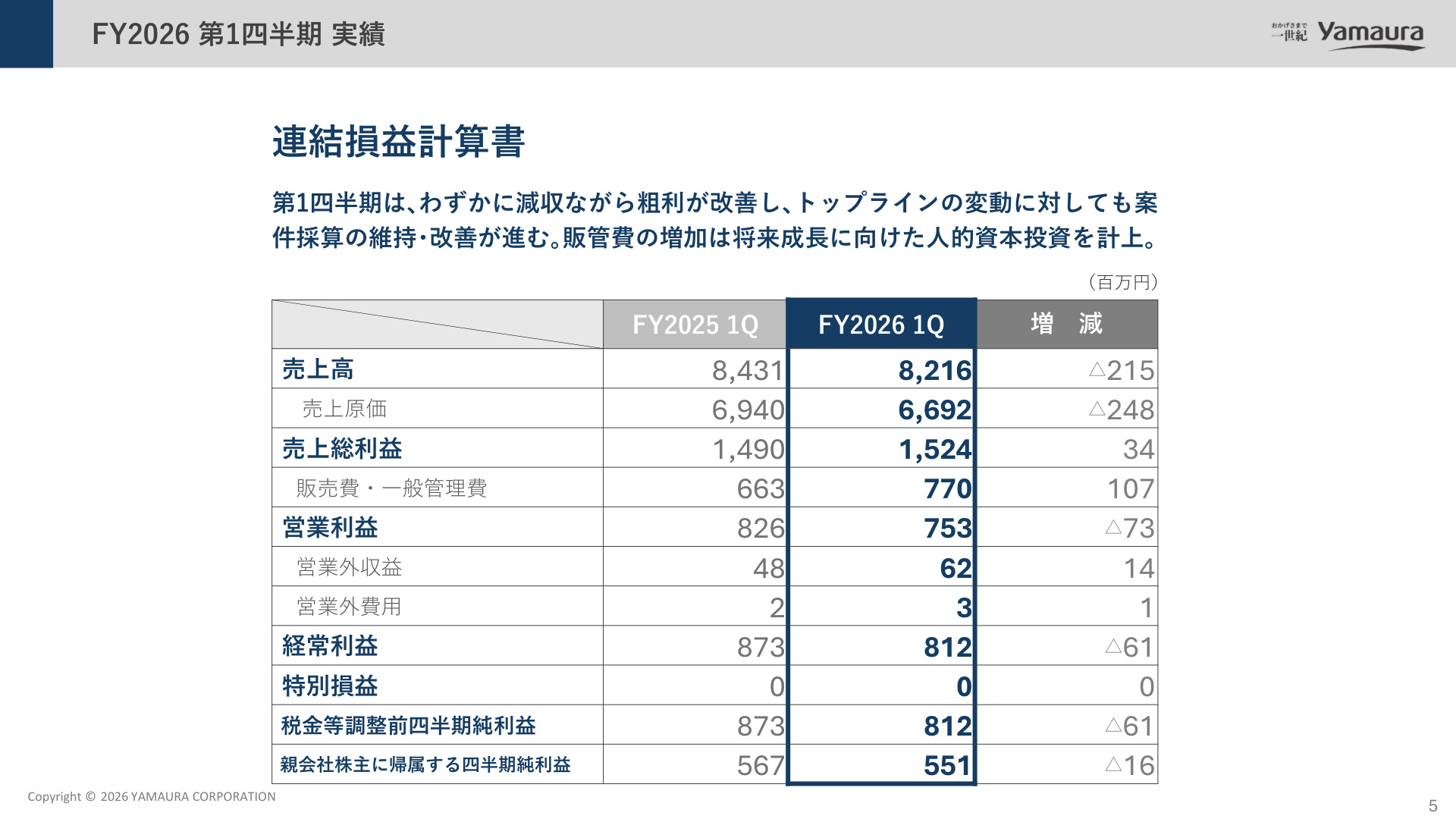
Slide PAGE_4 shows a year-on-year comparison of the consolidated P/L statement by account. Two key points emerge:
-
Increase in Gross Profit (+¥34 million YoY) Despite a decline in net sales from ¥8.431 billion to ¥8.216 billion, cost of sales was compressed from ¥6.940 billion to ¥6.692 billion, resulting in an expansion of gross profit from ¥1.490 billion to ¥1.524 billion. This confirms the company’s ability to secure high-margin projects through its regional proposal capabilities, productivity improvements at construction sites, and rigorous construction management.
-
Increase in Selling, General and Administrative (SG&A) Expenses (+¥107 million YoY) The primary factor weighing on operating profit was the increase in SG&A expenses (from ¥663 million to ¥770 million). This increase includes not only stock-based compensation expenses but also "human capital investment" for sustainable growth. Active investment in talent acquisition, development, and improvement of the working environment is viewed as a proactive forward-looking investment that will serve as a source of long-term competitiveness.
3. Balance Sheet (B/S) and Financial Soundness: A Robust Capital Base with a 71.1% Equity Ratio
Yamaura maintains a financial foundation that is among the most robust in the construction industry.
【Key Trends in Consolidated Balance Sheet】
- Total Assets : ¥36.288 billion (+¥281 million from previous fiscal year-end)
- Cash and Deposits : ¥9.579 billion (+¥740 million from previous fiscal year-end)
- Net Assets : ¥25.791 billion (-¥389 million from previous fiscal year-end)
- Equity Ratio : 71.1% (-1.6pt from previous fiscal year-end)
With the collection of trade receivables progressing since the start of the fiscal year, cash and deposits have accumulated to ¥9.579 billion , maintaining liquidity at an extremely high level. While there is a slight decrease in net assets and the equity ratio (from 72.7% to 71.1%), this is due to the company’s execution of share buybacks in accordance with its medium-term management plan. This reflects a management stance that balances capital efficiency and shareholder returns while maintaining high safety levels.
4. Segment Performance Analysis: Core Construction and Growth-Oriented Businesses
Yamaura’s business is classified into three segments: "Construction," "Engineering," and "Development."
① Construction Business (Core Business)
- Net Sales : ¥7.374 billion (YoY -¥146 million)
- Overview : This is the core revenue driver, accounting for over 89% of total sales. Although slightly down from ¥7.520 billion in the same period last year, progress is in line with the company’s initial plan. Supported by a high level of order backlog, the segment continues to maintain high profitability.
② Engineering Business
- Net Sales : ¥525 million (YoY -¥4 million)
- Overview : This division supports infrastructure development and industrial machinery. While Q1 sales are largely flat, orders from new customers are performing very strongly , and the outlook suggests an upward trend in both sales and profit moving forward.
③ Development Business
- Net Sales : ¥316 million (YoY -¥65 million)
- Overview : Includes real estate development and utilization projects. Due to the nature of the business, quarterly performance tends to fluctuate depending on the timing of property handovers and contract closures.
5. Full-Year Outlook and Progress: Scenarios for Achieving Targets
Yamaura has maintained its full-year consolidated earnings forecast for the fiscal year ending March 2027 without changes.
【Why this slide is important: Progress toward full-year targets and future certainty】
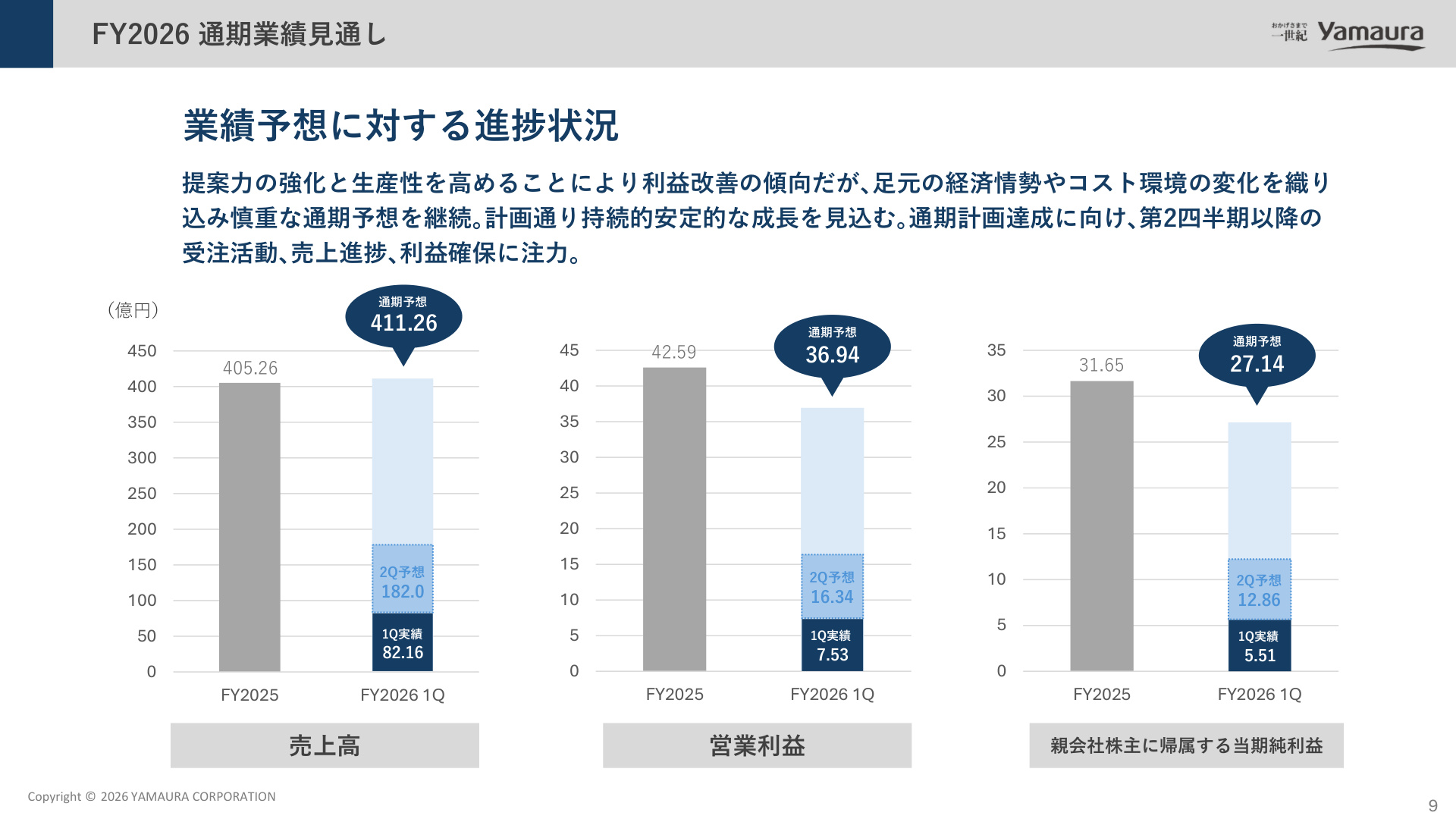
Slide PAGE_8 visually demonstrates the relationship between full-year forecasts, Q1 results, and progress toward the H1 (2Q) forecast.
【Full-Year Consolidated Forecast and Q1 Progress Rate】
- Net Sales : Full-year forecast ¥41.126 billion (Q1 result ¥8.216 billion / Progress 20.0% )
- Operating Profit : Full-year forecast ¥3.694 billion (Q1 result ¥753 million / Progress 20.4% )
- Net Income Attributable to Owners of Parent : Full-year forecast ¥2.714 billion (Q1 result ¥551 million / Progress 20.3% )
While the progress rate at the end of Q1 appears to be around 20% for each item, the company’s performance is characterized by seasonal bias, with construction completions and handovers concentrated in the second half (particularly Q4). Therefore, achieving over 20% progress in Q1 and establishing a solid foundation for the full-year operating profit target (¥3.694 billion) indicates that the company is on a steady course to meet its goals.
From Q2 onwards, the company plans to continue securing profits by strengthening proposal-based sales and improving construction site efficiency, while closely monitoring external factors such as construction material price trends and labor costs.
6. Conclusion and Future Focus Points
Yamaura’s Q1 FY2027 results demonstrate that, beyond the superficial "year-on-year decline in revenue and profit," the company has made steady progress in substantive earnings power (gross margin improvement) and capital investment for the future (human capital and stock-based compensation).
【Key Topics to Watch】
- Maintenance of Project Profitability : Can the upward trend in gross profit margin be sustained from Q2 onwards amidst rising construction material costs?
- Expansion of Engineering Business : How will the strong new order intake contribute to sales and profit in the second half?
- Capital Efficiency and Shareholder Returns : The continuity of B/S management, such as share buybacks, utilizing the robust financial base (71.1% equity ratio) and cash holdings (¥9.579 billion).
The focus moving forward will be on whether the company can maintain its stable growth trajectory, anchored by its solid customer base and high construction expertise in its core construction business.
This content is not intended as investment advice or a recommendation. Any opinions expressed are solely the personal views of each article.