


Veritas In Silico (130A) H1 FY2026 Earnings Analysis: A Growth Story Toward a Specialty Pharma Powerhouse Driven by a Proprietary AI Drug Discovery Platform and the 'Perfusio' DDS

StockClub
Published: Aug 06, 2026, 09:51 AM
Sentiment Analysis
Veritas In Silico (130A) H1 FY2026 Earnings Analysis
Veritas In Silico (VIS) , a pioneer in mRNA-targeted drug discovery, has released its financial results for the second quarter of the fiscal year ending December 2026. The company is steadily building a foundation for sustainable growth by advancing joint drug discovery research with major corporations (platform business), expanding its internal pipeline, and launching its new drug delivery system (DDS), "Perfusio."
This report provides a multi-faceted analysis of key topics from the company's earnings materials, detailing its business structure, R&D progress, financial position, and long-term growth narrative.
1. Structure of the Hybrid Revenue Model Supporting Drug Discovery
VIS utilizes its proprietary AI drug discovery platform, "aibVIS," as its core technology to develop small-molecule and nucleic acid drugs targeting mRNA. The company employs a "High-Growth Hybrid Model" that combines a "Platform-type" business, which generates stable early-stage revenue, with a "Pipeline-type" business, which targets large upfront payments and milestones upon licensing out.
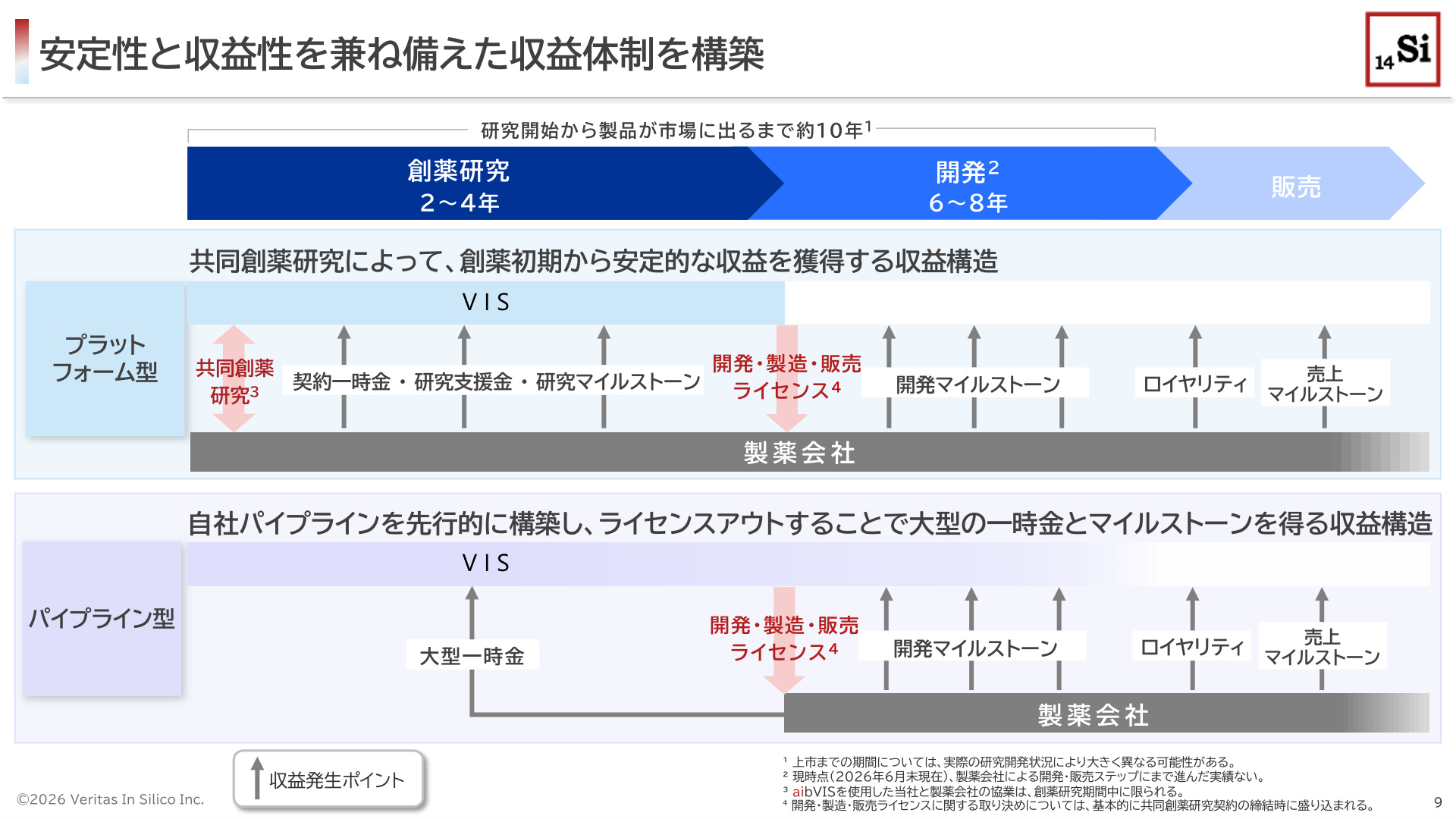
It typically takes about 10 years for a drug to move from research to market. In the platform business, VIS stabilizes revenue during the R&D phase by securing "upfront payments," "research support fees," and "research milestones" in stages from the early phases (2–4 years) of joint research with pharmaceutical companies.
Conversely, in the internal pipeline business, the company bears a portion of the research costs and risks while advancing non-clinical development, aiming to secure "large upfront payments," "development/sales milestones," and "royalties" through licensing. By operating these two engines in tandem, the company aims to achieve both revenue stability and future explosive growth.
2. H1 FY2026 Earnings Highlights and Profit Structure
Performance for the first half (January to June 2026) was as follows:
- Operating Revenue : 36 million JPY (43 million JPY in the same period last year, -15.0% YoY)
- Operating Expenses : 283 million JPY (229 million JPY in the same period last year, +23.2% YoY)
- R&D Expenses : 132 million JPY
- SG&A Expenses : 150 million JPY
- Operating Loss : -246 million JPY (vs. -186 million JPY in the same period last year)
- Ordinary Loss : -243 million JPY (vs. -182 million JPY in the same period last year)
- Net Loss : -386 million JPY (vs. -184 million JPY in the same period last year)
Operating revenue was primarily driven by research support fees from pharmaceutical partners. Meanwhile, operating expenses increased to 283 million JPY due to intensified R&D activities and the relocation of the Kawasaki Laboratory.
The widening net loss is primarily due to an extraordinary loss (impairment loss) of 141 million JPY recognized for fixed assets. This is an accounting adjustment aimed at optimizing future asset efficiency and does not involve cash outflow.
Looking at the quarter-on-quarter (QoQ) trend, operating expenses have remained steady at around 140 million JPY, reflecting disciplined R&D investment as a cutting-edge biotech firm.
3. Alliance Strategy and the Frontline of Contract Negotiations (CDA Status)
The most critical leading indicator for the platform business is the number of Confidential Disclosure Agreements (CDAs) and the progress of negotiations with potential partners.
Currently, the pharmaceutical industry is shifting toward prioritizing the introduction of external drugs over internal discovery, making a strategic approach essential for securing platform contracts. To enhance its visibility in the European market, VIS has initiated joint exploratory research with the Swiss company SpiroChem and is actively hosting webinars and conducting overseas visits.
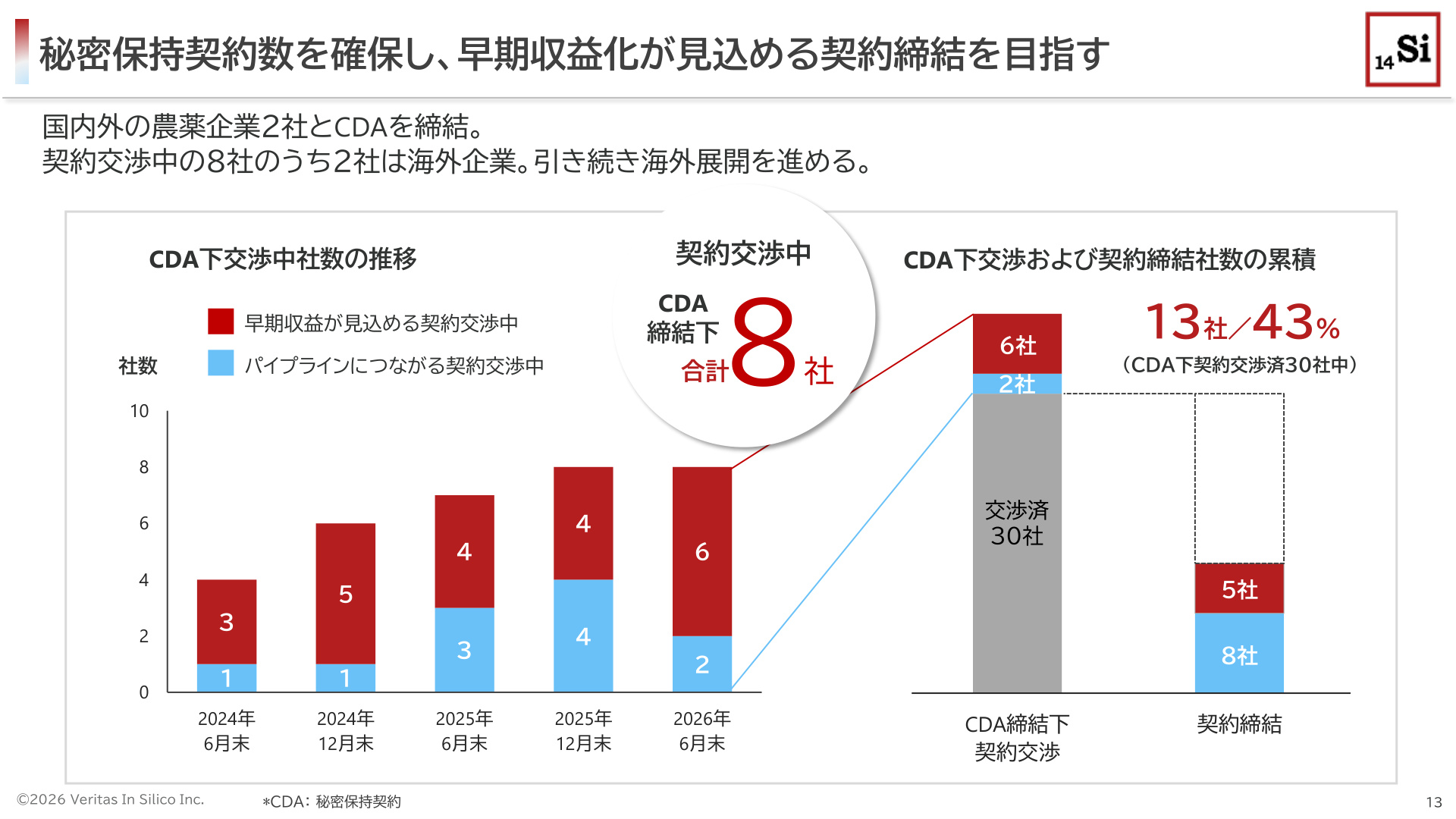
As of the end of June 2026, eight companies are in contract negotiations under CDAs (including two overseas firms), and this includes CDAs signed with two agricultural chemical companies. Of the 30 companies with which VIS has signed CDAs to date, 13 (43%) have already converted into final contracts, maintaining an exceptionally high conversion rate. Of the eight currently in negotiation, six are in advanced discussions expected to lead to early monetization , indicating a high probability of meeting the annual target of two new contracts for this and the next fiscal year.
4. Steady Progress of Internal Pipelines and Intellectual Property Strategy
The core of the VIS growth story lies in the creation of its internal pipeline and the comprehensive acquisition of intellectual property (patents).
Progress of Key Pipelines
- Internal Pipeline 1 : With an eye toward reducing the cost and duration of clinical trials using DDS, the company expects to begin animal testing for non-clinical trials within the year .
- Internal Pipeline 2 : The company is advancing the creation of multiple promising candidate substances, aiming for patent applications for new nucleic acid drugs within 2026.
- ALS (Amyotrophic Lateral Sclerosis) Drug : As a result of joint research with Jikei University School of Medicine, a material patent for a new nucleic acid drug has been published, and a joint press conference was held.
Strengthening the IP Portfolio
VIS holds 3 granted patents and 8 pending applications . In addition to foundational technology patents such as its AI drug discovery algorithm ( AISLAR ) and analysis technology ( STRIDE-seq ), the company has comprehensively applied for and obtained patents related to DDS catheters, animal models, and material patents for mRNA-targeted drugs and agrochemicals, steadily building high barriers to entry.
5. Breakthroughs and Roadmap for the New "Perfusio" (DDS Business)
The company has launched its proprietary drug delivery system, "Perfusio," as a new pillar of growth.
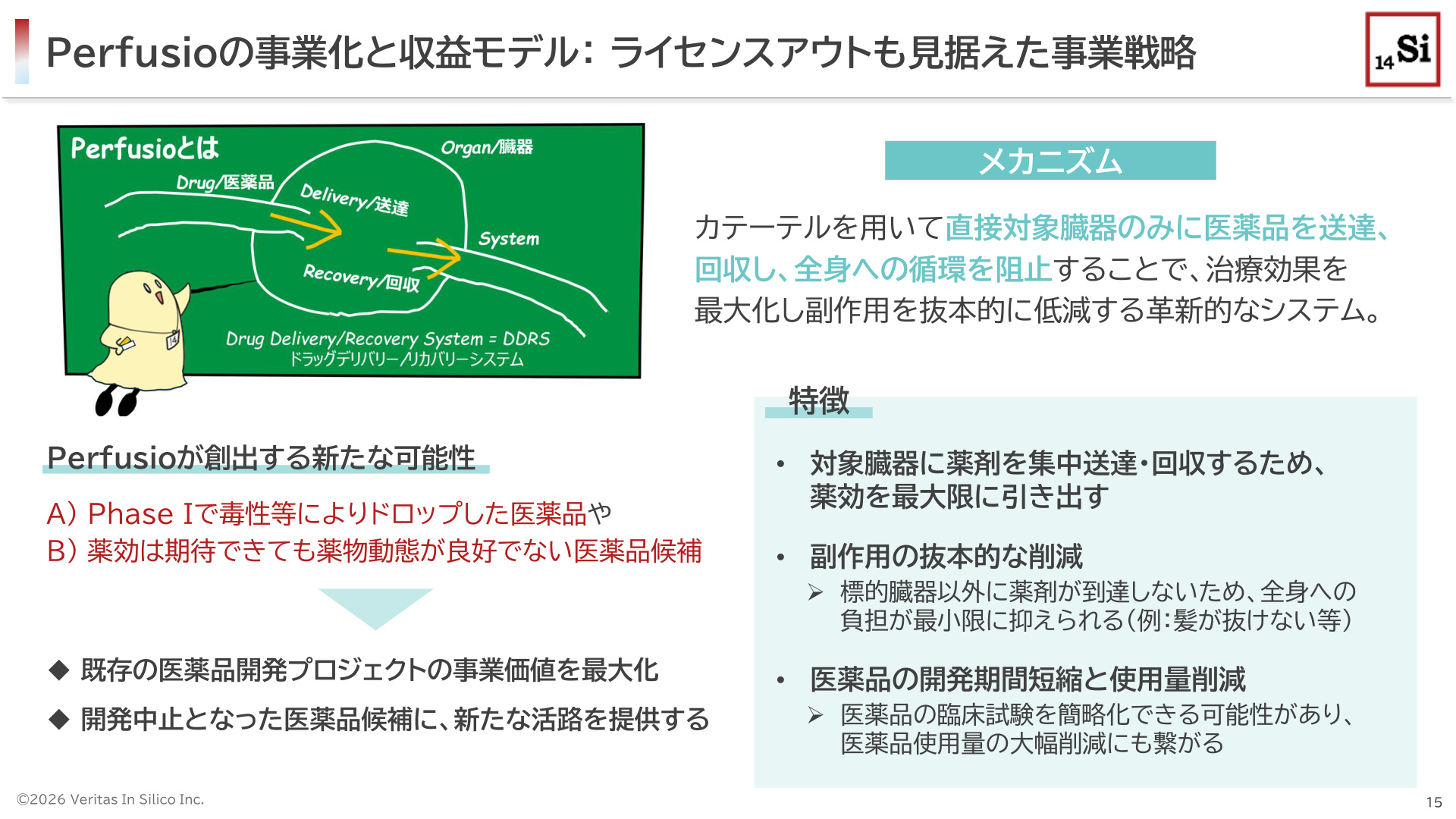
Perfusio Mechanism and Business Value
Perfusio is a Drug Delivery/Recovery System (DDRS) that uses a catheter to deliver drugs directly to the target organ and recover them , preventing systemic circulation.
- Dramatic Reduction in Side Effects : Because the drug does not circulate throughout the body, side effects such as hair loss and severe toxicity are drastically reduced.
- New Life for Dropped/Discontinued Drugs : By applying Perfusio to drugs that were previously discontinued in Phase I due to toxicity or poor pharmacokinetics, the company can resolve drug lag and maximize the business value of existing projects .
Clear Roadmap for Commercialization
- August 28, 2026 : Conducted pre-development consultation with the Pharmaceuticals and Medical Devices Agency ( PMDA ) to confirm evaluation criteria for approval applications.
- 2026–2027 : PMDA application and selection/contracting of partner companies.
- Within FY2027 : Target for launching the device .
- 2028 and beyond : Full-scale application to the company's own nucleic acid drug clinical trials.
Beyond licensing out Perfusio itself, the system is expected to contribute to the company's growth by dramatically increasing the success probability of its own nucleic acid drugs.
6. Strengthening R&D Infrastructure: Full Operation of the New "Kawasaki Laboratory"
To support business expansion, the company completed the relocation and expansion of the Kawasaki Laboratory on April 1, 2026, which is now in full operation.
- Laboratory space expanded approximately 4x (approx. 275㎡) (office space expanded approx. 1.5x).
- Capital Investment : 82 million JPY in facilities and 22 million JPY in research equipment (total 104 million JPY).
- Objective : Optimize cleanliness, workflow, and equipment layout for RNA research, while enhancing computing power, AI, and digital transformation (DX). The environment is now set to efficiently promote applied research, such as mRNA-targeted small-molecule agrochemicals.
7. Financial Soundness and Mid-to-Long-Term Growth Vision (2030 Roadmap)
Balance Sheet (BS) and Cash Flow
As of the end of June 2026, current assets stood at 1,497 million JPY, with 1,430 million JPY in cash and deposits (430 million JPY in cash and cash equivalents). Total assets are 1,519 million JPY, net assets are 1,397 million JPY, and the equity ratio is 92.0% , maintaining extremely high financial safety and soundness. While operating cash flow for the half-year was -282 million JPY, the company has sufficient liquidity through the withdrawal of time deposits.
Full-Year Forecast and Mid-Term KPIs
- FY2026 Full-Year Forecast : Operating revenue of 113 million JPY , operating expenses of 682 million JPY , and a net loss of -567 million JPY .
- Mid-Term Management Plan Annual KPIs : 2 new contracts/year , 1 new pipeline creation/year .
VIS has a clear growth track: evolving from early revenue via its drug discovery platform (startup era), through a hybrid era where the value of its internal pipeline is reflected in its stock valuation, and finally into a "sustainable specialty pharma" (2030 vision) equipped with both R&D and sales functions.
This content is not intended as investment advice or a recommendation. Any opinions expressed are solely the personal views of each article.