


Unicharm Q2 FY2026 Earnings Analysis: Achieving Revenue and Profit Growth, Upward Revision of Full-Year Sales, and Enhanced Shareholder Returns with a Total Payout Ratio of 65%+

StockClub
Published: Aug 05, 2026, 10:26 AM
Sentiment Analysis
Unicharm Q2 FY2026 Earnings Analysis: Achieving Revenue and Profit Growth, Upward Revision of Full-Year Sales, and Enhanced Shareholder Returns with a Total Payout Ratio of 65%+
Unicharm Corporation’s financial results for the second quarter of the fiscal year ending December 31, 2026 (January 1 to June 30), demonstrate significant growth in both consolidated net sales and core operating income year-on-year . Despite a challenging environment marked by geopolitical uncertainty in the Middle East and persistent cost pressures from logistics and labor, the company successfully leveraged rapid supply chain optimization and structural reforms. Furthermore, the company has significantly strengthened its shareholder return stance, announcing an upward revision to its full-year sales forecast and a new capital policy under its mid-term management plan, which raises the total payout ratio to 65% or higher .
This report provides an in-depth analysis of the company’s performance, profitability improvement structure, segment and regional details, and future growth and shareholder return strategies, centered on 10 key topics derived from the earnings materials.
1. H1 Performance Highlights: Revenue Growth and Margin Expansion
For the first half of FY2026 (January–June), consolidated net sales reached ¥487.1 billion (+4.9% YoY) , and core operating income stood at ¥65.0 billion (+14.1% YoY) . The core operating margin improved by 1.0 percentage point to 13.3% , up from 12.3% in the same period last year, indicating that profit growth is outpacing top-line expansion.
While profit before tax grew steadily to ¥66.6 billion (+6.6% YoY) , profit attributable to owners of the parent saw a slight decline to ¥41.0 billion (-1.9% YoY) . This dip is not due to operational weakness but rather temporary factors, such as the reversal of tax effects related to insurance income recorded in the previous year . Core operating income and EBITDA (¥89.9 billion, +4.4% YoY), which reflect the company’s underlying earning power, remain on a very solid trajectory.
2. Quarterly Performance Trends: V-Shaped Recovery and Record-High Q2 Sales
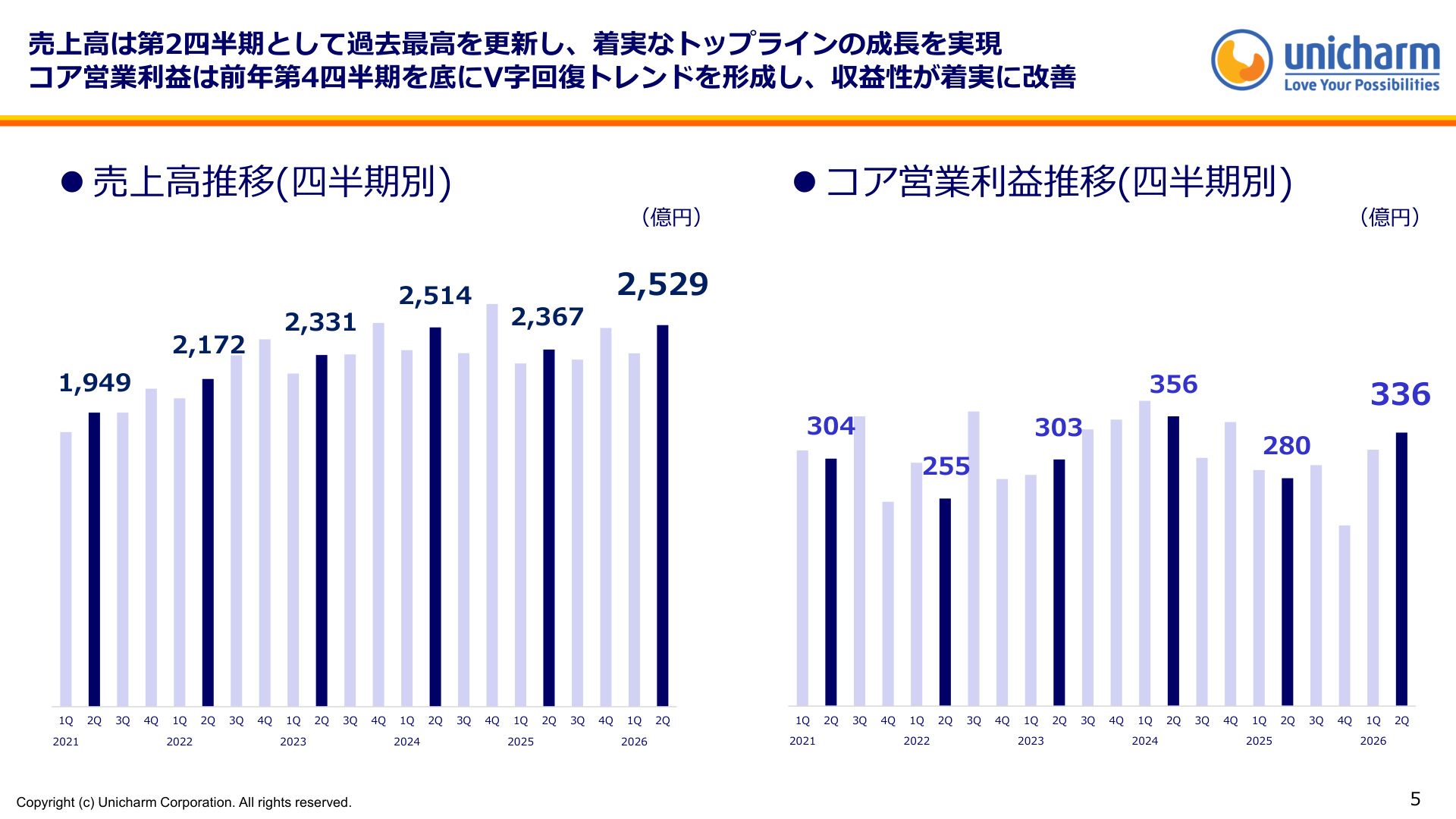
Quarterly trends clearly illustrate the success of the company’s structural reforms and price pass-through strategies. Since bottoming out in Q4 of the previous fiscal year (FY2025), core operating income has followed a robust V-shaped recovery trend .
[Slide Commentary: Quarterly Performance Trends (Page 4)]
This slide provides visual evidence that the company has moved past its worst period and is now on a recovery track. The net sales chart (left) shows that Q2 2026 sales reached ¥252.9 billion , marking a record high for a second quarter . The core operating income chart (right) confirms a steady climb from the Q4 2025 trough to ¥28.0 billion in Q1 2026 and ¥33.6 billion in Q2 2026. This demonstrates that effective price pass-through (value-based pricing) and the introduction of high-value-added products are directly contributing to the restoration of quarterly profitability.
3. Analysis of Core Operating Income: Gross Margin Improvement Outpacing Cost Increases
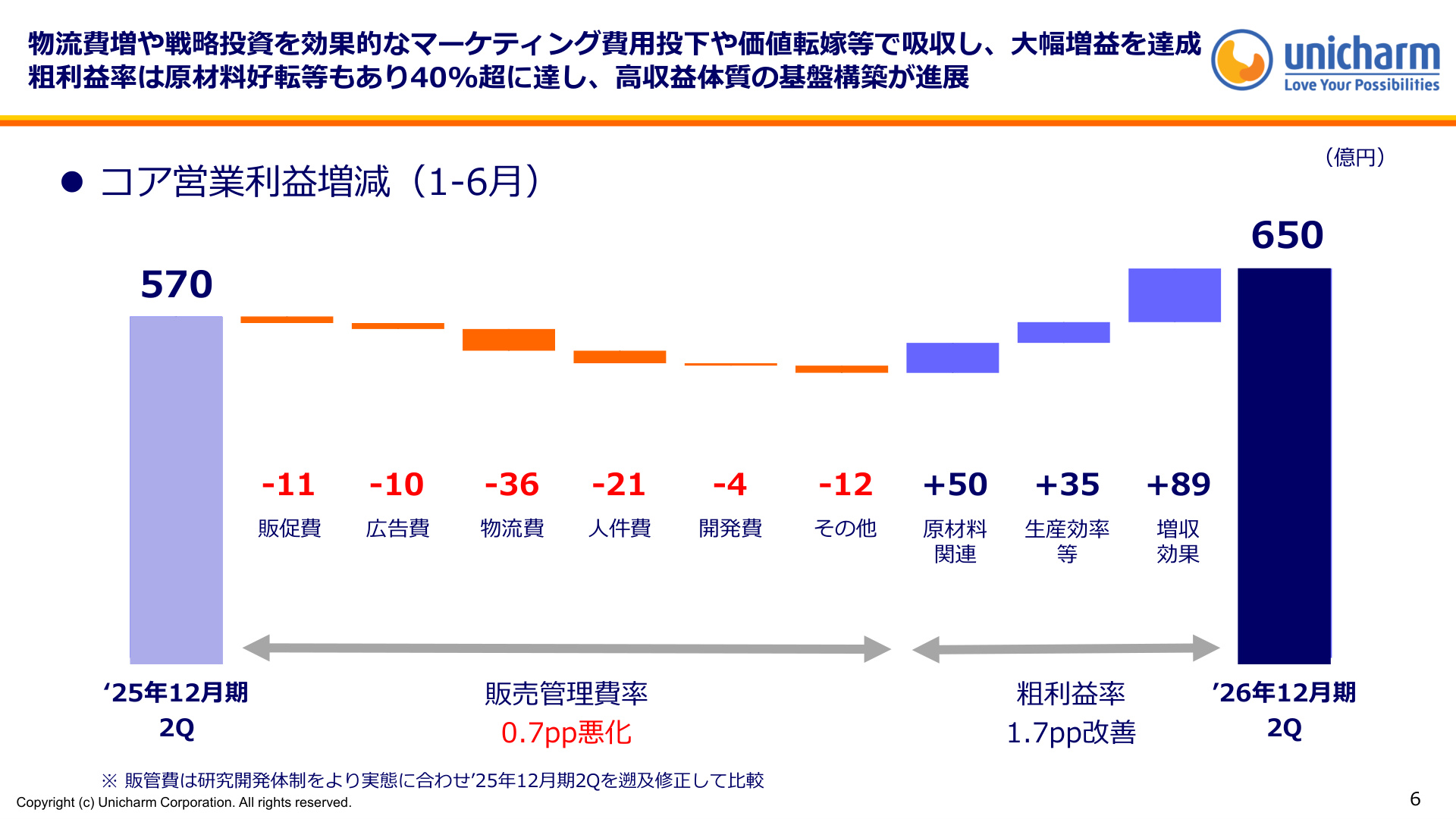
The detailed analysis of the ¥8.0 billion increase in core operating income highlights the company’s commitment to building a high-profit structure.
[Slide Commentary: Core Operating Income Variance (Page 5)]
This waterfall chart details the contrast between profit-eroding and profit-improving factors. On the SG&A side, global inflation and rising labor costs led to a 0.7-point deterioration in the SG&A ratio , driven by ¥3.6 billion in logistics costs , ¥2.1 billion in labor costs , and ¥2.1 billion in promotional and advertising expenses . However, this was more than offset by a 1.7-point improvement in the gross profit margin . Specifically, favorable raw material prices contributed +¥5.0 billion , production efficiency initiatives added +¥3.5 billion , and sales growth contributed +¥8.9 billion . The company has established a structure that absorbs cost increases through value-based pricing and production efficiency to generate profit.
4. Regional Segment Performance: Japan and Other Regions Lead, Asia Improves
Regional trends show that strategies in each market are clearly reflected in the numbers:
- Japan Market : Net sales of ¥171.1 billion (+2.1% YoY) and core operating income of ¥355.0 billion (+6.7% YoY) . The market turned to revenue and profit growth in Q2 due to the progress of value-based pricing and the capture of pre-emptive demand. High-value-added products, particularly in Wellness Care, helped maintain a strong profit margin of 20.7% .
- Asia Market : Net sales of ¥198.8 billion (+3.4% YoY) and core operating income of ¥10.2 billion (+23.2% YoY) . Recovery in Indonesia and stable growth in Vietnam drove overall performance. In China, despite ongoing market adjustments, the company promoted high-value-added products, with the core operating margin improving from 4.3% to 5.1% .
- Other Regions (North America, Middle East, Brazil, etc.) : Rapid growth with net sales of ¥117.3 billion (+12.5% YoY) and core operating income of ¥19.1 billion (+25.1% YoY) . Strong performance in the North American pet food business and the maintenance of high market share in the Middle East and Egypt contributed to double-digit growth.
Notably, the overseas sales ratio is 65.3% , and the Asia sales ratio is 40.8% , underscoring the global market as a powerful pillar of growth.
5. Business Segment Information: Rapid Growth in Pet Care
In terms of business divisions, the surge in the Pet Care business , a key growth driver alongside the core Personal Care business, is particularly notable.
- Personal Care Business : Net sales of ¥396.8 billion (+4.0% YoY) and core operating income of ¥48.0 billion (+10.7% YoY) . The profit margin rose to 12.1%, driven by high-value-added products in adult incontinence care (Wellness Care) and feminine care.
- Pet Care Business : Net sales of ¥82.9 billion (+9.6% YoY) and core operating income of ¥15.7 billion (+21.6% YoY) . The core operating margin reached an exceptionally high 19.0% (up from 17.1% in the same period last year), capturing expanding demand in North America and Asia, primarily in the food business.
6. Upward Revision of Full-Year Forecast and H2 Priorities
Based on the strong performance through the first half, the company has upwardly revised its full-year consolidated sales forecast for FY2026.
- Net Sales : Revised upward by ¥5 billion to ¥1,015 billion (+7.4% YoY) from the initial forecast of ¥1,010 billion.
- Core Operating Income : Maintained at ¥113 billion (+3.8% YoY, 11.1% margin) .
- Profit Attributable to Owners of Parent : Planned at ¥70 billion (+7.3% YoY) .
In the second half, while concerns remain regarding sharp increases in logistics and raw material costs, the company plans to gradually absorb these through the full-scale penetration of value-based pricing starting in July, improved product mix toward high-value-added items, and production efficiency, aiming to build a foundation for significant profit improvement in the next fiscal year.
7. Capital Policy Overhaul and Proactive Shareholder Returns: Total Payout Ratio of 65%+
One of the most significant topics in this earnings report is the major overhaul of the company’s capital policy .
[Slide Commentary: Shareholder Returns and Total Payout Ratio (Page 16)]
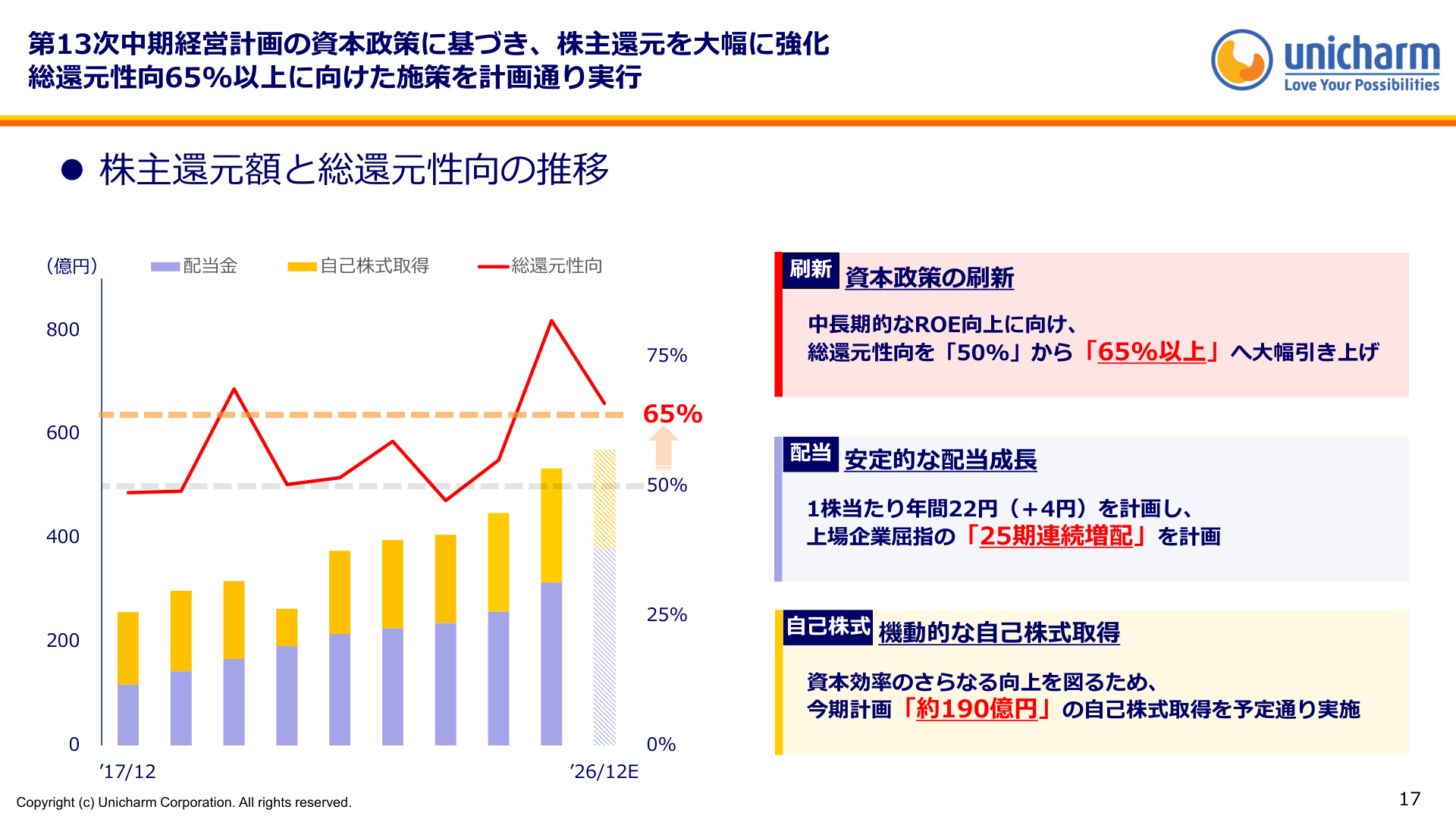
This slide indicates that the company’s approach to shareholder returns has entered a new stage. Based on the capital policy of the 13th Mid-Term Management Plan, the company has significantly raised its total payout ratio target from 50% to 65% or higher .
Specific measures include an annual dividend of ¥22 per share , an increase of ¥4 from the previous year, continuing a track record of 25 consecutive years of dividend increases , one of the best among listed companies. Furthermore, to improve capital efficiency (ROE), the company completed the repurchase of approximately ¥19.0 billion (19.41 million shares) of its own stock by April, as planned. This clearly demonstrates a commitment to balancing sustainable business growth with strong shareholder returns.
8. Global Growth Strategy: Expansion of Wellness Care and Pet Care
As mid-to-long-term growth engines, the company is accelerating the global expansion of Wellness Care (adult incontinence care) and Pet Care .
In Asian regions such as Thailand, Taiwan, and China, the company is promoting the Japanese success model of "ADL (Activities of Daily Living)-based care" and specialized products. To meet regional procurement and manufacturing needs, the company is actively utilizing strategic OEM/ODM partnerships alongside its own factories to increase deployment speed. In the pet care sector, in addition to the strong food business in North America, the company is leveraging local foundations such as "JIA PETS" in China and "Nutrire" in Brazil to expand market share in Asia and South America.
9. Region-Specific Product Development and Digital Marketing (DX)
To penetrate emerging markets, the company is deploying unique localization strategies:
- Infection and Hygiene Products : Launched the world’s first mosquito-repellent diapers (MamyPoko ANTIMOS) and wet wipes in Asia to combat dengue fever.
- Lifestyle-Adapted Products : Introduced products tailored to local needs, such as olive oil-infused diapers (Vietnam/Middle East), activated carbon-infused napkins (Thailand), and short-type napkins (China).
- Strengthening Digital Touchpoints : Enhanced digital marketing in Thailand, Indonesia, and other regions by utilizing TikTok streamers and LINE OpenChat to expand engagement with younger demographics.
10. Steady Execution of Mid-to-Long-Term ESG Goals: "Kyo-sei Life Vision 2035"
Beyond business growth, the company is committed to its mid-to-long-term ESG goals, " Kyo-sei Life Vision 2035 ," aimed at realizing a sustainable society.
Under the three pillars of "Protecting and Supporting Our Health," "Protecting and Supporting Social Health," and "Protecting and Supporting Earth’s Health," the company is advancing initiatives such as the social implementation of the "ReFF" used disposable diaper recycling business (expanding partnerships with local governments), as well as reductions in CO2 emissions and plastic usage. By viewing the resolution of environmental and social issues as inseparable from business opportunity creation, the company aims to maximize corporate value over the mid-to-long term.
Conclusion
Unicharm’s Q2 FY2026 earnings report is exceptionally strong, demonstrating a V-shaped recovery in quarterly performance driven by successful value-based pricing and the establishment of high-value-added products to overcome high costs. In addition to the upward revision of full-year sales, the company has further strengthened its stance toward investors by raising the total payout ratio to 65% or higher and planning for 25 consecutive years of dividend increases . Through the strengthening of profit foundations in both Japan and overseas and the continuation of growth investments, the company’s story of sustainable growth is progressing steadily.
This content is not intended as investment advice or a recommendation. Any opinions expressed are solely the personal views of each article.