


Omron FY2026 Q1 Earnings Deep Dive: Structural Analysis of the Industrial Automation Business's V-Shaped Recovery and Upward Revision Driven by AI Demand

StockClub
Published: Aug 05, 2026, 10:17 AM
Sentiment Analysis

Omron Corporation's financial results for the first quarter (April–June) of fiscal year 2026 show a significant year-on-year increase in both revenue and profit , driven primarily by its core Industrial Automation Business (IAB) . Consequently, the company has upwardly revised its full-year earnings forecast (revenue, operating profit, and net profit). This report provides a detailed analysis of the company's current performance, segment-specific status, and mid-to-long-term growth story, centered on 10 key topics derived from the earnings materials.
1. Overview of FY2026 Q1 Results and Changes in Accounting Standards
Omron has voluntarily adopted International Financial Reporting Standards (IFRS) starting in FY2026 , and comparative figures for FY2025 have been recalculated accordingly. The consolidated results for the first quarter showed substantial growth compared to the same period last year:
- Revenue : 209.9 billion yen ( +26.1% YoY)
- Gross Profit : 97.5 billion yen ( +28.8% YoY, Gross Margin 46.5%)
- Operating Profit : 18.9 billion yen ( +226.0% YoY, Operating Margin 9.0%)
- Net Profit Attributable to Owners of the Parent : 10.6 billion yen ( +131.1% YoY)
Operating profit increased by 13.1 billion yen , rising from 5.8 billion yen in the same period last year to 18.9 billion yen. The primary drivers were an increase in gross profit (+13.2 billion yen) due to revenue growth in the IAB segment and favorable foreign exchange impacts (+4.0 billion yen) . The company achieved significant profit growth while absorbing growth investments, such as increased fixed costs including personnel expenses (-4.9 billion yen) and expanded R&D expenditures (-1.8 billion yen).
2. Upward Revision of Full-Year Forecast: Targeting 80 billion yen in Operating Profit
Based on the strong progress in the first quarter and the current business environment, the company has increased its full-year forecast:
- Full-Year Revenue : 880 billion yen (+7.3% vs. initial plan, +14.6% YoY)
- Full-Year Operating Profit : 80 billion yen (+29.0% vs. initial plan, +41.7% YoY, Operating Margin 9.1%)
- Net Profit : 40.5 billion yen (+47.3% vs. initial plan, +82.1% YoY)
- ROIC : Approx. 5.5% (Up from the initial plan of approx. 4.0%)
- ROE : Approx. 7.0% (Up from the initial plan of approx. 5.5%)
The main driver for the full-year operating profit increase (+18.0 billion yen vs. initial plan) is revenue growth in the Industrial Automation Business (IAB) exceeding initial expectations . The assumed exchange rates for the second quarter and beyond have also been revised to reflect current market conditions: 155.0 yen per USD, 180.0 yen per EUR, and 23.0 yen per CNY.
3. Dramatic Demand Recovery and Order Trends in the Core IAB Segment
The Industrial Automation Business (IAB) is the primary driver of the company's overall performance. In Q1, IAB revenue reached 131.2 billion yen ( +37.2% YoY), and operating profit doubled to 21.3 billion yen ( +100.8% YoY). The full-year IAB revenue forecast has been significantly raised to 500 billion yen (+13.6% vs. initial plan), with operating profit at 65 billion yen (+47.7% vs. initial plan).
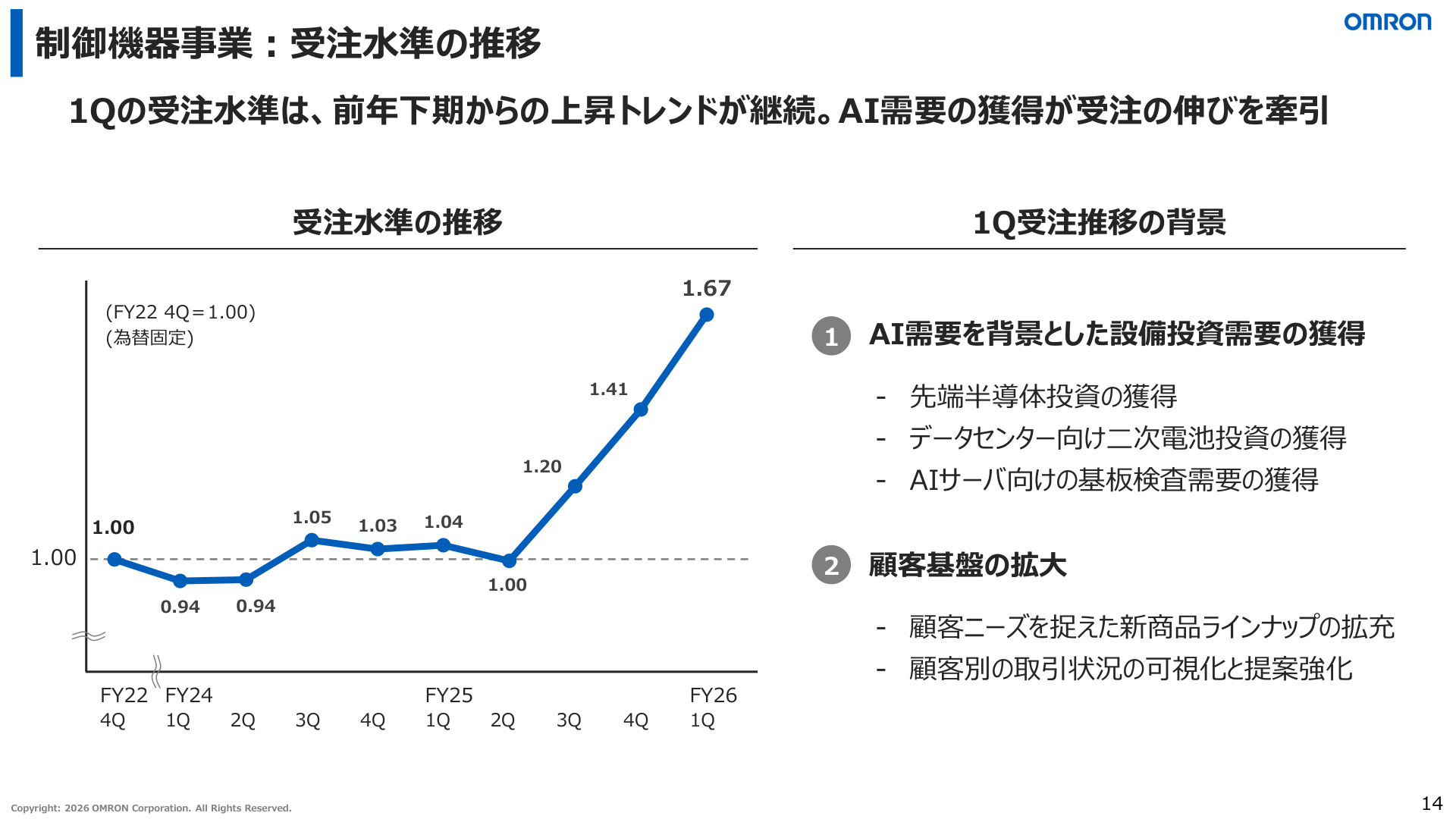
This is underpinned by a bottoming out and a sharp upward trend in order levels within the business.
Significance and Data Background of the Slide (Order Level Trends)
The slide above provides critical data showing the quarterly order level trends in the IAB segment (indexed to FY22 Q4 = 1.00, fixed exchange rates) . While demand adjustment continued from FY23 through FY24, it shifted to a clear upward trend starting in the second half of FY25 , showing a vertical takeoff to a high level of "1.67" in FY26 Q1 .
Two main factors contributed to this rapid expansion in orders:
- Capturing Capital Investment Demand Driven by AI : Successfully securing demand for advanced semiconductor investments, secondary battery investments for data centers, and board inspection needs for AI servers.
- Expansion of Customer Base : Results from the expansion of new product lineups that meet customer needs and the strengthening of proposal capabilities based on the visualization of transaction status by customer.
This indicates that the surge in orders is not merely a market recovery, but a direct result of the sophisticated customer approach the company has been focusing on.
4. Target Industries and High-Value-Added Products Driving Growth
A detailed look at the growth breakdown of the IAB segment reveals that specific focus industries and product groups have shown outstanding growth.
Explanation of the Slide (Industries and Products Driving Growth)
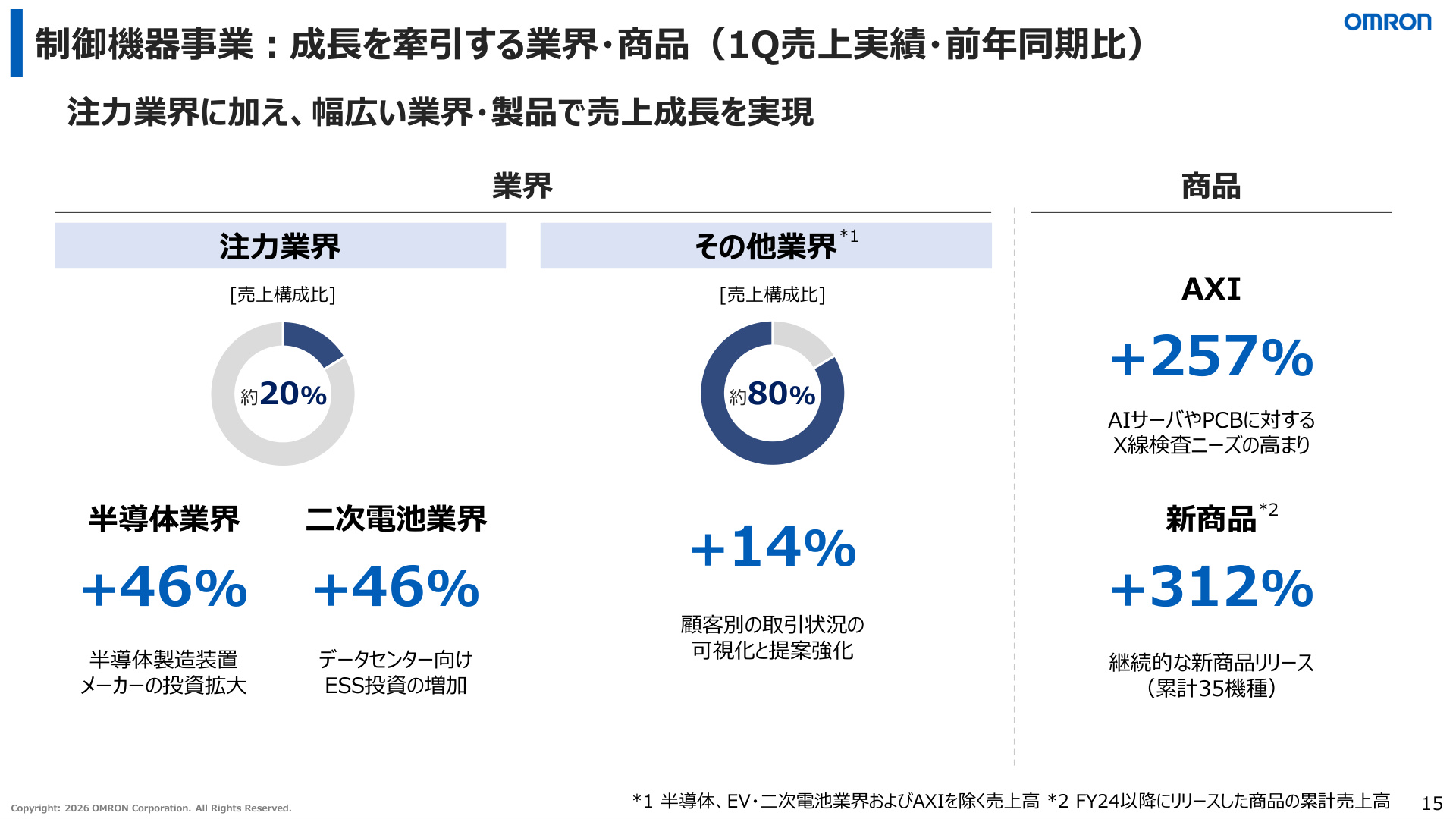
This slide clearly illustrates the "qualitative change" in revenue and where the "engines of growth" lie. Revenue from the semiconductor industry , a focus area (accounting for approximately 20% of total company revenue), grew by 46% YoY , and revenue from the secondary battery industry also grew by 46% YoY . Even more noteworthy is the growth rate of high-value-added products shown on the right:
- AXI (Automated X-ray Inspection Systems) : +257% YoY (Surging inspection needs for AI servers and PCBs)
- New Product Groups (Released since FY24) : +312% YoY (Results from the launch of 35 cumulative models)
Furthermore, in "Other Industries" (accounting for approximately 80% of the revenue mix), the company secured 14% YoY growth , confirming a broad recovery across the customer base. The increasing sales ratio of high-margin equipment and devices in advanced fields creates a virtuous cycle that improves the product mix (gross margin) of the entire business.
In the semiconductor field, the company's solutions, which leverage its unique integrated control technology and software development capabilities , are highly regarded by customers, ranging from front-end processes (work temperature uniform control, ultra-precision stage control, etc.) to back-end processes (nano-level high-precision motion control, 3D-X-ray inspection, etc.).
5. Overview of Business Segments and Environmental Awareness
Segments other than IAB are also showing steady progress, generally in line with initial expectations.
-
Healthcare Business (HCB)
- Q1 Results : Revenue 36.4 billion yen (+16.7% YoY), Operating Profit 2.4 billion yen (+101.7% YoY)
- Full-Year Forecast : Revenue 155 billion yen, Operating Profit 15.5 billion yen (Upward revision)
- Background : Global demand for blood pressure monitors remains steady. Despite the impact of sluggish personal consumption in the Chinese market, growth is maintained through the introduction of AI-enabled high-value-added blood pressure monitors and new products.
-
Social Systems Business (SSB)
- Q1 Results : Revenue 24.2 billion yen (-2.0% YoY), Operating Profit 0.1 billion yen (-62.5% YoY)
- Full-Year Forecast : Revenue 148 billion yen (Downward revision), Operating Profit 19.5 billion yen (Downward revision)
- Background : The competitive environment has intensified due to price offensives by rival manufacturers in the residential renewable energy and energy storage system market. Meanwhile, capital investment demand from railway companies remains steady.
-
Data Solutions Business (DSB / JMDC)
- Q1 Results : Revenue 13.1 billion yen (+22.8% YoY), Operating Profit 0.3 billion yen (Turned profitable from -0.1 billion yen in the same period last year). Of this, JMDC revenue was 12.6 billion yen (+17.5%) , and operating profit was 1.8 billion yen (+17.5%).
- Full-Year Forecast : Revenue 62 billion yen, Operating Profit 5 billion yen (Plan maintained)
- Background : The movement toward medical data utilization is steady among pharmaceutical and insurance industries. Service demand is expanding in line with rising health awareness.
6. Timeline for the Mid-to-Long-Term Growth Strategy "GEMBA DX"
The core of the growth story in the company's long-term vision, "Shaping the Future 2030 (SF2030)," is the realization of "GEMBA DX" (utilizing on-site data).
Strategic Shift Indicated by the Slide (Timeline for Realizing GEMBA DX)
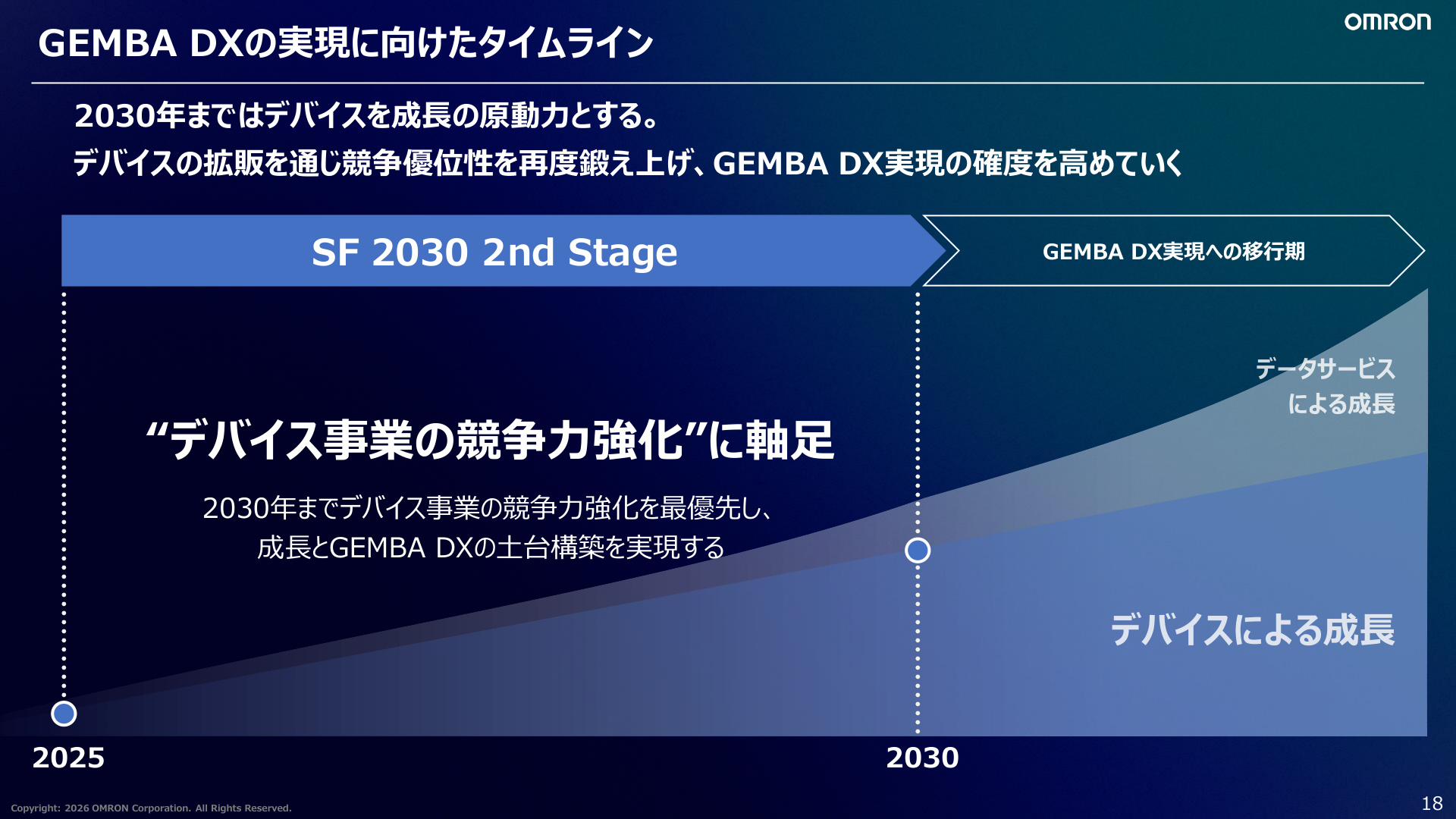
This slide is a mid-to-long-term strategic roadmap showing how Omron will increase its business value. A key point here is the clear stance that "priority will be placed on strengthening the competitiveness of the device business until 2030."
Rather than rushing into software or data services, the company will first rebuild and expand the overwhelming competitive advantage of its hardware (devices) , such as control equipment and sensors. It outlines a realistic and robust story of transitioning in stages to "growth through data services (GEMBA DX)" after 2030, based on high-quality on-site data obtained from that solid device foundation.
As a concrete initiative to support this strategy, the company is promoting the expansion of its global customer base by combining product development (VALUE) with the strengthening of sales channels and digital marketing (FRONT).
7. Financial Position and Cash Flow Status
In line with the recovery in performance, financial indicators and cash flow are also showing very healthy trends.
- Assets/Capital : Total assets as of the end of June 2026 were 1.3841 trillion yen. The equity ratio is 60.1% , maintaining a solid financial foundation.
- Operating Cash Flow : Generated 64 billion yen in the first quarter (+47.5 billion yen YoY). The recovery in cash-generating ability due to revenue expansion and improved profit margins is significant.
- Free Cash Flow (FCF) : Even after deducting capital expenditures (12.6 billion yen), there was a surplus of 33.7 billion yen (compared to 0.3 billion yen in the same period last year), and funds for future growth investments and shareholder returns are accumulating steadily.
8. Summary of Future Key Points
The key takeaways from this FY2026 Q1 earnings report are as follows:
- Rapid Earnings Recovery and Upward Revision : The V-shaped recovery of IAB (Industrial Automation) boosted overall company performance, leading to an upward revision of the full-year operating profit plan to 80 billion yen.
- Spillover of AI/Semiconductor Trends : Successfully converting global growth trends—such as generative AI-related demand, advanced semiconductors, and secondary batteries for data centers—into orders.
- Improvement in Product Mix : Achieving high profitability through a surge in high-value-added products such as AXI and new product releases.
- Clear Roadmap : Clarification of the phased growth axis toward 2030, moving from "device strengthening" to "GEMBA DX."
Going forward, the focus will be on how long the capital investment demand related to semiconductors and AI will persist, as well as profitability control in the intensifying residential renewable energy market (SSB).
This content is not intended as investment advice or a recommendation. Any opinions expressed are solely the personal views of each article.