


Ahresty Corporation FY2026 Q1 Earnings Deep Dive: Plunging into Red Amidst Soaring Metal Prices and Weak Market Demand; Structural Reforms Set Stage for H2 Recovery

StockClub
Published: Aug 05, 2026, 10:14 AM
Sentiment Analysis
Ahresty Corporation (Securities Code: 5852) faced a challenging start to fiscal year 2026, with its Q1 earnings report revealing a significant decline in profits and a slide into the red compared to the same period last year. While the company benefited from a weaker yen, these gains were overshadowed by sluggish sales among key customers in its core Die Casting business and the sharp rise in aluminum ingot prices. Additionally, the bottom line was further impacted by one-time costs, including special retirement payments associated with structural reforms aimed at adapting to changing market conditions in China.
This report provides a systematic analysis of the Q1 earnings highlights, detailed factors behind the profit and loss fluctuations across regions and business segments, and the outlook and key focus areas for the full-year performance targets.
1. FY2026 Q1 Earnings Highlights and Overview
For the first quarter of FY2026, consolidated net sales were 42,419 million yen (down 1.1% YoY), operating loss was 463 million yen (compared to an operating profit of 1,623 million yen in the same period last year), ordinary loss was 477 million yen (compared to an ordinary profit of 1,289 million yen), and net loss attributable to owners of the parent was 667 million yen (compared to a net profit of 976 million yen).
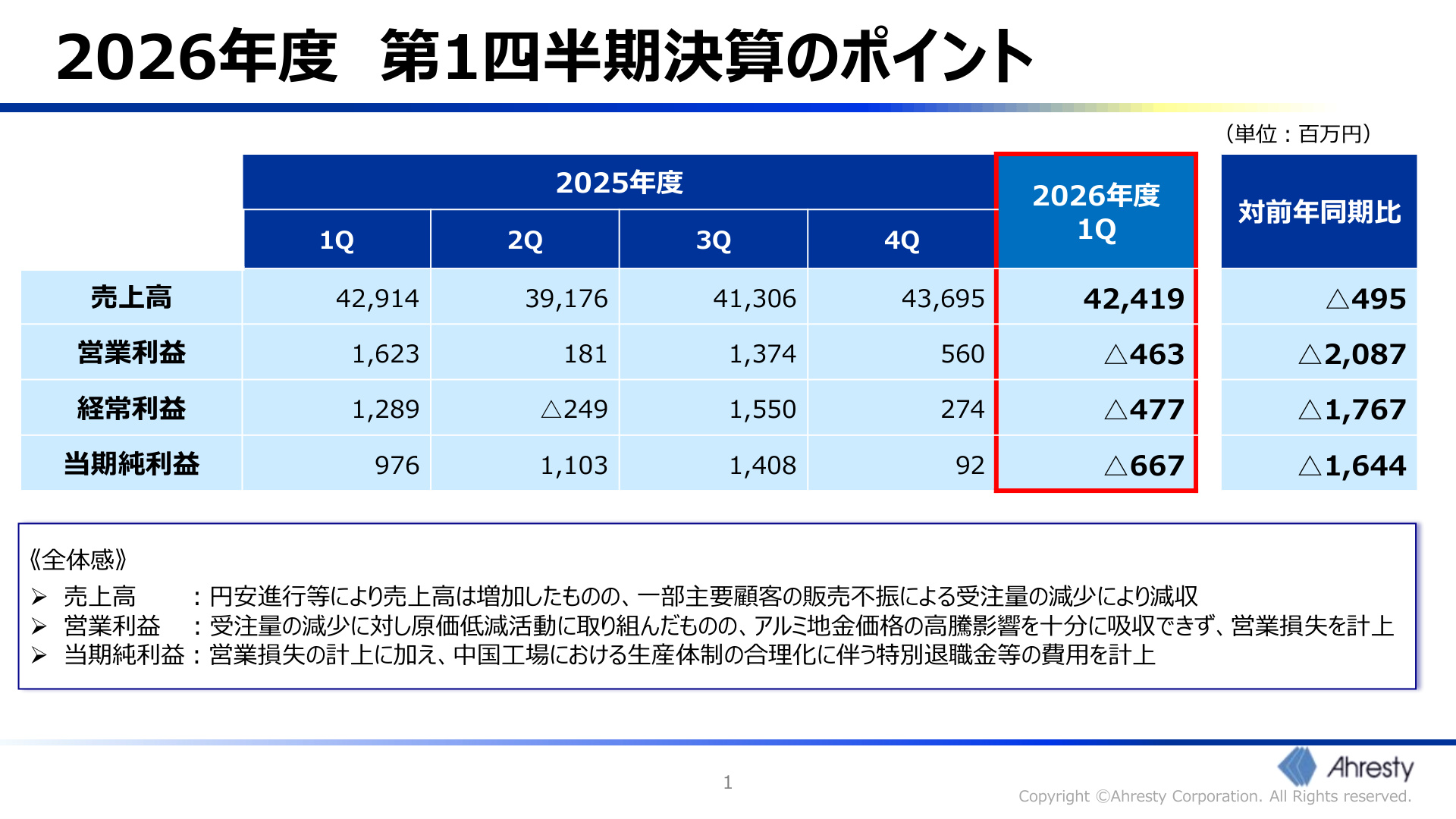
Slide Commentary (Page 1: Key Points of FY2026 Q1 Earnings)
As noted above, the company fell into a net loss across all profit tiers compared to the previous year. While the depreciation of the yen contributed positively to sales, this was offset by a decline in die casting product order volumes due to weak sales from major customers. Regarding profitability, despite rigorous cost reduction activities on the factory floor, the company could not fully absorb the soaring aluminum ingot prices driven by rising oil and energy costs, resulting in an operating loss. Furthermore, the net loss was exacerbated by the booking of extraordinary losses, including special retirement payments related to the rationalization of production systems (structural reform) at the Chinese plant to improve future profitability.
2. In-depth Segment Analysis
A closer look at Ahresty’s core Die Casting business (Japan, North America, and Asia), as well as its Aluminum and Finished Products businesses, reveals a clear divergence in performance based on regional and business environments.
(1) Die Casting Business (Japan)
Sales in the Japan segment reached 17,790 million yen (up 6.0% YoY), with a segment loss of 21 million yen (compared to a profit of 634 million yen in the same period last year). While sales volume remained at the previous year's level (largely in line with plans) and efforts in price pass-through negotiations and line efficiency yielded results, the rise in metal market prices exerted significant pressure on profits.
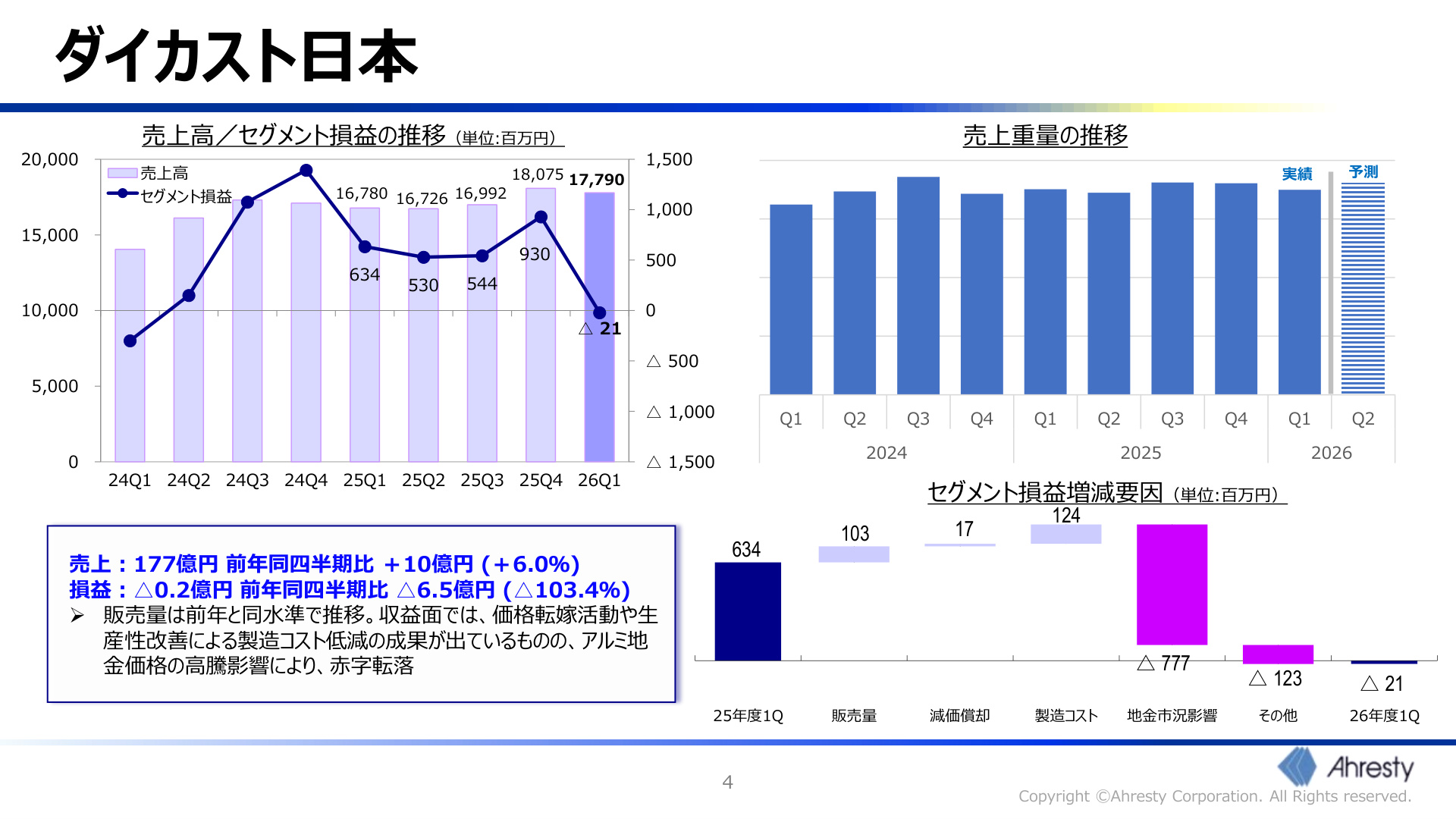
Slide Commentary (Page 4: Die Casting Japan)
As shown in the waterfall chart (profit/loss variance analysis) in the slide above, proactive cost reduction efforts on the manufacturing floor generated a 124 million yen improvement in manufacturing costs and a 103 million yen boost from sales volume . However, external factors—specifically the impact of metal market conditions—resulted in a massive 777 million yen negative impact , offsetting the improvements made on the floor and leading to a loss. The time lag in passing through metal price fluctuations and the volatility of the market directly hit the profitability of the Japanese segment.
(2) Die Casting Business (North America)
Sales in the North American segment were 13,725 million yen (down 2.9% YoY), with a segment loss of 650 million yen (compared to a profit of 633 million yen in the same period last year).
Although the U.S. plant has seen some improvement due to ongoing productivity enhancement measures, several negative factors overlapped:
- The reversal of one-time gains recorded in the previous fiscal year
- Rising labor and manufacturing costs due to inflation ( 368 million yen impact )
- The impact of soaring aluminum ingot prices ( 305 million yen impact )
- A decline in sales volume at the Mexico plant due to model changeovers and weak sales from some major customers ( 384 million yen impact ) Improving profitability in the North American region remains a critical challenge for the recovery of consolidated earnings.
(3) Die Casting Business (Asia)
Sales in the Asia segment were 8,272 million yen (down 10.4% YoY), with a segment profit of 29 million yen (down 47.3% YoY).
There is a stark contrast between countries within the Asia segment:
- India Plant : Profitability is steadily improving through the smooth launch of new orders and productivity gains, contributing to manufacturing cost reductions (+267 million yen).
- China Plant : Due to the rise of local EV manufacturers and the struggles of Japanese automakers, contract production volumes have dropped significantly (323 million yen negative impact from sales volume). This is the primary driver of the decline in sales and profit for the entire Asia segment. To address this, the company is proceeding with the rationalization of production systems and personnel optimization at the China plant to reduce fixed costs.
(4) Aluminum Business and Finished Products Business
- Aluminum Business : Sales of 2,145 million yen (up 30.7% YoY) and segment profit of 170 million yen (up 165.6% YoY). Driven by increased sales volume, higher unit prices, and cost reduction activities, the segment achieved solid growth in both sales and profit .
- Finished Products Business (Raised floors, etc.): Sales of 485 million yen (down 56.6% YoY) and segment profit of 10 million yen (down 93.9% YoY). The decline was due to a temporary drop in orders for cleanroom facilities from semiconductor-related companies, the primary customer base.
3. FY2026 Full-Year Plan and Earnings Recovery Scenario
Despite the Q1 loss caused by high metal prices and structural reform costs, Ahresty has not changed its full-year earnings forecast for FY2026. The company expects full-year sales of 161,600 million yen (down 3.3% YoY), operating profit of 1,400 million yen (down 62.6% YoY), ordinary profit of 800 million yen (down 72.1% YoY), and net profit of 500 million yen (down 86.0% YoY).
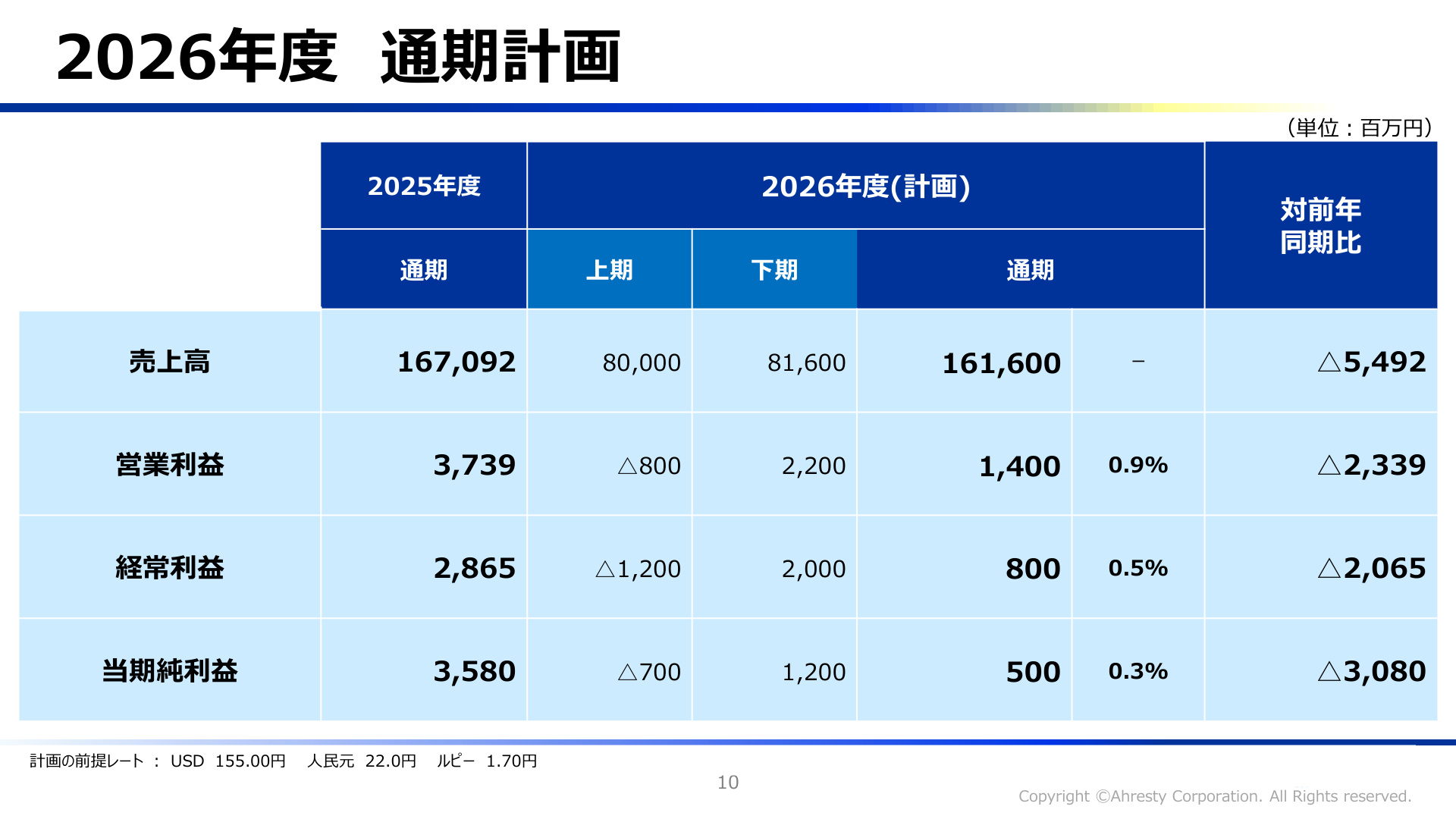
Slide Commentary (Page 10: FY2026 Full-Year Plan)
Breaking down the full-year plan into the first and second halves reveals a clear H2-weighted recovery scenario :
- H1 (Q1-Q2) Plan : Sales of 80,000 million yen, operating loss of 800 million yen , net loss of 700 million yen
- H2 (Q3-Q4) Plan : Sales of 81,600 million yen, operating profit of 2,200 million yen , net profit of 1,200 million yen
The plan assumes that by completing business rationalization in China, improving productivity in North America and Japan, and successfully passing through metal price fluctuations, the company will achieve a sharp recovery to an operating profit of 2,200 million yen in the second half . Sales volume trends from Q2 onwards are expected to follow the plan (see Page 2), making the execution of cost structure reforms and price optimization the key to achieving these targets.
4. Summary and Future Outlook
In Q1 of FY2026, Ahresty faced a temporary downturn due to the dual headwinds of soaring metal prices and declining sales volumes in China and North America. However, the following initiatives are underway:
- Decisive Cost Structure Reform : The company is front-loading negative factors, such as structural reform costs in China, to reduce fixed costs.
- Demonstrated Operational Improvement : Results in manufacturing cost reduction and productivity gains are clearly visible, particularly in Japan and India.
- Improved Metal Price Pass-through : Profitability is expected to normalize toward the second half as the pass-through of high aluminum ingot prices into product pricing progresses.
Future focus will be on the recovery of capacity utilization at the North American and Mexican plants, the fixed-cost reduction effects from the completion of structural reforms in China, and the progress of the operating profit recovery scenario for the second half.
This content is not intended as investment advice or a recommendation. Any opinions expressed are solely the personal views of each article.