

Nippon Denko FY2026 Q2 Earnings Analysis: Strategic Exit from Unprofitable Operations and Upward Revision of 'Core' Recurring Profit to ¥7.5 Billion

StockClub
Published: Aug 05, 2026, 10:13 AM
Sentiment Analysis
Nippon Denko K.K.'s FY2026 Q2 (interim) financial results highlight both critical management decisions aimed at structural reform and the robust underlying profitability of its core business segments.
This report provides a detailed analysis of 10 key topics that investors should monitor, based on the disclosed financial materials, including performance highlights , the exit from unprofitable operations , segment-specific performance , shareholder return policies , and the accelerated formulation of the next medium-term management plan .
1. FY2026 Full-Year Outlook and the 'Core' Performance Metric
Crucial to understanding Nippon Denko's performance is the dual structure of its accounting profit versus its "Core Recurring Profit." Because the company's ferroalloy business is subject to a six-to-twelve-month lag between raw material price fluctuations and their impact on the P&L, accounting profits are often distorted by "inventory effects." Furthermore, due to the occurrence of occasional one-time gains or losses, the company discloses and utilizes "Core" metrics to reflect its true earning power.
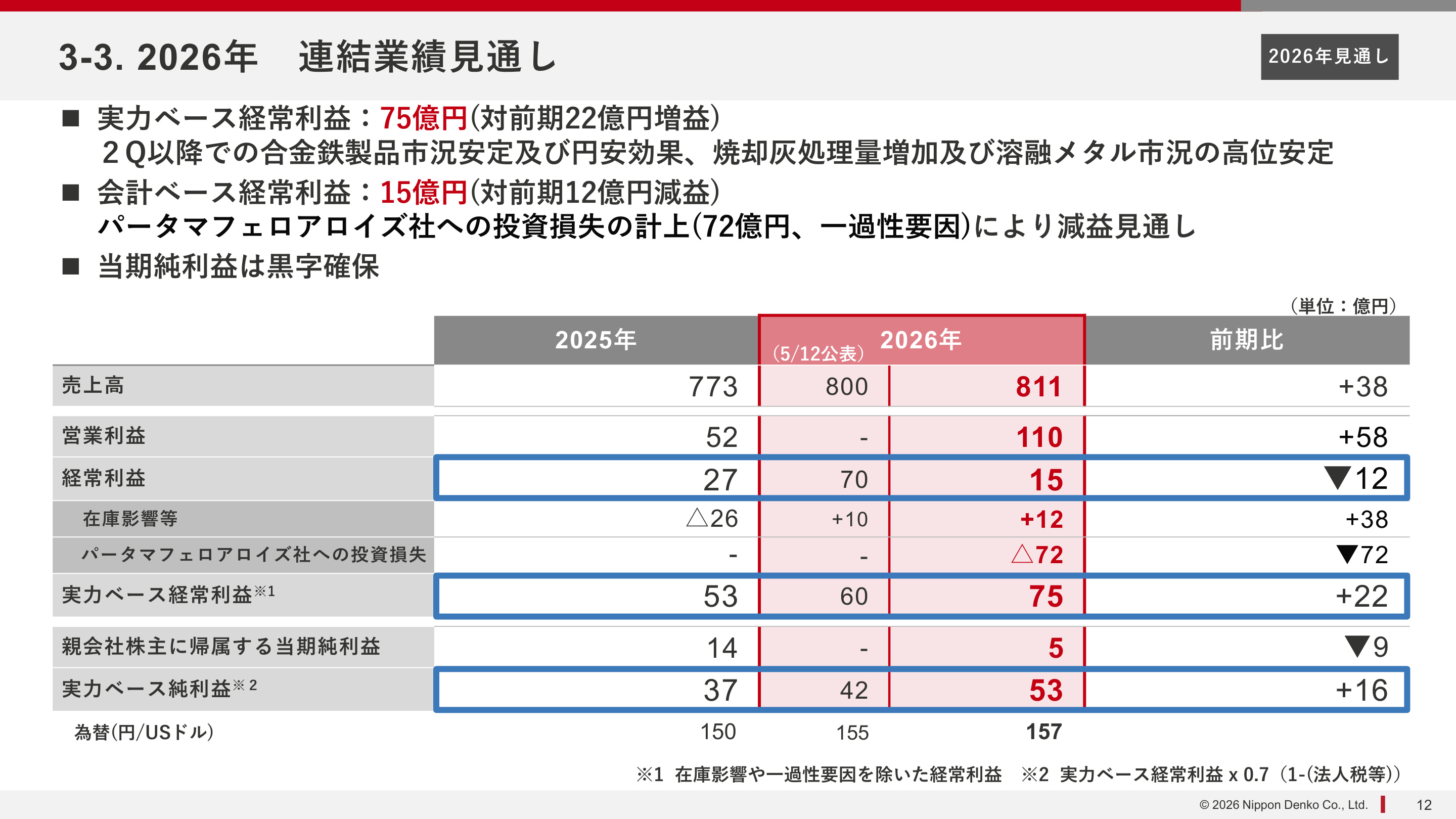
For the full fiscal year 2026, the company projects consolidated net sales of ¥81.1 billion (+¥3.8 billion YoY) and an operating profit of ¥11.0 billion (+¥5.8 billion YoY) , signaling significant growth. Conversely, accounting-based recurring profit is expected to remain at ¥1.5 billion (-¥1.2 billion YoY) , largely due to the impact of one-time investment losses discussed below.
However, excluding these one-time factors and inventory effects, "Core Recurring Profit" is projected at ¥7.5 billion (+¥2.2 billion YoY) , representing an upward revision of ¥1.5 billion from the initial forecast of ¥6.0 billion.
[Significance and Background of Slide 12 (Full-Year Consolidated Outlook)]
This slide is the most essential page, as it clearly illustrates the structural differences between accounting-based and core-based figures for the full year 2026.
As shown in the table, the accounting-based recurring profit of ¥1.5 billion is impacted by a total of -¥6.0 billion in one-time/special factors: inventory effects (+¥1.2 billion) and investment losses related to Pertama (-¥7.2 billion) . Adding these back reveals a ¥7.5 billion "Core Recurring Profit," demonstrating the company's significantly enhanced earning power. The upward revision from the initial forecast (¥6.0 billion to ¥7.5 billion) is attributed to the stabilization of ferroalloy product market conditions since Q2, the weak yen effect , and the increase in incinerated ash processing volume combined with high, stable market prices for molten metal .
2. Investment Loss and Full Exit from Malaysia's Pertama
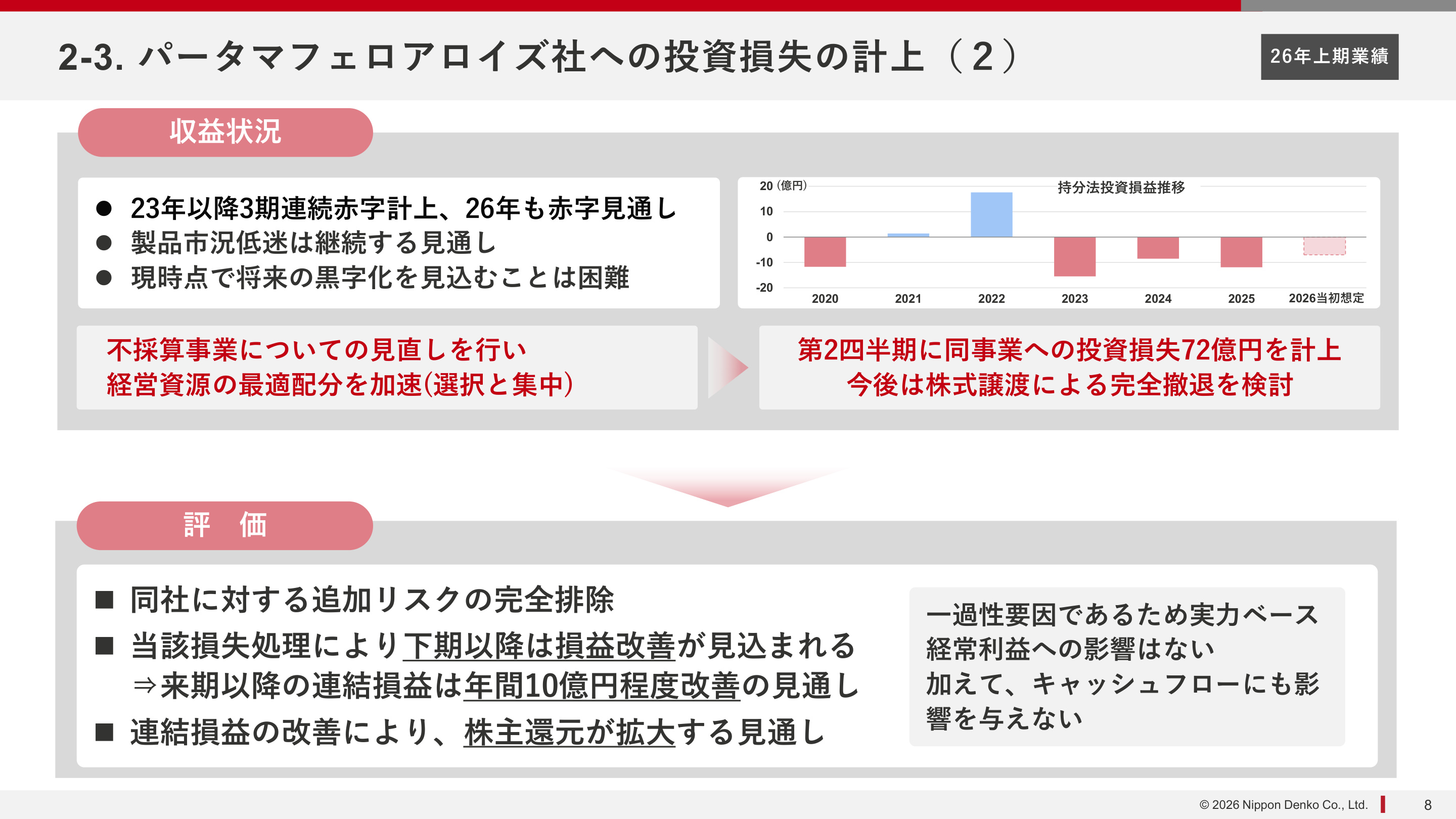
The most significant topic in these results is the one-time booking of a ¥7.2 billion investment loss related to its equity-method affiliate, Pertama Ferroalloys Sdn. Bhd. in Malaysia.
Nippon Denko invested 25% in the company in 2012, aiming to manufacture ferroalloys using low-cost, green hydroelectric power. However, with the expansion of supply from India, China, and Russia in recent years, market conditions for ferrosilicon and silicomanganese in Asia have remained chronically depressed. The venture has posted losses for three consecutive terms since 2023, with no prospect of future profitability.
Consequently, to optimize management resources (selection and concentration), the company decided to overhaul its unprofitable operations. It booked a ¥7.2 billion investment loss in Q2 and announced a policy to pursue a full exit via share transfer .
[Significance and Background of Slide 8 (Booking of Pertama Investment Loss)]
This slide clearly demonstrates that the seemingly negative event of booking a loss is a turning point that will significantly improve the company's financial and P&L structure in the medium to long term.
Key points are summarized as follows:
- Elimination of Additional Risk : By booking the impairment in one go, the risk of further losses stemming from this entity is removed.
- Improvement in Consolidated P&L : Exiting this loss-making business is expected to improve consolidated P&L by approximately ¥1.0 billion annually from the next fiscal year (2027) onwards.
- No Impact on Cash Flow : This impairment is a non-cash accounting adjustment and does not involve cash outflow, thus having no impact on the company's free cash flow or liquidity.
In short, this risk mitigation and P&L improvement represent a proactive structural reform that will lead to the expansion of future shareholder return capacity .
3. Segment Performance and Growth Drivers
A breakdown of the ¥2.2 billion increase in Core Recurring Profit by segment clarifies the environment and achievements of each business:
- Ferroalloy Business (Domestic) : Core recurring profit rose significantly to ¥2.3 billion (+¥1.1 billion YoY) . Although domestic crude steel production has been lower than expected, European ferromanganese market conditions remained stable due to the continuation of EU safeguard measures . Margins improved as raw material manganese ore prices declined, bolstered by continuous price improvement efforts and the weak yen .
- Incinerated Ash Recycling Business : Core recurring profit showed strong growth at ¥3.5 billion (+¥1.4 billion YoY) . In addition to increased processing volumes from municipal and private contracts, the high and stable market price of molten metal (a byproduct) contributed significantly. To expand the business, the company established a Kyushu sales office in April 2026 and has begun construction of Furnaces No. 5 and No. 6 (investment decision made in November 2025), aggressively expanding capacity.
- Functional Materials Business : Core recurring profit is expected to decline to ¥1.5 billion (-¥0.7 billion YoY) . While electronic component-related products (such as zirconium oxide) remain robust due to the expansion of the AI and data center markets , demand for battery materials (e.g., lithium-ion battery cathode materials) has stagnated due to the slowdown in the EV market and intensified competition. The termination of certain contract manufacturing sales in March 2026 also had an impact.
- Other Businesses : The Aqua Solution business (¥0.1 billion) and Power business (¥0.3 billion) maintain generally stable earnings.
4. Financial Position and Cash Flow
Financially, the company is making progress in improving asset efficiency to tighten its balance sheet. Efforts to reduce inventories have successfully shortened the inventory turnover period from 5.6 months in 2025 to 4.9 months .
In terms of cash flow, the company generated ¥14.4 billion in operating cash flow . Backed by this abundant cash, it executed strategic investments in growth areas such as the incinerated ash recycling business, resulting in investment cash flow expanding to -¥10.3 billion (compared to -¥5.6 billion in the previous period) . Despite funding aggressive growth investments, the company secured a free cash flow surplus of ¥4.1 billion , balancing a sound financial position with growth investment. The net D/E ratio remains at an extremely low level of 0.11 .
5. Strengthening Shareholder Returns and Dividend Increase
To mitigate the impact of earnings volatility and provide stable returns, the company has adopted a return policy based on "Core Net Income."
- Dividend Policy : Target a payout ratio of approximately 40% on a core basis , with the annual dividend floor raised from ¥10 to ¥11 .
- FY2026 Dividend Outlook : Based on a Core Recurring Profit of ¥7.5 billion, Core Net Income is calculated at ¥5.3 billion (¥7.5 billion × 70%). Accordingly, the annual dividend is planned at ¥17 per share (¥5.5 interim, ¥11.5 year-end). This is a ¥5 increase from the previous year's ¥12 and a ¥4 increase from the initial forecast of ¥13.
- Share Buybacks and Cancellation : The company executed a share buyback of approximately ¥4.0 billion (13 million shares) in 2025, and decided to cancel 12 million of those shares on August 21, 2026 . By reducing the total number of shares outstanding, the company aims to improve per-share value and capital efficiency (ROE).
6. Progress of Medium-Term Management Plan and Accelerated Formulation of the 'New Plan'
The company is currently executing the "9th Medium-Term Management Plan," which began in 2024.
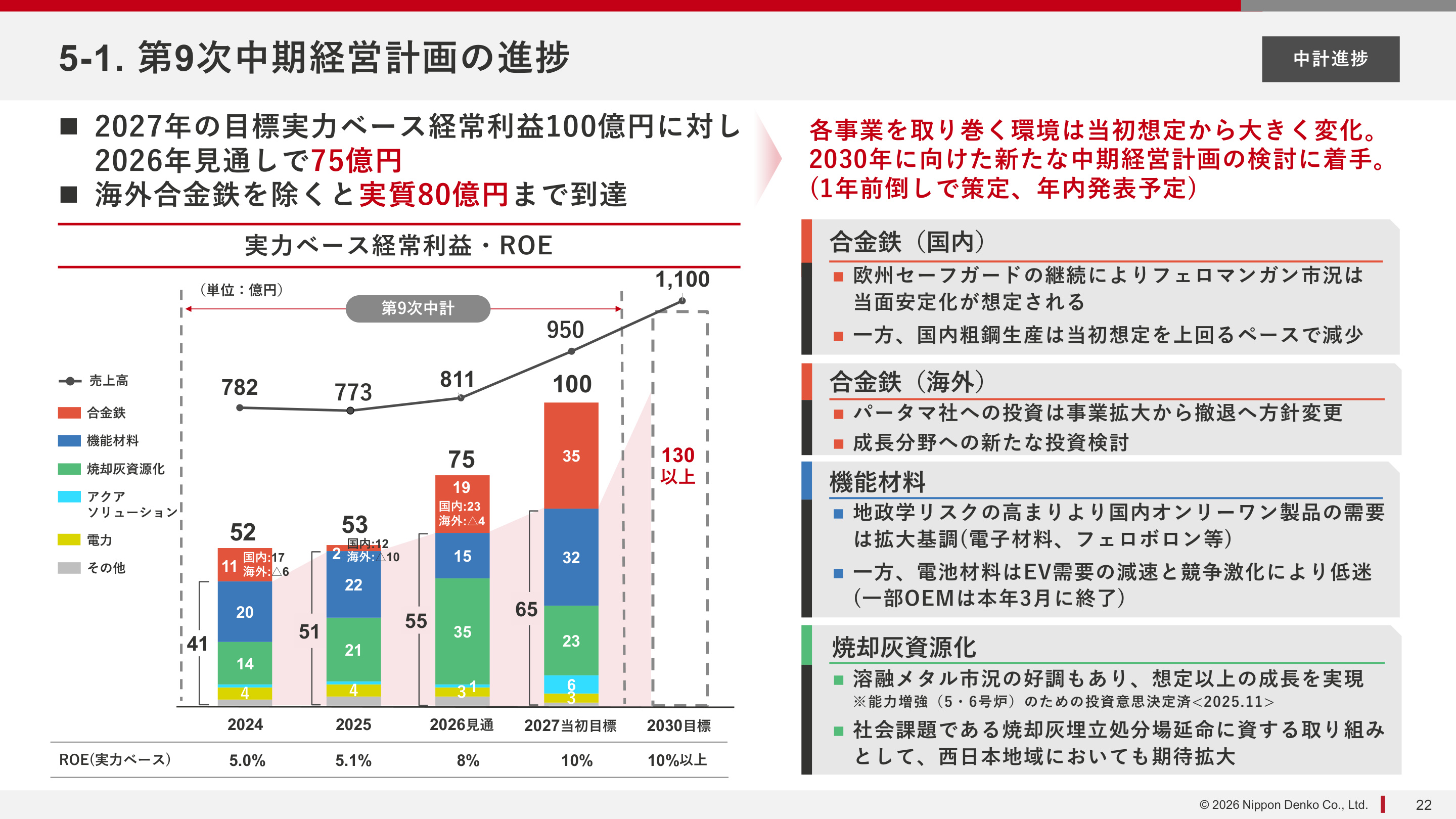
[Significance and Background of Slide 22 (Progress of the 9th Medium-Term Management Plan)]
This slide is critical as it provides a bird's-eye view of the company's past performance, future growth vision, and the turning point in management strategy.
As the graph shows, against the 2027 target of the 9th plan (¥10.0 billion in Core Recurring Profit) , the company is expected to reach ¥7.5 billion by the FY2026 forecast stage. Excluding the impact of the overseas ferroalloy business (Pertama, -¥0.4 billion), the domestic business has effectively reached the ¥8.0 billion scale , indicating steady progress.
However, not content with the status quo, the company announced that it will formulate a new medium-term management plan starting in 2027, one year ahead of schedule, and release it within this year . This is driven by the following changes in the business environment:
- Sluggish domestic crude steel production and changes in the market environment due to EU safeguards.
- Portfolio restructuring following the full exit from the unprofitable overseas business (Pertama).
- Review of the battery materials business due to the EV market slowdown, and a shift in demand toward domestic "only-one" products (electronic materials, ferroboron, etc.) due to geopolitical risks.
- Growth of the incinerated ash recycling business beyond expectations (expansion into Kyushu and construction of Furnaces No. 5 and 6) due to the deepening social issue of extending the life of ash disposal sites.
This decision to accelerate the new plan reflects the company's stance of restructuring its management strategy with speed in response to structural changes in the external environment, and steering toward its "ideal state" for 2030 .
Conclusion
Nippon Denko's FY2026 Q2 results were highly substantive, characterized by the liquidation of past issues through the loss processing of Pertama and the achievement of an upward revision to a ¥7.5 billion Core Recurring Profit and a ¥17 annual dividend .
With solid margin management in domestic ferroalloys, a focus on the high-growth, high-profit environmental business of incinerated ash recycling, and the expansion of electronic materials for AI, the earning power of each business is steadily increasing. All eyes are now on the upcoming new medium-term management plan (starting in 2027) to be announced later this year, which will reveal the company's vision for 2030.
This content is not intended as investment advice or a recommendation. Any opinions expressed are solely the personal views of each article.