


Shiseido H1 2026 Earnings Deep Dive: Structural Reform Success and the Pivot to Organic Growth in Q2

StockClub
Published: Aug 05, 2026, 10:11 AM
Sentiment Analysis
Shiseido (TSE: 4911) H1 2026 Earnings Deep Dive: Structural Reform Success and the Pivot to Organic Growth in Q2
Shiseido’s H1 2026 (January–June) financial results serve as clear evidence that the company’s multi-year global structural reforms and enterprise-wide cost management initiatives are yielding tangible results . Sales momentum shifted to organic growth in the second quarter (Q2), and core operating profit surged by 90.1% year-on-year .
This report provides an in-depth analysis of the key drivers and background behind these results, focusing on 10 essential topics that highlight the transformation of Shiseido’s growth model and management structure.
1. Overview of H1 Results and Key P&L Trends
For H1 2026, Shiseido reported consolidated net sales of ¥499.0 billion (+6.2% YoY, flat on an organic basis) and core operating profit of ¥44.4 billion (+90.1% YoY, an increase of ¥21.1 billion) , marking a significant expansion in profitability.
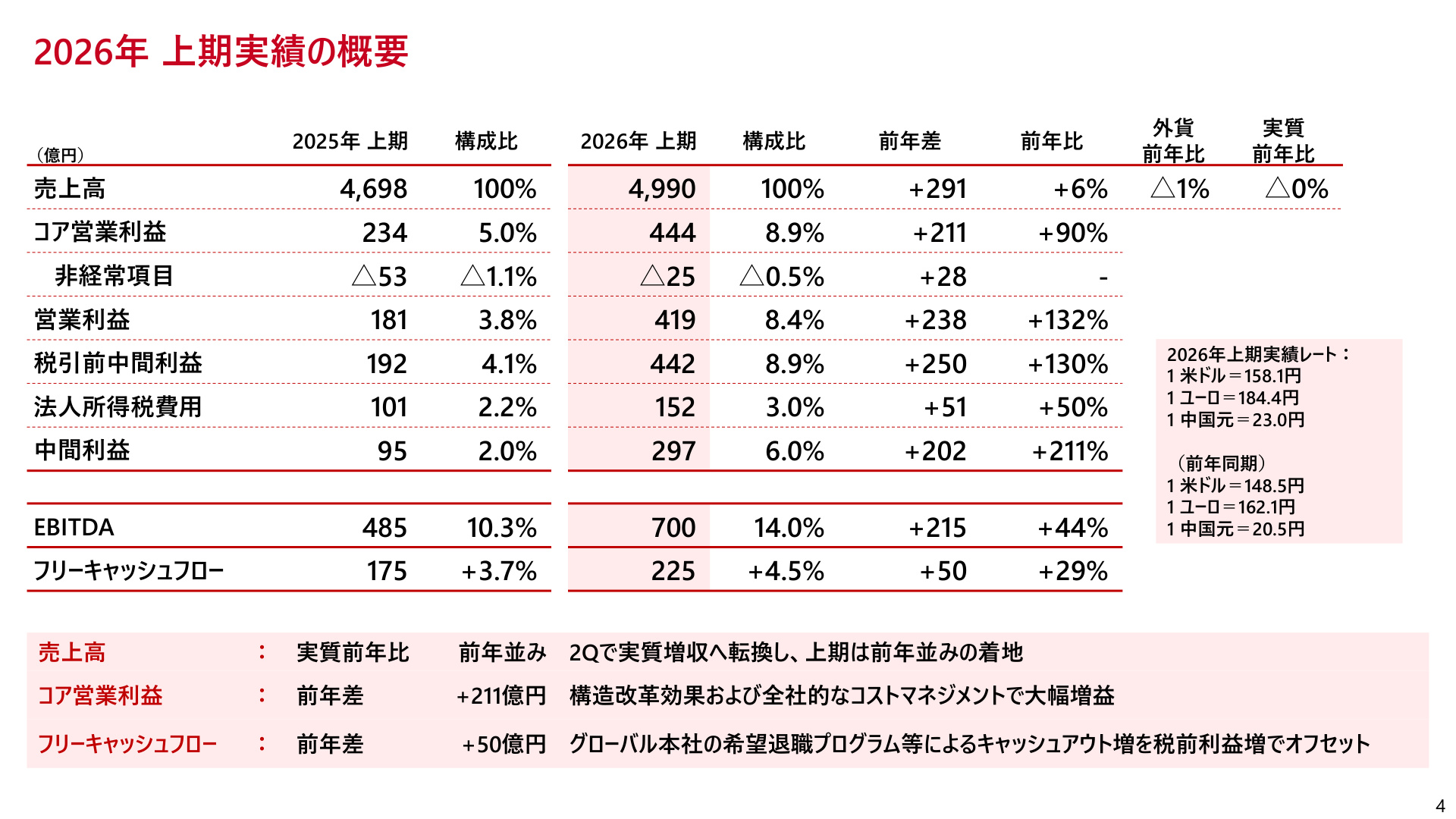
The slide above provides a comprehensive view of the H1 2026 performance and is the foundational document for understanding the radical shift in the company’s earnings structure.
Notably, while organic sales growth remained flat (0%), the core operating profit margin improved sharply by 3.9 percentage points, rising from 5.0% to 8.9% . The near-doubling of profit despite stagnant top-line growth is attributed to a combination of factors: improved cost of sales (down 1.5 points YoY) due to the reversal of inventory write-downs, rigorous reviews of personnel and operating expenses, and the positive impact of a weaker yen (e.g., 1 USD = 158.1 JPY, 1 EUR = 184.4 JPY). Furthermore, free cash flow increased to ¥22.5 billion (up ¥5.0 billion YoY) , demonstrating financial resilience as the increase in pre-tax profit effectively offsets the one-time cash outflows associated with voluntary retirement programs.
2. Quarterly Momentum: The Pivot to Organic Growth in Q2
Consolidated organic sales growth shifted from -3% in Q1 to +2% in Q2 .
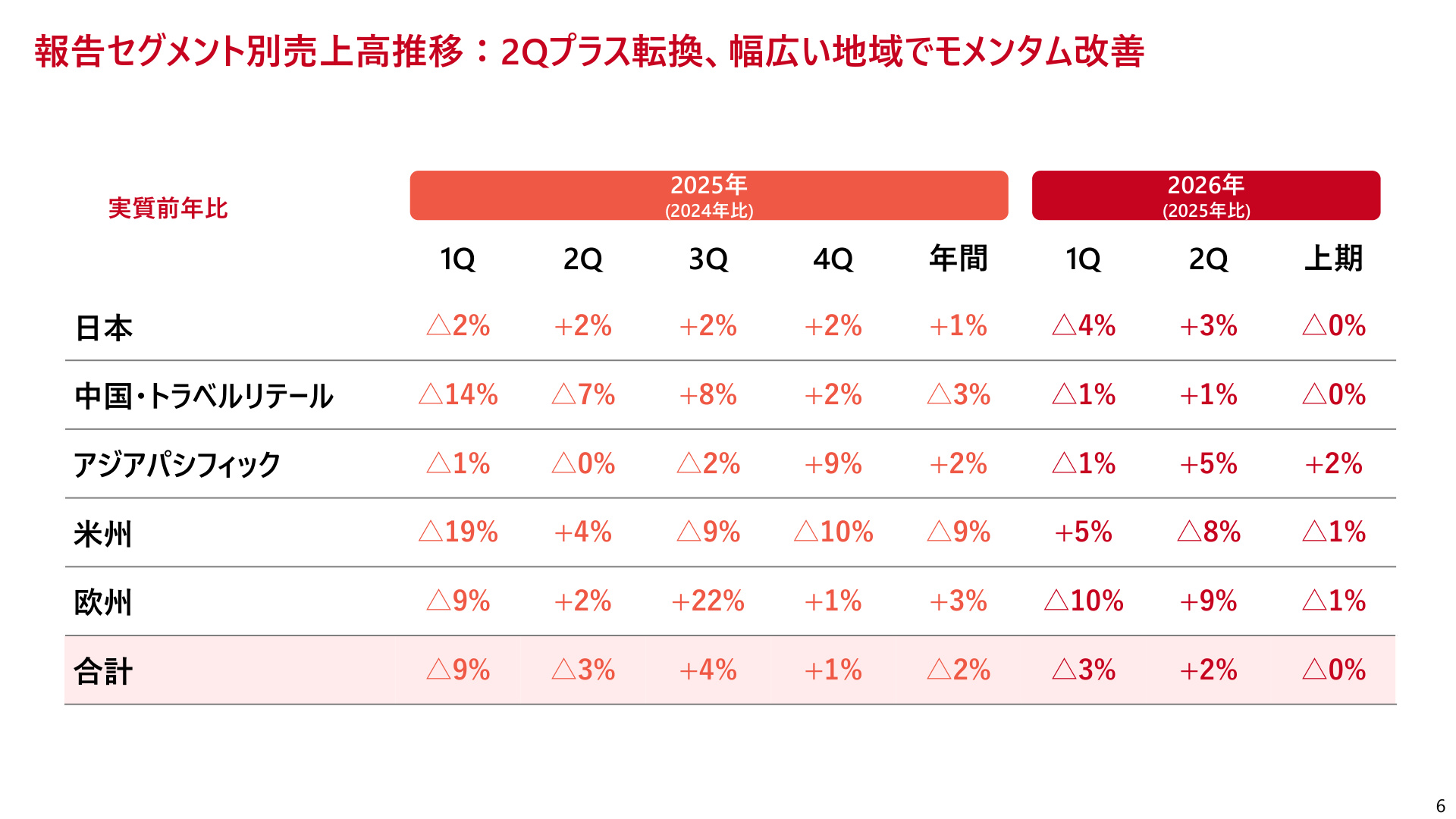
This slide breaks down organic sales trends by key reporting segments on a quarterly basis, clearly demonstrating that the group’s overall performance momentum has bottomed out and is now on a recovery trajectory .
Regionally, while Q1 saw a difficult start with all segments declining (total -3%), Q2 saw a return to positive growth in almost all major regions except the Americas: Japan (+3%) , China/Travel Retail (+1%) , Asia Pacific (+5%) , and EMEA (+9%) . The 9% growth in EMEA and 5% in Asia Pacific, in particular, indicate that global portfolio diversification and investments in new products are beginning to bear fruit.
3. Drivers of Core Operating Profit and Changes in Cost Structure
Of the ¥21.1 billion YoY increase in core operating profit, the cost of sales decreased by ¥1.0 billion , leading to a gross profit increase of ¥30.2 billion (78.9% margin, +1.5 pts YoY) .
Regarding SG&A expenses, while the company increased marketing investment by ¥10.9 billion (+8.1% YoY) to accelerate growth for focus brands and new products, it kept personnel cost increases low (+2.0%) through structural reform and natural attrition, and reduced other expenses (down 0.4%) through lower outsourcing and depreciation costs. This disciplined cost management —allocating funds to marketing while aggressively cutting indirect costs—is the primary driver of the margin improvement.
4. Segment Analysis ①: Japan Business Profitability and Customer Diversification
Japan’s net sales were ¥144.7 billion (organic -0.4%) , with core operating profit of ¥20.9 billion (+7.2% YoY) and a core operating margin of 14.4% (+1.1 pts YoY) , showing steady profitability improvement.
In the local market, moderate growth continued, with "ELIXIR" and "ANESSA" maintaining double-digit growth, while "SHISEIDO" successfully acquired new customers. Regarding inbound demand, market growth slowed due to a decline in Chinese travelers, resulting in a mid-single-digit decline in inbound sales. However, the company narrowed the gap by focusing on capturing demand from a diverse range of travelers from Thailand, Taiwan, and South Korea. A structure is being established where reductions in cost of sales and personnel ratios absorb the impact of lower inbound revenue.
5. Segment Analysis ②: China/Travel Retail – A Shift to "Quality Growth"
China/Travel Retail net sales were ¥191.4 billion (organic -0.1%) , with core operating profit of ¥47.6 billion (+22.7% YoY) and a core operating margin of 24.6% (+2.5 pts YoY) .
In mainland China, the strategic "selection and concentration" on hero products during the "618" e-commerce festival proved successful, with mid-single-digit growth in both offline and e-commerce channels. "Clé de Peau Beauté" and "NARS" led the performance. While the travel retail market continued to face headwinds from retailer restructuring, it showed resilience with signs of recovery in Hainan. By avoiding excessive discounting and enforcing price discipline to enhance brand value while improving human productivity , profitability has increased significantly YoY.
6. Segment Analysis ③: Americas – Turnaround and Return to Profitability
Americas net sales were ¥54.6 billion (organic -0.9%) , but the segment achieved a dramatic turnaround in core operating profit, moving from a ¥5.8 billion loss in the previous year to a ¥2.0 billion profit (3.6% margin) (a ¥7.8 billion improvement).
Structural reforms are expected to yield ¥7.5 billion in cost savings by 2026, with synergies between the US and Europe—such as centralized procurement of indirect materials and shared content production—now materializing. The company also shifted its channel structure, optimizing offline locations while seeing high-single-digit growth in e-commerce (particularly Amazon). Growth was supported by key brands such as "SHISEIDO," "Drunk Elephant," and "Dr. Dennis Gross Skincare."
7. Segment Analysis ④: Asia Pacific and EMEA Momentum
- Asia Pacific : Net sales of ¥37.1 billion (organic +2.1%) , core operating profit of ¥2.2 billion (vs. a ¥0.1 billion loss in the previous year) . Growth was driven by key markets like South Korea and Vietnam, and the expansion of "ELIXIR" in Asia (surging over +80%).
- EMEA : Net sales of ¥66.9 billion (organic -1.2%) , core operating profit of -¥3.4 billion (vs. -¥2.6 billion in the previous year) . While H1 saw a profit decline due to upfront marketing investments, Q2 sales rebounded sharply by 9% organically . Fragrance brands, led by "narciso rodriguez," maintained strong momentum, setting the stage for the profit recovery phase in H2.
8. Brand Strategy: The "Core Science" and "Serum-Foundation" Model
At the heart of Shiseido’s growth strategy is a "mechanism to convert innovation into growth," where proprietary technology is not limited to a single hit product but is rapidly deployed across the group and multiple brands.
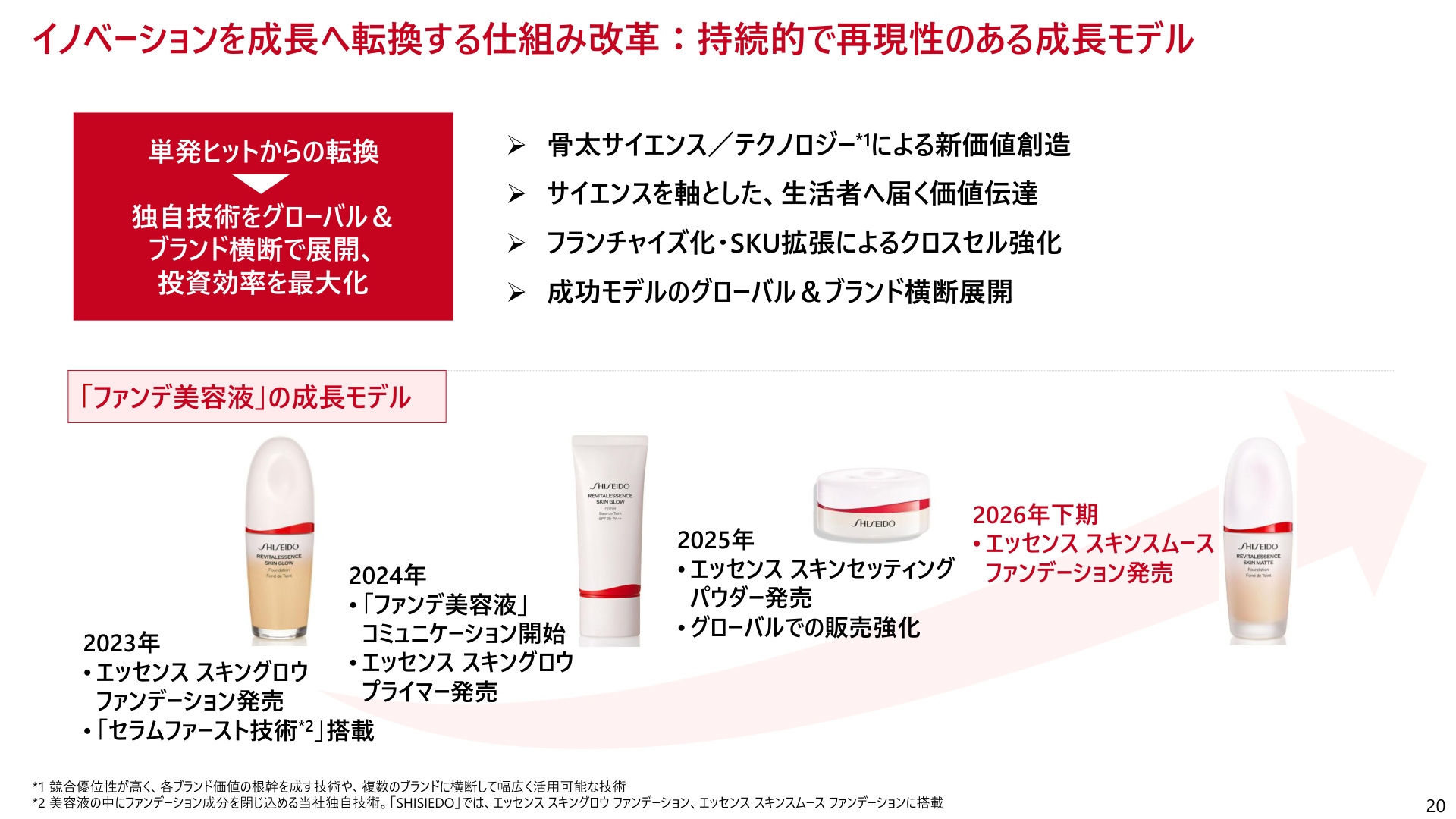
This slide is a crucial conceptual diagram symbolizing Shiseido’s reproducible growth model through innovation .
Moving away from a reliance on "one-off hits," the company defines proprietary technology (e.g., "Serum-First technology" that encapsulates foundation ingredients within a serum) as "Core Science/Technology." After successfully launching this with the "Essence Skin Glow Foundation" under the "SHISEIDO" brand in 2023, the company expanded the SKU and franchise to primers in 2024, powders in 2025, and the "Essence Skin Smooth Foundation" in H2 2026. By horizontally deploying this success pattern to other brands and global markets, Shiseido is maximizing R&D investment efficiency and enabling sustainable cross-selling .
9. Progress on Structural Reform and Global Cost Reduction
Enterprise-wide earnings structural reforms are progressing on or ahead of schedule. Shiseido achieved ¥16.0 billion in cost savings in H1 2026, putting it on track to meet the annual target of over ¥25 billion .
Specific reduction items include:
- Cost of Sales (H1: ¥4.0bn / Annual Plan: ¥7.0bn) : Selection and concentration of brands/SKUs, strategic price increases, and production line efficiency.
- Marketing Investment (H1: ¥1.0bn / Annual Plan: ¥1.0bn) : Reducing/optimizing promotional material costs and expanding local sample production.
- Personnel Expenses (H1: ¥6.0bn / Annual Plan: ¥8.0bn) : Organizational optimization and streamlining corporate functions.
- Other Expenses (H1: ¥5.0bn / Annual Plan: ¥9.0bn) : Reducing outsourcing costs, rationalizing/integrating systems, and logistics efficiency.
These fixed-cost reductions are functioning as a powerful "buffer" against market uncertainty.
10. Full-Year Outlook and H2 Growth Investment Policy
Shiseido has maintained its initial full-year 2026 guidance for both net sales and core operating profit.
While acknowledging downside risks such as intensifying competition in Western markets and uncertainty in China/Travel Retail, the company will accelerate focused investment in its new product pipeline in H2. This includes new serum-foundations for "SHISEIDO," high-performance creams for "Clé de Peau Beauté" and "ELIXIR," and a major new fragrance launch from the "MaxMara" brand. Supported by the positive impact of a weaker yen and rigorous cost management, the company aims to exceed its core operating profit plan .
Conclusion and Outlook
Shiseido’s H1 2026 results prove the transition to a "new management model" that generates profit not just through top-line volume, but through fixed-cost reductions via structural reform and high-value-added products based on "Core Science."
Investors should focus on three key points: (1) whether the sales momentum recovery seen in Q2 will solidify and accelerate with the H2 product launches, (2) whether the restructured cost base will ensure the achievement of full-year profit targets , and (3) whether the quality growth model in the two major overseas markets of China and the Americas will become fully entrenched.
This content is not intended as investment advice or a recommendation. Any opinions expressed are solely the personal views of each article.