


Takamatsu Construction Group: Q1 FY2027 Earnings Deep Dive Report

StockClub
Published: Aug 05, 2026, 09:52 AM
Sentiment Analysis
Takamatsu Construction Group (Securities Code: 1762) delivered a stellar performance in its Q1 FY2027 earnings , with all profit metrics showing year-on-year growth (excluding orders received). The company achieved record-highs for a first quarter across all key indicators: net sales, operating profit, ordinary profit, and quarterly net profit.
This report extracts and covers 10 key topics from the earnings presentation materials, providing a detailed analysis of the company's business structure, profitability improvement mechanisms, the performance of core subsidiaries, full-year outlook, and the enhanced shareholder return policy.
1. Q1 Earnings Highlights: Record-Highs Across Key Profit Metrics
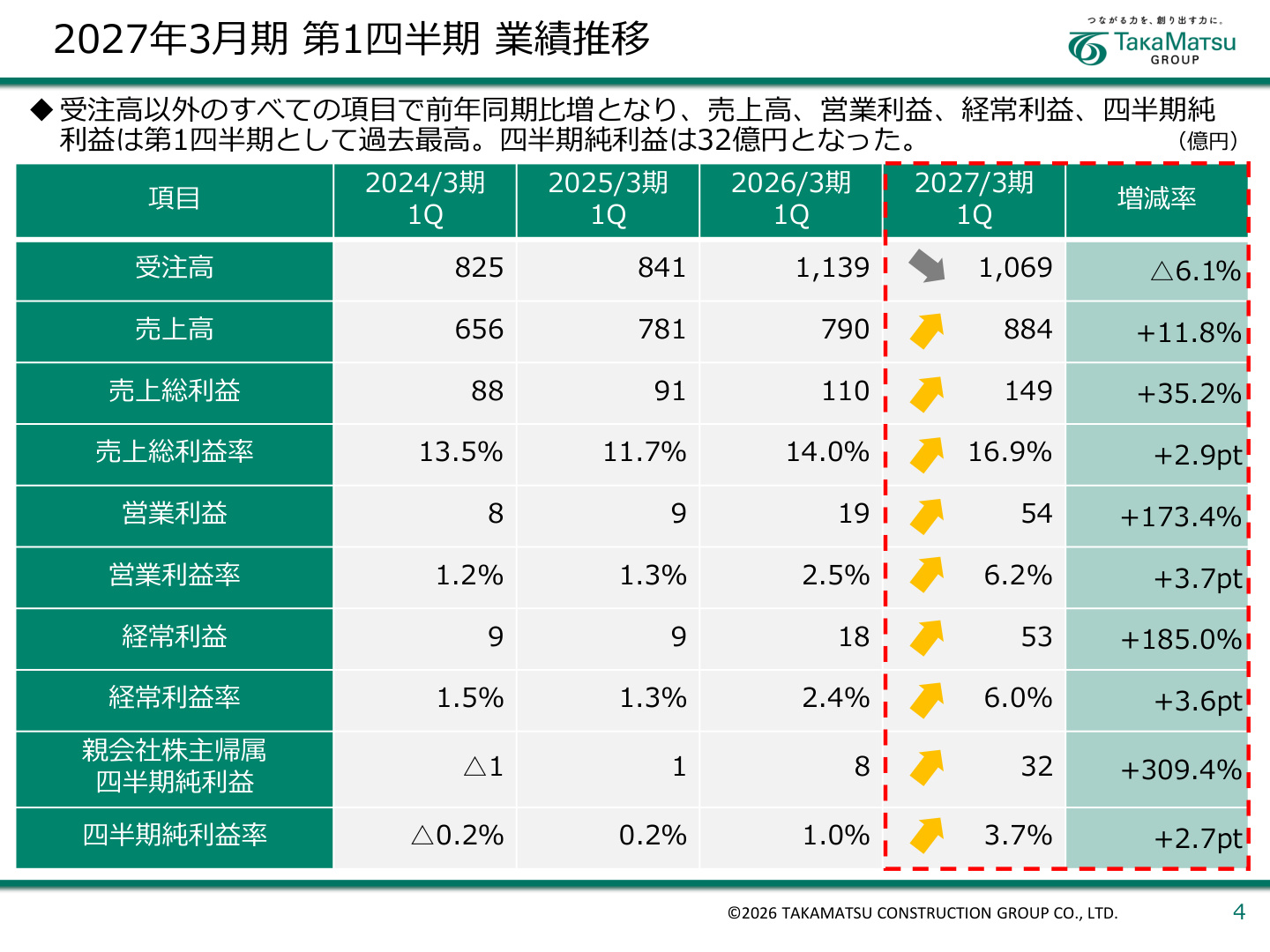
For the first quarter of the fiscal year ending March 2027, consolidated net sales rose 11.8% year-on-year to 88.4 billion yen . Operating profit surged 173.4% to 5.4 billion yen (compared to 1.9 billion yen in the same period last year), while ordinary profit increased 185.0% to 5.3 billion yen . Quarterly net profit attributable to owners of the parent soared 309.4% to 3.2 billion yen .
The slide below illustrates the historical Q1 performance trends and the growth rates for the current period.
[Significance and Background of the Above Slide]
The critical takeaway from this slide is the company's dramatic improvement in profitability, where "various profit metrics" are growing at a significantly faster pace than "net sales." While net sales grew by 11.8%, gross profit expanded by 35.2% (14.9 billion yen) , and the gross profit margin improved by 2.9 percentage points, from 14.0% to 16.9% . Furthermore, the operating profit margin jumped from 2.5% to 6.2% (+3.7 points) , and the quarterly net profit margin rose from 1.0% to 3.7% (+2.7 points) . Amid industry-wide challenges such as soaring material costs and labor shortages, Takamatsu Construction Group is demonstrating powerful profit-generating capabilities through effective price pass-throughs and rigorous progress management of high-margin projects.
2. Order Trends and Backlog Status
Consolidated orders received in Q1 totaled 106.9 billion yen, a 6.1% decrease year-on-year . While this reflects the high base of the previous year (113.9 billion yen) and a cyclical lull in orders at Aoki Asunaro Construction, the company maintained a robust order level exceeding 100 billion yen.
Furthermore, the backlog of construction contracts , which serves as the source for future revenue, reached 578.0 billion yen, a 12.0% increase year-on-year . With substantial order backlogs accumulated across core companies—including Takamatsu Construction (+11.3% to 270.8 billion yen), Aoki Asunaro Construction (+16.5% to 217.1 billion yen), and Mirai Construction (+23.2% to 53.3 billion yen)—the group has built a solid foundation for revenue recognition in the current fiscal year and beyond.
3. Profit Trends by Core Subsidiary: Dramatic V-Shaped Recovery
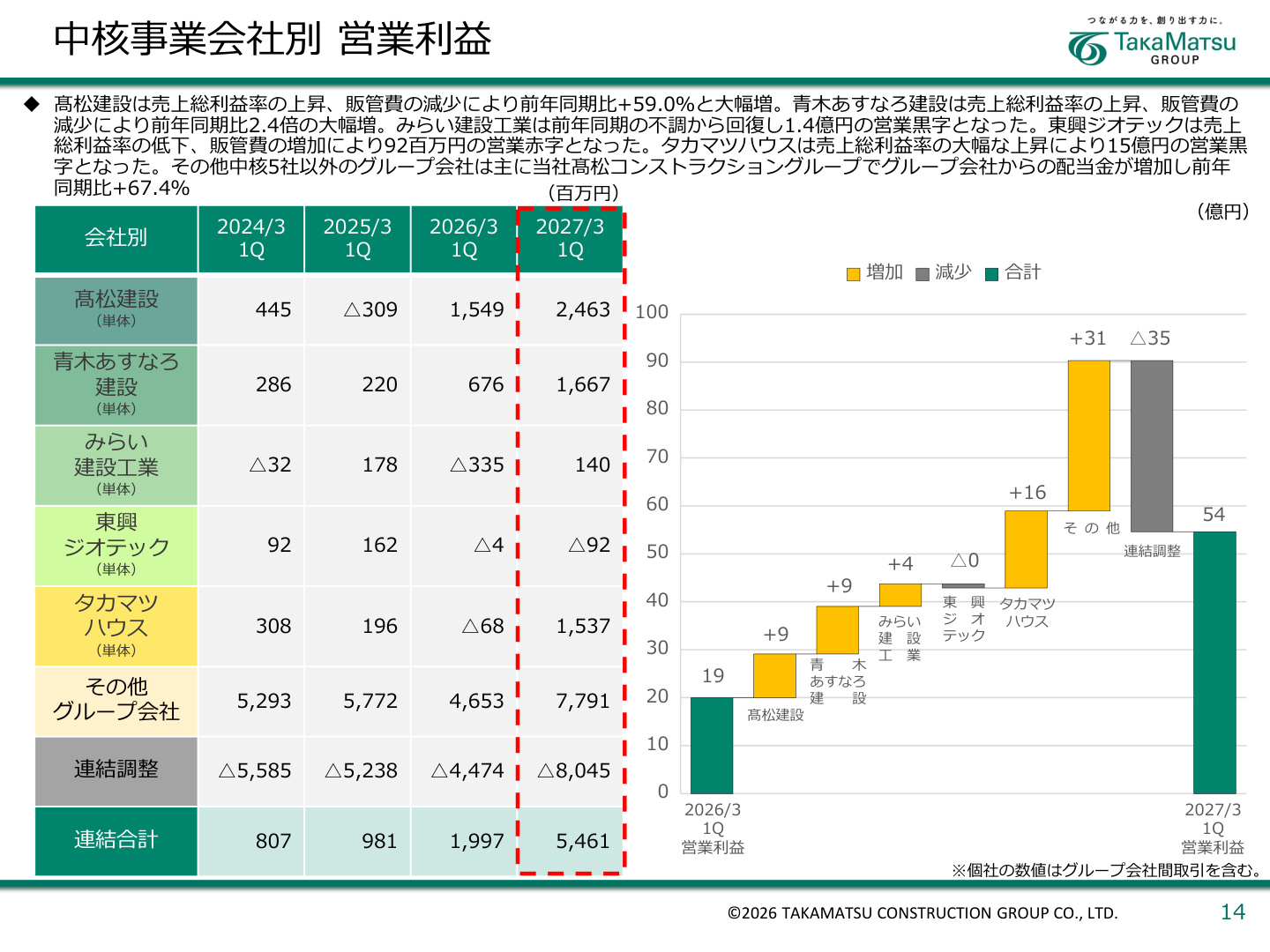
The surge in operating profit to 5.4 billion yen was driven not by a single entity, but by a synchronized and significant improvement in profitability across all major group companies.
The slide below shows the operating profit trends and variance analysis by core business subsidiary.
[Significance and Background of the Above Slide]
This slide is essential for understanding the specific breakdown and driving forces behind the group's profit explosion. Of particular note is the dramatic turnaround and growth of subsidiaries that struggled in the same period last year:
- Takamatsu Construction (Non-consolidated) : Operating profit of 2.46 billion yen (+59.0% YoY) , demonstrating the stability of the core business.
- Aoki Asunaro Construction (Non-consolidated) : Operating profit of 1.66 billion yen (2.4x YoY) , showing significant growth.
- Takamatsu House (Non-consolidated) : A rapid turnaround from a loss of 68 million yen in the previous year to a profit of 1.53 billion yen . The acquisition and sale of well-located properties in urban areas proved successful, making it a major profit contributor.
- Mirai Construction (Non-consolidated) : A turnaround from a loss of 335 million yen in the previous year to a profit of 140 million yen .
This demonstrates that the record-high consolidated profit was achieved not through reliance on a single entity, but through a comprehensive V-shaped recovery in areas that were previously a drag on performance.
4. Performance Analysis by Segment (Architecture, Civil Engineering, Real Estate)
All business segments achieved both revenue and profit growth.
- Architecture Segment
- Net Sales: 40.7 billion yen (+4.7% YoY)
- Gross Profit: 7.46 billion yen (+12.9% YoY)
- Operating Profit: 3.33 billion yen (+83.1% YoY)
- Driven by profitability improvements in the architecture divisions of Takamatsu Construction and Aoki Asunaro Construction.
- Civil Engineering Segment
- Net Sales: 24.2 billion yen (+10.2% YoY)
- Gross Profit: 3.29 billion yen (+49.1% YoY)
- Operating Profit: 1.51 billion yen (2.5x YoY)
- Driven by the recovery of Mirai Construction and the progress of civil engineering projects at Aoki Asunaro Construction.
- Real Estate Segment
- Net Sales: 23.4 billion yen (+29.2% YoY)
- Gross Profit: 4.14 billion yen (+88.0% YoY)
- Operating Profit: 2.44 billion yen (2.4x YoY)
- Sustained strong performance in the acquisition and sale of detached houses and income-generating properties at Takamatsu House boosted margins.
5. Structural Improvement in Gross Profit Margin
The consolidated gross profit margin improved by 2.9 percentage points year-on-year to 16.9% . The trends in gross profit margins for the five core companies are as follows:
- Takamatsu Construction : 20.2% → 23.1% (+2.9pt)
- Takamatsu House : 7.2% → 17.4% (+10.2pt)
- Aoki Asunaro Construction : 11.0% → 13.9% (+2.9pt)
- Mirai Construction : 4.8% → 9.2% (+4.4pt)
This result stems from rigorous cost estimation from the start of the fiscal year, thorough price pass-throughs to mitigate rising material and labor costs, and the completion of inventory adjustments at Takamatsu House combined with the sale of high-margin properties.
6. Takamatsu Construction: Regional and Usage Trends (Osaka vs. Tokyo)
An analysis of Takamatsu Construction's (non-consolidated) orders (39.6 billion yen, +3.2% YoY) reveals demand trends by region and usage:
- Residential (Rental Apartments, etc.) : Increased by 8.2 billion yen in Osaka (12.4 billion yen) and 2.4 billion yen in Tokyo (10.7 billion yen) , recording a total increase of 10.7 billion yen (23.2 billion yen total) . This highlights the resilience of the rental housing market, supported by demand for asset utilization and inheritance tax planning.
- General Construction (Factories, Buildings, Stores, etc.) : While Osaka saw an increase of 2.3 billion yen, Tokyo saw a decrease of 12.3 billion yen, resulting in an overall decrease of 9.9 billion yen (14.8 billion yen total) .
The strength of residential demand in the Kansai region is offsetting the decline in general construction in Tokyo, demonstrating the effectiveness of regional diversification and multi-faceted targeting.
7. Operating Profit Variance Analysis: Gross Profit Growth Outpacing SG&A
The factors behind the operating profit increase (from 1.9 billion yen to 5.4 billion yen, a +3.4 billion yen increase) are as follows:
- Increase in Gross Profit : +3.8 billion yen
- Profit growth from the five core companies: +3.7 billion yen (Takamatsu Construction +0.7B, Aoki Asunaro +0.8B, Mirai Construction +0.4B, Takamatsu House +1.7B, etc.)
- Profit growth from other group companies: +3.6 billion yen
- Increase in SG&A Expenses : -0.4 billion yen
- Despite increased SG&A expenses at the Takamatsu Construction Group headquarters and Takamatsu Urban Development, the overall growth in gross profit (+3.8 billion yen) far outweighed these costs, leading to a significant profit increase.
8. Stock Revenue Base: Occupancy Rates at Takamatsu Estate
The average occupancy rate for properties managed by Takamatsu Estate (constructed by Takamatsu Construction) remains at an ultra-high level of over 95% , specifically 98.1% in the Osaka/Nagoya area and 98.3% in the Tokyo area .
This exceptionally high occupancy rate proves the quality and prime location of the rental apartments developed by Takamatsu Construction. It serves as an essential stock business foundation that supports owner satisfaction and creates a virtuous cycle for new construction orders (repeats and referrals).
9. FY2027 Full-Year Earnings Forecast and Assumptions
The full-year consolidated earnings forecast for the fiscal year ending March 2027 remains unchanged from the initial announcement:
- Orders Received : 450 billion yen (+3.2% YoY)
- Net Sales : 400 billion yen (+11.8% YoY)
- Operating Profit : 20 billion yen (+12.3% YoY)
- Net Profit Attributable to Owners of the Parent : 12.5 billion yen (+9.6% YoY)
As of Q1, the progress rate for operating profit has reached 27.3%, marking a strong start. Note that this forecast does not currently incorporate uncertain factors such as potential oil price spikes due to escalating tensions in the Middle East, which will be monitored closely.
10. Enhanced Shareholder Return Policy: Progressive Dividend and Increased Payouts
The company has significantly strengthened its shareholder return policy under its Medium-Term Management Plan (FY2026–FY2028).
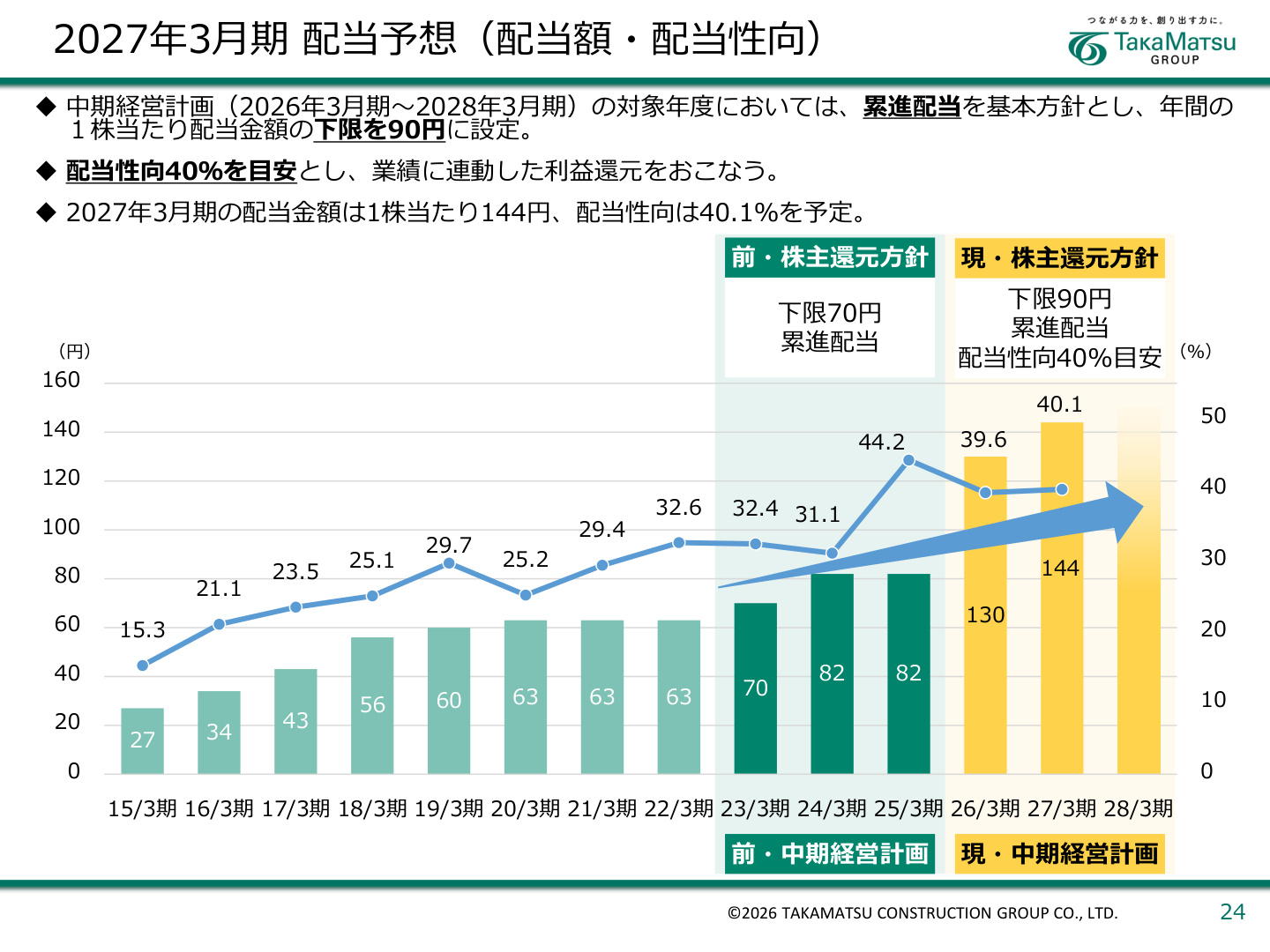
The slide below shows the changes in dividend policy and the trends in dividends per share and payout ratios.
[Significance and Background of the Above Slide]
This slide represents a clear shift in the company's fundamental stance toward shareholders and its capital allocation policy. Moving away from the previous policy (minimum annual dividend of 70 yen), the company has adopted a "progressive dividend as a basic policy" and increased the minimum annual dividend per share to 90 yen. Furthermore, it has introduced a performance-linked return policy with a "target payout ratio of 40%."
Based on this, the forecast for the annual dividend for FY2027 is 144 yen per share (payout ratio of 40.1%) . As seen in the historical dividend trends (FY23: 70 yen → FY24: 82 yen → FY25: 82 yen → FY26: 130 yen → FY27: 144 yen projected), the company is clearly demonstrating a strong commitment to actively returning the fruits of its growth to shareholders.
Summary
Takamatsu Construction Group's Q1 FY2027 earnings represent an exceptionally strong start, achieving record-high profits through the combination of stable profitability at Takamatsu Construction, a dramatic V-shaped recovery at subsidiaries like Takamatsu House and Mirai Construction, and improved gross margins across the group.
Backed by a substantial order backlog (578 billion yen), the market will continue to monitor the progress of construction projects, the achievement of the full-year plan (20 billion yen in operating profit), and the impact of the enhanced progressive dividend policy on shareholder returns.
This content is not intended as investment advice or a recommendation. Any opinions expressed are solely the personal views of each article.