


Kyushu Railway Company (9142) Q1 FY2027 Earnings Analysis Deep Dive: Growth Strategy Driven by Rail Passenger Services and Real Estate/Hotel Synergy, Coupled with Enhanced Shareholder Returns

StockClub
Published: Aug 04, 2026, 10:13 AM
Sentiment Analysis
Kyushu Railway Company (JR Kyushu, Securities Code: 9142) reported increased revenue and profit for the first quarter of the fiscal year ending March 31, 2027 , compared to the same period last year, supported by growth in railway passenger transportation revenue and robust demand in the real estate and hotel sectors. This report breaks down the key topics from the earnings presentation into 10 sections, providing a multi-faceted analysis ranging from actual performance and full-year forecasts to segment-specific details, the impact of recent natural disasters, and shareholder return policies.
1. Overview of Q1 Consolidated Results: A Strong Start Exceeding the Previous Year
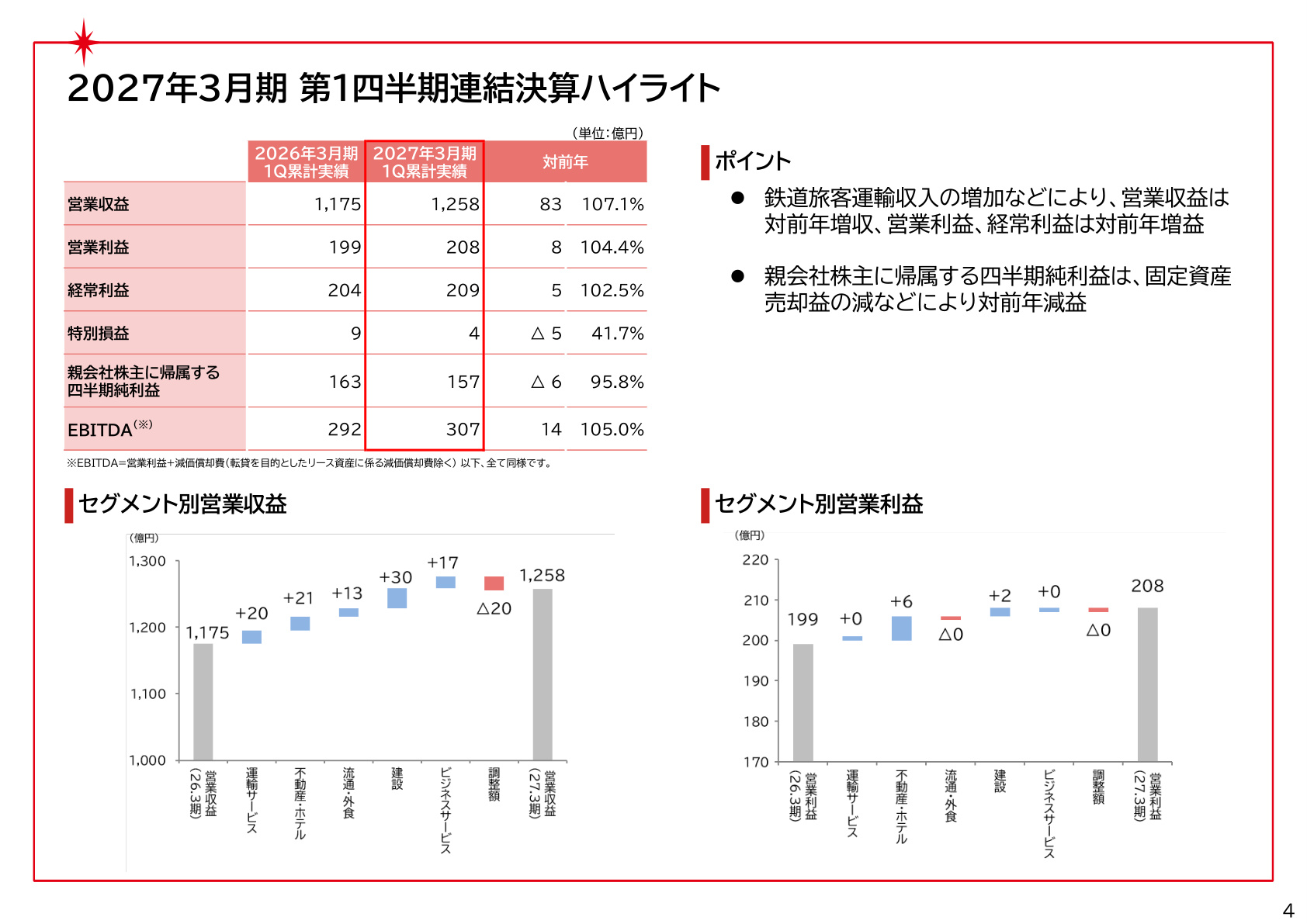
Consolidated results for the first quarter of FY2027 showed operating revenue of 125.8 billion yen (up 7.1% YoY) , operating income of 20.8 billion yen (up 4.4% YoY) , and ordinary income of 20.9 billion yen (up 2.5% YoY) , marking a trend of growth in both revenue and profit. While net income attributable to owners of the parent company was 15.7 billion yen (down 4.2% YoY) due to the absence of gains from the sale of fixed assets recorded in the same period last year, EBITDA , a key indicator of cash-generating ability, grew steadily to 30.7 billion yen (up 5.0% YoY) .
Slide Commentary: Significance of Q1 Earnings Results
The Q1 earnings highlight slide above clearly demonstrates the diversification of JR Kyushu's revenue structure and its growth trend . The waterfall chart of operating revenue by segment shows that not only the core Transportation Services (+2.0 billion yen) but also Real Estate and Hotels (+2.1 billion yen) , Retail and Restaurant (+1.3 billion yen) , Construction (+3.0 billion yen) , and Business Services (+1.7 billion yen) all recorded revenue exceeding the previous year's performance. In terms of operating income, a key feature is that the company successfully absorbed increased expenses—such as maintenance costs for safety and aging infrastructure, as well as personnel costs—through sales growth across all business segments.
2. Full-Year Earnings Forecast: Maintaining the Plan for Revenue and Profit Growth
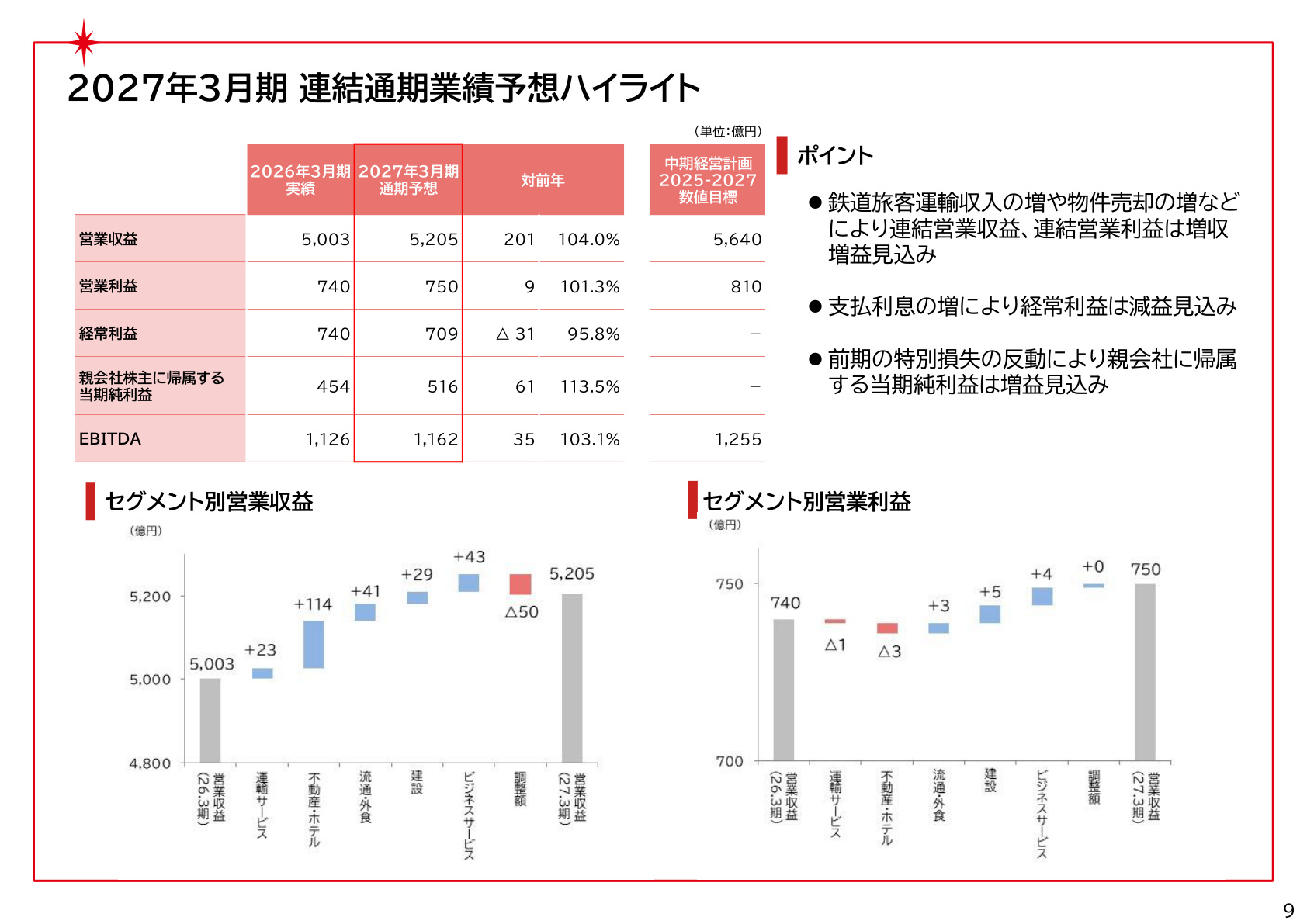
The full-year consolidated earnings forecast remains unchanged, with operating revenue of 520.5 billion yen (up 4.0% YoY) , operating income of 75.0 billion yen (up 1.3% YoY) , and net income attributable to owners of the parent company of 51.6 billion yen (up 13.5% YoY) . Factoring in the reversal of extraordinary losses incurred in the previous fiscal year, double-digit growth is expected at the bottom-line level.
Slide Commentary: Background and Positioning of Full-Year Forecasts
This slide provides essential data showing progress toward the targets of the Medium-Term Management Plan (2025-2027) and the projected full-year landing point . To reach the targets of 564.0 billion yen in operating revenue and 81.0 billion yen in operating income, the company is steadily scaling up its revenue and profit base in FY2027. By segment, while transportation and real estate/hotels drive earnings, the company is carefully managing its cost structure, accounting for the timing of property sales and increases in personnel and operating expenses, serving as a key indicator for annual profit management.
3. Transportation Services Segment: Fare Revisions and Strong Non-Commuter Demand
In the first quarter, the Transportation Services segment reported operating revenue of 47.3 billion yen (up 4.6% YoY) and operating income of 9.5 billion yen (up 0.3% YoY) . Railway passenger transportation revenue for the non-consolidated railway business performed well at 43.0 billion yen (up 4.8% YoY) .
- Commuter Revenue : 10.1 billion yen (up 10.7% YoY), primarily driven by the transition to new commuter fare rates.
- Non-Commuter Revenue : 32.8 billion yen (up 3.1% YoY), supported by the recovery trend in business and tourism travel and the effectiveness of sales initiatives.
- Shinkansen vs. Conventional Lines : Shinkansen revenue reached 16.6 billion yen (up 3.7% YoY), and conventional line revenue reached 26.3 billion yen (up 5.6% YoY), with both exceeding the previous year's results.
4. Qualitative Changes in Inbound Demand and the JR-KYUSHU RAIL PASS
Demand from inbound tourists remains at a high level, but there is a shift in its qualitative structure. Inbound revenue (estimated) for the first quarter was 1.9 billion yen , maintaining the same level as the previous year.
Of note is the sales trend of the "JR-KYUSHU RAIL PASS." Although the number of passes sold was 45,000 (down 25.6% YoY), the average unit price increased by approximately 8.3% to 17,100 yen . Furthermore, as inbound tourists shifted from using the pass to purchasing regular tickets and limited express tickets , overall inbound revenue remained stable.
5. Real Estate and Hotel Segment (1): Steady Performance in Leasing and Hotels
The Real Estate and Hotel segment as a whole performed well, with Q1 operating revenue of 42.0 billion yen (up 5.4% YoY) and operating income of 9.9 billion yen (up 6.7% YoY) .
- Real Estate Leasing : Operating revenue of 20.8 billion yen (up 7.0% YoY) and operating income of 5.2 billion yen (up 10.0% YoY). Despite the impact of typhoons, tenant sales at flagship facilities like "JR Hakata City" grew to 106.6% of the previous year , and occupancy rates for offices and rental apartments remained high.
- Hotel Business : Operating revenue of 8.7 billion yen (up 8.0% YoY) and operating income of 2.0 billion yen (up 17.0% YoY). The increase in the inbound ratio (approx. 57%), centered on the "THE BLOSSOM" brand, drove overall performance. The occupancy rate reached 84.1% , and the ADR (Average Daily Rate) was approximately 25,500 yen , exceeding the previous year's level (ADR 24,057 yen).
6. Real Estate and Hotel Segment (2): Real Estate Sales and Asset Liquidation Strategy
The Real Estate Sales business reported Q1 operating revenue of 12.5 billion yen (up 1.4% YoY) and operating income of 2.6 billion yen (down 5.4% YoY) .
In addition to the handover of condominiums such as "MJR Kumamoto Gate Power," the company executed the third-party sale of one rental apartment building ("Park Square Takenotsuka") as part of its asset liquidation strategy. For the full year, the company plans to hand over large-scale projects such as "MJR Urakami The Residence" and "MJR Kagoshima-Chuo Ekimae The Residence," and expects to record operating revenue from the sale of 16.0 billion yen worth of assets , with progress currently on track.
7. Other Segments (Retail/Restaurant, Construction, Business Services)
Other segments also saw steady operations by capturing increased foot traffic and group-internal demand.
- Retail and Restaurant : Operating revenue of 18.1 billion yen (up 8.1% YoY), operating income of 0.8 billion yen (down 9.6% YoY). Sales at convenience stores and franchise restaurants remained solid.
- Construction : Operating revenue of 20.7 billion yen (up 16.9% YoY), operating income of -0.3 billion yen (an improvement from -0.6 billion yen in the same period last year). Significant revenue growth was achieved due to the smooth progress of ongoing projects.
- Business Services : Operating revenue of 21.0 billion yen (up 8.9% YoY), operating income of 1.1 billion yen (up 7.3% YoY). Solid profits were recorded by capturing core demand.
8. Impact of the 2026 Kumamoto Earthquake and Recovery Efforts
Regarding the "2026 Kumamoto Earthquake" (magnitude 7) that occurred on July 28, 2026, centered in Uki City and Hikawa Town, Kumamoto Prefecture, the earnings materials outline the damage and response policy.
Damage occurred to viaducts, utility poles, and bridge girders on the Kyushu Shinkansen between Kumamoto and Kagoshima-Chuo and the Kagoshima Main Line between Uto and Yatsushiro, leading to temporary service suspensions. Some damage and gas supply disruptions also occurred at station buildings and hotel facilities, but operations are being resumed sequentially. Safety checks and surveys for the early restoration of railway lines are being accelerated.
9. Progress of the Medium-Term Management Plan 2025-2027 and Growth Initiatives
The JR Kyushu Group has set three priority strategies in its Medium-Term Management Plan: "Realizing Sustainable Mobility Services," "Urban Development through Enhanced Inter-Business Collaboration," and "Sowing Seeds for the Future."
Specific initiatives include station facility upgrades (real-time display boards, restroom renovations) and the planned interior renovation of the "883 series" limited express trains in the spring of 2027. Furthermore, through the expansion of the "JR Kyupo Wakuwaku Program" app and web members (approx. 4.82 million members as of the end of June 2026, 107% YoY), the company is promoting cross-group customer traffic (Conglomerate Premium), aiming for a profit contribution of approximately 0.5 billion yen in FY2027.
10. Shareholder Return Policy: Commitment to Stable Dividends and Share Buybacks
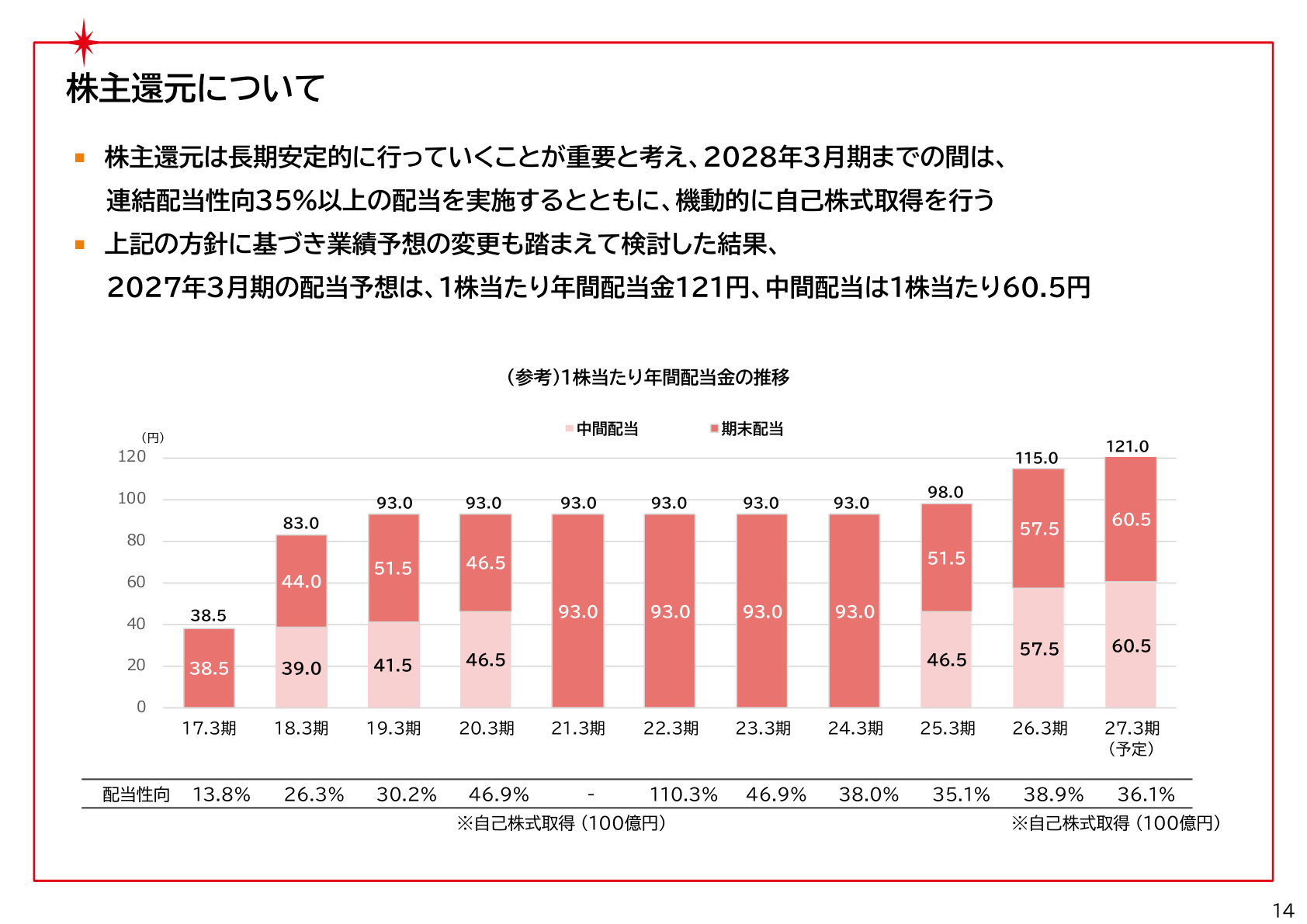
To improve capital efficiency and increase shareholder value, JR Kyushu has implemented a strong shareholder return policy. The company maintains its policy of implementing dividends with a consolidated payout ratio of 35% or more and conducting flexible share buybacks through the fiscal year ending March 2028.
Slide Commentary: Evolution of Shareholder Return Performance and Forecasts
The slide above symbolizes JR Kyushu's strong commitment to shareholder returns . The dividend forecast for FY2027 is 121 yen per share annually (60.5 yen interim, 60.5 yen year-end) , an increase from the previous year's 115 yen (consolidated payout ratio of 36.1%). As noted at the bottom of the graph, the company continues its stance of flexible and comprehensive shareholder returns, including share buybacks , similar to the 10 billion yen buybacks in FY2024 and FY2026. This is critical information for investors, as it enhances the predictability of the company's capital policy.
Conclusion
Kyushu Railway Company's Q1 FY2027 earnings report reflects a favorable performance where the recovery and fare revision effects of the core railway passenger business harmonize with the solid earnings base of related businesses such as station buildings, hotels, and real estate development . By appropriately addressing uncertainties such as disaster recovery while maintaining the growth trajectory targeted in the Medium-Term Management Plan and continuing an aggressive shareholder return policy including dividend increases, the company has demonstrated its comprehensive corporate strength.
This content is not intended as investment advice or a recommendation. Any opinions expressed are solely the personal views of each article.