


Kawasaki Kisen Kaisha (9107) Q1 FY2026 Earnings Analysis: Upward Revision of Full-Year Forecasts and Accelerated Shareholder Return and Capital Optimization Strategy

StockClub
Published: Aug 04, 2026, 10:12 AM
Sentiment Analysis
Kawasaki Kisen Kaisha, Ltd. (Ticker: 9107) announced its financial results for the first quarter (Q1) of the fiscal year ending March 2026 on August 4, 2026. The announcement featured an upward revision of the full-year earnings forecast , driven by a robust recovery in the dry bulk market and rising container freight rates. Furthermore, the company demonstrated significant progress in its capital optimization strategy, notably increasing the total shareholder return target for the medium-term management plan period to over 880 billion yen .
This report provides a comprehensive analysis of the Q1 performance, segment-specific details, the rationale behind the full-year forecast revisions, and the progress of shareholder returns and capital policies, based on the ten key topics from the released earnings presentation materials.
1. Overview of Q1 Consolidated Financial Results and Key Drivers
For the first quarter of FY2026, consolidated revenue was 286.8 billion yen (up 41.9 billion yen year-on-year), operating profit was 19.5 billion yen (down 0.2 billion yen YoY), ordinary profit was 24.0 billion yen (up 2.3 billion yen YoY), and profit attributable to owners of the parent was 23.3 billion yen (down 6.5 billion yen YoY).
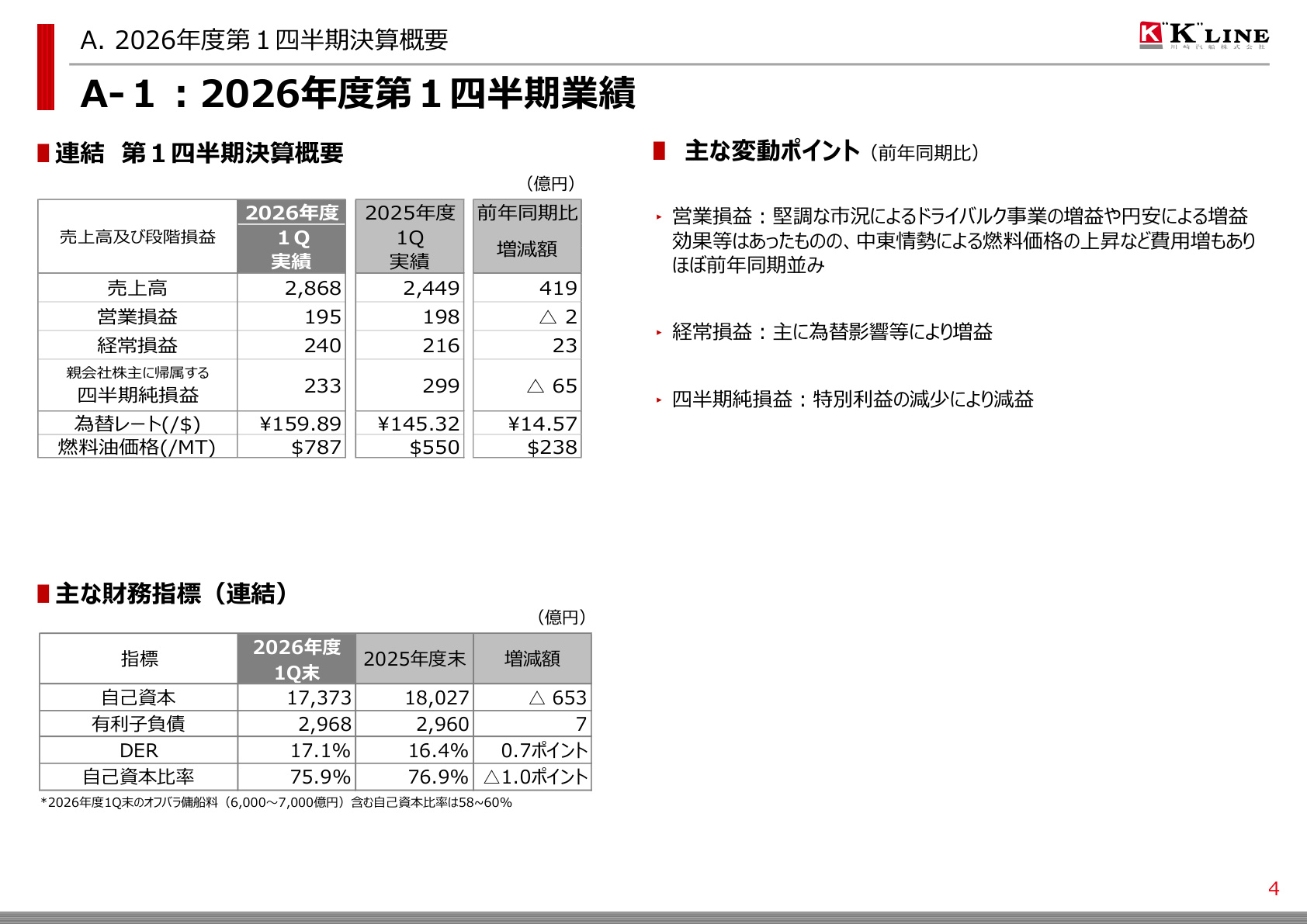
As shown above, while operating profit benefited from increased earnings in the dry bulk business and the positive impact of a weaker yen , these gains were offset by soaring fuel prices due to heightened tensions in the Middle East (rising from $550/MT in the same period last year to $787/MT) and increased operating costs, keeping profit levels flat compared to the previous year. While ordinary profit saw an increase due to foreign exchange effects, quarterly net profit declined primarily due to a decrease in extraordinary income. The exchange rate shifted significantly toward a weaker yen, moving from 145.32 JPY/$ in the same period last year to 159.89 JPY/$ .
2. Segment Performance: Highlights and Background
A review of Q1 performance by segment reveals that different factors influenced each business area:
- Dry Bulk Business : Revenue of 90.3 billion yen (up 19.6 billion yen YoY) and ordinary profit of 9.0 billion yen (up 9.3 billion yen YoY). The large vessel market remained firm, supported by active cargo movements of iron ore and bauxite, while the small-to-medium vessel market rose due to increased coal transport demand stemming from Middle East tensions. Additionally, the absence of one-time losses from port accidents and labor disputes incurred in the previous year, combined with favorable exchange rate effects, led to a significant year-on-year increase in profit .
- Energy Resource Business : Revenue of 29.8 billion yen (up 6.3 billion yen YoY) and ordinary profit of 3.2 billion yen (up 0.5 billion yen YoY). Despite the absence of one-time gains from the revision of tax effects on investments recorded in the same period last year, the business maintained profit growth due to strong LPG carrier and tanker market conditions.
- Product Logistics Business : Revenue of 166.0 billion yen (up 15.9 billion yen YoY) and ordinary profit of 10.8 billion yen (down 13.4 billion yen YoY).
- Car Carrier Business : Ordinary profit fell significantly to 2.1 billion yen (down 13.0 billion yen YoY) due to lower vessel utilization rates caused by Middle East tensions and increased operating costs such as fuel expenses.
- Container Ship Business : Although short-term freight rates rose due to tighter vessel supply and demand caused by Middle East tensions and port congestion, the increase in operating costs—driven by a rapid rise in fuel prices—outpaced these gains, resulting in an ordinary profit of 5.4 billion yen (down 1.2 billion yen YoY).
3. Upward Revision of FY2026 Full-Year Earnings Forecasts and Rationale
The full-year earnings forecast has been revised upward from the figures announced on May 24, 2026, and remains unchanged from the timely disclosure made on July 24, 2026.
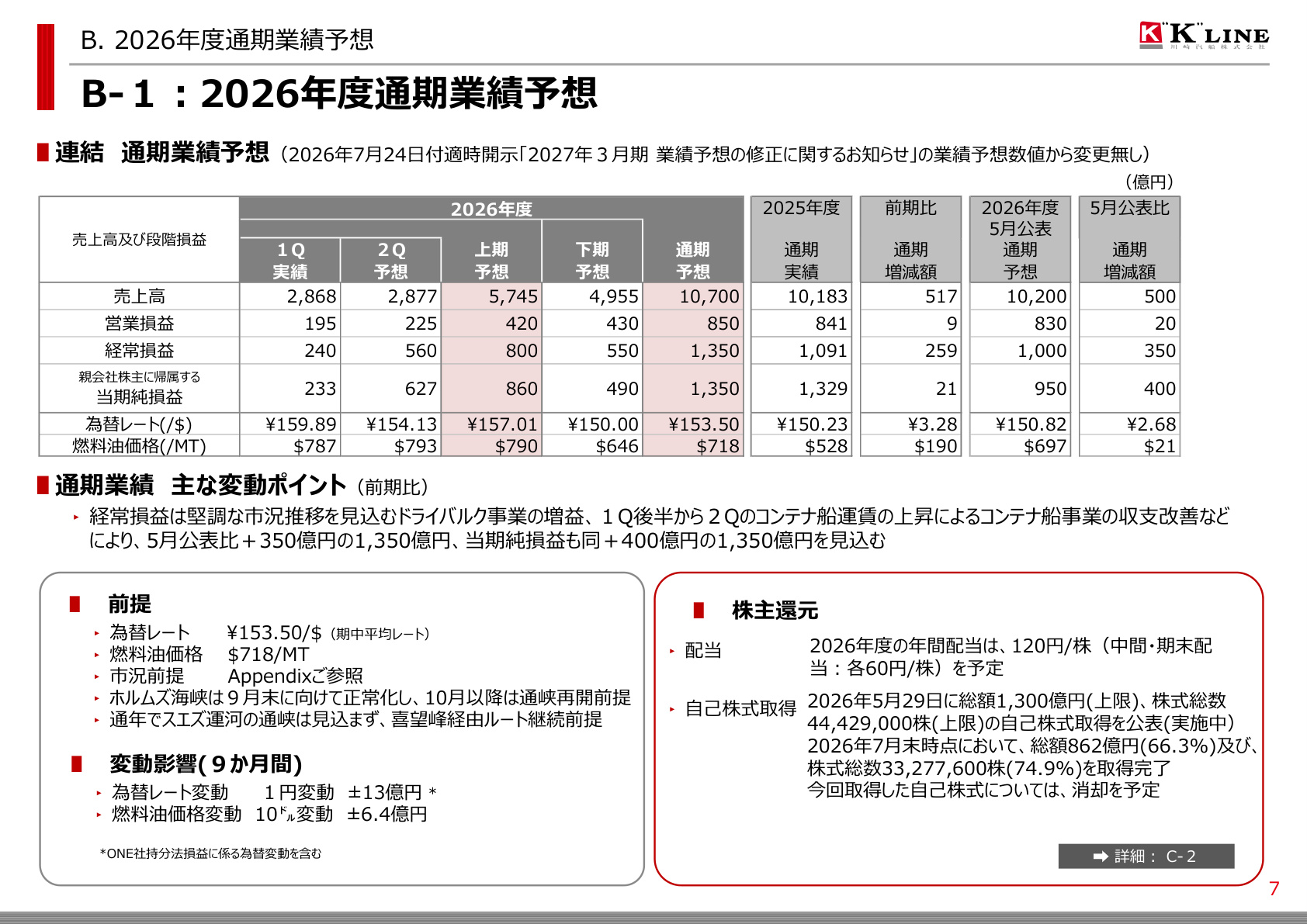
Full-year consolidated revenue is projected at 1,070 billion yen (up 50 billion yen from the May forecast), operating profit at 85.0 billion yen (up 2.0 billion yen), ordinary profit at 135.0 billion yen (up 35.0 billion yen), and net profit at 135.0 billion yen (up 40.0 billion yen). The primary drivers for this upward revision are the expectation of continued firm market conditions in the dry bulk business and improved profitability in the container ship business (e.g., ONE) due to the rise in container freight rates from the latter half of Q1 through Q2.
Assumptions for the full year include an average exchange rate of 153.50 JPY/$ and a fuel oil price of 718 USD/MT . Regarding route assumptions, the company anticipates the normalization of the Strait of Hormuz by the end of September and the resumption of transits from October onwards. Conversely, it does not factor in Suez Canal transits, assuming the continuation of routes via the Cape of Good Hope .
4. Advancement of Capital Policy and Expansion of Shareholder Return Framework
In line with its medium-term management plan, the company is pursuing both capital efficiency (ROIC) and financial soundness by strengthening its "earning power" and seeking an optimal capital structure.
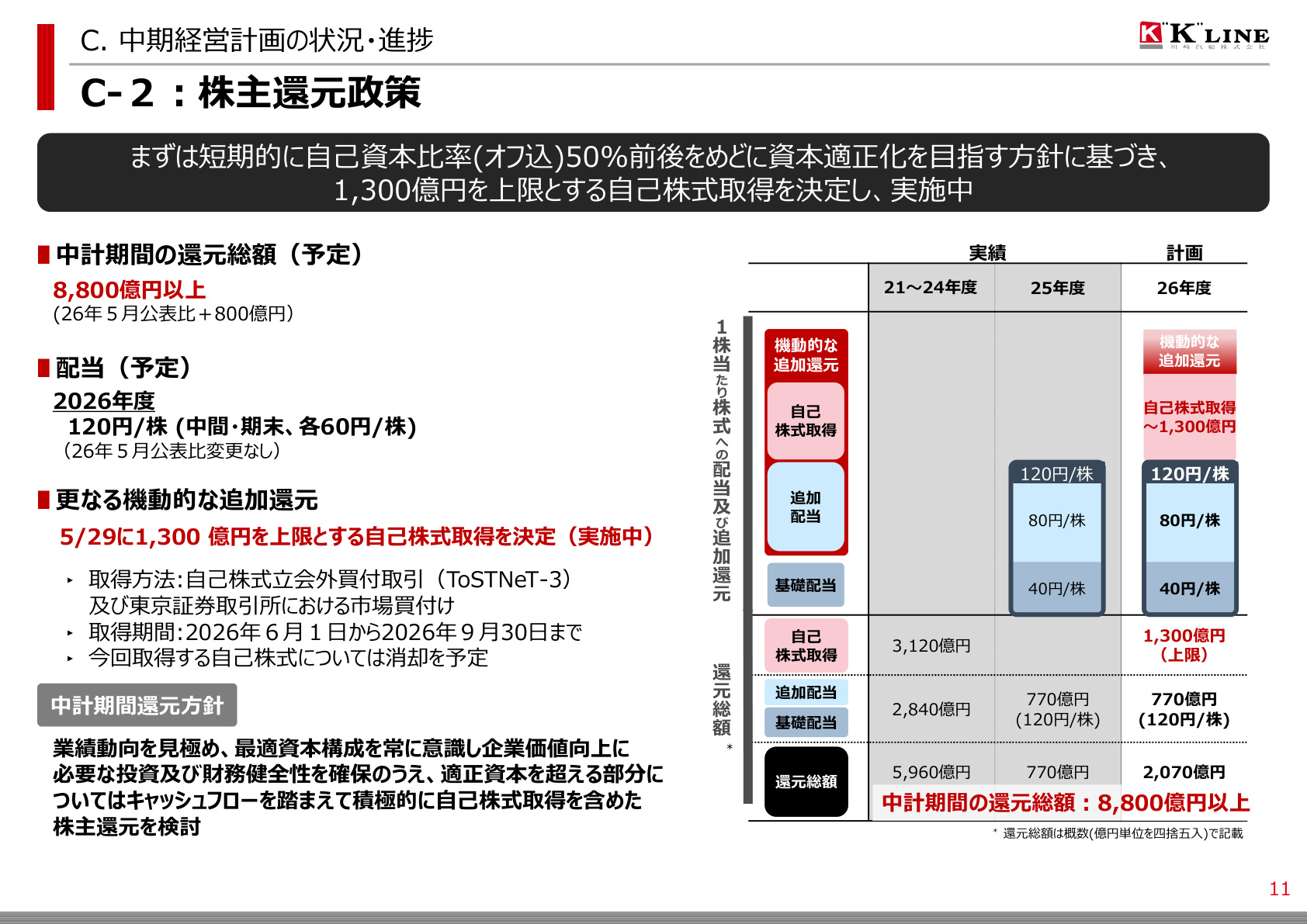
As shown in this slide, the key points of the financial targets and return policy are as follows:
- Performance Targets and ROIC : The ordinary profit target for the final year of the medium-term plan (FY2026) is set at 135 billion yen , with an expected ROIC of around 6% .
- Investment Plan : The company has earmarked 610 billion yen for investment cash flow during the medium-term plan period, executing investments in environmental initiatives and growth-driving businesses with discipline.
- Optimal Capital Structure and Equity : The company aims for capital optimization, targeting an equity ratio (including off-balance sheet items) of around 50% in the short term.
- Expansion of Shareholder Returns : Utilizing cash flow exceeding the optimal capital level, the total return target for the medium-term plan period has been increased by 80 billion yen from the previous announcement to over 880 billion yen .
- Annual Dividends and Share Buybacks : The annual dividend for FY2026 is planned at 120 yen per share (60 yen interim and 60 yen year-end). Furthermore, the company is proceeding with a share buyback program of up to 130 billion yen , announced on May 29, 2026, with the acquired shares scheduled for cancellation.
- Enhancement of Corporate Value (PBR Improvement) : The company aims to achieve an ROE of 15% or higher and consistently maintain a PBR of 1.0x or higher .
5. Business Environment and Risk Factors in the Shipping Industry
Externally, geopolitical risks centered on the Middle East and shifts in trade policy are having a significant impact.
- Middle East Situation and Route Risks : Due to transit restrictions in the Strait of Hormuz and the Suez Canal, the company continues to prioritize the safety of crew and cargo by rerouting vessels via the Cape of Good Hope. While this increases operating costs in the short term—such as higher fuel expenses and war risk insurance premiums—it also acts as a factor tightening vessel supply.
- Trade Policy and Tariff Trends : The company faces a landscape requiring adjustments to trade patterns and service/vessel deployment, driven by new U.S. tariffs under Section 301 of the Trade Act and countermeasures by the USTR against China-related vessels.
- Response to Environmental Regulations : In light of IMO (International Maritime Organization) greenhouse gas (GHG) emission regulations, the company is advancing its portfolio strategy and newbuilding program, including LNG-fueled vessels and liquefied CO2 carriers, to support low-carbon and decarbonization efforts.
6. Conclusion
In its Q1 FY2026 results, Kawasaki Kisen successfully achieved an upward revision to a full-year ordinary profit of 135 billion yen , capturing the strength of the dry bulk market and the recovery in container freight rates despite external risks such as Middle East tensions and high fuel costs. Simultaneously, the company is aggressively pursuing a total shareholder return of over 880 billion yen and a 130 billion yen share buyback program , demonstrating a commitment to simultaneously strengthening business profitability and optimizing capital.
This content is not intended as investment advice or a recommendation. Any opinions expressed are solely the personal views of each article.