


Mitsubishi Heavy Industries Q1 FY2026 Earnings Deep Dive: Robust Profit Growth Led by Energy Segment and Upward Revision of Full-Year Outlook

StockClub
Published: Aug 04, 2026, 10:04 AM
Sentiment Analysis
Mitsubishi Heavy Industries Q1 FY2026 Earnings Deep Dive
Mitsubishi Heavy Industries, Ltd. (TSE: 7011) reported significant year-on-year growth in both revenue and profit for the first quarter of fiscal year 2026 (announced August 4, 2026). This performance was driven by a dramatic expansion in the core Energy segment, the positive impact of a weaker yen, and company-wide profitability improvement initiatives. With order intake remaining at a high level, the company has upwardly revised its full-year order intake and free cash flow forecasts.
This report provides a comprehensive analysis of key topics from the disclosed earnings materials, logically and thoroughly examining performance highlights, factors behind business profit fluctuations, segment-specific details, and the full-year outlook.
1. Earnings Summary: Overview of Key Financial Indicators
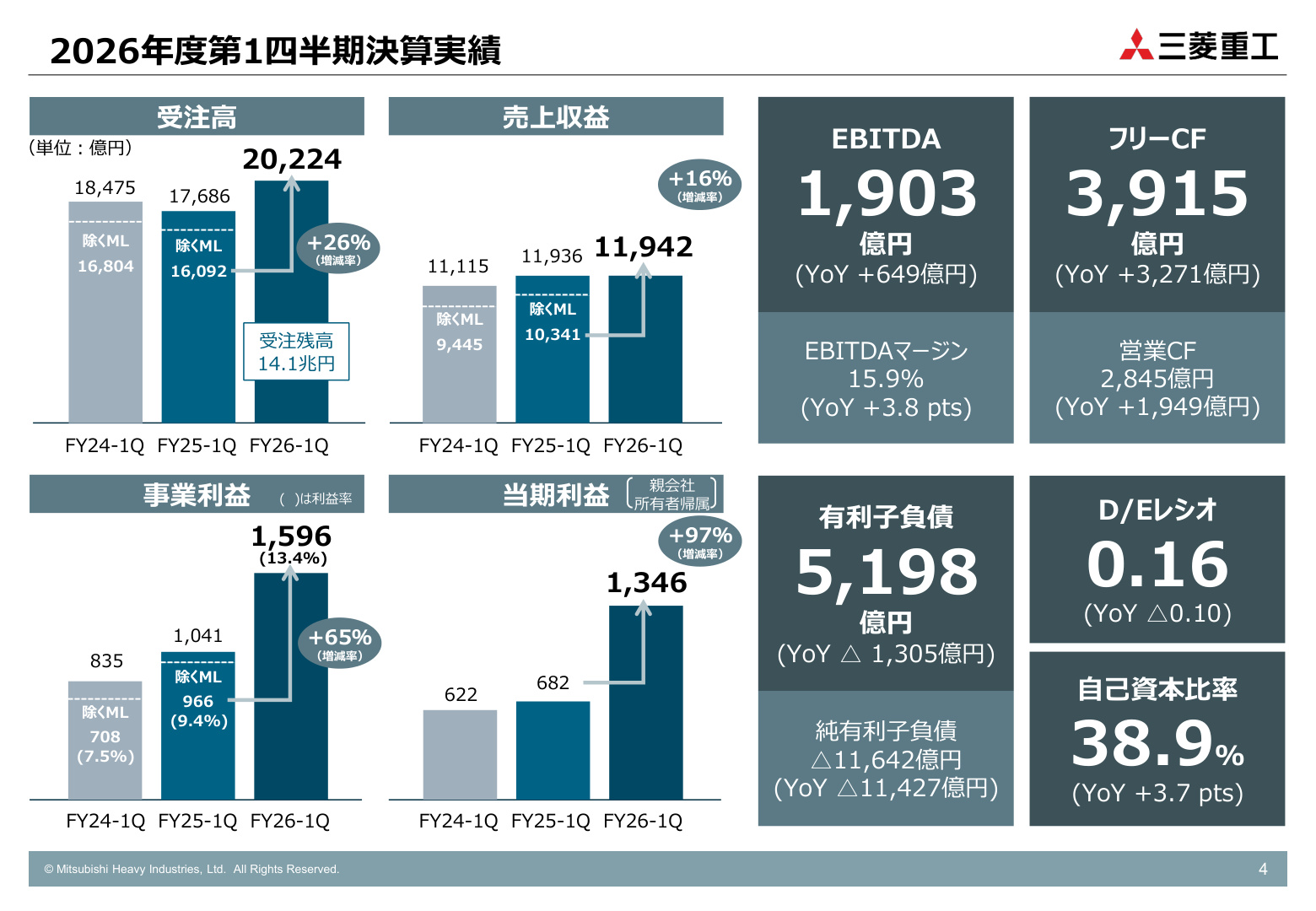
Consolidated results for the first quarter of FY2026 (April 1, 2025, to June 30, 2025) showed remarkable growth across almost all major financial metrics.
- Order Intake : ¥2,022.4 billion (+25.7% / +¥413.2 billion YoY)
- Revenue : ¥1,194.2 billion (+15.5% / +¥160.0 billion YoY)
- Business Profit : ¥159.6 billion (+65.1% / +¥62.9 billion YoY)
- Profit Attributable to Owners of Parent : ¥134.6 billion (+97.4% / +¥66.4 billion YoY)
- EBITDA : ¥190.3 billion (+51.8% / +¥64.9 billion YoY, EBITDA margin 15.9% )
- Free Cash Flow : ¥391.5 billion (+¥327.1 billion YoY)
The following slide visually illustrates the key indicators and their changes for the first quarter.
[Image Commentary: Significance of the Q1 FY2026 Results Slide]
This slide (P.4) provides critical data for understanding the strong performance level of this quarter at a glance. Even on a real-term basis, excluding the impact of the former Mitsubishi Logisnext (ML) deconsolidation from the previous year, the company achieved extremely high growth across all profit stages: order intake (+25.7%), business profit (+65.1%), and net profit (+97.4%). Notably, the order backlog has reached a massive scale of ¥14.1 trillion (+¥865.3 billion from the end of the previous fiscal year), confirming an extremely solid foundation for medium- to long-term revenue. Furthermore, the surge in free cash flow to ¥391.5 billion , which significantly contributed to the reduction of interest-bearing debt (¥519.8 billion, down ¥130.5 billion YoY) and the improvement of the equity ratio ( 38.9% , +3.7 pts YoY), is the most significant financial feature of these earnings.
2. Structural Analysis of Performance: Factors Behind the ¥62.9 Billion Increase in Business Profit
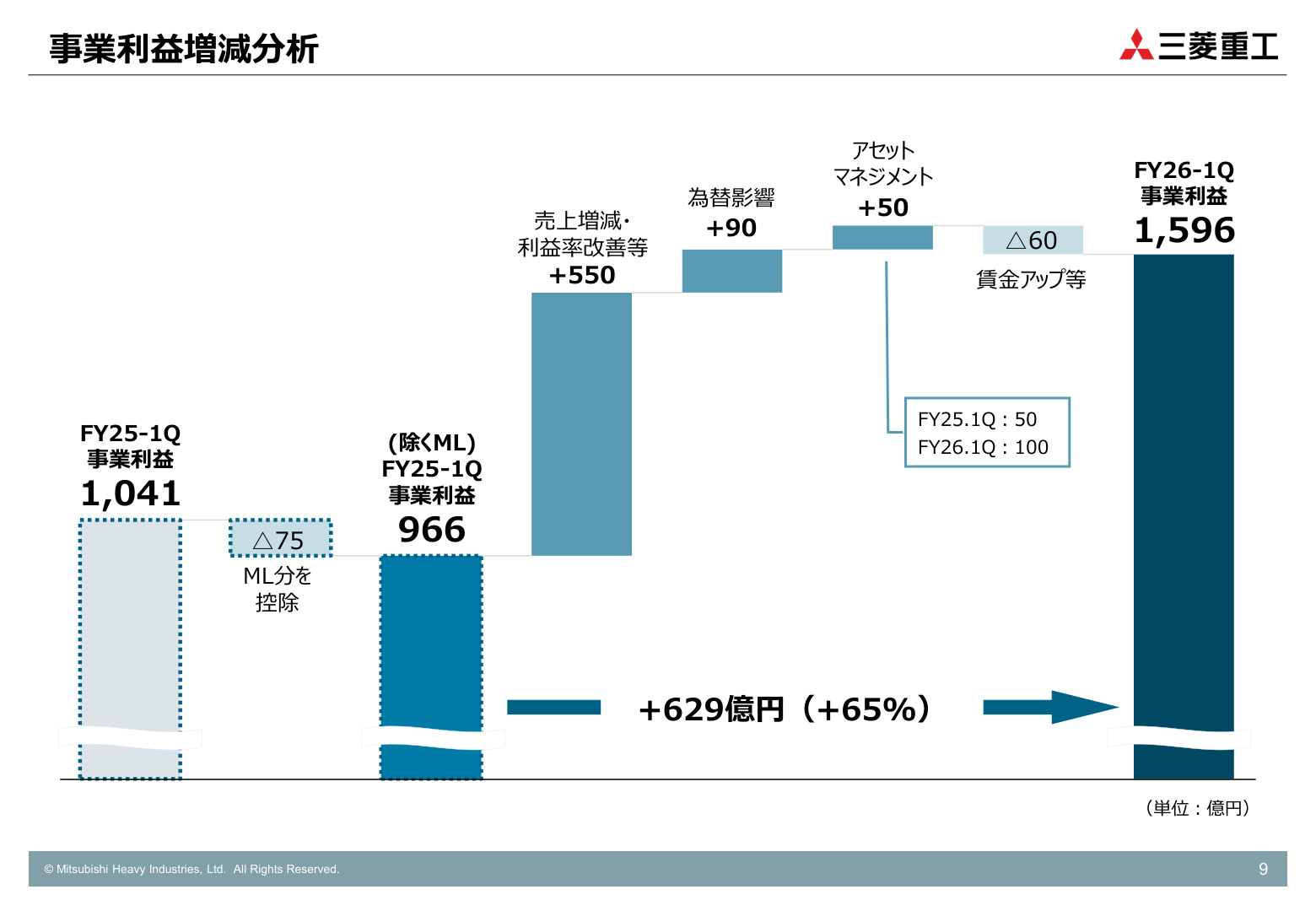
The increase in business profit by ¥62.9 billion (+65%) , from ¥104.1 billion in the same period last year (¥96.6 billion excluding ML), is rooted in structural profit improvements that go beyond mere external tailwinds.
[Image Commentary: Significance of the Business Profit Variance Analysis Slide]
This slide (P.9) breaks down and organizes the factors behind the fluctuation in business profit from the previous year, serving as the key to deeply understanding the profit improvement mechanism of these earnings.
Specifically, it consists of the following factors:
- Revenue/Profit Margin Improvement (+¥55.0 billion) : The primary driver of profit growth, reflecting increased capacity utilization in GTCC (Gas Turbine Combined Cycle) and nuclear power businesses, as well as improved product profitability.
- Foreign Exchange Impact (+¥9.0 billion) : The depreciation of the yen against the US dollar (average rate of 157.2 JPY/USD during the period) boosted profits.
- Asset Management, etc. (+¥5.0 billion) : Contributions from initiatives such as asset efficiency improvements.
- Wage Increases, etc. (-¥6.0 billion) : While absorbing cost increases due to rising labor costs and inflation, the company still secured a substantial net profit increase.
As this analysis makes clear, approximately 87% (¥55.0 billion) of the total profit increase is derived from core business revenue growth and margin improvement , indicating high-quality profit growth that is not reliant on currency fluctuations.
3. Detailed Segment Performance Analysis
Here is an overview of the trends in each segment that drove company-wide success.
(1) Energy Segment
- Order Intake : ¥1,359.3 billion (+56.0% YoY)
- Revenue : ¥536.3 billion (+26.7% YoY)
- Business Profit : ¥101.3 billion (+79.6% YoY / Business Profit Margin 18.9% )
Details : This segment was the primary driver of this quarter's earnings. Against the backdrop of expanding data center demand and rising electricity consumption, particularly in North American and Asian markets, GTCC orders were exceptionally strong . The number of large gas turbine orders increased from 8 units (4GW) in the same period last year to 10 units (4GW) , with a contract backlog reaching 80 units (35GW). Furthermore, the nuclear power business saw significant growth in both orders and revenue due to progress in domestic restart-related work and safety enhancement projects. The business profit margin improved significantly from 13.3% in the same period last year to 18.9%.
(2) Plants & Infrastructure Segment
- Order Intake : ¥368.8 billion (+54.0% YoY)
- Revenue : ¥200.0 billion (-3.8% YoY)
- Business Profit : ¥21.7 billion (+17.3% YoY / Business Profit Margin 10.9% )
Details : In terms of orders, large-scale projects in steel machinery and commercial ships (including engineering) contributed to significant growth. Although revenue saw a slight decline due to decreases in steel machinery and mechanical systems, the segment secured a 17% increase in profit and maintained a high profit margin (10.9%) due to profit growth in the engineering field and the progress of high-margin projects.
(3) Industrial Solutions Segment
- Order Intake : ¥193.0 billion (+18.6% YoY)
- Revenue : ¥177.9 billion (+15.1% YoY)
- Business Profit : ¥9.9 billion (+146.3% YoY / Business Profit Margin 5.6% )
Details : Profit was boosted by the recovery in demand for engines and turbochargers , primarily in the Asian market, as well as strong performance in the refrigeration and car air conditioning business , including large-scale domestic chillers. Business profit more than doubled from the same period last year (¥4.0 billion) to ¥9.9 billion, and the operating profit margin improved rapidly from 2.6% to 5.6%.
(4) Aircraft, Defense & Space Segment
- Order Intake : ¥120.9 billion (-65.5% YoY)
- Revenue : ¥286.0 billion (+9.8% YoY)
- Business Profit : ¥32.4 billion (+12.5% YoY / Business Profit Margin 11.3% )
Details : Order intake temporarily declined due to the rebound from a concentration of ultra-large defense-related orders in the same period last year, but demand remains at a high level. In terms of revenue, progress on defense aircraft and missiles was steady, and combined with the foreign exchange impact on commercial aircraft (recovery in shipments for Boeing 777, 787, etc.), both revenue and business profit exceeded the same period last year.
4. Revision of Full-Year Outlook and Growth Story
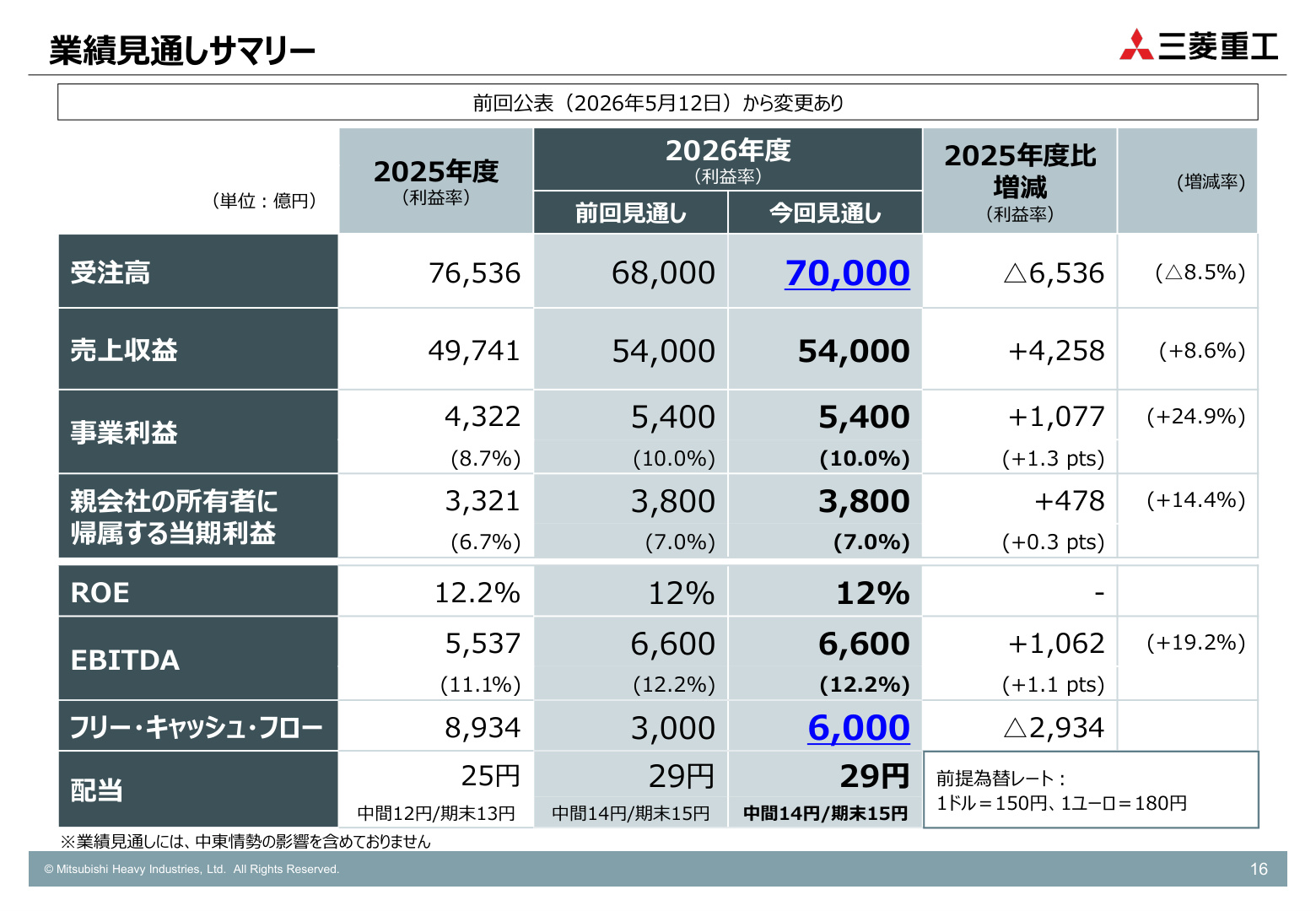
Given that progress in the first quarter has exceeded expectations, the company has partially upwardly revised its full-year earnings forecast for FY2026 (ending March 2026).
[Image Commentary: Significance of the Earnings Outlook Summary Slide]
This slide (P.16) is a crucial section demonstrating the company's confidence and revision points regarding its FY2026 full-year performance targets .
Key points of the revision are as follows:
- Order Intake Forecast : Increased by +¥200 billion from the previous forecast of ¥6.8 trillion to ¥7.0 trillion (-8.5% YoY). This primarily reflects higher-than-expected demand accumulation in the Energy (GTCC) and Aircraft, Defense & Space segments.
- Free Cash Flow Forecast : Doubled by +¥300 billion , from the previous forecast of ¥300 billion to ¥600 billion . This is due to the significant cash-in achieved in the first quarter (¥391.5 billion) and successful strengthening of working capital management.
- Revenue and Business Profit : The full-year forecasts of ¥5.4 trillion in revenue (+8.6% YoY) and ¥540 billion in business profit (+24.9% YoY, business profit margin 10.0% ) remain unchanged. However, the progress rate for business profit has already reached approximately 30% in the first quarter, indicating a very high level of confidence in achieving these targets.
- Dividend Policy : The annual dividend forecast is maintained at ¥29 per share (¥14 interim / ¥15 year-end).
5. Regional Trends and Key Takeaways for Investors
According to the regional revenue data in the supplementary materials (P.23), out of the total revenue of ¥1,194.2 billion, the composition is Japan (¥478.8 billion / 40%) , Americas (¥357.4 billion / 30%) , Asia-Pacific (¥187.5 billion / 16%) , and EMEA (¥170.4 billion / 14%) . Business expansion in overseas markets, centered on North America (60% of total revenue), is a powerful driving force.
Comprehensive Summary (10 Key Topic Analysis)
- Overview of Significant Revenue and Profit Growth : Achieved high growth with +16% revenue and +65% business profit.
- Order Backlog Surpasses Record Highs : Secured a ¥14.1 trillion backlog, ensuring excellent medium- to long-term visibility.
- Dramatic Improvement in Cash Flow : Generated ¥391.5 billion in free cash flow and significantly revised the full-year forecast to ¥600 billion.
- Further Strengthening of Financial Position : Reduction of interest-bearing debt continues, with the D/E ratio falling to 0.16 .
- Explosive Growth in Energy Business : Driven by GTCC and nuclear power, segment business profit grew by +80% .
- Global Dominance in GTCC : The contract backlog for large gas turbines has reached 80 units (35GW) .
- Profit Recovery in Industrial Solutions : Driven by engines and refrigeration, business profit grew by +146% .
- Stable Performance in Aircraft, Defense & Space : Despite a lull in mid-term orders, business profit grew by +13% due to increased defense-related revenue.
- Upward Revision of Full-Year Order Intake : Increased from the initial plan of ¥6.8 trillion to ¥7.0 trillion .
- Competitiveness in Overseas Markets : Established a foundation to accurately capture power and cooling demand, such as for North American data centers.
In summary, Mitsubishi Heavy Industries' Q1 FY2026 earnings can be evaluated as evidence of the company's transformation into a structurally high-profit enterprise , supported by the rapid expansion of national-level demand for decarbonization, energy security, and defense.
This content is not intended as investment advice or a recommendation. Any opinions expressed are solely the personal views of each article.