


Earnings Deep Dive: NTN Q1 FY2027 – Revenue and Profit Growth Driven by Structural Reform and FX Tailwinds; Progress Toward Integration with NSK

StockClub
Published: Aug 04, 2026, 10:02 AM
Sentiment Analysis

Earnings Deep Dive: NTN Q1 FY2027 – Revenue and Profit Growth Driven by Structural Reform and FX Tailwinds; Progress Toward Integration with NSK
NTN Corporation (Securities Code: 6472) has released its financial results for the first quarter of the fiscal year ending March 31, 2027 (April 1, 2026 – June 30, 2026). As the company advances its structural reform program, " DRIVE NTN100 Final ," it achieved year-on-year growth in both revenue and profit , supported by improved selling prices, various cost-reduction measures, and favorable foreign exchange effects from the weak yen. Furthermore, discussions regarding the business integration with NSK Ltd. , a move drawing significant industry attention, are proceeding smoothly.
This report extracts 10 key topics from the disclosed financial materials to provide a comprehensive and objective analysis of the company's latest performance, factor analysis, trends by business segment and region, financial health improvements, and the progress of its structural reforms.
1. Earnings Highlights and Key Topics
First, we summarize the key points of this quarter's financial results:
- Consolidated Q1 results show growth in both revenue and profit (Net sales: 212.3 billion yen; Operating income: 8.3 billion yen).
- Full-year earnings and dividend forecasts remain unchanged (Annual dividend forecast: 13.0 yen per share).
- Improved selling prices, structural reforms, and FX gains served as primary profit drivers.
- Aftermarket business remained robust , with its share of total sales rising to 19%.
- CVJ Axle business overcame production cuts and project completions in China to secure profit growth.
- Excluding FX impacts, the company saw a decline in revenue , highlighting a challenging demand environment.
- Inventory reduction progressed , with inventory turnover improving to 3.5x.
- Interest-bearing debt continued to decrease , maintaining a net D/E ratio of 0.6x (0.5x on an adjusted basis).
- Operating cash flow improved significantly , generating 14.7 billion yen in free cash flow.
- Due diligence for the business integration with NSK Ltd. is currently underway .
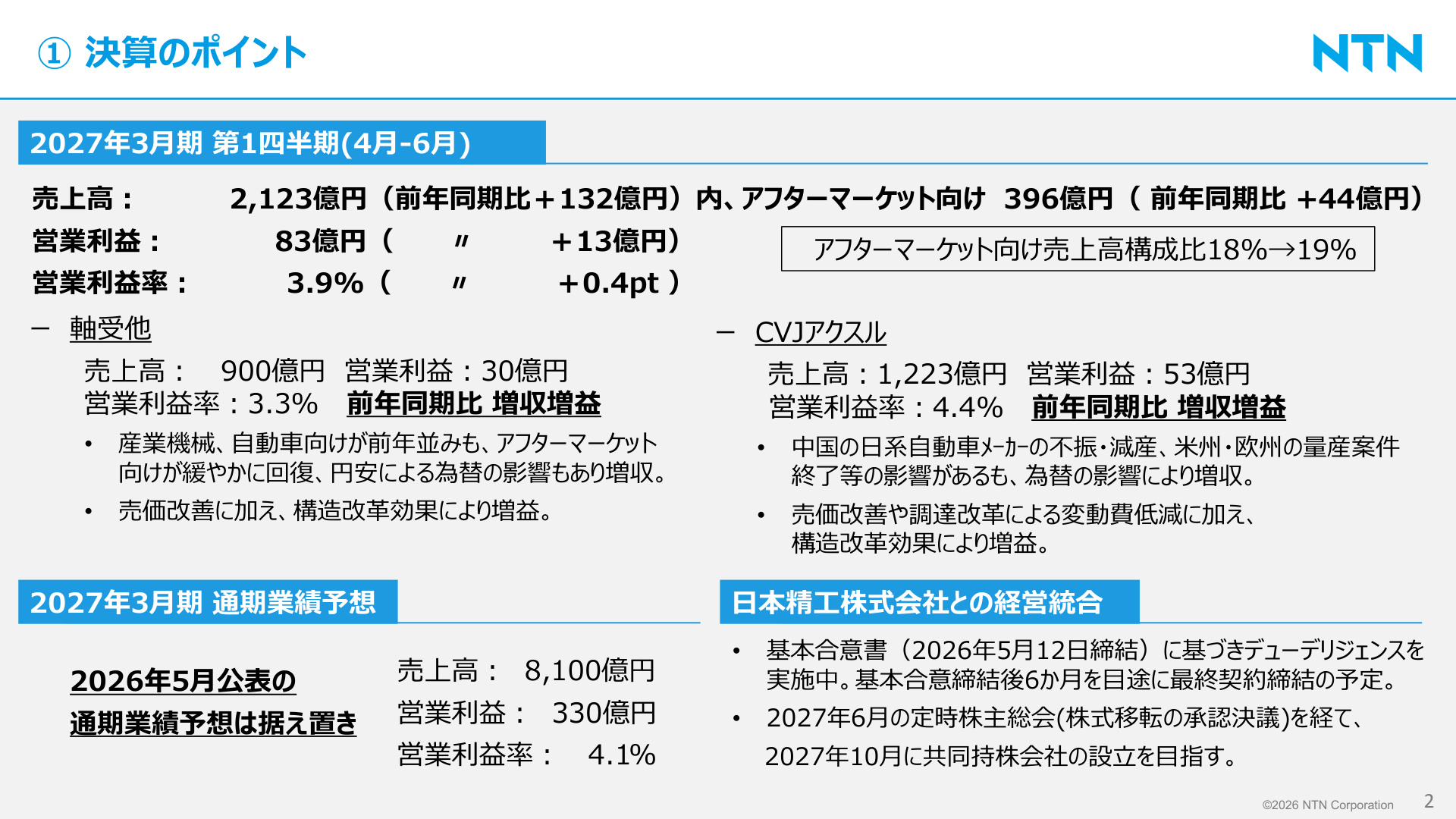
[Significance and Background of Slide 1 (PAGE_1)]
This slide is critical as it consolidates the key performance highlights for Q1 FY2027 and the schedule for the business integration with NSK Ltd. , the company's most important strategic topic, onto a single screen.
Regarding performance, net sales reached 212.3 billion yen (+13.2 billion yen YoY) , and operating income reached 8.3 billion yen (+1.3 billion yen YoY) , with an operating margin of 3.9% (+0.4pt). The growth in high-margin aftermarket sales to 39.6 billion yen (19% of total sales) contributed to the overall bottom line.
Even more significant is the progress on the "Business Integration with NSK Ltd." shown at the bottom right. Following the basic agreement signed on May 12, 2026, the company is currently conducting due diligence. The roadmap remains unchanged: signing the final agreement within approximately six months of the basic agreement, obtaining approval at the annual general meeting of shareholders in June 2027, and establishing a joint holding company in October 2027 .
2. Analysis of Operating Income Variance
The increase in operating income from 7.0 billion yen in the same period last year to 8.3 billion yen is the result of a complex interplay between positive and negative factors.
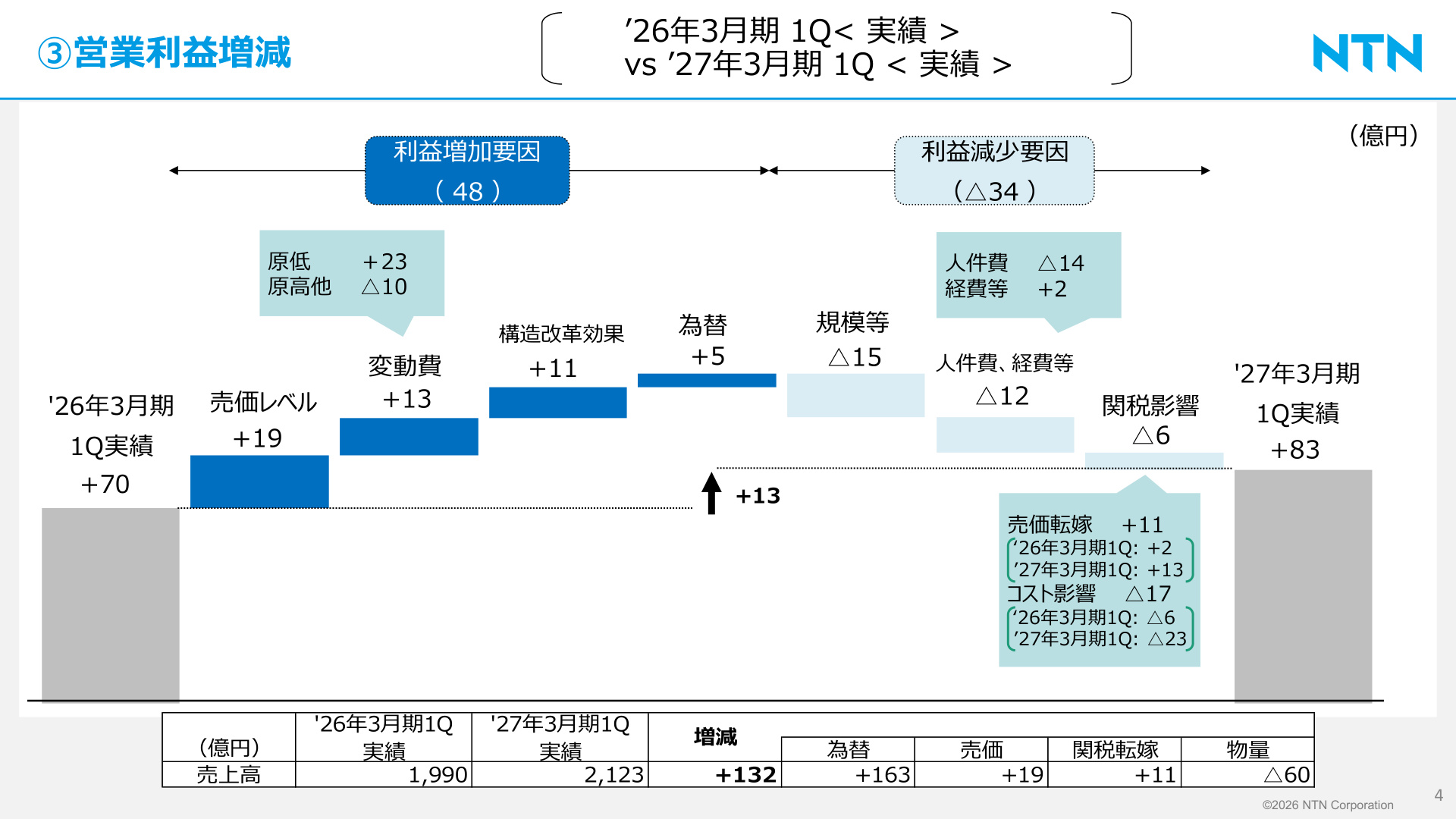
[Significance and Background of Slide 3 (PAGE_3)]
This slide visualizes the variance in operating income using a waterfall chart, providing crucial data for analyzing how "internal factors (structural reforms and sales strategies)" and "external factors (demand trends and cost increases)" impacted profitability.
Details of the primary profit-increasing factors (total +4.8 billion yen) are as follows:
- Improved selling prices (+1.9 billion yen) : Negotiations to pass on cost increases caused by inflation to product prices were successful.
- Variable cost reduction (+1.3 billion yen) : Cost-reduction activities (+2.3 billion yen) outweighed the impact of rising raw material costs (△1.0 billion yen), creating a net positive effect.
- Structural reform effects (+1.1 billion yen) : Production efficiency and fixed cost reductions under "DRIVE NTN100 Final" are yielding steady results.
- FX impact (+0.5 billion yen) : Positive contribution from the weak yen.
Conversely, profit-decreasing factors (total △3.4 billion yen) include:
- Volume, etc. (△1.5 billion yen) : Impact of declining sales volume due to the slowdown in automotive production, primarily in China, and the completion of mass-production projects.
- Personnel and other expenses (△1.2 billion yen) : Increases in personnel costs due to global inflation and fluctuations in various expenses.
- Tariff impact (△0.6 billion yen) : Despite progress in cost pass-throughs (+1.1 billion yen), it did not fully offset the total increase in tariff costs (△1.7 billion yen), resulting in a net negative impact.
As shown, the company successfully countered headwinds such as volume declines and rising costs through self-driven profit improvement measures: price pass-throughs, cost reductions, and structural reforms.
3. Performance Trends by Business Segment and Region
Trends by Business Segment (Bearings vs. CVJ Axles)
NTN's business is broadly divided into " Bearings and Others " and " CVJ (Constant Velocity Joint) Axles ."
-
Bearings and Others :
- Net Sales: 90.0 billion yen (+7.0 billion yen YoY / +0.8 billion yen excluding FX)
- Operating Income: 3.0 billion yen (+0.7 billion yen YoY / 3.3% operating margin)
- While industrial machinery and automotive sales remained flat, the gradual recovery of the high-margin aftermarket segment , combined with price improvements and structural reform effects, led to growth in both revenue and profit.
-
CVJ Axle Business :
- Net Sales: 122.3 billion yen (+6.2 billion yen YoY / △3.8 billion yen excluding FX)
- Operating Income: 5.3 billion yen (+0.6 billion yen YoY / 4.4% operating margin)
- Despite volume-based revenue declines (△3.8 billion yen excluding FX) due to the struggles of Japanese automakers in China and the completion of mass-production projects in the Americas and Europe, the business achieved profit growth thanks to FX tailwinds and variable cost reductions through procurement reforms and price improvements.
Trends by Region
Looking at net sales by region (excluding inter-group sales), the differences in demand environments on a real basis (excluding FX translation) become clear:
- Japan : Net sales of 53.4 billion yen (+1.6 billion yen YoY, +1.6 billion yen excluding FX). Remained robust, driven by industrial machinery and the aftermarket.
- Americas : Net sales of 69.1 billion yen (+4.7 billion yen YoY, △2.4 billion yen excluding FX). While the weak yen boosted revenue, demand was down in real terms.
- Europe : Net sales of 50.4 billion yen (+4.1 billion yen YoY, △1.5 billion yen excluding FX). Similar to the Americas, growth was primarily driven by FX translation.
- Asia and Others : Net sales of 39.3 billion yen (+2.8 billion yen YoY, △0.7 billion yen excluding FX). Impacted by the sluggish Chinese market.
In terms of regional operating income, Japan ( 4.2 billion yen , a significant increase from 0.5 billion yen last year) and Asia/Others ( 4.3 billion yen ) are the primary profit pillars, while profitability in the Americas ( 0.5 billion yen ) and Europe ( △0.4 billion yen loss ) remains a challenge.
4. Financial Position and Cash Flow Trends
As part of its structural reform, NTN is tightening its balance sheet and strengthening its cash-generating capabilities.
Control of Inventory and Interest-Bearing Debt
- Inventory : Stood at 245.6 billion yen as of the end of June 2026, remaining nearly flat from 245.9 billion yen at the end of March 2026 (△0.2 billion yen YoY). Inventory turnover improved to 3.5x (from 3.4x in the same period last year), and management continues to work toward the full-year targets of 220 billion yen and 3.7x.
- Interest-bearing debt : Stood at 302.4 billion yen as of the end of June 2026 (△16.8 billion yen from the end of March 2026). The net D/E ratio is maintained at 0.6x (0.5x after considering the equity credit of hybrid financing), and the company is on track toward its full-year target of 300 billion yen.
Cash Flow Structure
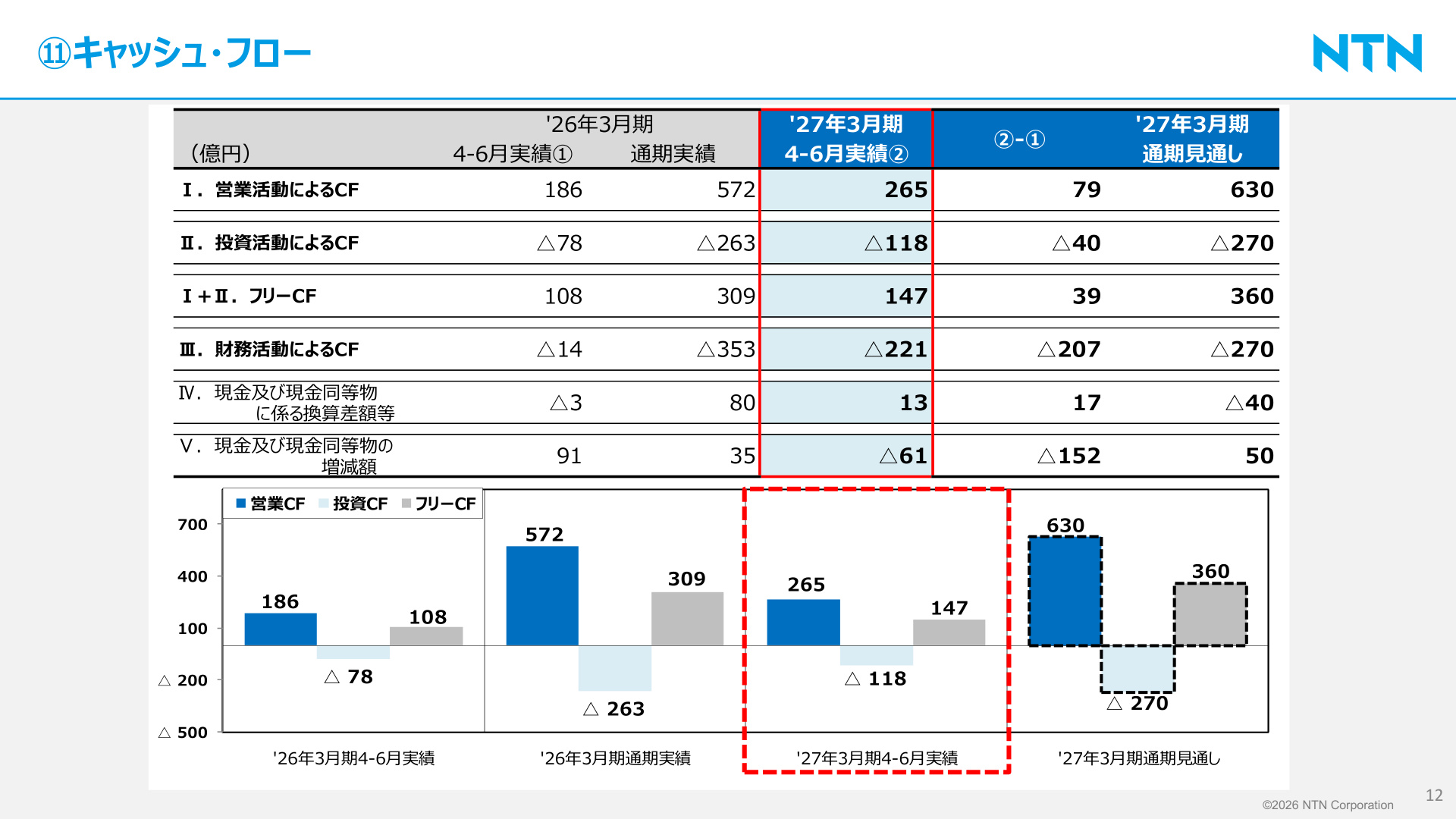
[Significance and Background of Slide 11 (PAGE_11)]
This slide illustrates the company's cash-generating ability , which is critical for understanding how it funds future growth investments, shareholder returns, and debt reduction.
Operating cash flow (Operating CF) for Q1 reached 26.5 billion yen , a significant increase of +7.9 billion yen from the same period last year (18.6 billion yen). This was driven by increased operating income and efficient working capital management, such as inventory control.
Meanwhile, investing cash flow (Investing CF) was △11.8 billion yen , an increase in investment from the same period last year (△7.8 billion yen). Capital expenditures were 7.1 billion yen (5.0 billion yen last year), reflecting continued investment in future productivity and rationalization.
As a result, free cash flow (Free CF) , calculated as Operating CF minus Investing CF, was a surplus of 14.7 billion yen (+3.9 billion yen from 10.8 billion yen last year). This FCF was allocated to financing activities (△22.1 billion yen, including debt repayment), demonstrating a virtuous cycle where improved profitability directly leads to debt reduction and a stronger financial position.
5. Outlook and Summary
The company has maintained its full-year earnings forecast for the fiscal year ending March 31, 2027:
- Net Sales : 810.0 billion yen (△16.3 billion yen YoY)
- Operating Income : 33.0 billion yen (+2.0 billion yen YoY)
- Operating Margin : 4.1% (+0.3pt YoY)
- Ordinary Income : 21.0 billion yen
- Net Income Attributable to Owners of Parent : 15.0 billion yen
- Annual Dividend : 13.0 yen (Interim 6.5 yen, Year-end 6.5 yen)
Although external challenges remain—such as automotive production trends in the Americas, Europe, and China, and an uncertain macroeconomic environment—the company is thoroughly implementing price improvements, cost reductions, procurement reforms, and inventory reduction under "DRIVE NTN100 Final."
The generation of free cash flow and the improvement in operating margin in Q1 indicate that these structural reform measures are taking hold. Moving forward, the key focus for the company's long-term corporate value will be further improving the profitability of existing businesses and ensuring that the procedures for the business integration with NSK Ltd., targeted for October 2027 , proceed according to plan.
This content is not intended as investment advice or a recommendation. Any opinions expressed are solely the personal views of each article.