


St. Cousair (2937) Q1 FY2027 Earnings Deep Dive Report

StockClub
Published: Aug 04, 2026, 09:52 AM
Sentiment Analysis

St. Cousair (2937) Q1 FY2027 Earnings Deep Dive Report
1. Earnings Overview and Performance Highlights
St. Cousair Co., Ltd. (Securities Code: 2937) reported its consolidated financial results for the first quarter of the fiscal year ending March 31, 2027 (April 1, 2026, to June 30, 2026). Driven by the stability of its core domestic retail business and growth in wholesale and global operations, net sales reached 5,081 million yen (+6.3% YoY) , marking a record-high top line for a first quarter. Conversely, due to soaring material and raw ingredient costs, alongside upfront investments for future growth, gross profit was 1,763 million yen (+1.8% YoY) , operating profit was 73 million yen (-47.0% YoY) , and ordinary profit was 81 million yen (-23.3% YoY) . However, thanks to a reduction in extraordinary losses compared to the previous year, net profit attributable to owners of the parent rose to 37 million yen (+32.8% YoY) .
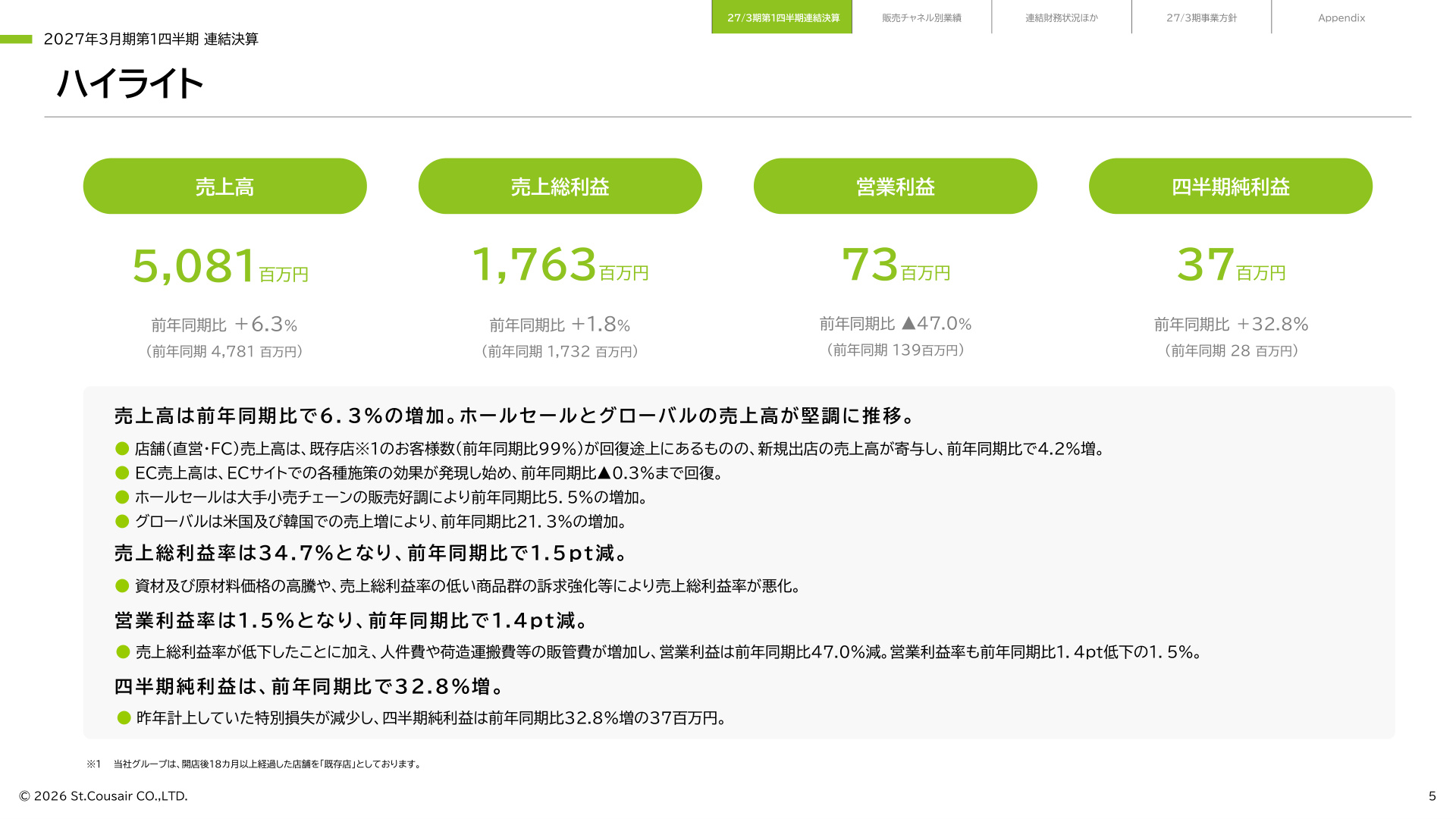
The slide above highlights the key factors symbolizing the overall performance and shifts in the profit structure for this quarter . As the data indicates, the top line (net sales) grew steadily by 300 million yen (+6.3% YoY) . This growth was driven by the wholesale business (+5.5% YoY) , fueled by increased transactions with major domestic retail chains, and the global business (+21.3% YoY) , which is expanding primarily in the U.S. and South Korea.
On the profit front, the gross profit margin fell by 1.5 points YoY to 34.7% . This was primarily due to higher costs for raw materials and packaging, as well as a shift in product mix toward high-profile, high-appeal items with relatively lower margins, as the company prioritized "store floor reforms" to recover customer traffic. Furthermore, operating profit was pressured by a 6.1% increase in SG&A expenses, including higher depreciation costs (+19 million yen YoY) linked to the operation and capital investment of the "Nagano Production Base," base salary increases (+30 million yen YoY) , and higher packing and shipping costs (+30 million yen YoY) associated with increased sales. Consequently, the operating profit margin contracted to 1.5% (-1.4 points YoY) .
2. Performance Trends by Channel and Expansion of Customer Base
A detailed analysis of performance by sales channel clarifies the strengths and challenges of the company's multi-channel (omnichannel and global) strategy .
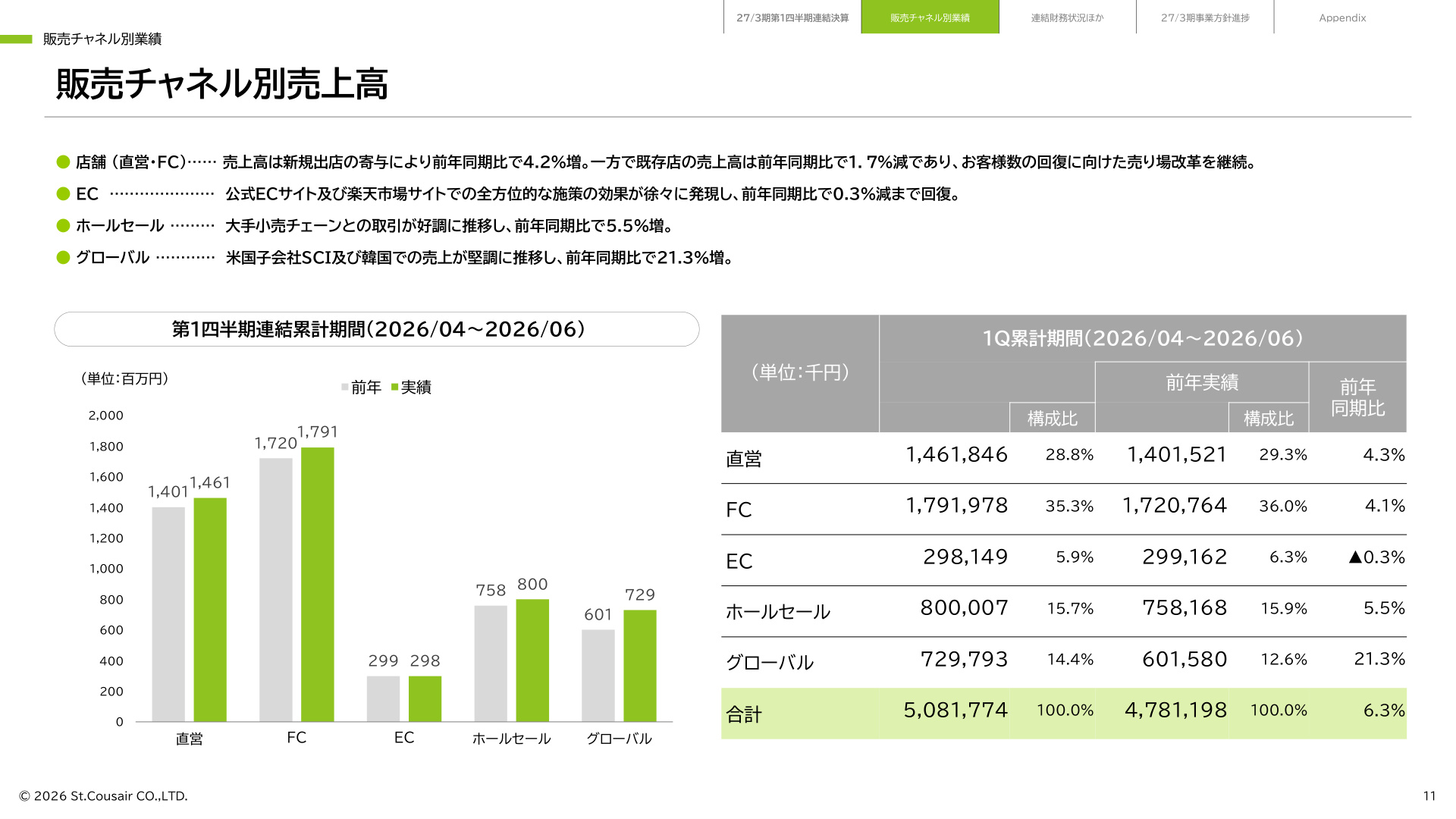
The sales by channel slide above visualizes the diversity of the company's business structure and the growth pace of each segment. The status of each channel is as follows:
-
Store Business (Directly Managed & FC): Directly managed store sales were 1,461 million yen (+4.3% YoY) , and FC store sales were 1,791 million yen (+4.1% YoY) . While new store openings contributed to sales growth as the company shifted its strategy from "quantity to quality," same-store sales declined by 1.7% YoY. However, customer traffic at existing stores is showing a steady recovery trend, supported by the resumption of in-store sampling and enhanced store displays.
-
Customer Base (CRM & Loyal Customers): The number of store members grew to 489,000, marking the 27th consecutive month of month-on-month growth . Furthermore, through initiatives such as app-based point rewards, the ratio of loyal customers —who exhibit high purchase frequency and spending—has risen to 18.5%, forming a solid foundation for repeat purchases.
-
EC Business: Sales were 298 million yen (-0.3% YoY) , recovering to levels comparable to the previous year. Various promotional and UI improvement measures on the company's own e-commerce site and external malls are beginning to yield results.
-
Wholesale Business: Sales grew steadily to 800 million yen (+5.5% YoY) . Against the backdrop of rising national brand awareness for "Kuze Fuku & Co.," the company has expanded its presence in major retail chains, including supermarkets and convenience stores.
-
Global Business: Sales recorded the highest growth rate at 729 million yen (+21.3% YoY) . This was significantly contributed to by the growth of the company's own "KUZE FUKU & SONS" brand in the U.S., the contribution of the acquired "KELLY'S JELLY" brand, and expanded transactions through the South Korean subsidiary (SCK).
3. Financial Position and Capital Efficiency
As of the end of the first quarter (June 30, 2026), total assets stood at 10,544 million yen (+3.3% from the end of the previous fiscal year) . With the acquisition of the new "Nagano Production Base," fixed assets increased to 4,251 million yen (+10.8%) . To fund this, the company utilized long-term borrowings, resulting in total liabilities rising to 5,616 million yen (+11.9%) and an equity ratio of 46.7% (-4.1 points) .
Regarding capital efficiency, ROE (trailing 12 months) improved to 13.1% in line with the increase in net profit attributable to owners of the parent. Conversely, ROIC declined to 7.6% due to the increase in invested capital from capital expenditures and the temporary decline in operating profit. The company plans to boost ROIC again by improving the utilization rate of the new factory and reducing costs through increased in-house production.
4. Mid-to-Long-Term Growth Strategy and Global Expansion Progress
St. Cousair is pursuing two major strategies for sustainable growth: "Expanding domestic profitability and production efficiency" and "Leaping forward in the global business."
In the domestic business, the company is implementing store reforms to increase annual sales per existing store by 1.2 times and is working to increase the in-house production ratio and reduce costs by introducing AI and automated lines at the "Nagano Production Base," which began operations in June 2026. Furthermore, by strengthening M&A within its "Food SPA (Specialty Store Retailer of Private Label Apparel) model," which integrates development, manufacturing, and sales, the company aims to improve gross margins and create high-value-added products.
In the global business, expanding in the massive U.S. market is the top priority.
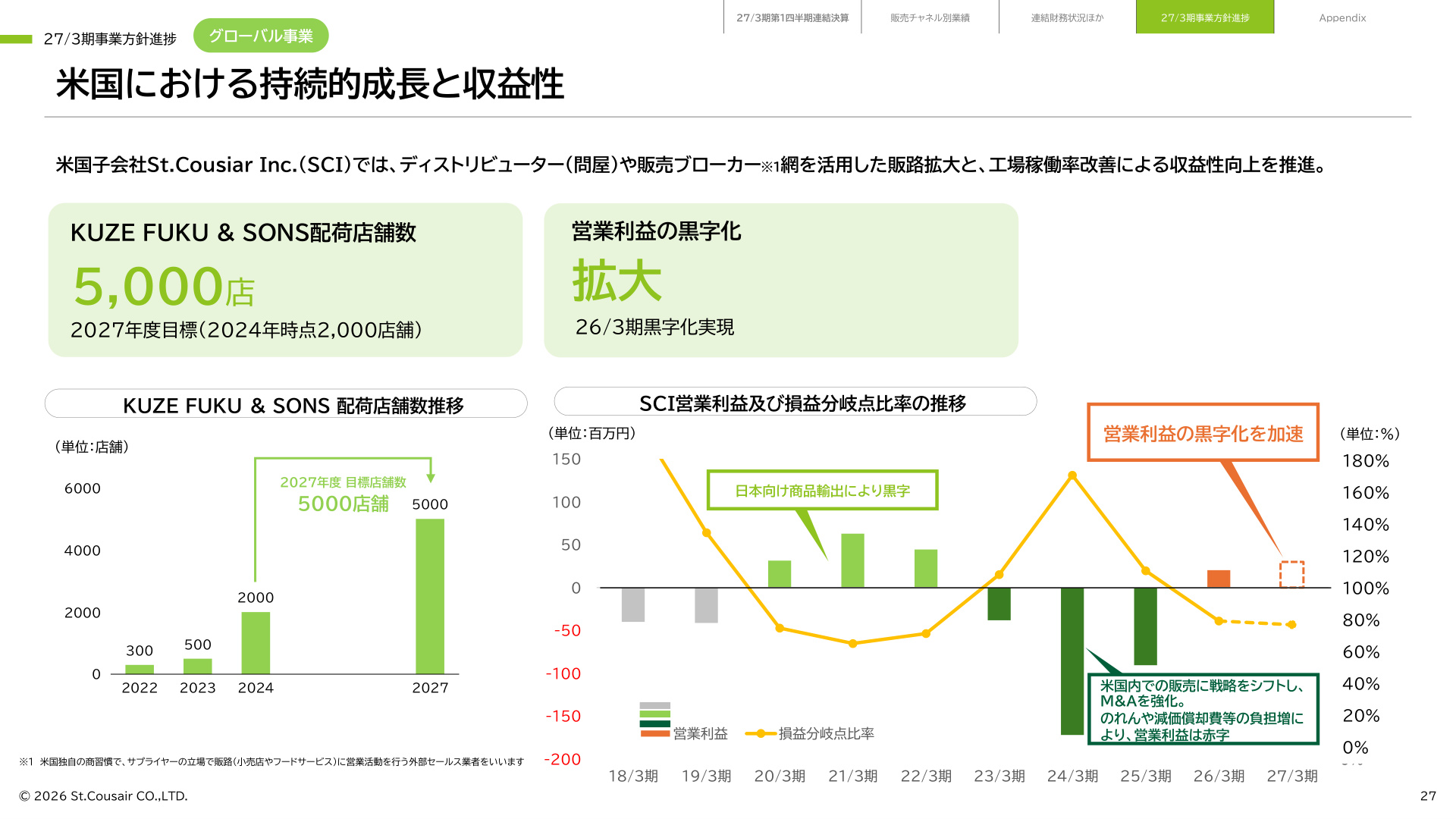
The slide above shows the roadmap for the U.S. market, a key growth driver . The U.S. subsidiary (SCI) is expanding distribution across the U.S. by leveraging distributors and sales broker networks, aiming for the "KUZE FUKU & SONS" brand to be carried in 5,000 stores by FY2027 (up from 2,000 in 2024) .
Regarding P&L, although the business had been posting operating losses due to goodwill and depreciation from past M&As, the break-even point ratio has dropped significantly. This is due to improved utilization of the U.S. factory, increased exports to Japan, and the progress of cross-selling strategies with acquired brands such as "Portlandia," "Bonnie's Jams," and "KELLY'S JELLY." The company expects to accelerate the stabilization and expansion of operating profit . In Asia, the company is building a global growth foundation, with stable growth in Taiwan and the introduction of products to major retailers via the local South Korean subsidiary (SCK).
5. Progress Against Full-Year Forecasts and Summary
Progress against the full-year consolidated earnings forecast for the fiscal year ending March 31, 2027, is as follows:
- Net Sales: 5,081 million yen / Full-year forecast 21,082 million yen ( 24.1% progress )
- Operating Profit: 73 million yen / Full-year forecast 812 million yen ( 9.0% progress )
- Ordinary Profit: 81 million yen / Full-year forecast 758 million yen ( 10.7% progress )
- Net Profit: 37 million yen / Full-year forecast 403 million yen ( 9.2% progress )
Progress in net sales is very steady at 24.1% . While profit progress appears low at first glance, the company's business model has seasonal characteristics where profits concentrate in the third quarter (October–December) due to autumn/winter gift demand and the Christmas shopping season. Therefore, the company has maintained its full-year earnings forecast.
Although this quarter saw upfront investment burdens such as new factory operations and base salary increases, profitability is expected to improve toward the second half of the year, driven by the recovery in store customer traffic, steady sales growth in wholesale and the U.S., and anticipated manufacturing cost reductions.
This content is not intended as investment advice or a recommendation. Any opinions expressed are solely the personal views of each article.