


Daicel Corporation: Q1 FY2027 Earnings Deep Dive Report

StockClub
Published: Aug 03, 2026, 11:52 AM
Sentiment Analysis
Introduction: Overview of Daicel's Q1 FY2027 Financial Results
Daicel Corporation’s Q1 FY2027 financial results marked a strong start to the fiscal year, with the company achieving year-on-year growth in both revenue and key profit metrics , significantly outperforming initial company forecasts .
Key consolidated financial figures for Q1 are as follows:
- Revenue : ¥152.4 billion (+9.4% YoY, +10.0% vs. forecast)
- Operating Profit : ¥14.0 billion (+7.7% YoY, +116.0% vs. forecast)
- Ordinary Profit : ¥14.6 billion (+18.1% YoY, +108.2% vs. forecast)
- Net Income Attributable to Owners of Parent : ¥9.4 billion (-2.7% YoY, +87.2% vs. forecast)
- EBITDA : ¥24.8 billion (+8.4% YoY)
The strong Q1 performance, which saw profit levels more than double against the plan, was driven by proactive sales price revisions in response to rising raw material and fuel costs, the impact of moving-average inventory valuation from the previous fiscal year-end, and robust demand in the core High-Performance Polymers segment. The slight year-on-year decline in net income is attributed to the absence of subsidy income recorded in the same period last year.
Chapter 1: Transition to a New Segment Structure and Business Restructuring
Starting in FY2027, Daicel has revised its business segments to clarify business characteristics and focus resources on growth areas.
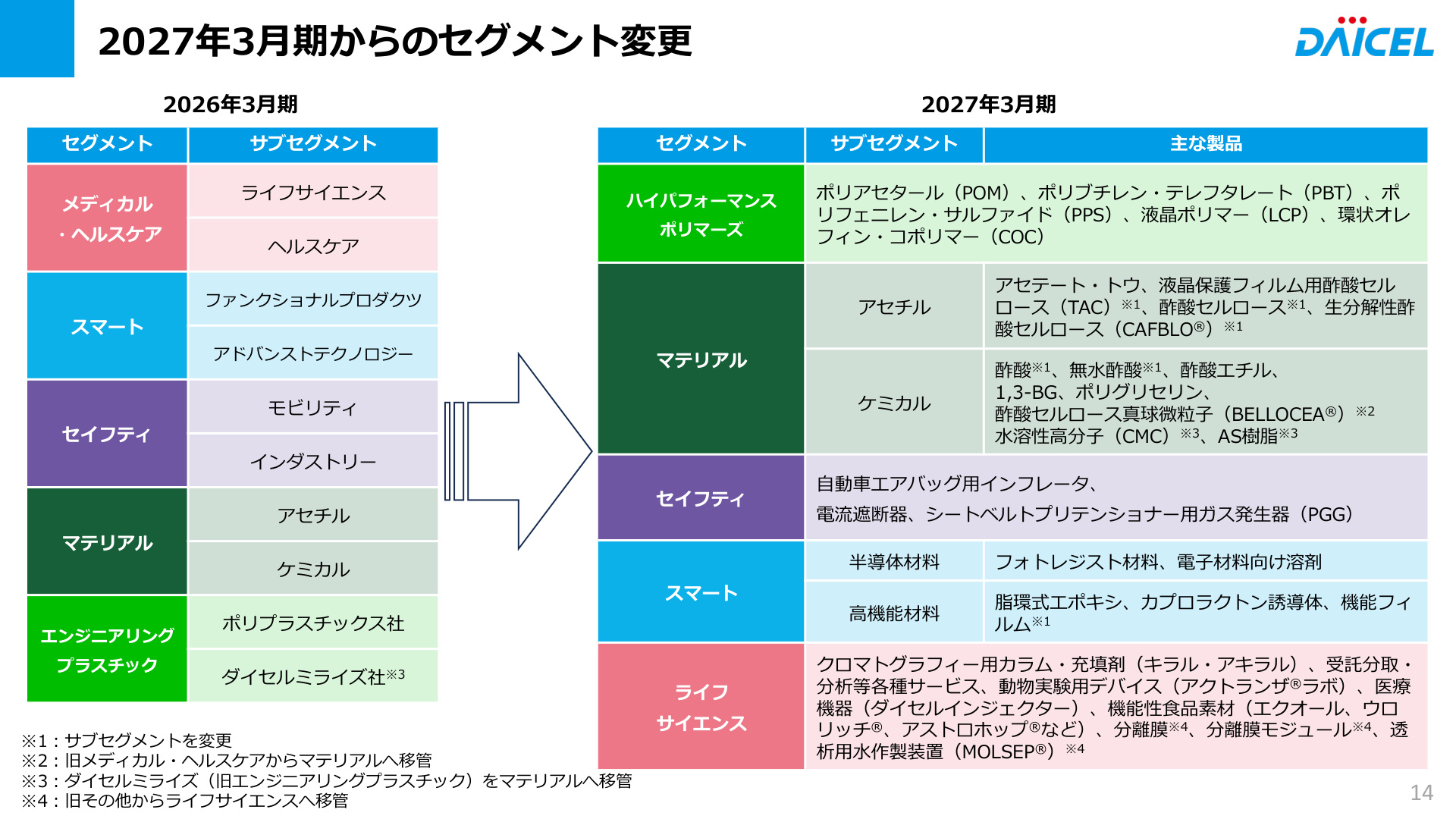
Slide Commentary: Background and Structural Changes in Segments
The slide above illustrates the comparison between the old segments (up to FY2026) and the new segments (from FY2027). The organization, previously dispersed across "Medical/Healthcare," "Smart," "Safety," "Material," and "Engineering Plastics," has been reorganized into five new segments: "High-Performance Polymers," "Material," "Safety," "Smart," and "Life Sciences."
Key changes include:
- Independence of High-Performance Polymers : High-performance resins previously handled by Polyplastics Co., Ltd.—such as POM (polyacetal), LCP (liquid crystal polymer), PBT (polybutylene terephthalate), and PPS—have been consolidated into a single, core business unit.
- Functional Integration into Material : Daicel Miraizu and parts of the former Medical/Healthcare segment have been integrated into the Acetyl/Chemical domain (Material) to strengthen synergies in the chemical business.
- Establishment of the Life Sciences Domain : Chiral columns, contract analysis, and functional food ingredients (e.g., Equol) have been consolidated to redefine the growth axis in high-value-added areas.
This restructuring provides a clearer disclosure of investment priorities and the profitability of each business.
Chapter 2: Segment Performance and Factor Analysis
The analysis of revenue and operating profit for each segment in Q1, compared to the previous year, is as follows:
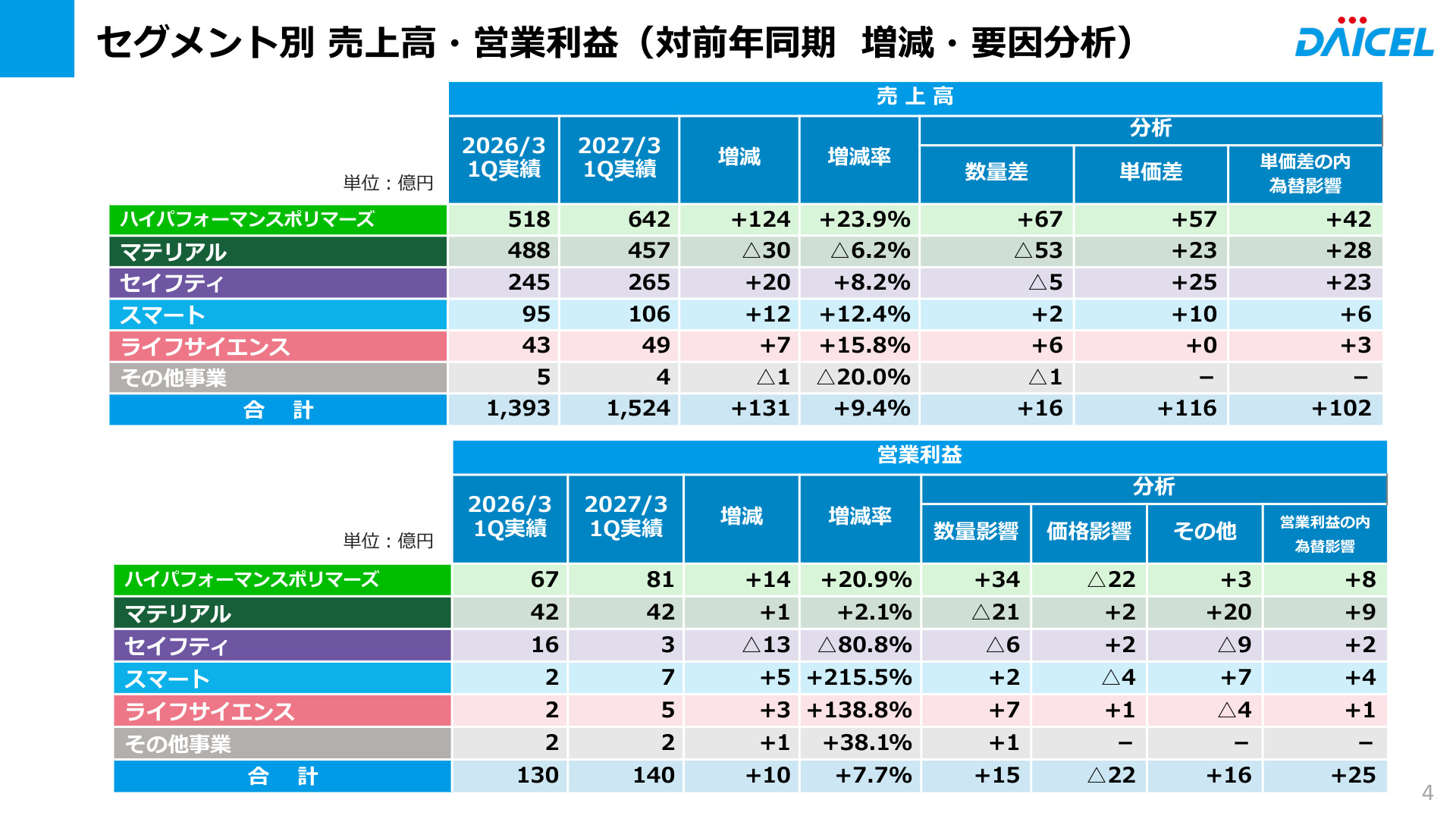
Slide Commentary: Overview of Segment Variance Factors
The slide above breaks down the company-wide revenue increase of ¥13.1 billion and operating profit increase of ¥1.0 billion by segment and by factor (volume, price, exchange rates, etc.). The primary driver of revenue growth was the High-Performance Polymers segment (+¥12.4 billion) , and the volume increase in this segment ( +¥3.4 billion ) was the clear engine behind the company's overall profit growth.
Specific trends by segment are as follows:
1. High-Performance Polymers (Revenue and Profit Growth)
- Revenue : ¥64.2 billion (+23.9% YoY)
- Operating Profit : ¥8.1 billion (+20.9% YoY)
- Details : Sales volume increased across all resin types. POM recovered from the previous year's disruptions caused by U.S. tariff trends and Chinese anti-dumping duties, while demand for inventory security due to Middle East tensions provided a tailwind. LCP and PPS saw significant volume growth, capturing strong demand for AI server optical connectors and automotive applications.
2. Material (Revenue Decline, Slight Profit Growth)
- Revenue : ¥45.7 billion (-6.2% YoY)
- Operating Profit : ¥4.2 billion (+2.1% YoY)
- Details : The core Acetate Tow business saw a revenue decline (down 12.1% in the Acetyl segment) due to transportation stoppages in the Red Sea and delayed shipments to certain customers. Conversely, in the Chemical field, the pass-through of acetic acid price increases, the impact of a weaker yen, and inventory valuation effects from rising acetic acid market prices (+¥2.0 billion) helped maintain operating profit at the previous year's level.
3. Safety (Revenue Growth, Profit Decline)
- Revenue : ¥26.5 billion (+8.2% YoY)
- Operating Profit : ¥0.3 billion (-80.8% YoY)
- Details : While sales volume for automotive airbag inflators increased due to production and sales expansion in the Indian market, operating profit fell sharply due to declining demand in the Chinese market , unfavorable product mix, and the timing of expenses.
4. Smart (Revenue and Profit Growth)
- Revenue : ¥10.6 billion (+12.4% YoY)
- Operating Profit : ¥0.7 billion (+215.5% YoY)
- Details : Driven by the recovery in semiconductor demand , sales of solvents for electronic materials performed well. Despite shipment restrictions on caprolactone derivatives due to Middle East tensions, price pass-throughs and exchange rate effects helped achieve significant profit growth.
5. Life Sciences (Revenue and Significant Profit Growth)
- Revenue : ¥4.9 billion (+15.8% YoY)
- Operating Profit : ¥0.5 billion (+138.8% YoY)
- Details : Chiral column sales to China and contract analysis services in India remained steady. Additionally, demand for functional food ingredients, particularly "Equol" for supplements, grew significantly.
Chapter 3: Troubleshooting and Unexpected Risk Factors
Behind the strong Q1 results, a risk factor has been reported: a malfunction in the CO (carbon monoxide) plant heat exchanger .
- Event : In July 2026, a malfunction occurred in the heat recovery process downstream of the gasification process.
- Response Plan : A planned shutdown of the facility will begin in mid-August 2026 for inspection and repairs.
- CO Plant Shutdown : Approximately 22 days starting mid-August.
- Acetic Acid Plant Shutdown : Approximately 27 days starting mid-August.
- Financial Impact : The estimated loss from production suspension is currently projected at approximately ¥0.8 billion .
This loss will be reflected in the Q2 results and beyond, but it is considered absorbable given the Q1 performance surplus.
Chapter 4: Full-Year Forecast and Outlook
Despite significantly exceeding Q1 targets, Daicel has maintained its full-year earnings forecast .
- Full-Year Revenue Forecast : ¥595.0 billion (+2.6% YoY)
- Full-Year Operating Profit Forecast : ¥42.5 billion (+0.9% YoY)
- Full-Year Net Income Forecast : ¥27.0 billion (+164.7% YoY)
- Assumed Exchange Rate : ¥150/USD (Q1 actual was ¥159/USD)
Company View and Cautious Stance for H2
The strong Q1 performance is analyzed to include some one-time factors, such as "front-loaded demand" from customers anticipating raw material price hikes and cost impacts from moving-average inventory valuation. Given the need to monitor customer inventory adjustments in the second half and the impact of logistics and raw material costs due to prolonged Middle East tensions, the company has made a rational decision to maintain its full-year plan at this stage.
Chapter 5: Significant Strengthening of Shareholder Return Policy
One of the biggest topics for investors in this announcement is the drastic strengthening of the shareholder return policy .
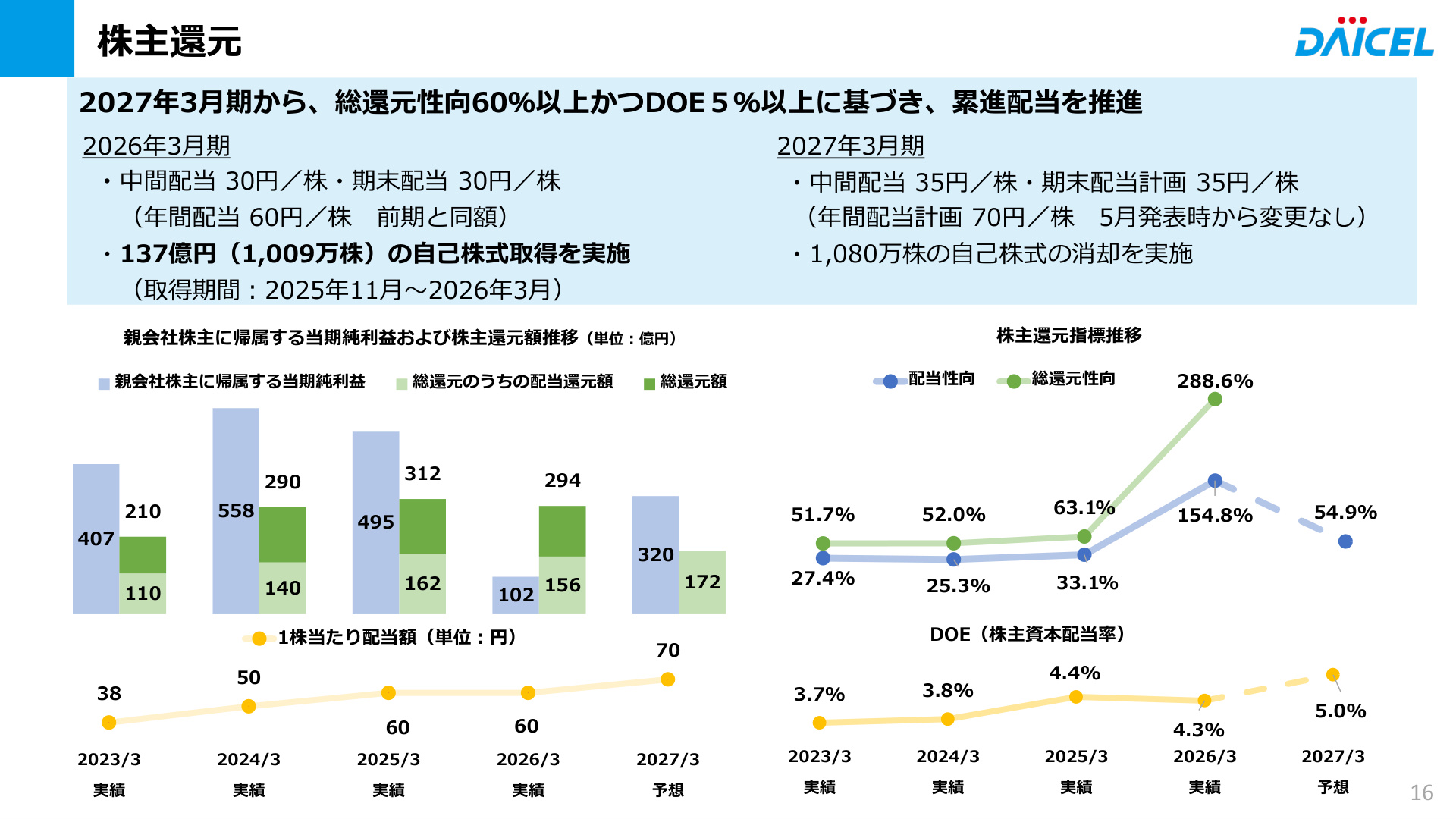
Slide Commentary: New Return Policy and Trends in Dividends/Share Buybacks
The slide above shows the new shareholder return policy introduced in FY2027 and the trends in return indicators.
Key Points of the New Shareholder Return Policy
- Total Return Ratio of 60% or more : Implementing aggressive total returns by combining flexible share buybacks.
- DOE (Dividend on Equity) of 5% or more : Committing to a stable dividend level less susceptible to short-term earnings fluctuations.
- Introduction of Progressive Dividends : Adopting a policy of maintaining or increasing dividends without reducing them.
FY2027 Dividend Plan
- Annual Dividend Forecast : ¥70 per share (¥35 interim, ¥35 year-end).
- An increase of ¥10 from the ¥60 annual dividend in FY2026.
- Expected DOE is 5.0% , and the expected total return ratio is 54.9% (achieved through dividends alone, with room for additional share buybacks).
- Cancellation of Treasury Shares : 10.8 million shares were cancelled in May 2026.
This strengthening of the return policy is viewed as a strong commitment by the company to improve capital efficiency and enhance shareholder value.
Summary: Conclusion and Future Focus Points
Daicel's Q1 FY2027 results were excellent, driven by growth in high-performance resins capturing AI server-related demand and the effects of exchange rates and price revisions. The transition to the new segment structure has made the strengths and challenges of each business clearer.
Points to watch moving forward include:
- The extent of customer inventory adjustments in the second half
- Swift recovery from the CO plant shutdown scheduled for August (approx. ¥0.8 billion loss impact)
- Timing of the resolution of logistics disruptions for Acetate Tow and other products due to worsening Middle East tensions
- Movements toward additional share buybacks in line with the new shareholder return policy (DOE 5%+, Total Return Ratio 60%+)
These results confirm the progress of the company's business structural reform in terms of both fundamental strength and shareholder returns.
This content is not intended as investment advice or a recommendation. Any opinions expressed are solely the personal views of each article.