


Infomart FY2026 Q2 Earnings Analysis: Significant Profit Growth Driven by Stock Revenue and Evolving AI/Data Strategy

StockClub
Published: Aug 03, 2026, 11:51 AM
Sentiment Analysis
Infomart (TSE Prime: 2492) reported a highly robust performance for the second quarter (interim period) of the fiscal year ending December 2026 . Driven by steady expansion in its core 'FOOD' and 'ES' business segments, combined with revenue growth and rigorous cost structure optimization, the company achieved a significant 49.1% year-on-year increase in operating profit .
This report provides a comprehensive and detailed analysis of the company's performance, key drivers, shifts in cost structure, and the full scope of its rapidly advancing 'AI and Data Strategy,' based on insights extracted from the earnings materials.
1. Overview and Key Topics of the FY2026 Q2 Earnings
The key management highlights from the earnings materials are summarized in the following 10 points:
- Significant Profit Growth : Consolidated net sales reached ¥9.98 billion (+11.0% YoY) , with operating profit hitting ¥2.11 billion (+49.1% YoY) .
- Progress Toward Full-Year Targets : Progress stands at 46.8% for net sales and 42.4% for operating profit, largely in line with the full-year plan. The company aims to achieve its final-year medium-term management plan targets through momentum in the second half.
- Expansion of User Base : The number of platform users surpassed 1.3 million (+8.6% YoY) , maintaining a powerful network effect covering approximately 35% of all domestic companies.
- High Level of Stock Revenue : The stock revenue ratio reached 96.9% , establishing a highly robust and predictable revenue foundation.
- Double-Digit Growth and Expansion in FOOD Business : Beyond core ordering/receiving, the 'Ordering Light & TANOMU' services for individual restaurants and wholesalers grew rapidly by 44.0% YoY .
- Acceleration of ES Business : 'BtoB Platform Invoicing' grew by 13.3% YoY , while 'TRADE' surged by 58.4% YoY , with adoption expanding primarily among large enterprises and corporate groups.
- Cost of Sales Control and Gross Margin Improvement : The completion of the cloud migration contributed to a reduction in data center costs, pushing the gross profit margin to 74.9% (75.0% for Q2 alone) .
- Continued Investment in Human Capital : While strengthening the wage structure and sales/CS systems (totaling 924 full-time employees ), the company successfully absorbed these costs through revenue growth.
- Productivity Innovation via Internal AI : Achieved a 24% reduction in call center response time and a 33% reduction in development man-hours through AI-driven development.
- Deployment of 'IM DATA PLATFORM' and 'IMAgent' : Launched AI products and data services leveraging real transaction data amounting to ¥71 trillion annually .
2. In-depth Analysis of Operating Profit Variance
By examining the cost components contributing to profit growth alongside revenue, the strength of the company's profit structure becomes clear.
Slide Commentary: Background of Operating Profit Variance
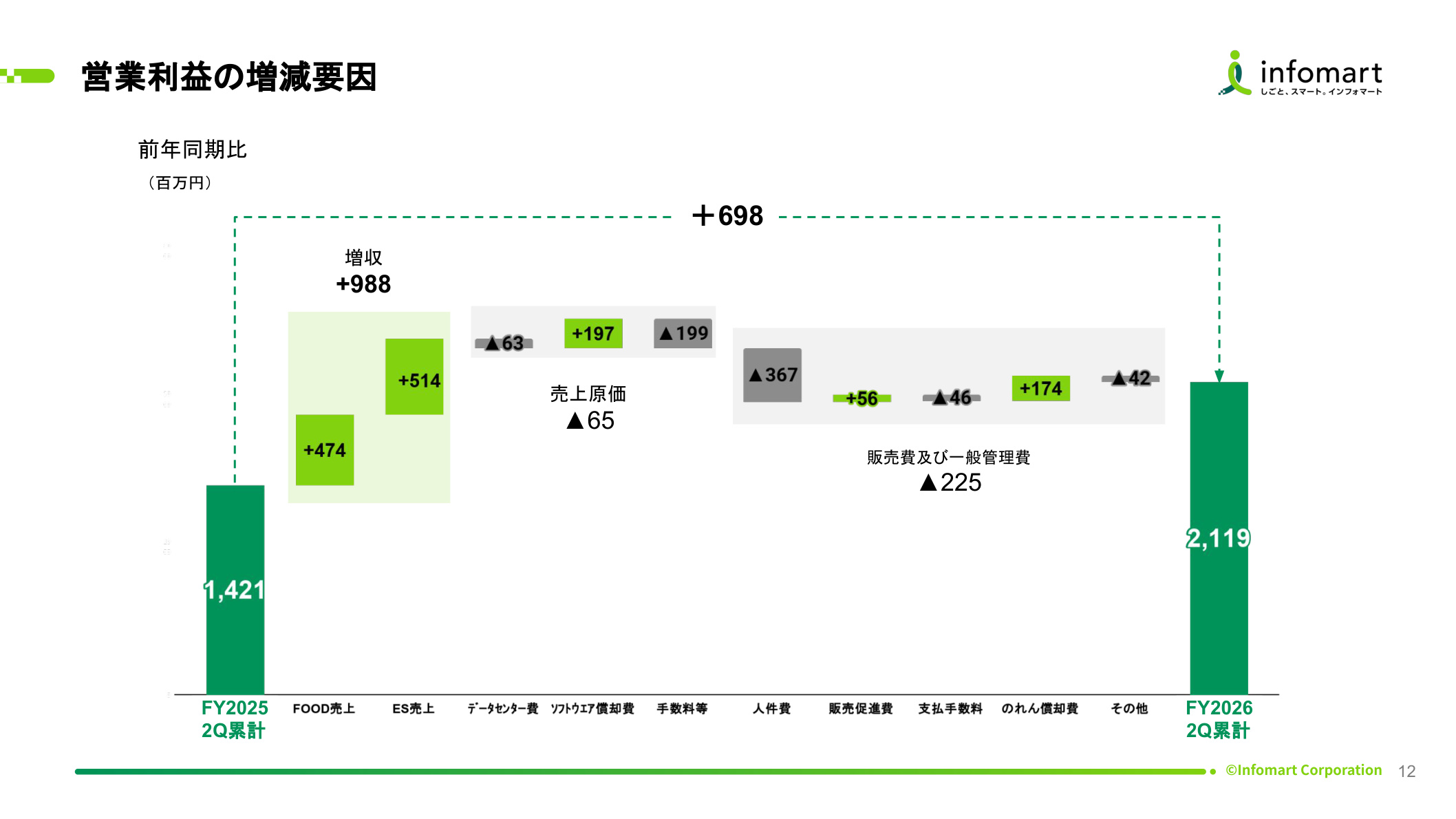
The Operating Profit Variance slide above illustrates the detailed process by which operating profit increased by ¥698 million (+49.1%) , rising from ¥1.421 billion to ¥2.119 billion between the first half of FY2025 and FY2026.
- Positive Contribution from Revenue Growth (+¥988 million) : Both the FOOD business (+¥474 million) and the ES business (+¥514 million) drove growth in a balanced manner. Expansion in existing areas and the acquisition of new contracts translated effectively into revenue.
- Control of Cost of Sales (Minimal increase of +¥65 million) : The ¥197 million reduction in data center costs due to cloud migration was a major contributor. While customer referral fees and other partner-related costs increased by ¥199 million, the overall cost of sales was kept to a very low increase.
- Control and Efficiency in SG&A Expenses (Limited increase of +¥225 million) : Despite investments in human capital (+¥367 million) and sales promotion (+¥56 million), the company successfully minimized the increase in SG&A expenses relative to the significant revenue growth, thanks to a reduction in goodwill amortization for TANOMU (▲¥174 million) and other cost management measures.
It is clear that 'positive leverage' is functioning, where the revenue growth rate (+11.0%) significantly outpaces the cost increase rate.
3. Segment Performance: Details of FOOD and ES Businesses
FOOD Business (Net Sales: ¥6.223 billion / +8.3% YoY)
The core 'BtoB Platform Ordering/Receiving' maintained stable growth at ¥4.459 billion (+4.5% YoY) , capturing the demand for operational efficiency in restaurant chains, hotels, and the food service industry. Additionally, the combined sales of the more accessible 'Ordering Light' and 'TANOMU' reached ¥762 million (+44.0% YoY) , showing extremely high growth and penetration among individual restaurants and regional food wholesalers.
ES Business (Net Sales: ¥3.766 billion / +15.8% YoY)
'BtoB Platform Invoicing,' which promotes the digitalization of inter-company transactions, reached ¥2.890 billion (+13.3% YoY) , driven by digitalization demand following the introduction of the Invoice System. Furthermore, 'TRADE,' which digitizes the entire process from quoting to invoicing, grew rapidly to ¥308 million (+58.4% YoY) , serving as a growth engine for the entire company.
4. Cost Structure Changes and Profit Margin Improvement Trajectory
Of particular note in Infomart's profitability improvement is the structural reduction in cost of sales following the completion of the system's cloud migration.
Slide Commentary: Implications of Cost of Sales and Gross Profit Trends
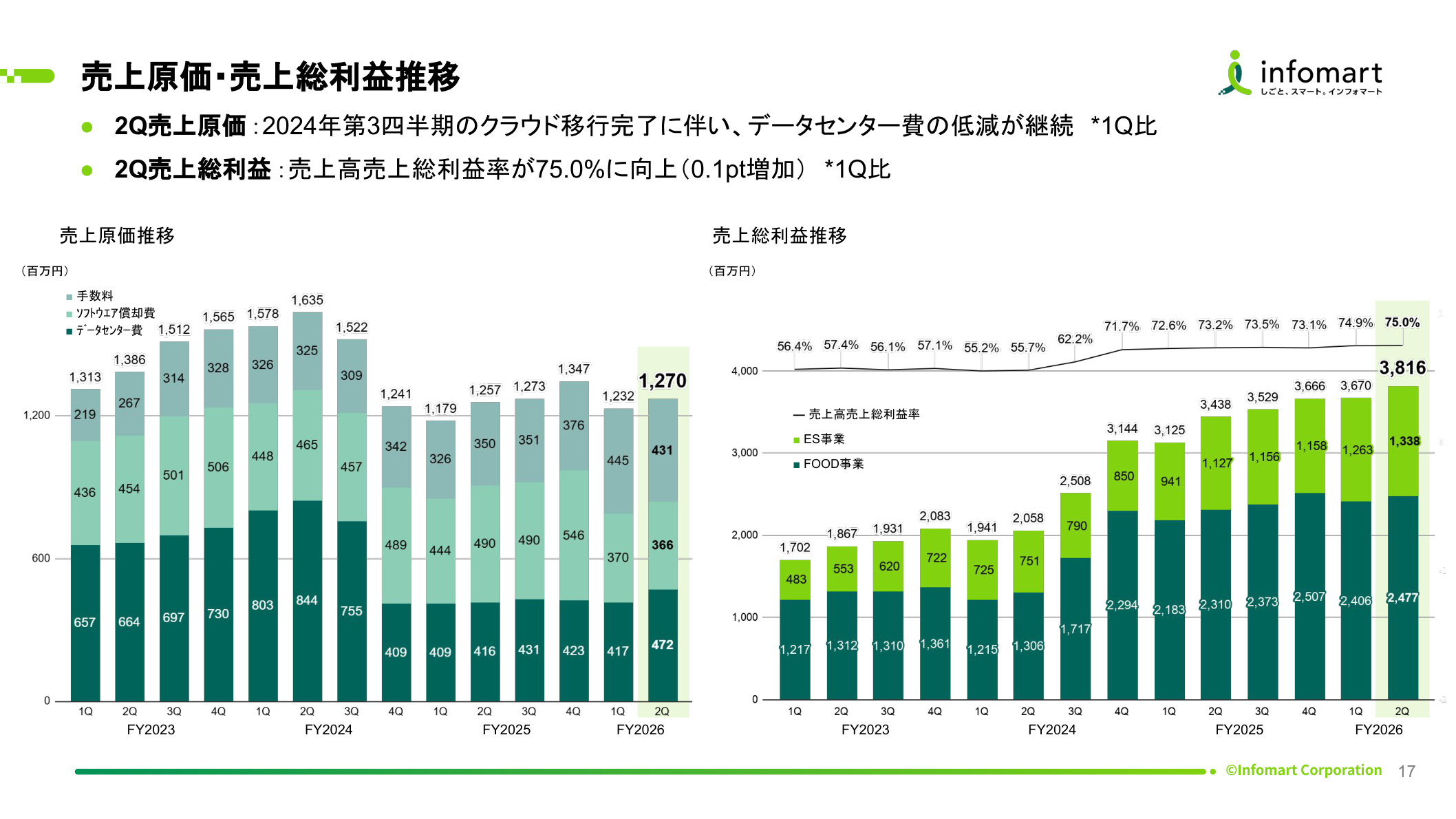
The slide above shows the trend in the company's cost of sales and the change in the gross profit margin .
- Dramatic Reduction in Data Center Costs : Due to the migration from on-premises to the cloud, completed in Q3 2024, data center costs, which previously accounted for ¥700–800 million per quarter, have been compressed to the ¥300–400 million range .
- V-Shaped Recovery of Gross Profit Margin : The gross profit margin, which remained in the high 50% to low 60% range in 2023, surged due to cost reduction effects, reaching 74.9% in Q1 2026 and 75.0% in Q2 .
The scale merits typical of SaaS companies, where the cost-to-sales ratio decreases as revenue grows, have fully manifested following the completion of the infrastructure overhaul.
5. Synergy Between Customer Base and High Stock Revenue
The source of the company's strength lies in its overwhelming customer base and stock-based business model , which are not easily imitated by competitors.
- Network Effect of 1.3 Million Users : As of Q2 2026, the number of user companies reached 1,302,081 . With a massive platform covering approximately 35% of domestic companies, the 'network effect' is firmly in place, naturally increasing the incentive for new companies to join.
- Stock Revenue Ratio of 96.9% : 96.9% of net sales are composed of recurring stock revenue, such as monthly subscription fees. This confirms an extremely low churn rate and generates stable cash flow that is resilient to economic fluctuations.
6. AI/Data Strategy and Productivity Improvement via Internal DX
Positioning itself as a 'Data/AI Platform' rather than just a business efficiency tool, the company is rapidly deploying initiatives in both internal and customer-facing DX.
Slide Commentary: Consolidation of AI Usage and Concrete Results
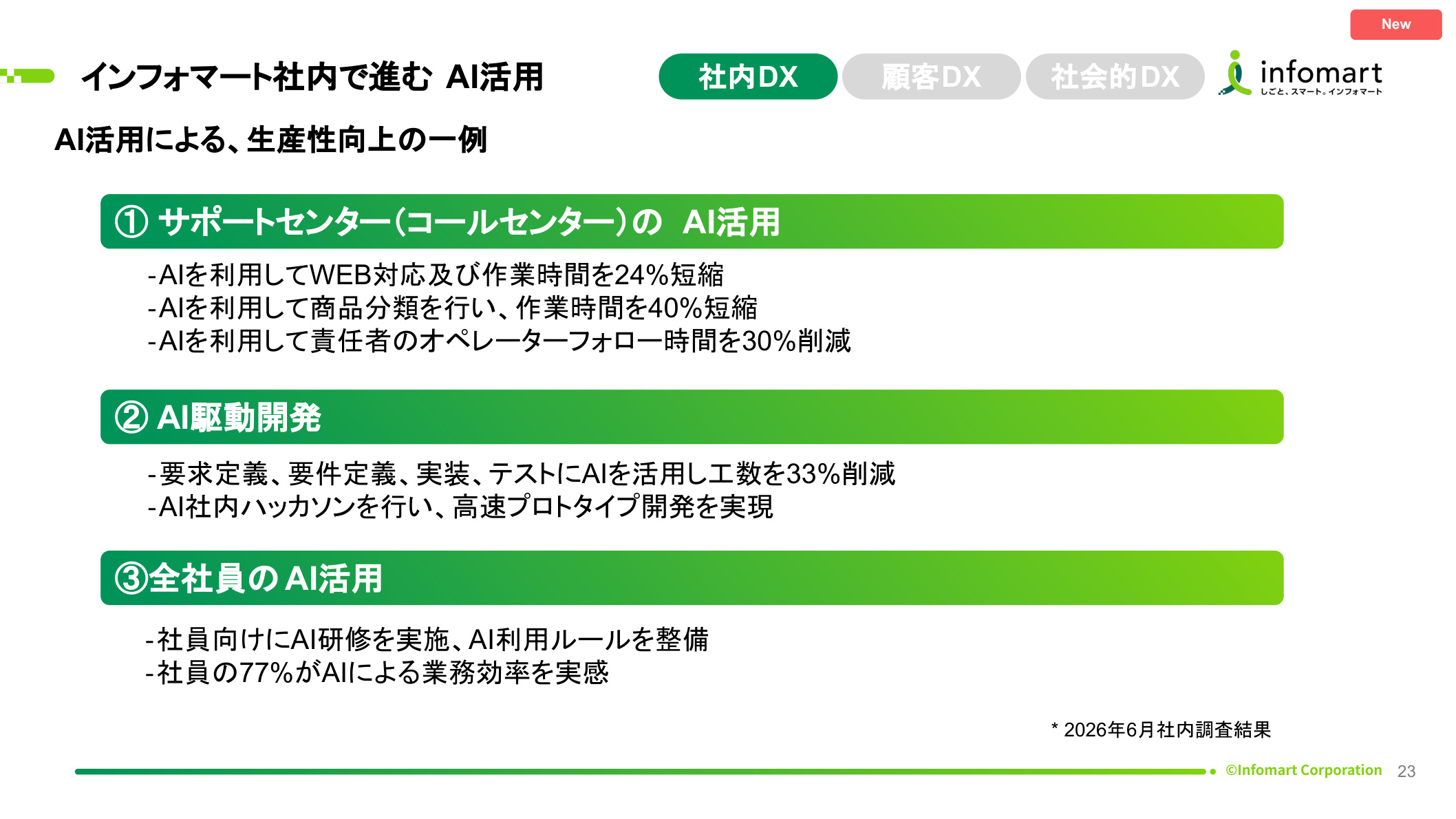
The slide above summarizes the actual figures for operational efficiency through AI usage that the company is promoting as part of its internal DX.
- Revamping Support Center Operations : By utilizing AI for inquiry responses and tasks, the company achieved a 24% reduction in work time . Furthermore, it realized dramatic efficiency in customer support by automating product classification ( 40% reduction ) and reducing follow-up time by supervisors ( 30% reduction ).
- Results of AI-Driven Development : By incorporating AI into the process from requirements definition to implementation and testing within the engineering organization, development man-hours were reduced by 33% . The company has built a high-speed prototype development system through internal hackathons.
- Company-wide AI Penetration : Through AI training for employees and the establishment of guidelines, 77% of employees reported that they feel the benefits of AI-driven operational efficiency.
These internal DX achievements not only lead directly to the suppression of future labor and outsourcing costs but are also being returned as foundational technology and know-how for the AI services the company provides to customers (such as 'IMAgent' and 'IM DATA PLATFORM').
Additionally, the company, which possesses real transaction data on a scale of ¥71 trillion annually (FY2025 results), is moving forward with the launch of sites that visualize distribution trends by anonymizing and aggregating this data, as well as implementing AI-based automatic journalizing and matching functions (IMAgent), aiming to create new revenue sources through data utilization.
7. Future Outlook and Conclusion
FY2026 is the final year of the current medium-term management plan. As of the end of the interim period, both sales and profits are progressing steadily against the plan, and the company expects to continue new business development and expand the value provided to existing customers through the second half. Furthermore, the next three-year medium-term management plan (2027–2029) is scheduled to be announced within the year, raising market expectations.
Infomart has entered a phase where it is steadily growing its current performance against the backdrop of a solid customer base and high stock revenue structure, while enjoying the cost reduction effects of cloud migration. By fully launching its AI and Data Strategy leveraging vast transaction data, the company is establishing its position as a 'socially shared data platform' that goes beyond mere ordering and invoicing infrastructure.
This content is not intended as investment advice or a recommendation. Any opinions expressed are solely the personal views of each article.