

MAX Co., Ltd. Q1 FY2027 Financial Results Deep Dive Report

Sentiment Analysis
MAX Co., Ltd. Q1 FY2027 Financial Results Deep Dive Report
MAX Co., Ltd. (Securities Code: 6454) delivered a robust start to the fiscal year ending March 31, 2027, with its Q1 financial results hitting record highs for both net sales and all profit levels . This performance was primarily driven by strong global demand for the Industrial Equipment segment, led by rebar tying tools (such as the TwinTier series) . In light of these results, the company has upwardly revised its full-year and interim earnings forecasts (originally announced in April 2026) and announced an aggressive capital policy, including a share buyback program of up to 7.1 billion yen (4,000,000 shares) .
This report provides a comprehensive analysis of the company’s earnings summary, drivers of profit growth, segment performance, overseas expansion, growth strategies, and risk factors, based on 10 key topics identified from the financial briefing materials.
1. Earnings Highlights: Record-Breaking Q1 Performance
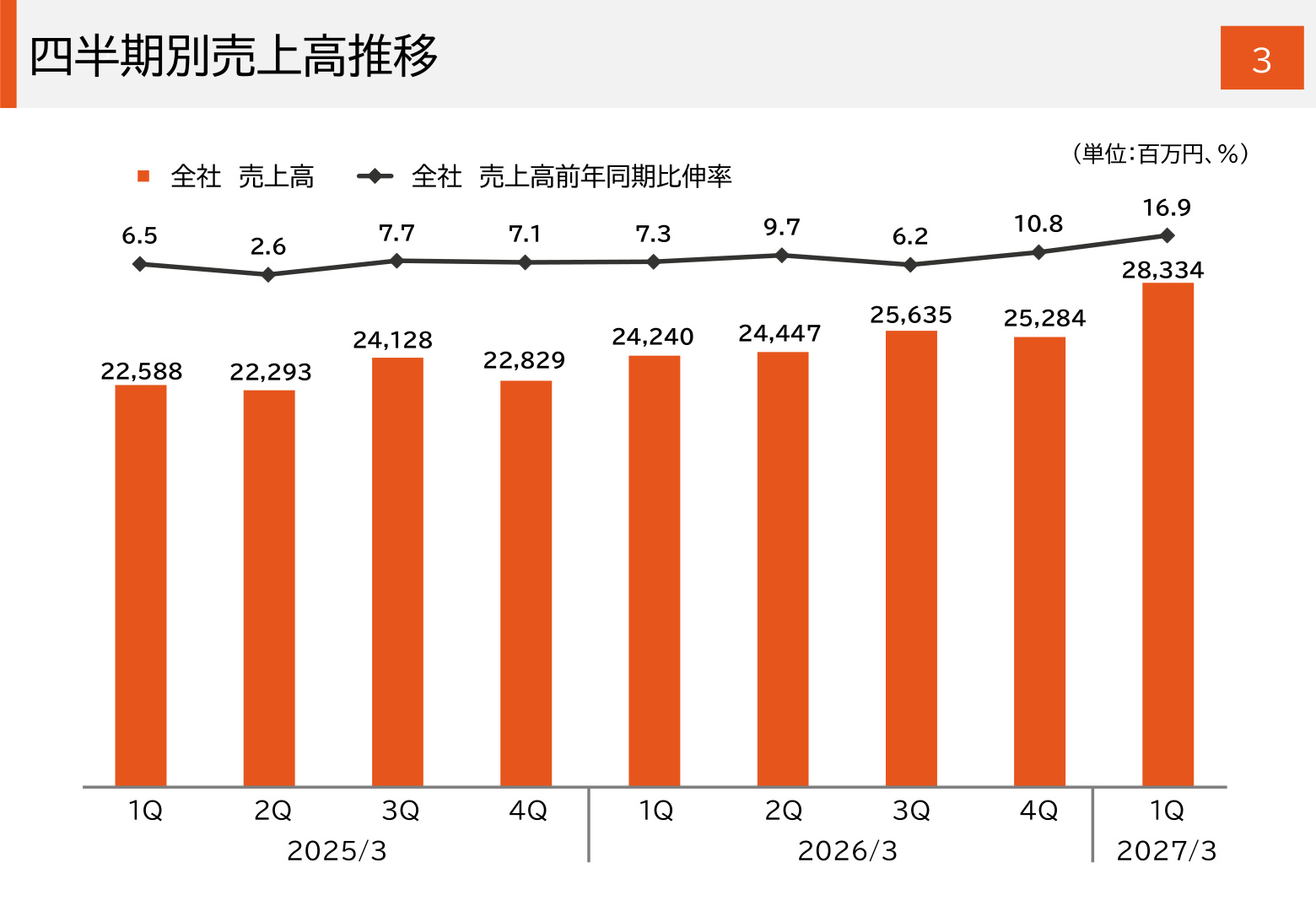
For the first quarter of the fiscal year ending March 2027, the company reported net sales of 28.334 billion yen (+16.9% YoY) , operating profit of 5.879 billion yen (+20.1% YoY) , ordinary profit of 6.015 billion yen (+21.1% YoY) , and quarterly net profit attributable to owners of the parent of 4.323 billion yen (+20.2% YoY) .
The progress rates against the first-half targets reached 54.4% for net sales and 61.2% for operating profit , indicating that performance is outpacing initial expectations. This success is attributed to strong sales of high-value-added products, particularly in overseas markets, and the tailwind from a weaker yen (159.90 yen/USD and 185.49 yen/EUR).
2. Analysis of Operating Profit Variance
The primary factors behind the 984 million yen (+20.1%) increase in operating profit compared to the same period last year are analyzed as follows:
[Why this slide is important and its context]
This slide is critical as it demonstrates that the growth in Q1 operating profit was not merely a result of currency tailwinds (external factors), but was strongly driven by core business efforts such as increased sales volume and price revisions (internal factors) .
- Currency Impact (+944 million yen) : The positive impact of sales exchange rates (+1.713 billion yen) significantly outweighed the negative impact of cost exchange rates (-769 million yen), boosting overall profit.
- Volume and Mix Variance (+1.292 billion yen) : Increased global sales of rebar tying tools and their consumables significantly contributed to the results, highlighting an improvement in underlying earning power.
- Price Increases (+256 million yen) : The effects of price revisions implemented both domestically and internationally are now materializing.
- Absorption of Negative Factors : Despite rising costs such as raw materials (-238 million yen), currency translation losses (-249 million yen), and proactive increases in SG&A expenses for future growth (-1.269 billion yen), the company successfully absorbed these costs through volume growth and currency effects.
3. Segment Performance: Industrial Equipment Segment as the Primary Driver
The company’s business is divided into three main segments: "Industrial Equipment," "Office Equipment," and "HCR (Healthcare/Rehabilitation) Equipment."
- Industrial Equipment Segment : Net sales of 21.790 billion yen (+20.3% YoY) and segment profit of 6.245 billion yen (+21.5% YoY) . The segment profit margin remains at an exceptionally high level of 28.7% , serving as the pillar of the company's overall performance.
- Office Equipment Segment : Net sales of 5.783 billion yen (+8.1% YoY) and segment profit of 1.034 billion yen (+4.6% YoY) . Contributions came from domestic stationery/marking equipment consumables and new "Letatwin" products overseas.
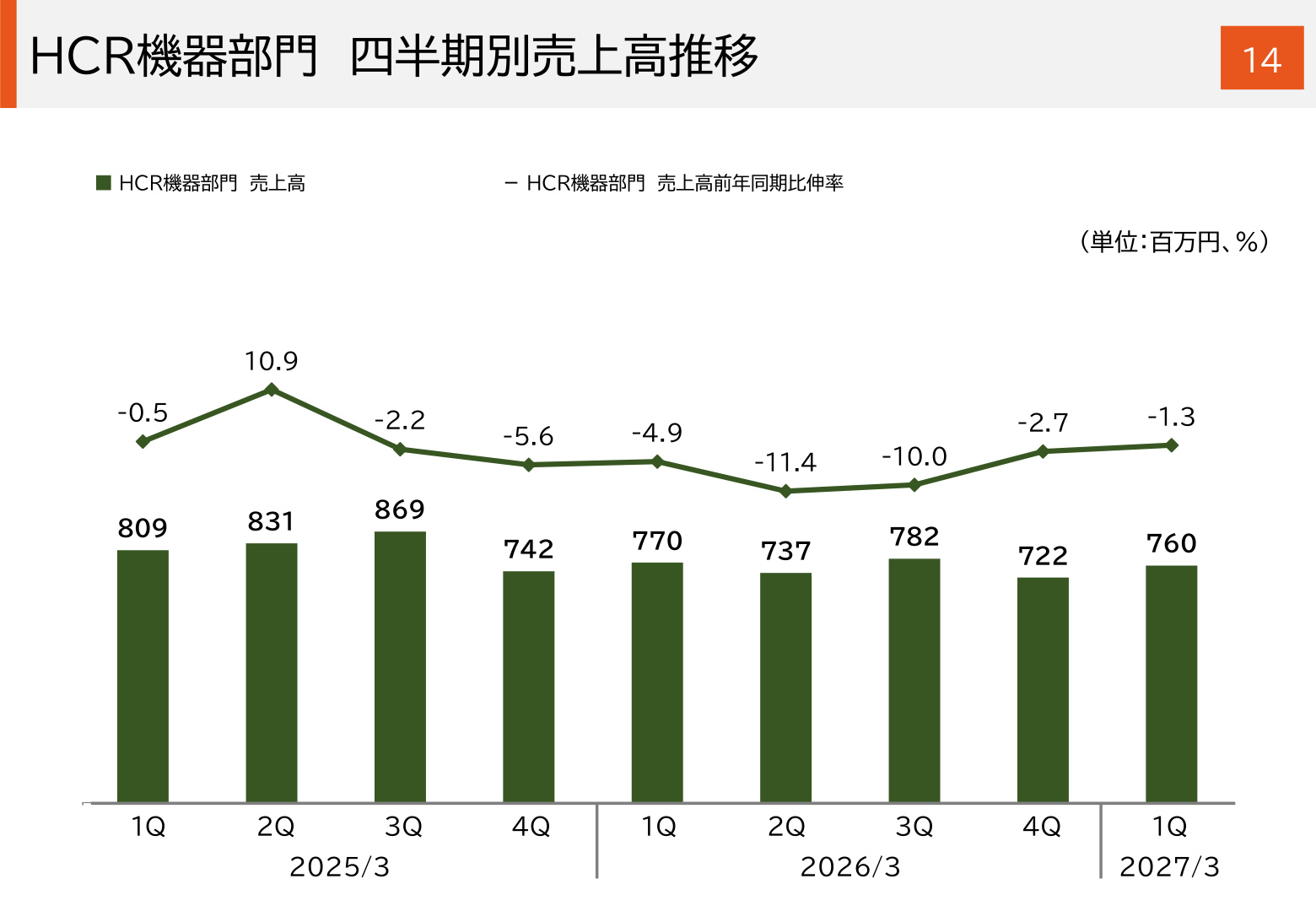
- HCR Equipment Segment : Net sales of 760 million yen (-1.3% YoY) and segment profit of -6 million yen (compared to a 2 million yen profit in the same period last year) . While domestic wheelchair sales remain steady, the decline in the Chinese rental market impacted results.
4. Rapid Expansion of Overseas Business and Regional Trends
The overseas sales ratio rose to 58.0% in Q1 (compared to 51.7% in the same period last year), with total overseas sales reaching 16.435 billion yen (+31.2% YoY) .
- North America : Net sales of 7.145 billion yen (+27.6% YoY). Demand for both machine units and high-margin consumables expanded due to large-scale projects in infrastructure and data centers.
- Europe : Net sales of 6.389 billion yen (+40.6% YoY). Growth was driven by steady infrastructure investment in Germany, new user acquisition in France and Eastern Europe, and demand for rental company fleet replacements in Sweden.
- Asia and Others : Net sales of 2.900 billion yen (+21.9% YoY). The company made progress in expanding its overseas office business and various equipment lines.
5. Overview and Growth Story of the Key "Rebar Tying Tool Business"
The status of the company's largest growth driver, tools for concrete structures, centered on the rebar tying tool business , is as follows:
[Why this slide is important and its context]
This slide is the most important data point, as it structurally explains the global deployment of "rebar tying tools (TwinTier, etc.)" , which forms the core of the company's growth strategy. Net sales for tools for concrete structures reached 13.4 billion yen (+32% YoY) , with a progress rate of 29% against the full-year plan, a very high level.
- Structural Tailwinds in Western Markets : The need for "labor-saving and efficiency in construction" is rising rapidly due to severe labor shortages, and the company's TwinTier is becoming the standard tool.
- Strength of the Business Model (Stock-type Revenue) : As the cumulative number of units in operation (flow) increases, it leads to continuous sales growth of "consumables (stock)" such as dedicated wire, establishing a high-profit model.
- Resilience of the Domestic Market : Although the growth of machine units slowed due to the sluggish domestic housing starts, the accumulation of units in operation has supported consumable sales.
6. Strategic M&A and Creation of Group Synergies
To strengthen supply capacity and expand sales networks for the rebar tying tool business, the company recently completed two M&As, which began contributing to group operations this quarter.
- Fuji Kogyo Co., Ltd. (Grouped since April 1, 2026) : Responsible for increasing production as a processing plant for key components to meet the rising demand for rebar tying tools. The company is dispatching a President from MAX to drive PMI and achieve cost reductions.
- Bo Fastening AB (now MAX Scandinavia AB, grouped since May 1, 2026) : Acquired all shares to strengthen sales activities in the Nordic region. Q1 results showed double-digit growth compared to the previous year, and it will be developed as a marketing hub for the entire Nordic region.
7. Upward Revision of Full-Year and Interim Earnings Forecasts for FY2027
Following the strong progress in Q1, the company has upwardly revised its full-year and second-quarter (interim) plans for the fiscal year ending March 2027 .
[Why this slide is important and its context]
This slide is a crucial planning table that quantitatively demonstrates the company's outlook that the strong Q1 performance is not temporary but will continue throughout the fiscal year .
- Revisions to Full-Year Company-wide Plan : Net sales increased by 4.4 billion yen from the initial plan of 105.5 billion yen to 109.9 billion yen (+10.3% YoY) . Operating profit was revised upward by 1.1 billion yen from the initial 18.8 billion yen to 19.9 billion yen (+13.3% YoY) .
- High Profitability Metrics : The company expects an operating profit margin of 18.1% and an ROE (Return on Equity) of 13.0% , aiming for very high capital efficiency as a global manufacturer.
- Upward Revisions by Segment : The full-year net sales plan for the Industrial Equipment segment has been significantly revised upward from 80.35 billion yen to 84.35 billion yen .
8. Shareholder Returns and Capital Policy Implementation
The company has clearly stated its proactive stance on shareholder returns to enhance medium- to long-term corporate value and capital efficiency (ROE).
- Share Buybacks (Ongoing) : The company is conducting a share buyback program for the period from May 1 to December 31, 2026, with a maximum of 4,000,000 shares (2.22% of total shares outstanding) and a total acquisition cost of up to 7.1 billion yen .
- Stock Split : A 4-for-1 stock split was implemented on April 1, 2026, to expand the investor base and improve liquidity.
9. External Environmental Risks and Qualitative Concerns
Despite the smooth performance, the company also indicated its assessment of qualitative risks, including the situation in the Middle East , in its financial materials.
- Rising Material Costs and Construction Delays : Soaring housing prices and construction delays are having a partial negative impact on the domestic industrial tools and living environment equipment businesses.
- Logistics and Procurement Costs : There are risks of increased transportation costs due to disruptions in maritime and air transport, as well as rising raw material prices. The company's policy is to prioritize stable product supply and consider/promote cost responses, such as alternative procurement and focusing on domestic operations.
10. Conclusion and Future Outlook
MAX's Q1 FY2027 financial results are highly impressive, characterized by the explosive growth of rebar tying tools capturing labor-saving needs, primarily in the West , and the solid cycle of the high-value-added consumables business .
The company is clearly demonstrating a strong push for both "growth investment" and "shareholder returns," evidenced by the strengthening of production and sales systems through M&A, the upward revision of interim and full-year earnings forecasts, and a focus on capital efficiency through share buybacks. Moving forward, attention will be focused on progress toward the upwardly revised full-year targets (net sales of 109.9 billion yen, operating profit of 19.9 billion yen) while managing geopolitical risks such as the situation in the Middle East and rising logistics costs.
Correction (September 29, 2026): Corrected the specified amounts, rates or reporting periods against the original company disclosure; the verified changes are recorded in the correction ledger. Source
This content is not intended as investment advice or a recommendation. Any opinions expressed are solely the personal views of each article.