


Workman Q1 FY2027 Earnings Deep Dive: Record-High Profits Driven by Mass-Market Product Strategy and New Store Formats

StockClub
Published: Aug 03, 2026, 11:43 AM
Sentiment Analysis

Workman Co., Ltd. (Securities Code: 7564) delivered a robust start to the fiscal year ending March 31, 2027, with its Q1 results (April 1, 2026 – June 30, 2026) marking two consecutive years of year-on-year revenue and profit growth for the first quarter , while significantly surpassing record-high profit levels .
This report provides a comprehensive analysis based on 10 key topics extracted from the earnings presentation materials, covering overall performance, existing store sales analysis, trends in product categories and private brands (PB), the growth-driving "Mass-Market Product Policy," as well as international expansion and full-year forecasts.
1. Overall Performance and Key Profit Highlights
In the first quarter, total chain-wide sales reached 67.561 billion yen (+18.6% YoY) , and total operating revenue was 51.812 billion yen (+24.7% YoY) . Profitability also saw significant double-digit growth, with operating profit at 12.031 billion yen (+33.3% YoY) , ordinary profit at 12.431 billion yen (+34.6% YoY) , and net income at 7.792 billion yen (+34.0% YoY) .
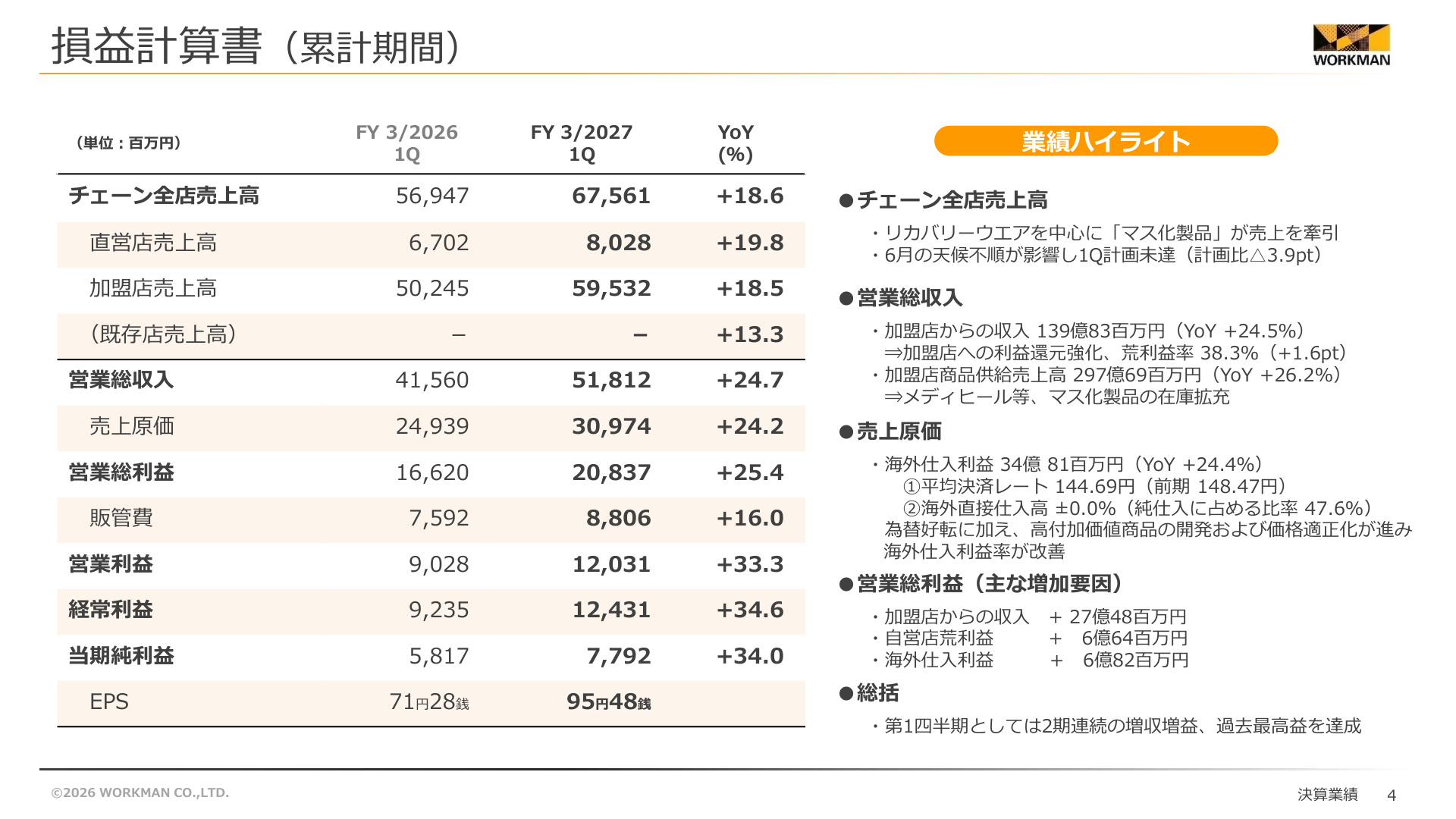
[Slide Commentary: Why the Income Statement Matters]
The slide above summarizes the core data symbolizing this term's strong performance. Notably, growth was driven not just by higher sales, but by improvements in total operating profit margins and gross profit margins . In addition to growth in revenue from franchisees (13.983 billion yen, +24.5% YoY) and product supply sales to franchisees (29.769 billion yen, +26.2% YoY), overseas procurement profit expanded to 3.481 billion yen (+24.4% YoY) due to favorable exchange rates, high-value product development, and price optimization, all of which contributed significantly to the profit growth.
2. Analysis of Customer Traffic, Unit Price, and Monthly Trends
Existing store sales grew by 13.3% YoY in the first quarter. This was driven by a balanced growth in both customer traffic (+7.9%) and average spend per customer (+5.0% to 3,413 yen) . The rise in unit price resulted from price revisions accompanying product renewals, as well as multiple purchases and cross-selling of mass-market products like the "MEDiHEAL" recovery wear and "XShelter." Average daily customer traffic increased to 204 (+15 YoY).
Regarding monthly trends, April (+12.7% YoY) and May (+26.4% YoY) saw explosive sales of mass-market products like "XShelter" and "UV-cut Parkas" following new product launches and TV commercials. Conversely, June (-8.8% YoY) saw a temporary slowdown due to low temperatures and unfavorable weather (frequent rain), which delayed demand for summer items and hindered the growth of fan-equipped apparel.
3. Sales by Format and Store Network Restructuring
In terms of store development, the growth of "Workman Colors" (including women's stores) was remarkable, with existing store sales up 34.0% YoY , significantly outperforming the chain as a whole. Colors and women's stores now account for 16.1% of total chain sales. The flagship "WORKMAN Plus" maintained a 61.9% share while continuing to increase store size and profitability through renovations and scrap-and-build initiatives.
At the end of the first quarter, the total group store count reached 1,107 (+13 from the end of the previous fiscal year), with a focus on opening Colors stores in shopping centers (SC) and through corporate franchises.
4. Sales by Product Category and PB Brand Evolution
Product categories showed clear divergence based on weather and demand shifts.
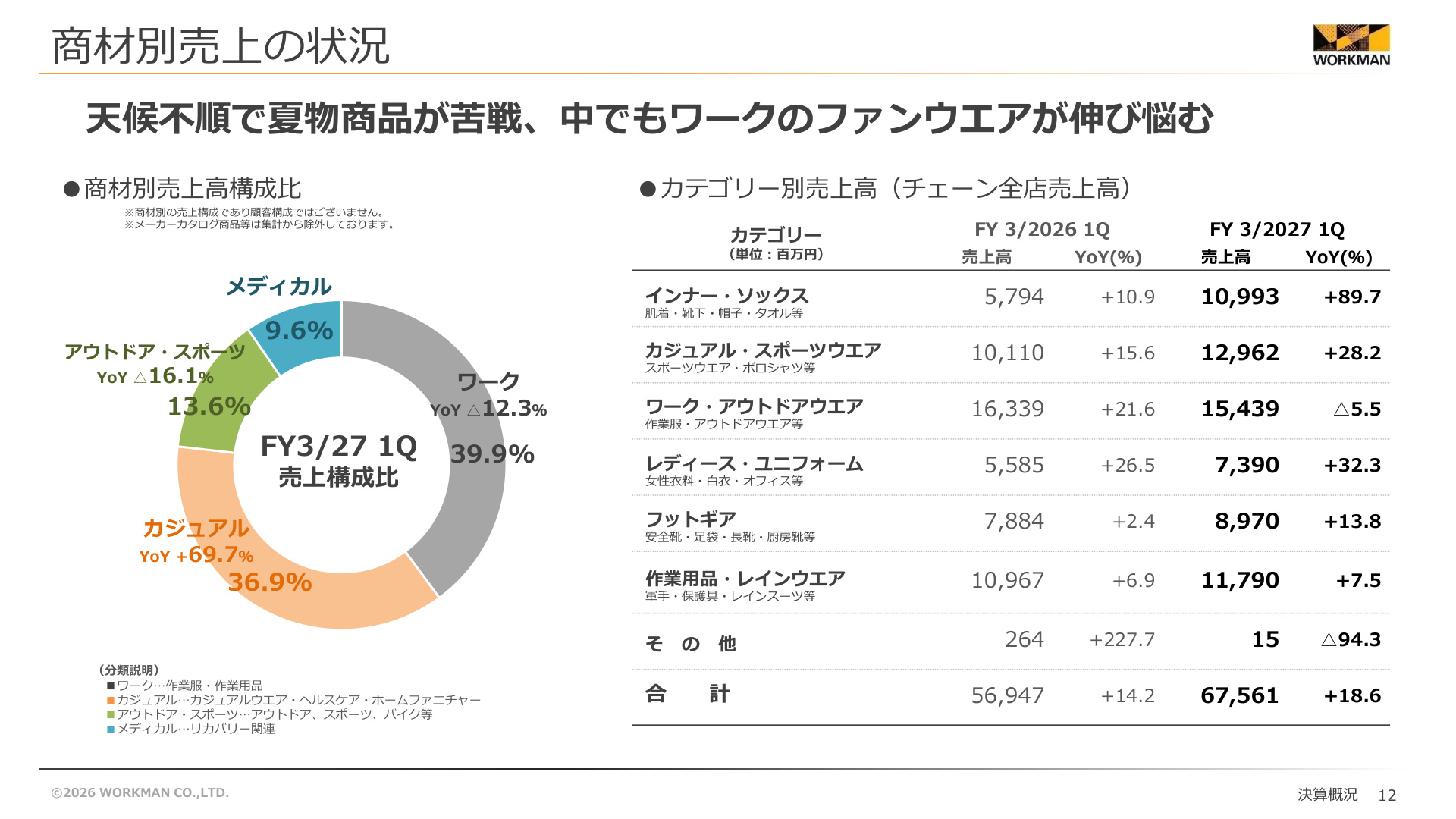
[Slide Commentary: Why the Product Sales Slide Matters]
This slide illustrates a historic turning point in Workman's product structure. While the traditional core "Work/Outdoor Wear" category declined by 5.5% YoY due to the struggle of fan-equipped apparel amid poor weather, "Innerwear/Socks" surged to 10.993 billion yen (+89.7% YoY) and "Casual/Sports Wear" reached 12.962 billion yen (+28.2% YoY) . This confirms that the product lineup capturing daily-use demand from general consumers has evolved to fully compensate for the decline in work-related demand, driving overall growth.
Furthermore, the PB (Private Brand) ratio rose significantly to 74.9% (from 68.5% in the previous year). By brand, the daily wear line "Workman DAYS" saw sales jump to 19.649 billion yen (+116.5% YoY) , becoming the largest brand and accounting for 38.8% of total PB sales.
5. Progress of the Core Strategy: "Mass-Market Product Policy"
The key strategy for Workman is the "Mass-Market Product Policy," which leverages the strength of high functionality and low prices to capture the general public market . In the first quarter, mass-market products accounted for 25.3% of total sales .
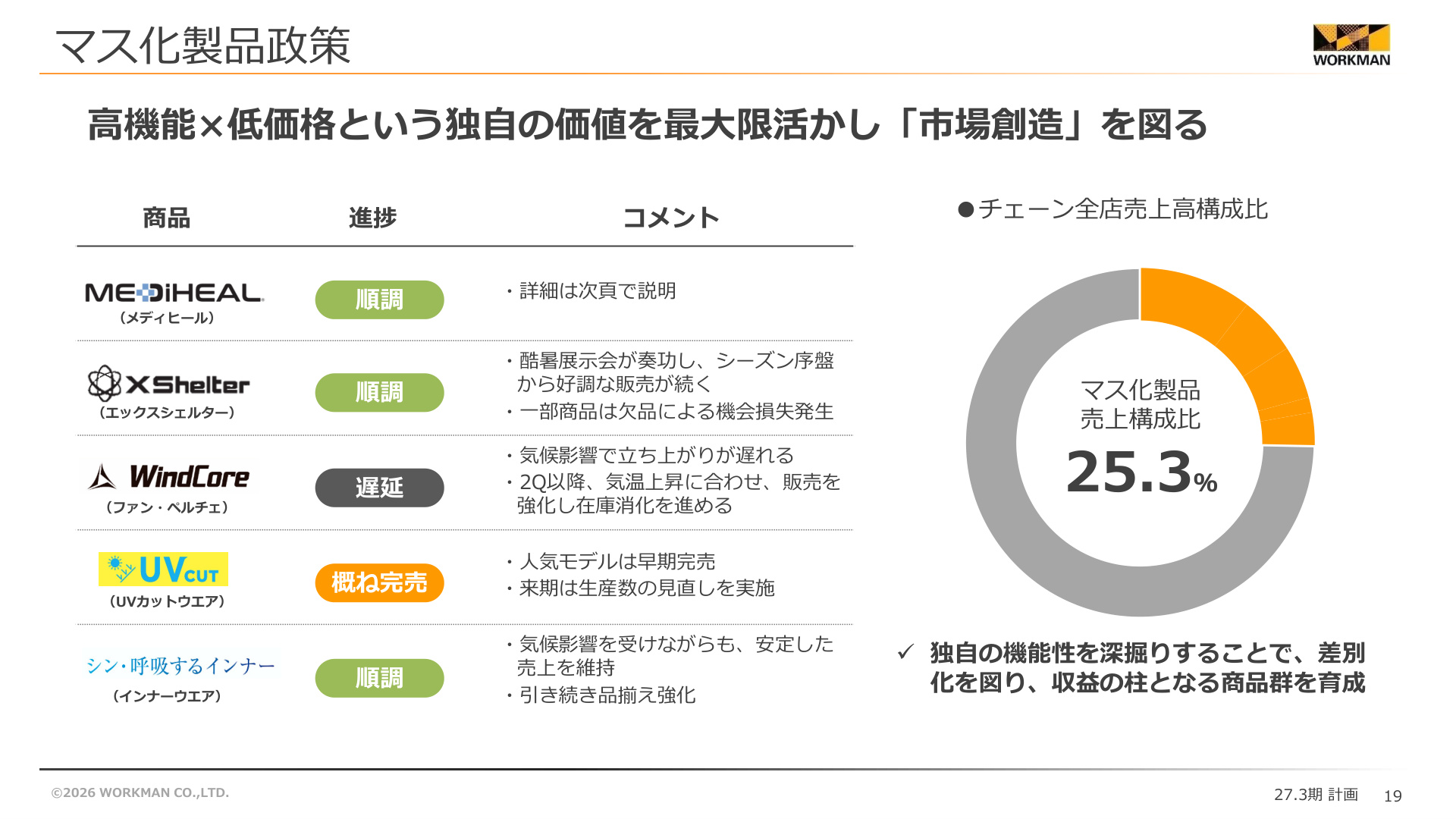
[Slide Commentary: Why the Mass-Market Product Policy Slide Matters]
The slide above is the crux of the strategy, showing the progress and composition of the five major mass-market product categories. In particular, the fatigue-recovery wear "MEDiHEAL" became a mega-hit, selling approximately 5.04 million units (approx. 7.1 billion yen) in the three months from April to June 2026. "XShelter," featuring heat-shielding and insulation, also maintained strong sales. While "WindCore" (fan-equipped apparel) had a slow start due to climate factors, the company plans to clear inventory as temperatures rise from Q2 onwards. By continuously launching unique, high-function products, the company achieves both differentiation and high profitability.
6. Cost Structure, Financial Base, and FX Risk Management
Although SG&A expenses increased to 8.806 billion yen (+16.0% YoY), the SG&A-to-sales ratio was contained at 13.0% (-0.3pt YoY), reflecting disciplined cost control. While personnel expenses (+12.6%) and sales promotion expenses for new product launches and TV commercials (+79.3%) increased, these were offset by reductions in logistics costs through rebate income.
Regarding FX risk, approximately 85% of direct trade for the fiscal year ending March 2027 has been hedged , with a full-year assumed rate of 150 yen (147 yen for H1, 153 yen for H2). Progress toward the overseas procurement profit target (10.8 billion yen for the full year) is on track, establishing a robust supply chain management system resilient to currency volatility.
Financially, while inventories have increased temporarily due to the accumulation of summer stock, operating cash flow remains positive at +11.469 billion yen, and the equity ratio stands at a highly sound 83.6%.
7. Global Expansion and Full-Year Earnings Forecast
As a new medium-to-long-term growth initiative, the Board of Directors resolved on August 3, 2026, to establish a local subsidiary in Taiwan (capital of 200 million TWD, approx. 1 billion yen) . The plan is to take the first step toward globalization by deploying the "high-functionality × low-price" chain store model established in Japan as 100% owned direct-operated stores in the Taiwanese market.
Regarding the full-year earnings forecast for the fiscal year ending March 2027 , the company has decided to maintain its current plan , taking into account the impact of delayed summer demand in June:
- Total Chain-wide Sales : 237.97 billion yen (+13.7% YoY)
- Total Operating Revenue : 183.376 billion yen (+14.0% YoY)
- Operating Profit : 31.112 billion yen (+8.2% YoY)
- Net Income : 22.329 billion yen (+8.3% YoY)
As of the first quarter, the progress rate against the full-year plan is 37.5% for operating profit and 34.9% for net income , indicating a very strong pace. From the second quarter onwards, the company expects to reliably achieve its targets through the launch of new autumn/winter products starting in September and strengthened promotional activities.
This content is not intended as investment advice or a recommendation. Any opinions expressed are solely the personal views of each article.